
In May 2026, a Nature study using data from about 500,000 UK Biobank participants reported a pattern that catches the eye without settling the whole question: people who reported sleeping less than 6 hours or more than 8 hours had signs of faster multi-organ biological aging than those in the middle range.[1] That does not mean a person can reverse aging by forcing a perfect sleep number. The sleep-duration data were self-reported, and the study cannot prove whether disrupted sleep speeds aging, aging disrupts sleep, or both are happening together.
Still, the finding gives a useful reason to stop brushing off later-life sleep changes as a character flaw. If you are 62, 68, or 74 and you fall asleep earlier than you used to, wake before dawn, sleep lightly, or make more trips to the bathroom, the first question is not whether you have become undisciplined. The better question is which part of your sleep biology has changed, because the best sleep tips for healthy aging work only when they match the mechanism.
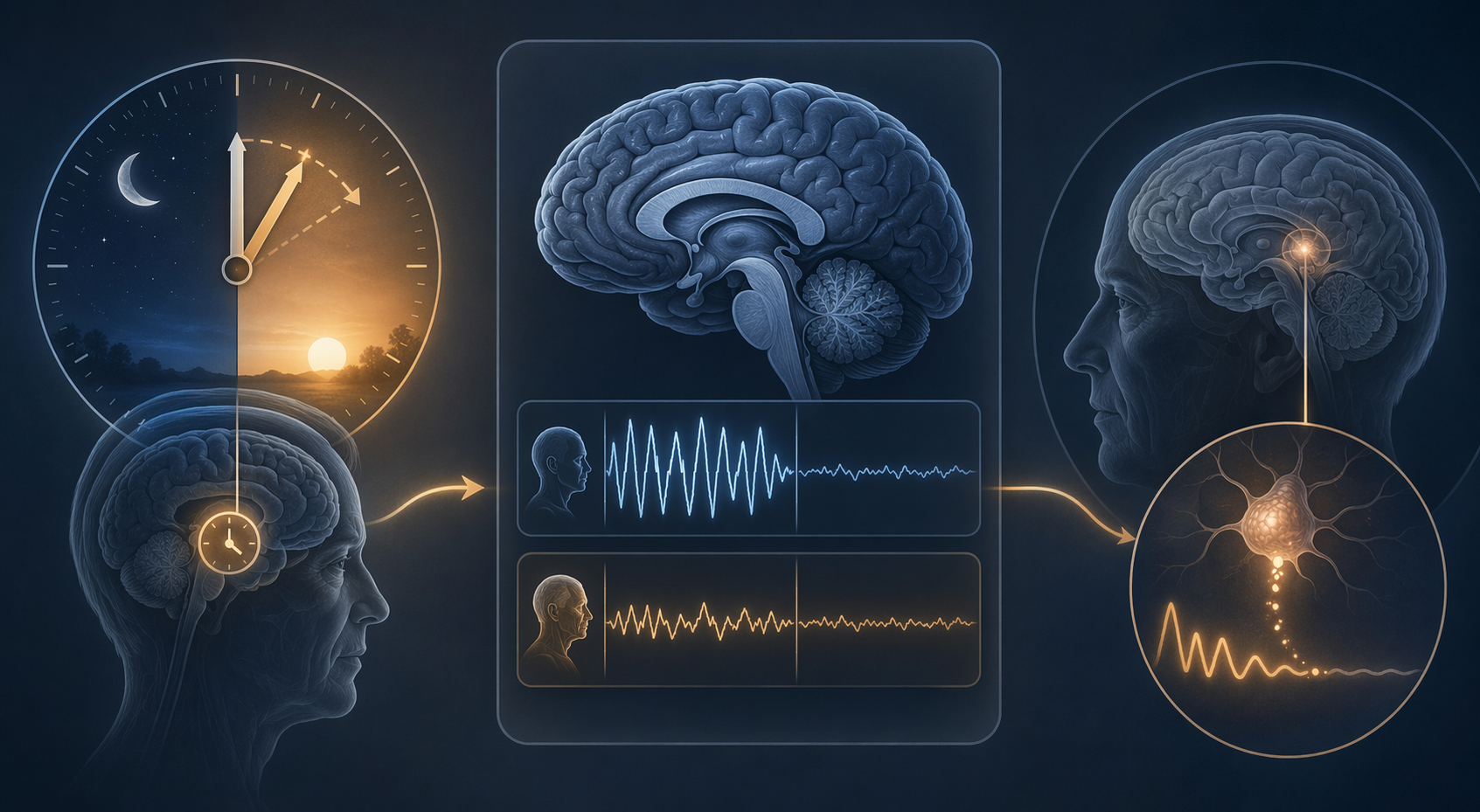
The three sleep changes that matter most after midlife
Several things can disturb sleep at any age: pain, stress, alcohol, caregiving, anxiety, a noisy bedroom. But normal aging adds its own pattern. Three changes are especially useful to understand because they explain complaints that generic sleep advice often misses.
| What changes | How it often feels | Best-matched lever |
|---|---|---|
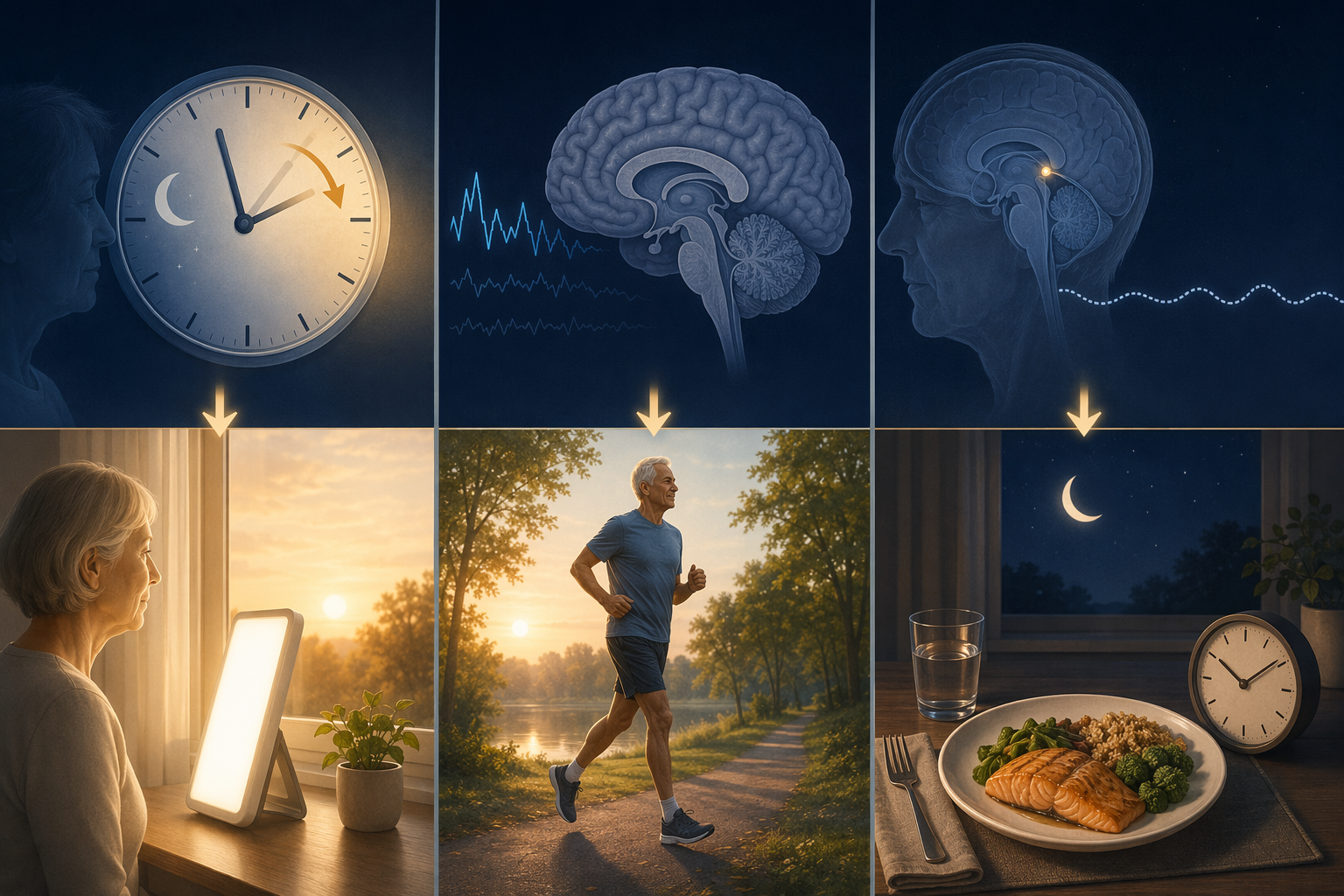
| Circadian phase advance | Sleepiness arrives earlier in the evening; waking happens earlier in the morning | Morning bright light and a steady wake time |
| Slow-wave sleep decline | Sleep feels thinner, lighter, and less physically restorative | Regular aerobic exercise, with realistic expectations |
| Reduced melatonin amplitude | The internal night signal feels weaker or less reliable | Day-night light contrast and rhythm consistency |
The Sleep Foundation describes older adults as more likely to have earlier bedtimes and wake times, more awakenings, and less time in deep sleep.[2] A review of sleep in normal aging adds more detail: wake after sleep onset increases by about 10 minutes per decade from ages 30 to 60 and then plateaus, while slow-wave sleep declines by roughly 75% from ages 20 to 60 and then tends to stabilize after 60 in healthy adults.[3] Those numbers matter because they separate two different experiences that often get lumped together: waking too early and sleeping too lightly.
When your body clock moves earlier
Circadian phase advance is the name for a body clock that shifts earlier. The pattern is familiar: you can barely keep your eyes open after dinner, then you are wide awake at 4:45 a.m. and annoyed with yourself by 5:10. This is not simply a preference. Yale Medicine explains that aging affects the suprachiasmatic nucleus, or SCN, the brain region that helps coordinate circadian rhythm, and this deterioration contributes to earlier sleep and wake timing.[4]
The practical mistake is trying to fix an advanced clock only at bedtime. A better pillow, stricter willpower, or another evening rule may not touch the strongest signal your clock is waiting for. For many older adults, the day needs a clearer start.
Use morning light as a clock signal, not as decoration
Morning bright light is the most directly matched intervention for circadian phase advance. The point is not that sunlight is wholesome in a vague way. The point is that bright light early in the day gives the circadian system a timing cue when that system has become less forceful with age.
- Get outdoor light soon after waking, especially if your pattern is early evening sleepiness and very early waking.
- Make the morning cue consistent before judging whether it helps; a scattered routine gives the clock scattered information.
- If outdoor light is not safe or practical, ask a clinician whether a bright-light device is appropriate, especially if you have eye disease or take photosensitizing medication.
- Keep evenings dimmer by comparison, because the contrast between day and night is part of the signal.
This is where a consistent wake time earns its place. It is not magic, and it is not a moral test. It simply gives morning light a stable anchor. If you wake at 5:00 a.m. but stay in dim indoor light until 9:30, the brain may not receive a strong morning signal. If you wake, move safely, open curtains, and get outdoor light when possible, you are giving the clock something it can use.
One caution: if you are already falling asleep too early, very bright light late in the day is not the first lever to pull without guidance. Light timing can shift the clock in different directions depending on when it is used. For a typical early-to-bed, early-to-wake pattern in later life, the simple, low-risk starting point is a stronger morning signal and a calmer evening light environment.
When sleep gets lighter even though you are in bed long enough
The loss of slow-wave sleep is often the change people grieve without having a name for it. Slow-wave sleep is the deeper, heavier sleep that many adults remember from earlier life. With age, sleep can still occupy a respectable number of hours on paper while feeling less solid. The review of normal aging reports that slow-wave sleep declines by about 75% from ages 20 to 60, then stabilizes after 60 in healthy adults.[3]
That finding should be handled with some kindness. If you no longer sleep like you did at 28, you are not failing at relaxation. Your sleep architecture has changed. But that does not mean nothing can be done. It means the intervention should aim at sleep depth and continuity, not just bedtime neatness.
Exercise is not a generic tip here
Aerobic exercise deserves more respect than it gets in most sleep lists because it targets the right problem. A Northwestern controlled trial found that aerobic exercise at about 75% of maximum heart rate, four times per week, improved sleep quality from poor to good. That kind of result is different from saying, loosely, that movement is healthy. It suggests that sufficiently regular aerobic work can change how sleep is experienced.
For an older adult, the useful version is not a heroic workout plan. It is a repeatable plan that raises breathing and heart rate while staying appropriate for joints, balance, heart history, and medications. Brisk walking, cycling, water exercise, or supervised gym work may all fit, depending on the person. The important details are regularity and enough intensity to count as aerobic training, not the brand of activity.
- If you are inactive now, start below the target and build with medical guidance if you have cardiovascular disease, dizziness, falls, or major joint pain.
- Put the exercise where you will actually repeat it; for many people, morning or early afternoon works better than late evening.
- Track the right outcome: fewer long awakenings and better daytime function matter more than one perfect sleep-stage score from a wearable.
- Give the plan time. Sleep architecture usually does not respond like a light switch.
Wearables can be useful for noticing trends, but they can also turn lighter sleep into a nightly report card. If the device says your deep sleep is low, compare that with how you function: alertness, mood, steadiness, pain tolerance, and whether you are nodding off unintentionally. A consumer sleep graph is not the same as a sleep-lab measurement.
When the melatonin signal is weaker
Melatonin is often discussed as if the only question is whether to buy a bottle. The aging issue is broader than that. Yale Medicine notes that older adults may produce a reduced amplitude of melatonin, meaning the signal that helps tell the body “night is here” can become less robust.[4]
A weaker melatonin rhythm makes the surrounding cues more important. If days are dim, meals drift, naps slide later, and evenings are brightly lit, the body receives a muddled message. A supplement may not fix that muddle, and for adults taking several medications, adding another substance is not a harmless default.
Strengthen the rhythm before reaching for a supplement
The safer first move is to make day and night easier for the brain to distinguish. Morning light helps here too. So does a predictable pattern of meals and activity. The National Sleep Foundation’s sleep health and aging recommendations emphasize daytime behaviors as part of sleep health in older adults, not just what happens after bedtime.[5]
- Eat meals at fairly consistent times, especially breakfast, so the body gets another daily timing cue.
- Avoid letting long or late naps steal pressure from nighttime sleep; if you nap, keep it intentional rather than accidental.
- Dim the evening environment enough that the body can tell the active part of the day is ending.
- Discuss melatonin with a clinician if you are considering it, particularly if you use prescription medicines or have neurologic, mood, or bleeding-risk concerns.
This is not an argument that melatonin is never useful. It is an argument against making it the center of the plan when the age-related problem is often a weaker rhythm, not a simple missing ingredient.
The smaller levers still count, but they are not all the same kind of evidence
Bedroom temperature, meal timing, and evening fluids can help, but they should not be sold as if they have the same evidence base as a targeted circadian-light plan or a structured exercise intervention. They are practical adjustments that reduce friction around sleep.
A cool bedroom is a good example. A commonly recommended sleep temperature range is 60–67°F. That range is worth trying if you wake hot, sweat, or throw covers on and off. But comfort, circulation problems, housing conditions, and safety matter. A number on the thermostat is not more important than whether the person can sleep without getting chilled or stiff.
Evening fluid restriction is similar. If you wake to urinate, it is reasonable to shift more fluid earlier in the day and reduce large drinks close to bedtime. But thirst, kidney disease, heart failure instructions, urinary medications, and fall risk all change the calculation. Nocturia is common enough in later life that people normalize it, yet it can also reflect medical issues that deserve attention.
Meal timing sits between comfort and clock-setting. A heavy late meal can disturb sleep for obvious digestive reasons, while irregular meals can blur circadian timing. The useful goal is not a rigid rule. It is a pattern your body can predict.
A practical way to match the tip to the complaint
Start with the pattern you recognize most clearly. Do not change six things at once if you want to learn what helps.
| If this is the main pattern | Try first | What to watch |
|---|---|---|
| You get sleepy too early and wake too early | Morning outdoor light, steady wake time, dimmer evenings | Whether your sleep window shifts later or early waking becomes less abrupt |
| You sleep enough hours but feel sleep is shallow | Regular aerobic exercise matched to your health status | Whether awakenings shorten and daytime energy improves |
| Your nights feel irregular and your body does not seem to know when to sleep | Consistent meals, morning light, active days, calmer evenings | Whether sleepiness becomes more predictable |
| You wake mainly to urinate | Shift fluids earlier and review medications or urinary symptoms | Whether trips decrease without dehydration or dizziness |
The cleanest experiment is usually two weeks of one primary change, with a simple log: bedtime, wake time, number of longer awakenings, naps, exercise, morning light, alcohol, and bathroom trips. The log does not need to become a second job. It just keeps memory from rewriting the week.
When “normal aging” is the wrong explanation
Some sleep changes are age-related. Some are medical. Some are medication-related. Older adults are also more likely to be managing several conditions at once, and about 40% of adults 65 and older take five or more medications. Diuretics can increase nighttime urination; beta-blockers, corticosteroids, and other drugs may disturb sleep or alertness. That does not make the medication wrong, but it does mean the sleep problem may not be solved by blackout curtains.
Sleep apnea deserves special caution. Loud snoring, witnessed breathing pauses, morning headaches, high blood pressure, and daytime sleepiness are not just signs of poor sleep hygiene. Restless legs symptoms, periodic limb movements, persistent insomnia, depression, pain, reflux, and repeated falls at night also need more than a home experiment.
- Ask for professional evaluation if insomnia lasts for weeks and affects daytime function.
- Bring a medication list, including over-the-counter sleep aids, supplements, and the timing of diuretics or steroids.
- Mention nocturia clearly; do not hide it as merely “getting older.”
- Seek help sooner for breathing pauses, severe daytime sleepiness, confusion at night, chest symptoms, or falls.
The realistic promise is modest but worthwhile. Aging changes sleep biology. It can move the clock earlier, thin out deep sleep, and weaken the internal night signal. Matching the intervention to the mechanism gives you a better chance than repeating generic sleep hygiene and blaming yourself when it fails.
References
- Sleep Chart of Biological Ageing Clocks, Nature, May 2026
- Aging and Sleep, Sleep Foundation
- Sleep in Normal Aging, PMC
- How Aging Affects Sleep, Yale Medicine
- Sleep Health and Aging, National Sleep Foundation, 2023
Comments
Join the discussion with an anonymous comment.