
A warm bath before bed helps sleep for a less cozy reason than people usually give. The useful part is not that you climb into bed still warm. It is that warm water brings blood toward the skin, especially in the hands and feet, so the body can release heat afterward. Under the conditions studied in a 2019 systematic review and meta-analysis, passive body heating by a warm bath or shower 1–2 hours before bedtime shortened sleep onset latency by about 36%, with the best-supported water temperature range at 104–109°F (40–43°C). The review included 17 studies, with 13 included in the quantitative synthesis.[1]
That timing is doing real work. A bath taken too late can leave you hot when you want your core temperature to be falling. A bath taken early enough gives the body a chance to move from heat loading to heat loss. If the goal is relaxation before bed, relaxation is only part of the story; the measurable sleep effect depends on thermoregulation.
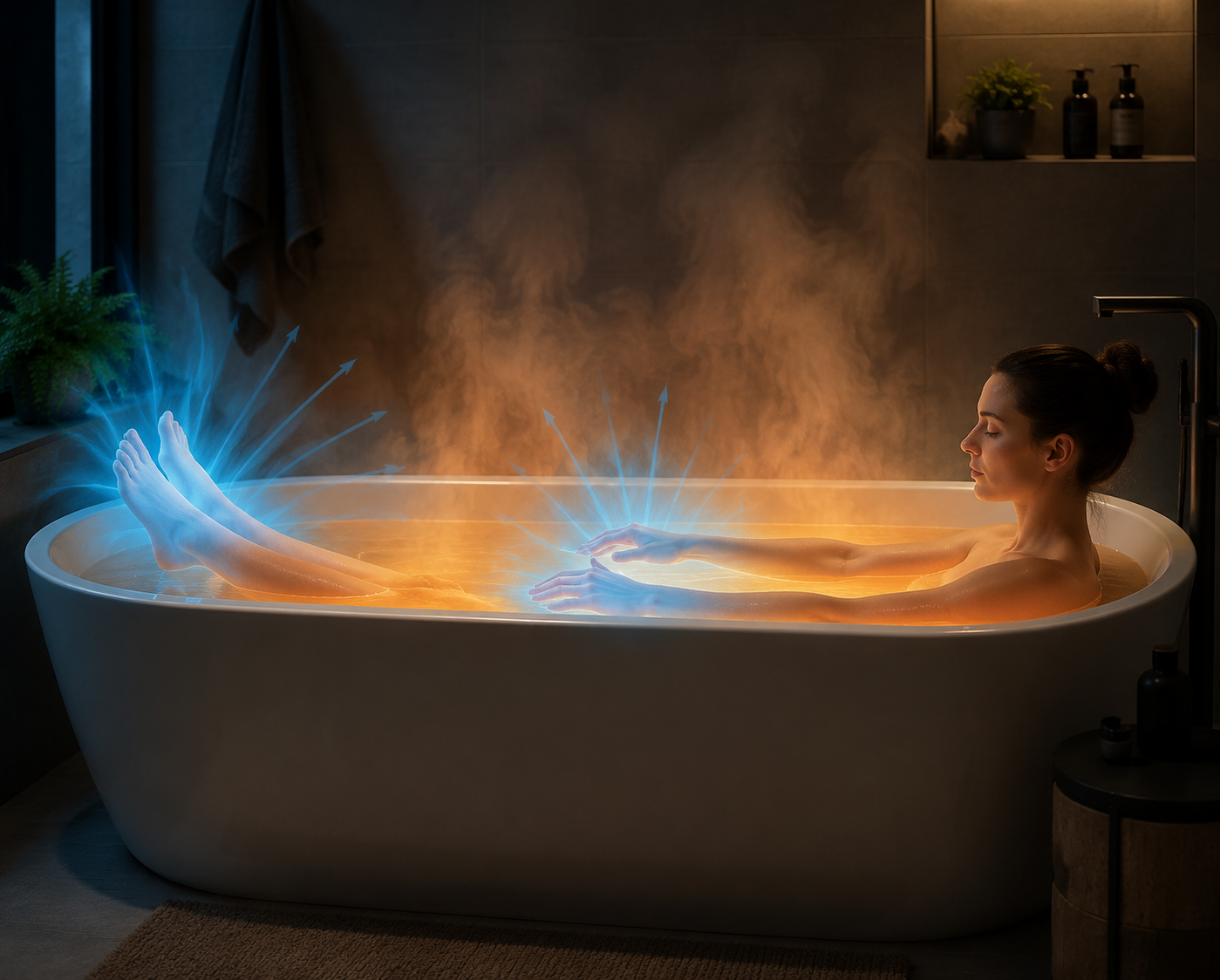
The Bath Works by Helping You Cool Down
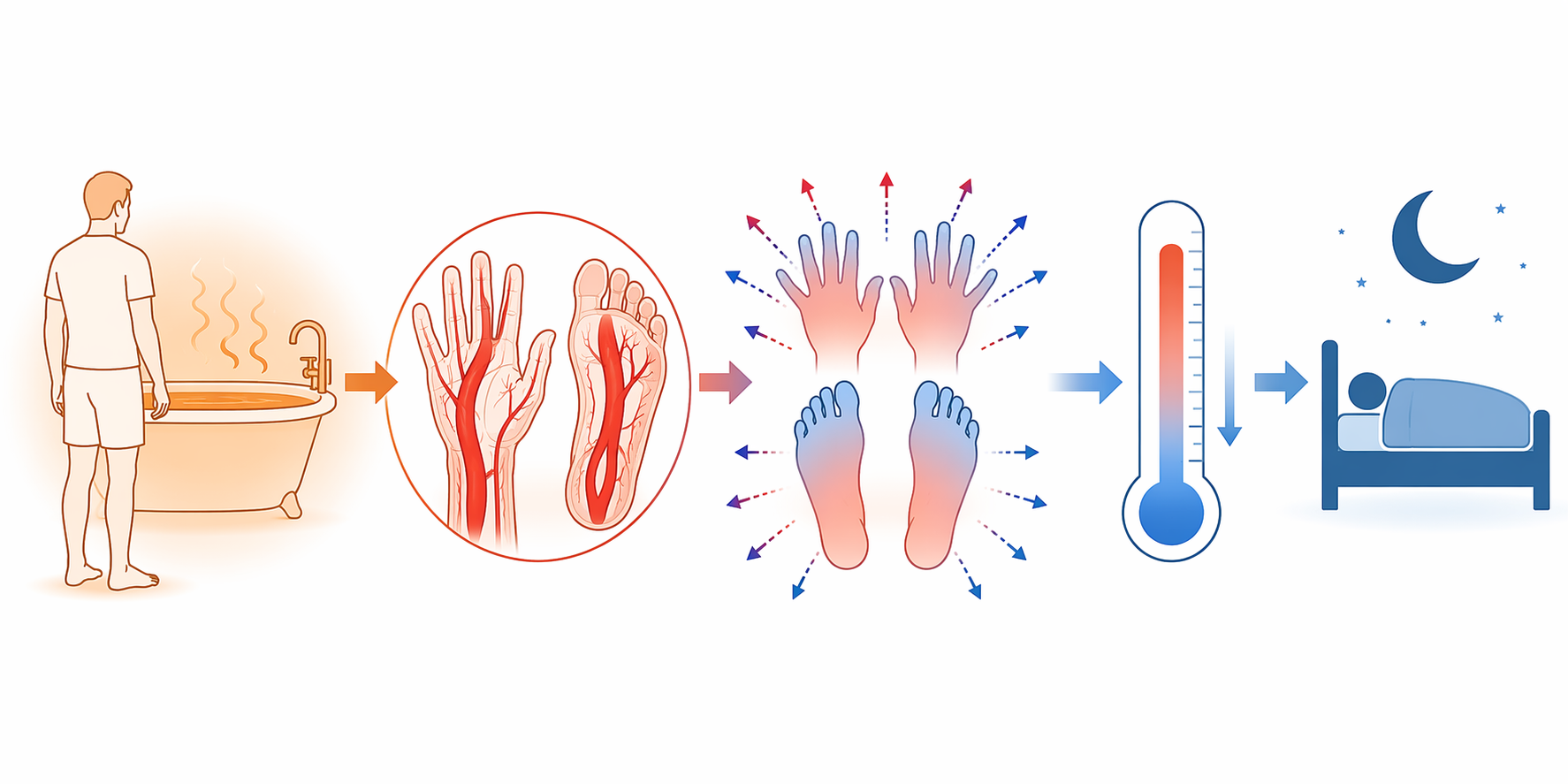
Sleep onset is easier when the body is moving into its usual nighttime cooling pattern. In the evening, core body temperature naturally begins to fall. At the same time, skin temperature in the extremities rises as blood vessels open and carry warm blood outward. The hands and feet become heat exchangers.
Researchers often describe this with the distal-to-proximal skin temperature gradient, or DPG. “Distal” means farther from the trunk: hands and feet. “Proximal” means closer to the trunk. When distal skin becomes warmer relative to the trunk, the gradient rises. A higher gradient means the body is set up to lose heat more efficiently through the extremities.
Warm water pushes that process along. It causes vasodilation in the skin, including the small blood vessels in the hands and feet. More warm blood reaches the surface. After the bath, that heat can leave the body into the surrounding air. The result is not permanent warmth; it is a controlled post-bath cooling phase that overlaps with the body’s normal pre-sleep temperature drop.
This is why the advice is easy to get wrong. If the water is too cool, the body may not warm enough to trigger much heat loss afterward. If the bath is too hot or too close to bedtime, the sleeper may still be overheated in bed. The useful window sits between those mistakes: warm enough to raise body temperature meaningfully, early enough to cool afterward.
Why a Quick Shower Is Not the Same as a Bath
The most practical evidence here comes from an ordinary home-bathing comparison rather than a highly controlled sleep-lab setup. In a 2023 field experiment in Japan, 23 adults completed three evening bathing conditions at home: showering, a short bath of about 5 minutes, and a longer bath of about 16 minutes. Their sleep onset latency was 20.3 minutes after showering, 16.1 minutes after the short bath, and 12.3 minutes after the long bath.[2]
The temperature data make the comparison more useful. Showering raised sublingual temperature by about 0.35°C, while the longer bath raised it by about 0.9°C.[2] That does not mean a higher temperature rise is always better. It means the longer bath did enough heating to set up a stronger cooling phase afterward. A quick rinse may be pleasant, but in this study it did not produce the same sleep-onset result.
| Evening condition | Approximate body-temperature effect | Sleep onset latency |
|---|---|---|
| Shower | Sublingual temperature rose about 0.35°C | 20.3 minutes |
| Short bath, about 5 minutes | Intermediate heating condition | 16.1 minutes |
| Long bath, about 16 minutes | Sublingual temperature rose about 0.9°C | 12.3 minutes |
There are limits to how broadly that exact pattern should be applied. The study was small, the participants bathed at home, and the bathing culture was Japanese, where tub bathing may differ from typical U.S. routines. Still, the comparison answers a common practical question cleanly: in this experiment, the longer warm bath outperformed showering alone.
The Best-Supported Timing Is a Range, Not a Magic Minute
The strongest synthesis points to 1–2 hours before bed as the main target window.[1] That does not mean exactly 90 minutes is biologically sacred. It means the bath should happen far enough ahead of lights-out for the warming phase to turn into a cooling phase.
A cohort study of 1,094 older adults found that hot-water bathing 61–180 minutes before bed was significantly associated with shorter sleep onset latency and a higher distal-proximal skin temperature gradient.[3] The study population matters: the mean age was 72, so it should not be treated as a perfect map for every younger adult. But it supports the same general timing logic. The useful interval is not “right before bed.” It is roughly the hour or two before bed, with some evidence extending into a 3-hour window in older adults.
For most adults trying this at home, the easiest starting point is simple: finish the bath about 90 minutes before the intended bedtime. If you tend to feel hot under the covers, move it earlier. If you cool quickly and have cold hands and feet at bedtime, the middle of the 1–2 hour window may be more useful than pushing the bath too far back.
A Practical Bath Protocol
The evidence does not require a spa ritual. It points to a heat-transfer routine. The bath should be warm, time-limited, and followed by enough cooling time before bed.
- Temperature: aim for 104–109°F (40–43°C), the range identified in the meta-analysis as optimal for improving sleep outcomes.[1]
- Timing: finish the bath about 1–2 hours before bed; about 90 minutes is a reasonable first trial point.[1]
- Duration: use enough time to warm the body meaningfully. In the home experiment, the roughly 16-minute bath produced better sleep-onset results than showering or the roughly 5-minute bath.[2]
- After the bath: dress lightly enough that you do not trap too much heat, and let the cooling phase happen before getting under heavy bedding.
- Track the outcome: compare nights by sleep onset, nighttime overheating, and morning grogginess rather than by how relaxing the bath felt in the moment.
The last point matters because comfort and physiology can diverge. A very hot bath may feel dramatic and soothing while still being a poor sleep intervention if it leaves you flushed in bed. A moderately warm bath that feels almost boring may do the better job if it raises skin blood flow and then lets temperature fall on schedule.
Where the Effect Can Fail
The bath effect has boundaries. The meta-analysis supports passive body heating in a specific temperature and timing range, not unlimited heat at any time of night.[1] If the bath happens less than an hour before bed, there may not be enough time for the post-bath cooling phase. If the water is above the studied optimal range, the body may be pushed toward overheating rather than useful heat loss.
People who are prone to dizziness, fainting, blood-pressure swings, or heat intolerance should be especially conservative. Older adults should treat hot-water immersion as a cardiovascular stressor as well as a sleep-hygiene tool. The goal is warm water, not endurance.
There is also a sleep-condition boundary. A bath may help with sleep onset when the problem is partly thermoregulatory or routine-related. It is not, by itself, a treatment for chronic insomnia, untreated sleep apnea, restless legs, major circadian delay, or medication-related sleeplessness. If the bath reliably shortens sleep onset, useful. If it does nothing after a fair trial, that result is information too.
How to Tell Whether It Is Working
Give the routine several comparable nights before judging it. Keep bedtime, caffeine, alcohol, and room temperature as steady as possible. If those variables swing wildly, the bath becomes hard to interpret.
- A useful response: you feel warm after bathing, then comfortably cooler before bed, and sleep onset shortens.
- A too-late response: you get into bed flushed, restless, or sweaty.
- A too-weak response: the bath feels pleasant but does not warm the hands, feet, or body enough to change sleep onset.
- A mismatch response: sleep onset improves, but nighttime awakenings increase because bedding or room temperature traps heat.
Adjust only one variable at a time. Move the bath earlier before raising the temperature. Extend a 5-minute soak before making the water hotter. Change bedding before assuming the bath failed. The mechanism depends on a sequence: warm the surface, open blood flow to the extremities, release heat, then enter bed during the cooling phase.
A warm bath before bed is therefore a credible sleep-hygiene tool, but not because warmth is inherently sedating. It works best when it creates the conditions for cooling. The useful part of the bath is what happens after it ends.
References
- Before-bedtime passive body heating by warm shower or bath to improve sleep: A systematic review and meta-analysis, PubMed, 2019.
- Maeda et al. 2023 field experiment on showering, short bathing, and long bathing at home, PMC, 2023.
- Tai et al. 2021 cohort study on hot-water bathing before bed and sleep onset latency in older adults, Journal of Clinical Sleep Medicine, 2021.
Comments
Join the discussion with an anonymous comment.