
Yes: eating fast food before bed can affect sleep, and the reason is more specific than “you ate something late.” Three things tend to get tangled together: the composition of the meal, the timing of the meal, and the fact that you may lie down while digestion is still active. A late burger, fries, soda, and dessert is not just a late meal; it is often a high-saturated-fat, high-sugar, highly processed meal eaten at a time when the body is supposed to be shifting toward sleep.
That distinction matters because the strongest sleep evidence is not simply about guilt, fullness, or “bad choices.” In a controlled crossover trial from Uppsala University, 15 healthy young men ate either a junk food diet or an isocaloric healthy diet for one week, then had sleep measured with polysomnography. The junk food diet produced shallower slow-wave activity during deep sleep, and the effect persisted into a recovery night after the diet period ended.[1]
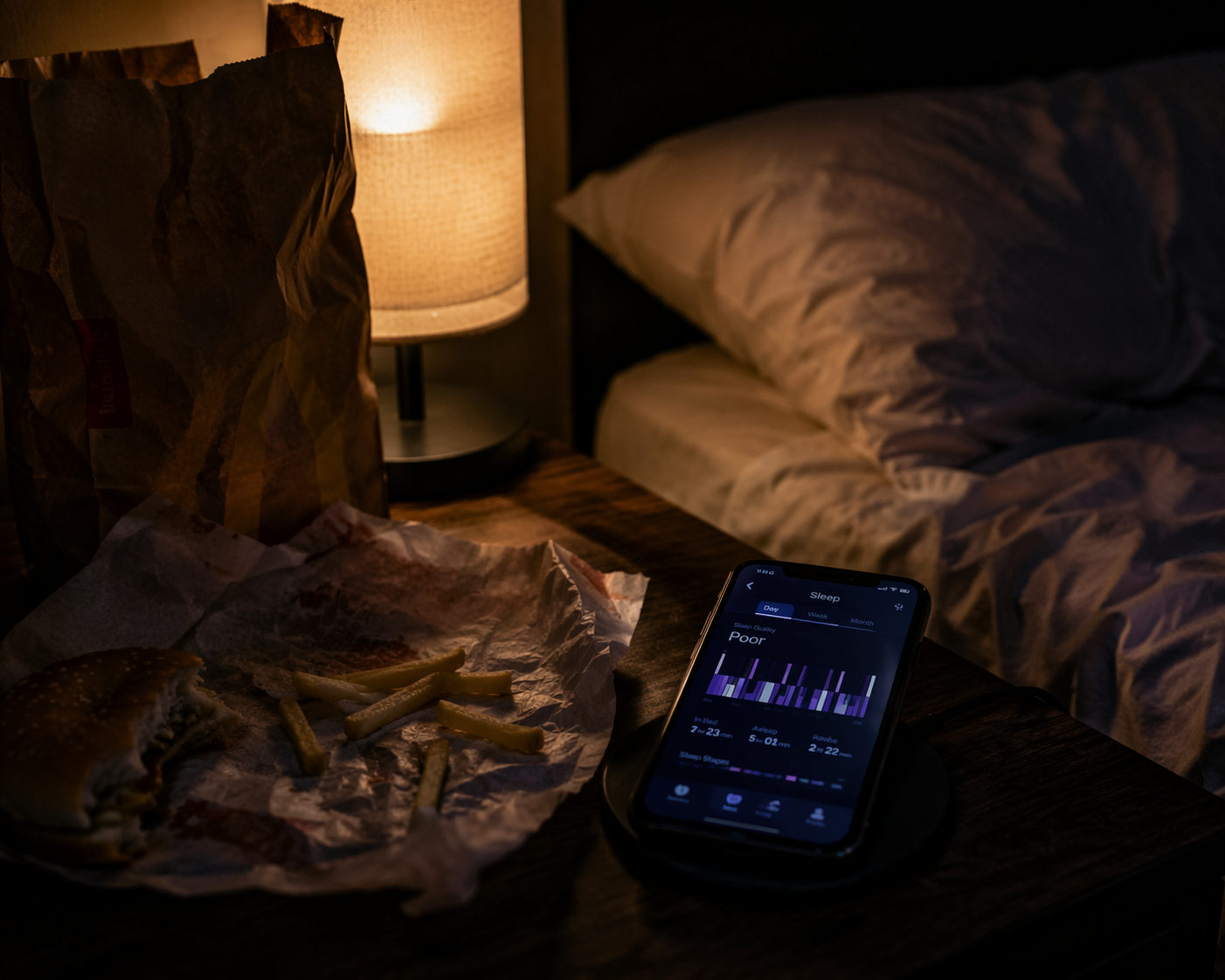
The sleep cost is not just about calories
The Uppsala finding is useful because it removes one of the easiest explanations. The two diets were matched for calories, so the result cannot be reduced to “they ate more.” The sleep difference appeared after a diet pattern high in features typical of junk food, especially saturated fat and sugar, compared with a healthier diet carrying the same energy load.[1]
Slow-wave sleep is the dense, deep part of the night most people describe as “real sleep.” On a brain recording, it is marked by slower, higher-amplitude activity. When slow-wave activity becomes shallower, a person may still be asleep for a normal number of hours, but the night can feel less restorative. That is the bridge between the lab result and the familiar morning-after impression: “I slept, but it was light.”
The caveat belongs close to the claim. This was a small study of healthy young men, not a definitive trial in women, older adults, shift workers, people with reflux, or people with insomnia. It also tested a short-term junk food diet, not a single fast-food meal eaten at 11:30 p.m. Still, it directly measured sleep architecture, and that makes it more informative than a food diary study for the narrow question of whether diet quality can show up in deep sleep.
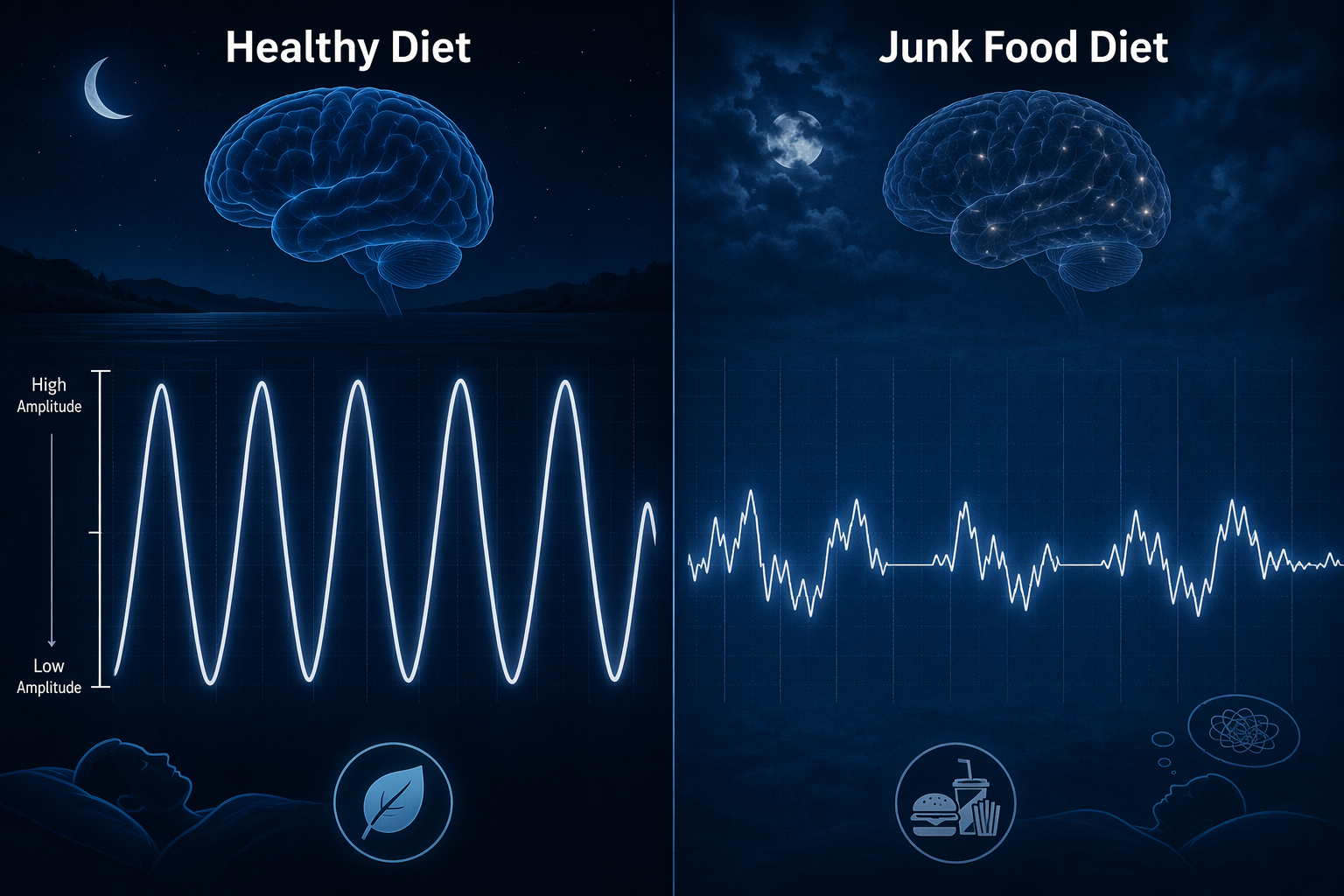
How a fast-food night can unfold in the body
A heavy fast-food meal close to bedtime can press on sleep from several directions at once. None of these pathways requires the meal to be enormous, and none proves that every late fast-food dinner will ruin the night. The issue is that the same meal often stacks multiple sleep-disrupting signals into a short window.
Fat and sugar can make deep sleep shallower
Fast food is not physiologically neutral just because it is familiar. A meal rich in saturated fat and refined carbohydrate arrives with different metabolic demands than a lighter meal with more fiber and less saturated fat. The Uppsala trial suggests that this kind of diet pattern can change the depth of slow-wave sleep even when total calories are controlled.[1]
Other sleep-architecture research points in the same direction, though with weaker causal force. In a study of 52 healthy adults, higher saturated fat intake before bed was associated with lower REM sleep percentage, lower sleep efficiency, and more wake after sleep onset. Because the study was correlational, it cannot prove that saturated fat caused those sleep changes, but it fits the broader pattern: meal composition appears to matter, not just bedtime proximity.[2]
This is why “I ate the same number of calories” does not settle the sleep question. Calories measure energy. Sleep architecture measures how the brain and body organize the night. A late meal can be calorically ordinary and still be compositionally difficult for sleep.
Digestion can raise the odds of waking after sleep starts
The next part of the night is more mechanical. After a heavy meal, the stomach is still working. Blood flow, gut motility, temperature regulation, and discomfort signals do not switch off because the lights are out. If the meal is fatty, gastric emptying tends to be slower, and lying flat can make the upper digestive tract less forgiving.
Population-level timing data supports this part of the story, but it needs careful handling. In an American Time Use Survey analysis, eating or drinking within one hour of bed was associated with more than double the odds of clinically significant wake after sleep onset, defined as at least 30 minutes awake after initially falling asleep; the reported odds ratio was 2.26 for all respondents.[3]
That study does not prove that fast food caused the awakenings. It was cross-sectional, and “eating or drinking” could mean many things. A glass of water, fruit, cereal, leftovers, and a full takeout meal are not the same exposure. The finding is still relevant because it captures a practical timing problem: when intake moves into the final hour before bed, more people report a night with substantial wakefulness after sleep begins.[3]
Reflux can compound the same pattern. A greasy, high-volume meal followed by lying down increases the chance that stomach contents move upward, especially in people already prone to heartburn. Even mild reflux does not have to fully wake someone to fragment sleep; brief arousals, position changes, coughing, throat irritation, or a sense of restlessness can all make sleep feel thinner by morning.
Late metabolic signaling can push against melatonin timing
Sleep is not only a response to being tired. It is also timed by circadian signals, including the evening rise of melatonin. Late eating sends the body a conflicting message: keep processing nutrients at a time when the central sleep-wake system is preparing for biological night.
In a controlled human study published in Current Biology, later meal timing shifted circadian phase, showing that food timing can act as a timing cue for the body rather than a mere source of calories.[4] This does not mean one late fast-food meal resets the whole clock. It does mean that a meal near bedtime can push metabolic activity into the same window when melatonin signaling and sleep consolidation are trying to take priority.
For a person who already has a delayed schedule, jet lag, rotating shifts, or a socially late evening, that conflict may be more noticeable. The problem is not moral weakness. It is timing friction: digestion, glucose handling, reflux risk, and circadian preparation are being asked to share the same narrow stretch of night.
What is strongest, and what is still indirect
The cleanest evidence here is not a large, perfect trial of “fast food at bedtime.” That study is not in the evidence base provided. The strongest direct sleep measurement comes from the Uppsala crossover trial, which tested a junk food diet against an isocaloric healthy diet and found shallower deep sleep activity.[1] Its strength is polysomnography; its weakness is size and population.
| Claim | What the evidence supports | Main limitation |
|---|---|---|
| Junk-food-style diets can make deep sleep shallower | A one-week controlled crossover trial found reduced slow-wave activity after a junk food diet despite matched calories. | Only 15 healthy young men were studied. |
| Higher saturated fat intake is linked with worse sleep architecture | A small study associated higher saturated fat intake before bed with lower REM percentage, lower sleep efficiency, and more wake after sleep onset. | The study was correlational. |
| Eating very close to bed is linked with more nighttime wakefulness | ATUS data found eating or drinking within one hour of bed more than doubled the odds of clinically significant wake after sleep onset. | The data did not isolate fast food or prove causation. |
| Late meals can affect circadian timing | Controlled meal-timing research shows late eating can shift circadian phase. | This supports mechanism more than it predicts the effect of any single meal. |
Taken together, the evidence is more convincing than a generic warning and less sweeping than a ban. It supports a bounded conclusion: fast food close to bedtime is most likely to degrade sleep when it is high in saturated fat and sugar, eaten in the last few hours before bed, and followed by lying down before digestion has settled.
A practical way to read your own bad night
If you sleep poorly after late fast food, the most useful question is not whether you “failed” at sleep hygiene. It is which part of the exposure was most likely active.
- If sleep felt light but not especially interrupted, meal composition may be the more relevant suspect: saturated fat, sugar, and overall diet quality can affect sleep architecture.
- If you woke repeatedly, tossed, or spent long stretches awake after initially falling asleep, timing and digestion may have played a larger role.
- If you had burning, coughing, sour taste, throat irritation, or needed extra pillows, reflux may have compounded the disruption.
- If you felt strangely alert despite being tired, late metabolic signaling may have pushed against your normal melatonin rhythm.
The adjustment does not have to be dramatic. When late food is unavoidable, the sleep-relevant move is to reduce the stack: choose a smaller portion, go easier on high-fat sides and sugary drinks, sit upright for a while before lying down, and avoid making the final hour before bed the main eating window. Those choices do not turn fast food into a sleep aid. They reduce the number of mechanisms working against the night at the same time.
So, does eating fast food before bed affect sleep? The credible answer is yes, especially when the meal is fatty, sugary, large, and very close to lying down. The evidence is not perfect for every population or every menu item, but controlled sleep measurement, observational timing data, circadian biology, and reflux physiology all point in the same direction: late fast food is a real sleep variable, not just a nutrition lecture wearing pajamas.
References
- Eating junk food may affect deep sleep, Harvard Health Publishing.
- Fat intake negatively influences the sleep pattern in healthy adults, American Academy of Sleep Medicine.
- Timing of food and fluid intake and its association with sleep duration and quality: findings from the American Time Use Survey, British Journal of Nutrition, 2021.
- Meal Timing Regulates the Human Circadian System, Current Biology, 2017.
Comments
Join the discussion with an anonymous comment.