
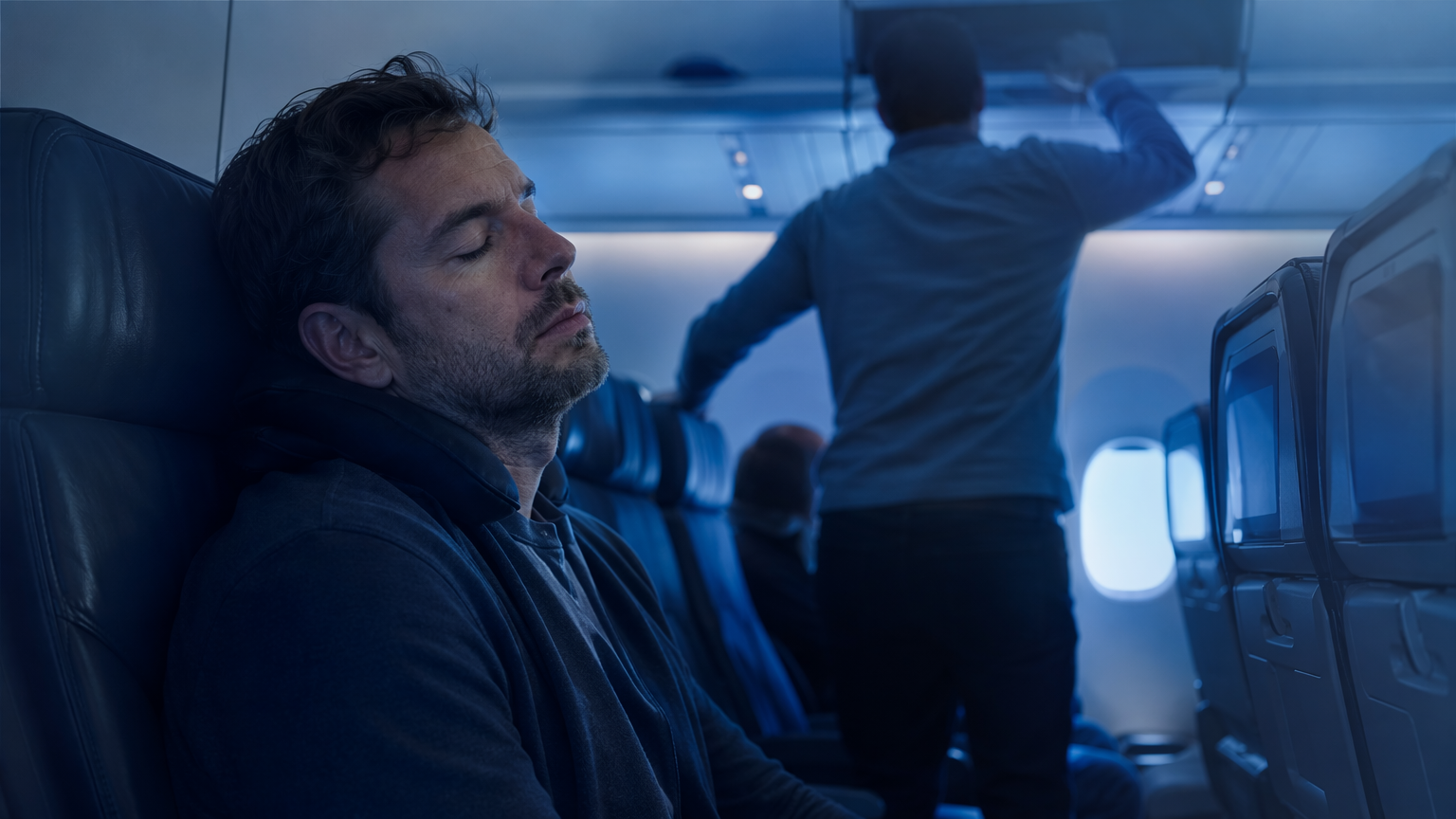
The risky part of a flight is not always the dramatic part. It can be the passenger who slept four hours, left home before breakfast, sat still through a short-haul flight, then stood up fast when the seatbelt sign turned off. Sleep deprivation does not make fainting inevitable. Most tired passengers get where they are going without a medical event. But poor sleep can shrink the body’s margin of safety when it is combined with lower cabin oxygen, long sitting, dehydration, skipped meals, or a sudden change from seated to standing.
That matters because fainting and near-fainting are not rare footnotes in aviation medicine. In a review of about 49,000 in-flight medical events using MedAire data, syncope or near-syncope accounted for 32.7% of events, making it the most common category reported.[1] A later Duke/MedAire analysis put the broader setting in perspective: about 1 in 212 flights involved a medical emergency, and 1.7% of those events resulted in diversion.[2] The point is not that every tired traveler is in danger. It is that the most common in-flight medical emergency sits close to ordinary travel behavior.
Why a Tired Passenger Has Less Room for Error
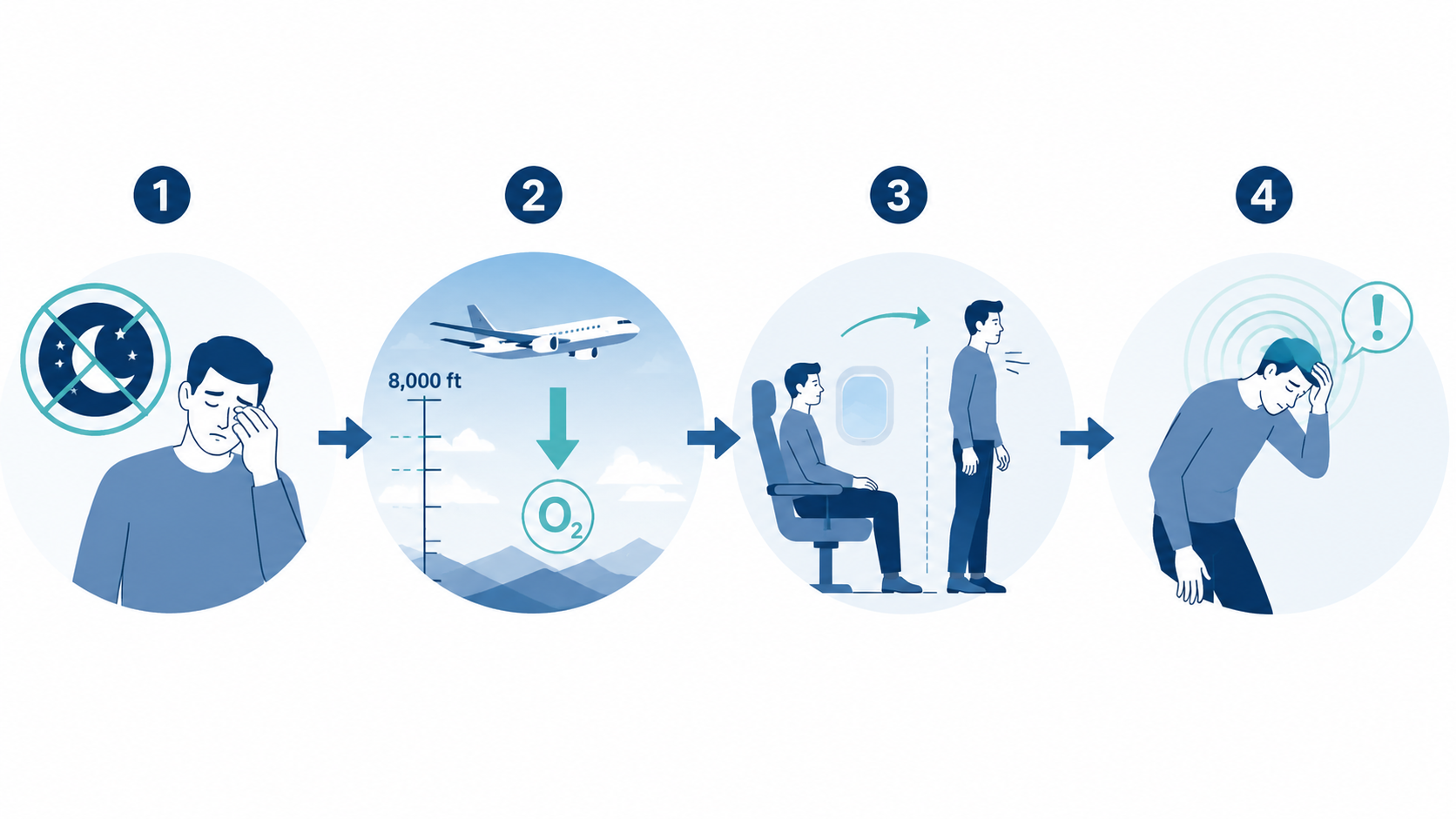
Fainting happens when the brain briefly does not get enough blood flow or oxygen to maintain consciousness. In the cabin, several mild pressures can stack: the air contains less available oxygen than at sea level, the passenger may be seated and folded for a long time, and standing suddenly asks the cardiovascular system to move blood upward against gravity. Add sleep deprivation, and the body may be slower or less resilient in handling that transition.
Aviation syncope literature specifically lists sleep deprivation as a situational trigger for hypoxic syncope, separate from orthostatic hypotension.[3] That distinction is useful. Orthostatic hypotension is about a blood pressure drop when someone stands. Hypoxic syncope is about vulnerability under lower-oxygen conditions. On an airplane, these are not tidy compartments in a traveler’s body. They can arrive together: low sleep, lower oxygen, long immobility, then a fast stand into the aisle.
Cabin altitude is part of the reason. Commercial aircraft cabins are pressurized, but not usually to sea-level conditions. The relevant comparison used in flight physiology is often about 8,000 feet, or 2,438 meters. In a German Aerospace Center study of healthy adults sleeping under simulated flight conditions at that altitude, mean oxygen saturation during sleep fell to about 88%, and 74.5% of sleep time was spent below an SpO2 of 90%.[4]
SpO2 is the percentage of hemoglobin in the blood carrying oxygen. At sea level, healthy people commonly sit comfortably above the levels described in that simulated cabin-altitude sleep study. A number around 88% does not mean every sleeping passenger is about to faint; the study involved flight crew, and a simulation cannot capture every real passenger, seat, illness, medication, or travel pattern. But it does show the physiological direction clearly: sleeping at cabin-like altitude can push oxygen saturation down into a range clinicians treat as hypoxic.[4]
The Vulnerable Moment Is Often the Transition
A passenger does not usually faint because one thing happened. More often, the problem is a sequence. Poor sleep reduces reserve. Cabin altitude lowers oxygen availability. Sitting still lets blood pool in the legs. Skipping food or drinking little because the restroom line is inconvenient may add another stressor. Then the passenger stands quickly, reaches overhead, twists into the aisle, or rushes to make a connection.
That last step is easy to underestimate. Standing is a cardiovascular task. The body has to tighten blood vessels, adjust heart rate, and keep blood moving to the brain. A rested, hydrated person often compensates without noticing. A sleep-deprived person in a mildly hypoxic cabin may still compensate, but with less spare capacity. The warning signs can be brief: warmth, nausea, sweating, tunnel vision, gray vision, ringing in the ears, sudden fatigue, or the feeling that the cabin has become very far away.
Most syncope episodes resolve within minutes with the person lying flat and the legs elevated, according to the aviation syncope review. The same review notes slower recovery in sleep-deprived passengers.[3] That is a narrow claim, and it should stay narrow. It does not prove that sleeping more before a flight prevents a specific event in a specific seat. It does support a practical conclusion: sleep loss is not just discomfort before travel; it is one of the conditions that can make recovery and compensation less forgiving.
What to Change Before the Flight
The most useful prevention starts before boarding because the cabin is not the only variable. You cannot choose cabin pressure. You often cannot choose the departure time. But you can avoid arriving at the gate with every reserve already spent.
- Protect the sleep before early departures when you can. A 6 a.m. flight often means the real wake-up time is much earlier, especially with commuting, parking, security, and boarding. Treat that lost sleep as part of the flight, not as a separate inconvenience.
- Do not stack avoidable stressors. If you are already short on sleep, skipping breakfast, limiting fluids all morning, and rushing through the airport all point in the same direction physiologically.
- Be cautious with alcohol before or during travel. It can worsen dehydration and sleep quality, and it can make early warning signs easier to miss.
- Plan for the first stand-up. If you know you get lightheaded, choose a moment when the aisle is not crowded, stand in stages, and keep one hand available for balance.
The sleep advice is not moral instruction. People take red-eyes because meetings, families, costs, and weather do not arrange themselves around circadian biology. The practical question is what to avoid adding on top of unavoidable sleep loss. A tired passenger who eats something reasonable, drinks enough to avoid obvious dehydration, moves periodically, and stands gradually is giving the body fewer simultaneous problems to solve.
What to Do in the Cabin
Onboard prevention is less about perfect travel wellness and more about reducing the force of the sequence that leads to fainting. The cabin environment already nudges oxygen saturation downward. Sitting still for a long stretch adds pooling in the legs. The goal is to keep circulation responsive and to avoid making the first movement after immobility the most demanding one.
| Cabin habit | Why it helps |
|---|---|
| Move your ankles, calves, and feet while seated | Muscle movement helps push blood back toward the heart instead of letting it pool in the legs. |
| Stand gradually after long sitting | A slower transition gives blood pressure and heart rate more time to adjust. |
| Hydrate sensibly | Adequate fluid supports circulating volume; overdoing fluids is not necessary, but intentional restriction can backfire. |
| Eat if you have skipped a meal | Food does not treat cabin hypoxia, but it can remove one common stressor from an already strained travel day. |
| Respond early to symptoms | Sitting down before a full faint protects the brain and reduces the chance of injury from falling. |
If warning signs begin, the best immediate move is not toughness. Sit down. If possible, lie back or get lower and raise the legs. Tell a flight attendant early, especially if symptoms do not pass quickly, if there is chest pain, shortness of breath, one-sided weakness, confusion, bleeding, or if the person is pregnant or has known heart disease. This article is about prevention, not diagnosing every onboard event; fainting can be simple, but it is not always harmless.
Where the Evidence Is Strong, and Where It Is Not
The strongest evidence here is not a trial showing that one extra hour of sleep prevents a certain number of in-flight faints. The evidence is a chain: syncope and near-syncope are the most common reported in-flight medical events in a large MedAire-based review; medical emergencies occur often enough to be operationally visible across airlines; sleep deprivation is named in aviation medicine as a trigger for hypoxic syncope; and simulated cabin altitude can lower oxygen saturation during sleep in healthy adults.[1][2][3][4]
Each link has limits. MedAire data are broad but come from one ground-support provider, not every flight worldwide. The Duke/MedAire figure is useful for scale, not for predicting an individual passenger’s risk. The simulated-altitude sleep study involved flight crew, not a perfect cross-section of travelers. The aviation syncope paper is a review, not a cabin intervention trial. Those limits matter because they keep the conclusion honest: sleep deprivation increases vulnerability; it does not mechanically cause an emergency.
That is still enough to change behavior. Better sleep before a flight is not a guarantee against fainting, and it will not erase the effects of cabin altitude. But it is a meaningful way to preserve reserve in the most common category of in-flight medical emergency, especially at the ordinary moments travelers overlook: after hours of sitting, when the aisle opens, the bags come down, and the body is asked to stand up before it is ready.
References
- In-flight Medical Emergencies, AAFP, 2021.
- New Study Reveals Frequency of In-Flight Medical Emergencies, Duke Health, 2025.
- Demystifying airline syncope, World Journal of Cardiology, 2020.
- Sleep-Induced Hypoxia under Flight Conditions, Nature and Science of Sleep, 2022.
Comments
Join the discussion with an anonymous comment.