
Stopping drugs is supposed to make the body safer. So when sleep gets worse after stopping—when 3 a.m. becomes familiar, dreams turn vivid or disturbing, and the nervous system feels switched on after an exhausting day—it can feel like something has gone wrong.
That fear deserves a direct answer: persistent insomnia, fragmented sleep, short sleep, intense dreams, REM changes, and hyperarousal are common during recovery. They are not proof that sobriety is failing. They are signs that the sleep-wake systems shaped by substance use are still recalibrating.
The scale is large enough that it should not be brushed off as ordinary restlessness. In alcohol-dependent patients, reported insomnia ranges from 36% to 91%, depending on the sample and measurement method.[1] That wide range is important: it does not give one tidy number, but it does say that sleep disruption is a major recovery symptom, not a rare complaint.
Drug abuse and sleep disruption are also not the same across every substance. Alcohol, cannabis, opioids, and stimulants can all disturb sleep, but they do it through different patterns: altered REM timing, reduced deep sleep, rebound dreaming, hyperarousal, shortened total sleep time, or a misleading gap between how sleep feels and what a sleep study would show.
Why Sleep Can Stay Broken After the Drug Is Gone
Many substances do not merely “make you sleepy” or “keep you awake.” They reshape sleep architecture: the structure of the night, including non-REM sleep, slow-wave sleep, REM sleep, awakenings, and the timing of transitions between stages. A sedated night is not automatically a restored night. Someone can be unconscious for hours and still miss the deeper, more stabilizing parts of sleep.
For readers who want the terminology before going further, the difference between NREM, REM, and slow-wave sleep is explained in this sleep architecture guide. The short version is this: slow-wave sleep is the deep, high-amplitude sleep most associated with physical restoration and sleep pressure discharge, while REM sleep is a more activated stage linked with dreaming, emotional memory processing, and a brain that is asleep but far from quiet.
Recovery can expose the difference between sedation and sleep. When the substance is removed, the brain may rebound toward lighter, more fragmented, more REM-heavy, or more alert states. That does not mean every bad night has the same cause. It means the timeline matters.
| Substance class | Common recovery sleep pattern | Documented persistence |
|---|---|---|
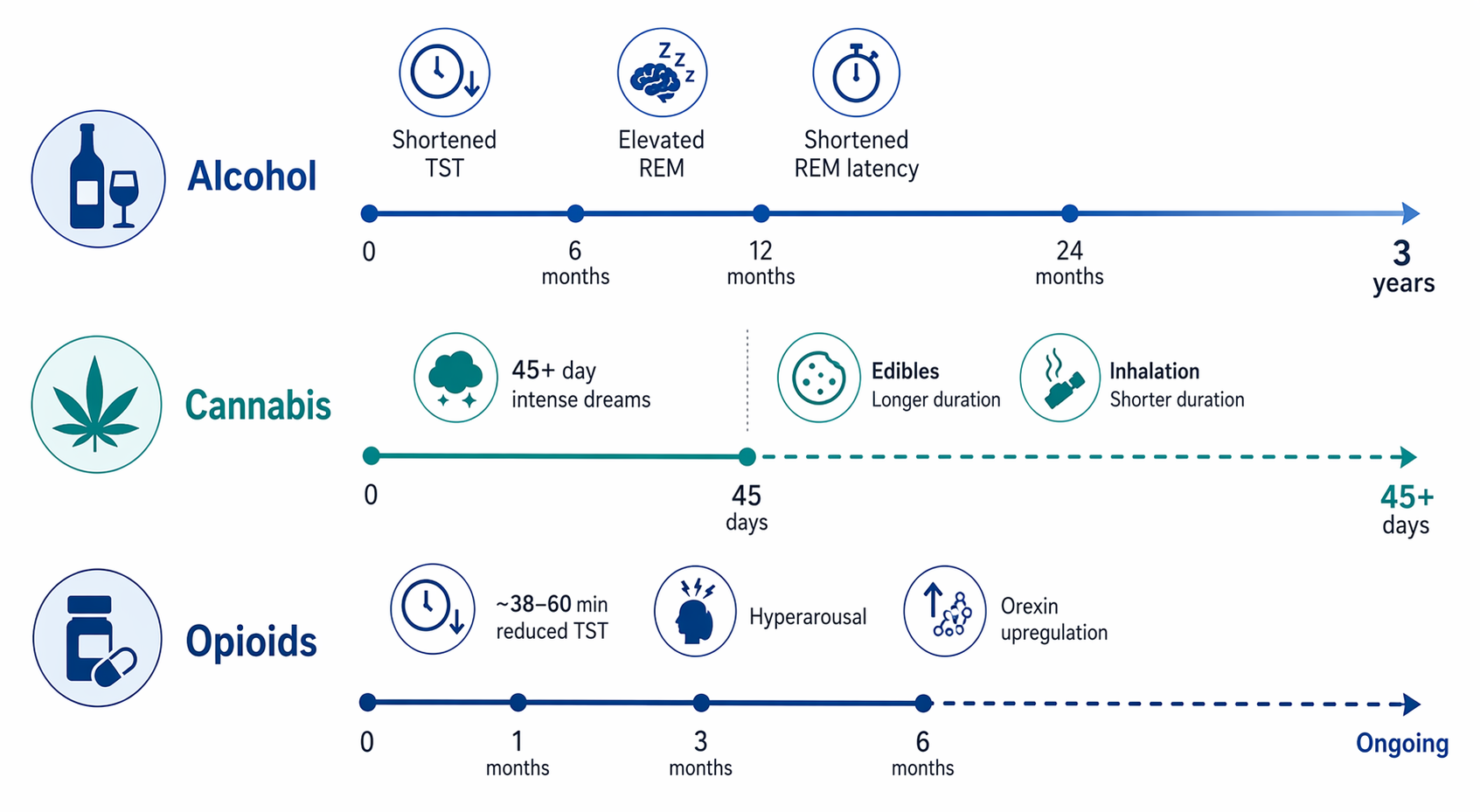
| Alcohol | Shorter total sleep time, reduced slow-wave sleep, elevated REM percentage, shortened REM latency | Some abnormalities reported up to 3 years of abstinence |
| Cannabis | Vivid or strange dreams, sleep disturbance during withdrawal, sometimes prolonged dream intensity | A subset reports intense dreams persisting beyond 45 days |
| Opioids | Reduced total sleep time and hyperarousal | Meta-analysis estimates total sleep time reduced by about 38-60 minutes |
| Cocaine | Subjective sleep may feel better while objective sleep remains impaired | Described as “occult insomnia” in abstinence research |
Alcohol: When the Night Looks Busy but Does Not Restore
Alcohol has the strongest sleep-recovery evidence, and it is also where the stakes are clearest. During abstinence, studies have found shortened total sleep time, elevated REM percentage, shortened REM latency, and sleep abnormalities that can persist up to 3 years.[2] That last phrase should land heavily. A person who is months sober and still sleeping badly is not necessarily doing recovery wrong; their sleep system may still be recovering on a much longer clock than detox.
REM latency means how long it takes to enter REM sleep after falling asleep. When REM latency shortens, the brain moves into REM unusually quickly. Elevated REM percentage means more of the night is spent in REM. Together, these changes can create a night that feels vivid, emotionally loaded, and insufficiently settled.
Slow-wave sleep matters for a different reason. It is the deep, heavy sleep that helps discharge sleep pressure. When slow-wave sleep is low, a person may spend enough time in bed and still wake feeling as if the night never did its job. This is one reason “just get eight hours” can be such a useless instruction in early recovery. The clock may say sleep happened; the architecture may say the system remained unstable.
Alcohol is especially deceptive because many people used it as a sedative. It can help someone pass out, but that does not mean it creates healthy sleep. Removing it may initially reveal a nervous system that has lost its borrowed off-switch. The result can be short sleep, frequent awakenings, and REM pressure that feels like the mind is trying to dream with the volume turned up.
Cannabis: The Dream Rebound Can Be the Main Event
Cannabis withdrawal is often discussed as irritability, appetite change, or insomnia, but for many people the most unsettling part is the return of intense dreams. In abstinent cannabis users, strange and intense dreams have been reported to persist unabated for more than 45 days in a subset of people.[3] That detail matters because the person waking from another vivid dream six weeks after stopping may assume they are outside the normal range. Some are not.
This does not mean prolonged dream disturbance happens to every former cannabis user. The evidence supports a narrower statement, but the experience can still be disruptive enough to affect mood, daytime fatigue, and the temptation to use cannabis again just to make dreaming stop.
Route of use may also matter. In one study, edible cannabis users reported more sleep disturbances than inhalation users.[4] That finding should not be stretched into a universal rule about all edible use, but it is a useful correction to the assumption that cannabis sleep withdrawal is identical for everyone. Dose pattern, route, frequency, and individual neurobiology can all shape the night that follows abstinence.
Opioids: Less Sleep, More Arousal
Opioid-related sleep disruption often centers on reduced total sleep time and a body that does not easily stand down. A 2025 meta-analysis reported that people with opioid use disorder had total sleep time reduced by about 38-60 minutes.[5] Losing that much sleep night after night is not just unpleasant; it shrinks the recovery margin during a period when emotional regulation, pain tolerance, and decision-making are already under strain.
One mechanism under study is orexin, a wake-promoting neuropeptide system involved in arousal, stress, and reward. Opioid-related hyperarousal has been linked with orexin upregulation, which helps explain why some people in recovery feel tired but unable to switch off.[6] Orexin is not a trendy label to paste onto every sleepless night. It is one plausible biological bridge between withdrawal, stress activation, and the stubborn wakefulness that can follow opioid use.
This is also why advice that treats opioid recovery insomnia as ordinary bedtime misbehavior can miss the point. A quieter room may help. A consistent wake time may help. But hyperarousal is not solved by shame, and it is not proof that someone secretly does not want recovery enough.
Cocaine and the Problem of Feeling Better Too Soon
Stimulant recovery adds a different complication: the person may feel that sleep is improving while objective sleep remains abnormal. Cocaine abstinence research has described “occult insomnia,” where users report improved sleep even as polysomnography shows worsening sleep.[3] That gap is not a reason to distrust every personal report. It is a reason to be careful with quick conclusions.
Subjective improvement still matters. If someone feels less miserable, that is real. But in stimulant recovery, a better-feeling night may not mean sleep architecture has fully normalized. Caffeine, late-day stimulation, and irregular schedules can add more load here; if that is part of the picture, this explanation of how coffee interferes with sleep may be more useful than another generic warning to “avoid stimulants.”
Why This Matters for Relapse Risk
Sleep disruption is often treated as a comfort issue: bad, but secondary. In recovery, that framing is too soft. In alcohol dependence, low slow-wave sleep and elevated REM pressure predicted relapse more strongly than age, marital status, employment, or depression ratings.[1][7] That is the kind of finding that should change the clinical seriousness of the conversation.
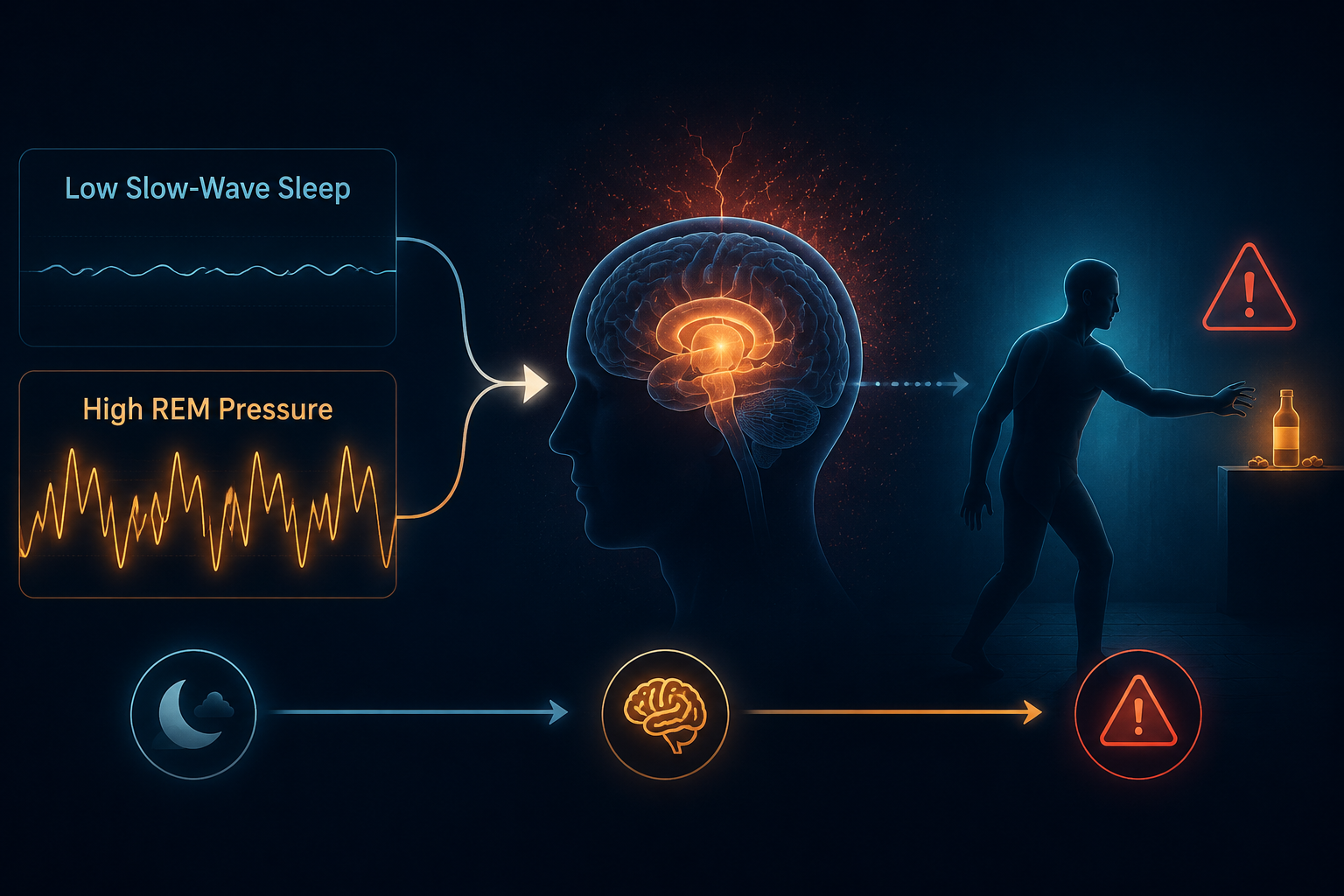
Slow-wave sleep and REM pressure are not moral variables. They do not measure commitment, honesty, or character. They measure a nervous system’s nightly state. When deep sleep is low and REM pressure is high, the next day may arrive with less emotional cushioning, more intrusive dreaming, more fatigue, and a thinner pause between craving and action.
This does not prove that fixing sleep automatically prevents relapse. The evidence is more specific than that. Certain sleep architecture patterns predict relapse risk, and some treatments improve sleep. Whether a specific treatment reduces relapse has to be shown directly, not assumed because sleep improved.
The relationship also runs both ways. Poor sleep can precede substance use, substance use can damage sleep, and withdrawal can make sleep worse before it gets better. That loop is one reason recovery plans should ask about sleep early instead of waiting until exhaustion becomes a crisis. For readers coming from overdose-related concerns, how drug overdose and poor sleep feed each other covers the higher-risk end of that overlap.
What Helps Without Undermining Recovery
Once relapse risk is clear, the treatment question becomes more precise: the goal is not simply to knock someone out. The goal is to improve sleep in a way that protects recovery rather than borrowing relief from another risky sedative.
CBT-I improves sleep, but relapse claims need restraint
Cognitive behavioral therapy for insomnia, or CBT-I, is the first behavioral treatment to take seriously. In recovering alcohol-dependent patients, CBT-I has improved subjective sleep quality, sleep efficiency, sleep onset latency, and awakenings.[2] Those are meaningful outcomes. Falling asleep faster, spending more of the night actually asleep, and waking less often can reduce the daily burden of recovery.
The boundary is just as important: controlled trials have not consistently shown that CBT-I reduces relapse rates in this population.[2] That does not make CBT-I weak. It means the accurate claim is that CBT-I improves sleep during recovery, while relapse prevention may require a broader plan that includes craving management, medications when appropriate, therapy, social support, and monitoring.
A recovery-adapted CBT-I plan may include fixed wake time, careful sleep restriction under guidance, stimulus control, reducing time awake in bed, and changing the dread-filled thinking that builds around bedtime. If someone needs a stepped non-pill approach before or alongside professional care, this guide on how to sleep without pills is a practical place to start.
Gabapentin is worth discussing with a clinician
Gabapentin complicates the false choice between white-knuckling insomnia and using a medication that jeopardizes sobriety. In a placebo-controlled trial of alcohol-dependent patients, gabapentin in the 900-1800 mg range improved both sleep and drinking outcomes.[8] That dose range is study context, not personal dosing advice. Medication decisions belong with a clinician who knows the person’s substance history, other medications, kidney function, relapse risk, and misuse risk.
The reason gabapentin deserves attention is not that it is a universal sleep drug. It is that the evidence connects it to both sleep and alcohol outcomes in a way many insomnia treatments do not. For someone in alcohol recovery whose sleep disruption is increasing craving or destabilizing the day, that is a conversation worth having rather than quietly enduring another month of broken nights.
Orexin antagonists fit the biology, but the evidence is still emerging
Orexin antagonists, including suvorexant, are interesting because they target a wake-promoting system involved in arousal and addiction-related neurobiology.[6] That makes them biologically plausible for some recovery-related insomnia, especially where hyperarousal is prominent. Plausible is not the same as proven across substance use disorder populations, so this remains a clinician-level discussion rather than a self-directed solution.
Trazodone may be considered second line
Trazodone is often used for insomnia in people with substance use histories and has been discussed as a second-line option in this context.[2] Its place is not the same as CBT-I, and it should not be treated as automatically harmless because it is not a benzodiazepine. Next-morning sedation, interactions, other psychiatric symptoms, and individual medical history still matter.
Benzodiazepine receptor agonists require firm caution
Benzodiazepine receptor agonists are a poor fit for many people in substance recovery because they carry abuse liability and can interact dangerously with alcohol.[2] This is not a purist objection to medication. It is a risk calculation. A drug that quickly reduces distress but increases the chance of misuse, dangerous combinations, or dependence can turn a sleep problem into a recovery problem.
Where Sleep Hygiene Still Belongs
Basic sleep hygiene is not useless. It is just not enough to explain recovery insomnia by itself. A dark room, regular wake time, morning light, less caffeine, and fewer late-night screens can reduce extra friction. They do not fully address REM pressure, low slow-wave sleep, opioid-related hyperarousal, or cannabis dream rebound.
The useful version is recovery-specific: remove cues associated with use from the sleep environment, plan for vivid dreams instead of being blindsided by them, tell a sponsor or clinician when sleep loss starts increasing craving, and treat bedtime dread as a symptom to work with rather than a private failure. For a broader evidence check, this article on what sleep hygiene can and cannot do separates helpful habits from overpromised advice.
- Track sleep and craving together for a few weeks, not as a perfection project but to see whether bad nights are raising relapse risk.
- Bring persistent insomnia, intense dreams, or early-morning awakenings to a clinician instead of waiting for them to disappear.
- Avoid using alcohol, cannabis, benzodiazepines, or leftover sedatives as sleep tools during recovery.
- Ask specifically about CBT-I or recovery-informed insomnia treatment, not only general relaxation advice.
- If medication is considered, ask how it affects relapse risk, next-day functioning, interactions, and misuse potential.
How Long Until Sleep Feels Normal?
There is no honest single timeline. Alcohol-related sleep abnormalities can persist for months and, in some findings, up to 3 years.[2] Cannabis-related intense dreams may last beyond 45 days in a subset of abstinent users.[3] Opioid use disorder is associated with reduced total sleep time, with the 2025 meta-analysis estimating a loss of about 38-60 minutes.[5] Cocaine recovery can include a period where sleep feels better before objective measures agree.[3]
Those timelines can sound discouraging if they are heard as a sentence. They are better understood as a map. If sleep is still erratic at two months, that does not mean the body is permanently damaged. If dreams are still intense after several weeks, that does not mean stopping was the wrong decision. If exhaustion is making cravings louder, that does mean sleep deserves a place in the recovery plan now.
The careful conclusion is neither “just give it time” nor “something is broken forever.” Sleep may recover slowly, sometimes over months or years, and the timeline depends on substance class and individual neurobiology. Persistent sleep disruption is still treatable. Bad sleep after stopping drugs does not mean sobriety is the problem; it means the nervous system is still recalibrating, and recovery is safer when that recalibration is taken seriously.
References
- Insomnia and Alcoholism: A Review of Epidemiology, Risk Factors and Treatments, Alcoholism: Clinical and Experimental Research, 2010
- Sleep Disturbance in Substance Use Disorders, Psychiatric Clinics of North America, 2015
- Sleep and Circadian Contributions to Adolescent Alcohol Use Disorder, Alcohol Research: Current Reviews, 2019
- Sleep Quality and Cannabis Use Problems: A Longitudinal Study of Young Adults, Addictive Behaviors, 2020
- Sleep disturbance in opioid use disorder: a systematic review and meta-analysis, EClinicalMedicine, 2025
- Drugs, sleep, and the addicted brain, Neuropsychopharmacology, 2020
- Increased REM sleep pressure at admission predicts relapse in nondepressed patients with primary alcoholism at 3-month follow-up, Archives of General Psychiatry, 1994
- Gabapentin Treatment for Alcohol Dependence: A Randomized Clinical Trial, JAMA Internal Medicine, 2014
Comments
Join the discussion with an anonymous comment.