
The hard part is not deciding whether smoke is bad for sleep. It is standing in a hot bedroom at 10 p.m., windows shut, throat already dry, and deciding whether the machine in the room will cool the air you are breathing or pull more smoke toward the bed.
So the useful answer to “does air conditioner affect sleep during smoke?” is system-specific. Some air conditioners mostly recirculate indoor air and can make the bedroom safer and more sleepable. Others depend on outdoor air or create pressure problems that can quietly make the room smokier.
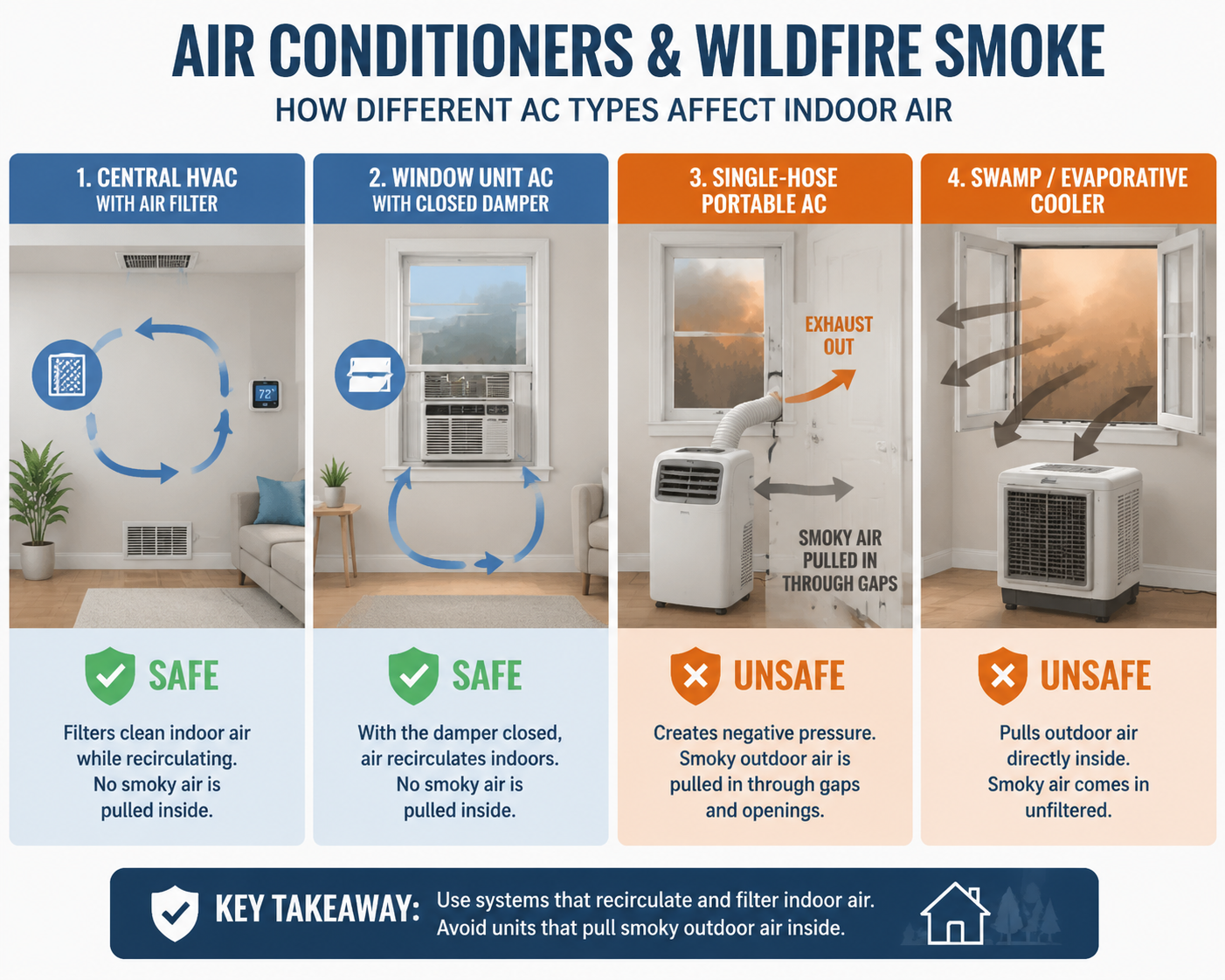
| Cooling setup | Run it during wildfire smoke? | Bedroom action before sleep |
|---|---|---|
| Central AC / forced-air HVAC | Usually yes, if configured to recirculate and filter | Use the best compatible filter, ideally MERV 13 or higher if the system allows it; close the fresh-air intake; run the fan to keep air moving through the filter.[1] |
| Window AC | Usually yes, if it is well sealed | Close any outdoor-air damper or vent, check the side panels and window gaps, and avoid modes that intentionally bring in outside air.[2] |
| Single-hose portable AC | Avoid if possible during smoke | It exhausts indoor air outdoors, which can create negative pressure and draw smoky outdoor air in through leaks.[3] |
| Dual-hose portable AC | Possibly better than single-hose, but still check the seal | Because the airflow path is different, it may reduce the negative-pressure problem, but smoke guidance is less settled; seal the hoses and window plate carefully. |
| Evaporative cooler / swamp cooler | No | Turn it off during smoke because it cools by pulling outdoor air into the home.[2] |
| Standalone HEPA purifier | Yes, as a bedroom clean-room tool | Run it in the room where you sleep, sized for the room, with doors and windows closed.[1][4] |
Why the type of AC matters more than the word “air conditioning”
During a smoke night, the question is not whether the unit makes cold air. The question is where it gets the air it moves, where it sends exhaust, and whether the bedroom can stay slightly isolated from the smoky outdoors.
A recirculating system can help because it keeps the windows closed while moving indoor air through a filter. A leaky or outdoor-air system can hurt because cooling comes with smoke entry. That mechanical difference is why “just run the AC” is too vague for anyone using a window unit, portable unit, or swamp cooler.
The sleep reason is not abstract. In a 2026 field study of 163 young adults, higher bedroom PM2.5 was significantly associated with a lower proportion of deep sleep, even though the median bedroom PM2.5 level was 16 micrograms per cubic meter.[5] That study does not prove that a purifier or a particular AC setting will guarantee better sleep tonight. It does make the bedroom particle level worth treating as part of the sleep environment, alongside heat and noise.
Central AC can be the safest cooling option, but only in recirculation mode
Central air is usually the most workable setup during wildfire smoke because it can cool the home while recirculating indoor air through the return ducts and filter. That advantage disappears if the system is pulling in outdoor air through a fresh-air intake, economizer, or ventilation setting.
Before bedtime, look for the boring controls that matter: the filter slot, the thermostat fan setting, and any fresh-air damper. EPA guidance for wildfire smoke recommends using a high-efficiency HVAC filter rated MERV 13 or higher if the system can handle it, setting the system to recirculate air, and closing outdoor air intakes where possible.[1] If the system manual says a high-MERV filter will restrict airflow too much, do not force it; an overheated blower or frozen coil is not a sleep improvement.
The fan setting deserves special attention. On many thermostats, “auto” means the fan runs only while the system is actively cooling. “On” keeps air moving through the filter more continuously. During smoke, that can help the bedroom and the rest of the home keep cycling air through the filter instead of waiting for the next cooling call. The tradeoff is more fan noise and energy use, so the practical bedtime choice is whether the extra filtration and steadier temperature are worth the sound in your room.
If your bedroom is the clean room, close the door, keep windows shut, and reduce indoor particle sources: no candles, incense, frying, vacuuming, or smoking. EPA’s clean-room guidance emphasizes choosing a room that can be closed off from the rest of the home and using filtration there during smoke events.[1] For a sleeper, that usually means the smallest comfortable bedroom, not the prettiest room in the house.
Window AC units are acceptable when the outside-air path is closed
A window air conditioner can be a decent smoke-night tool if it is operating like a sealed, recirculating cooler. Many window units mostly recirculate room air across a cold coil. Some also have a small vent, lever, or damper that lets outdoor air in. During wildfire smoke, that vent should be closed.
The weak point is often not the compressor; it is the installation. Accordion side panels, foam strips, tilted frames, and old window sashes can leave gaps. At night, those gaps sit inches from the bed in many apartments. Better Health Victoria advises that refrigerated air conditioners can be used when smoky outside if they are set to recirculate indoor air, while fresh-air intakes should be closed.[2]
- Close the fresh-air vent or outdoor-air damper if the unit has one.
- Press foam, tape, or a towel into obvious window gaps before sleeping.
- Avoid “vent,” “fresh air,” or similar modes during smoke.
- Clean or replace the unit’s washable screen filter, but do not confuse it with a HEPA purifier; many window-unit filters mainly protect the machine from lint and dust.
A well-sealed window unit plus a bedroom HEPA purifier is often a realistic renter setup: the AC handles heat, the purifier handles fine particles, and the closed bedroom door gives both machines a smaller volume of air to work on.
Single-hose portable ACs can cool the room while pulling smoke into it
The single-hose portable AC is the machine that most often sounds helpful and behaves badly during smoke. It sits inside the room, pulls room air across its components, and sends hot exhaust air out through one hose to the window. That exhausted air has to be replaced somehow. In a leaky apartment or house, replacement air can come through cracks, hallways, window frames, bathroom fans, and door gaps — exactly the paths that can carry smoky outdoor air indoors.
Jeffrey Siegel, a University of Toronto engineering professor, described this negative-pressure issue in wildfire-smoke coverage: portable air conditioners with one hose can draw outdoor air into the home as they exhaust indoor air.[3] That is the part generic cooling advice misses. The unit may make the air near the bed feel colder while the room’s fine-particle level gets worse.
If a single-hose portable is your only cooling device, the decision is ugly, not theoretical. Smoke exposure is harmful, but dangerous heat is also dangerous. The safest answer may be to relocate for the night, use a community cooling or clean-air space if one is available, or sleep in the coolest room that can be filtered without running that unit. What is not useful is pretending the single-hose portable is an air-cleaning device. It is a cooling device with an airflow penalty during smoke.
Dual-hose portable ACs are different because one hose brings in outdoor air for the condenser side and the other exhausts it back out, reducing the need to pull replacement air through the room. That does not automatically make every dual-hose installation safe: the window plate, hose connections, and room leaks still matter, and the public guidance is less clear than it is for central AC, window AC, and evaporative coolers. If you use one, seal the window insert carefully and pair it with a bedroom purifier.
Evaporative coolers should be off during wildfire smoke
Evaporative coolers, or swamp coolers, cool by drawing outdoor air across wet pads and sending that air indoors. That design is the problem. During smoke, they are not recirculating the bedroom air; they are importing the outdoor air you are trying to keep out.
EPA advises avoiding evaporative coolers when outdoor smoke is present unless there is a heat emergency and no other cooling is available.[1] Better Health Victoria is similarly direct: evaporative air conditioners should not be used when it is smoky outside because they bring outside air in.[2]
That does not mean someone should sit in dangerous heat to obey smoke advice. It means the swamp cooler should not be counted as a protective sleep setup during wildfire smoke. If it is the only way to avoid extreme heat, treat that as an emergency tradeoff, not as normal indoor-air management.
A HEPA purifier fills the gap AC usually cannot
Air conditioning and air cleaning are related at bedtime, but they are not the same job. AC controls heat and humidity. Filtration controls particles. A central HVAC filter may help, but the bedroom often benefits from a standalone HEPA purifier because it works in the room where your face will be for the next several hours.
A 2025 rapid review from the National Collaborating Centre for Environmental Health found that portable air cleaners reduced indoor PM2.5 by an average of 57% during wildfire events, and lowered the indoor/outdoor PM2.5 ratio from 0.68 to 0.34. The review rated the certainty of evidence as low, so this should be read as the best available practical evidence, not a guarantee of individual health or sleep outcomes.[4]
For sleep, the placement is simple: put the purifier in the closed bedroom, keep it away from blocked corners, and run it on the highest setting you can tolerate for noise. If the loud setting keeps you awake, run it high before bed and reduce it once you are trying to sleep. That compromise is not perfect air science, but it is often the difference between using the purifier all night and turning it off at midnight.
For broader poor-air-quality sleep routines — when to check AQI, how to prepare a clean room, and what to do before the smoke arrives — use this as the AC-specific companion to How to Sleep Well During an Air Quality Health Advisory.
The bedtime setup that makes the most sense
If the bedroom has central AC or a sealed window unit, the strongest overnight setup is a closed room, recirculating cooling, the best compatible HVAC filtration, and a standalone HEPA purifier. That setup handles the two things most likely to wreck the night at once: heat stress and particle exposure.
- Close bedroom windows and exterior doors before the smoke gets worse, if you can.
- Set central AC or a window unit to recirculate; close fresh-air dampers and vents.
- Use a MERV 13 or higher HVAC filter only if your system is rated for it.
- Run a HEPA purifier in the bedroom, preferably before bedtime and through the night.
- Avoid single-hose portable ACs and evaporative coolers as smoke-protection tools.
There is also a biological reason to take the sleep side seriously. In an EPA-affiliated animal study published in 2025, a single 1-hour eucalyptus smoke exposure at PM2.5 concentrations of 632 to 904 micrograms per cubic meter reduced REM and non-REM sleep, increased wake time, and increased blood pressure in rats.[6] Those were animals, not people sleeping in ordinary bedrooms, and the concentrations were high. Still, the result fits the more direct human concern: smoke particles are not just an outdoor visibility problem; they can become part of the night your body is trying to recover from.
The final call is mechanical before it is motivational. Cooling helps sleep during wildfire smoke when the system is not importing smoke. Central AC and tightly sealed window units can be useful. A bedroom HEPA purifier makes that setup stronger. Single-hose portable ACs and swamp coolers may lower the temperature, but they are not protective sleep tools during smoke; if those are your only options in dangerous heat, the problem has moved beyond sleep hygiene and into finding a safer place to spend the night.
References
- Wildfires and Indoor Air Quality, US EPA, https://www.epa.gov/emergencies-iaq/wildfires-and-indoor-air-quality-iaq
- Using air conditioners when it's smoky outside, Better Health Victoria, https://www.betterhealth.vic.gov.au/using-air-conditioners-when-its-smoky-outside
- Wildfires may keep you inside more often this summer. Is it safe to run the AC?, Global News, 2023, https://globalnews.ca/news/9754806/wildfires-canada-air-conditioning-smoke/
- Indoor air filtration during wildfires: Impacts on air quality and health, National Collaborating Centre for Environmental Health, June 2025, https://ncceh.ca/resources/evidence-reviews/indoor-air-filtration-during-wildfires-impacts-air-quality-and-health
- Scientific Reports bedroom PM2.5 and sleep field study, Scientific Reports, February 2026, https://www.nature.com/articles/s41598-026-37949-2
- Rentschler et al., Particle and Fibre Toxicology, December 2025, https://link.springer.com/article/10.1186/s12989-025-00650-9
Comments
Join the discussion with an anonymous comment.