
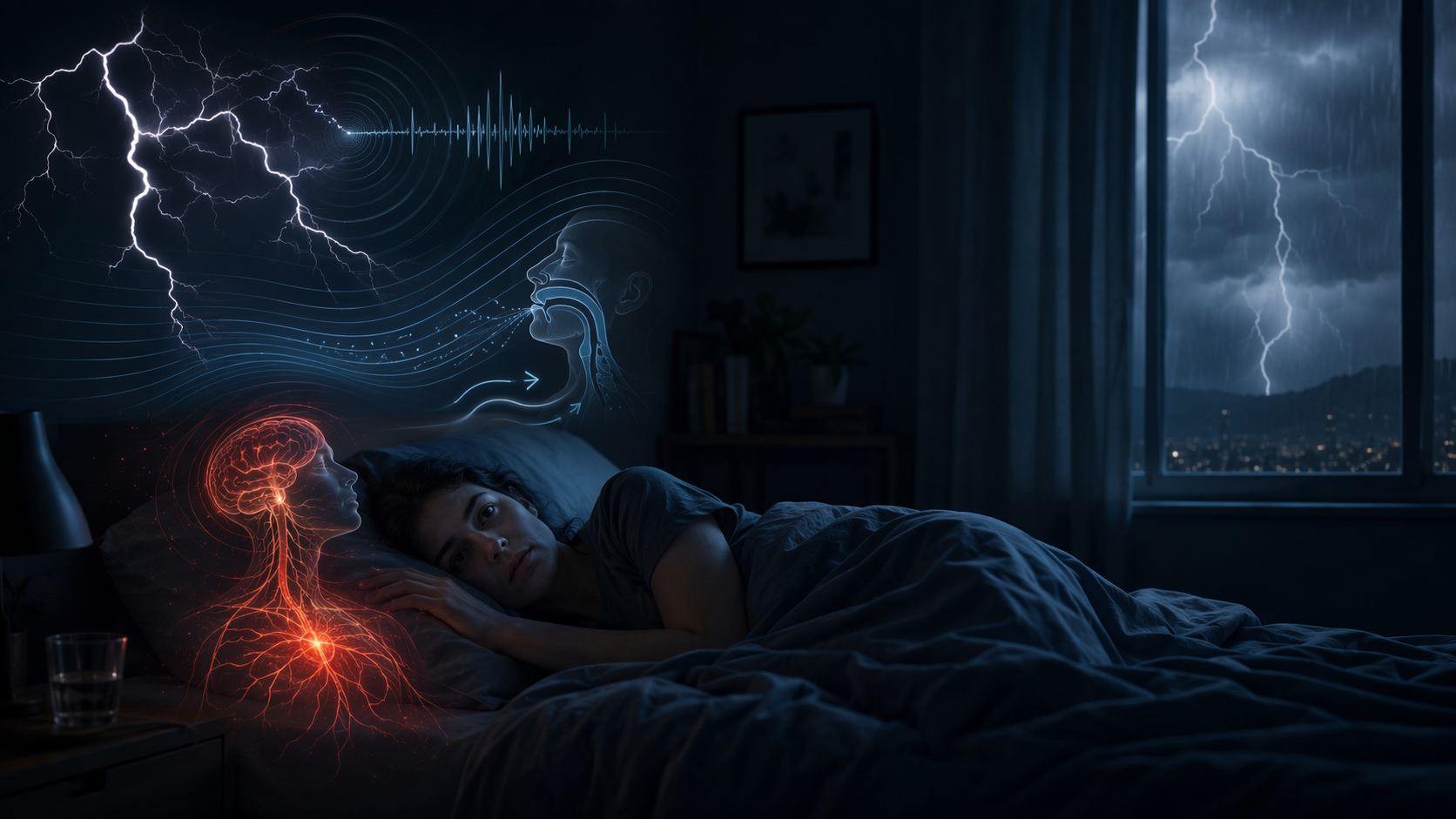
If earplugs are already in and the white-noise machine is already running, the problem is probably not that you failed to find the magic thunderstorm trick. Storms wake people through more than one route. Thunder and lightning jolt the senses. Pressure changes may matter for some people’s breathing, especially if obstructive sleep apnea is already in the picture. Fear or vigilance can keep the nervous system standing watch long after the loudest clap has passed.
That is why the useful answer to how to sleep during a thunderstorm is layered. First make the room less startling. Then protect any breathing routine you already depend on. Then give the body a clear signal that it can come down from alert. One fix may help one layer and leave the other two untouched.
Start By Naming Which Layer Is Keeping You Awake
At 2 a.m., it is tempting to treat the whole storm as one problem. It is not. The person who wakes with every lightning flash needs a different first move than the person who wakes gasping, and both need something different from the person who is physically safe but still checking radar every few minutes.
| What You Notice | Likely Layer | First Move Tonight |
|---|---|---|
| You wake at each thunderclap or lightning flash | Sensory disruption | Block, mask, and reduce contrast |
| You have diagnosed sleep apnea, snoring, or storm-night breathing trouble | Breathing vulnerability | Use CPAP as prescribed and check the mask seal |
| Your heart races, muscles stay tight, or you keep monitoring the storm | Anxiety-driven hyperarousal | Use downshifting techniques before trying to force sleep |
The order matters because a nervous system cannot settle while the room keeps ambushing it. A sound machine can help with thunder contrast, but it will not fix a leaking CPAP mask. A breathing exercise can soften panic, but it will not stop lightning from strobing through uncovered windows. Work the layer that is actually active.
Layer One: Make Thunder and Lightning Less Startling
Thunder is not just “noise.” Sleep handles steady noise better than sudden contrast. A low fan hum may fade into the room; a close thunderclap cuts across it. Lightning does the same thing visually, especially in a dark bedroom where each flash turns the window into a camera bulb.
This is where the difference between blocking, masking, and contrast reduction matters.
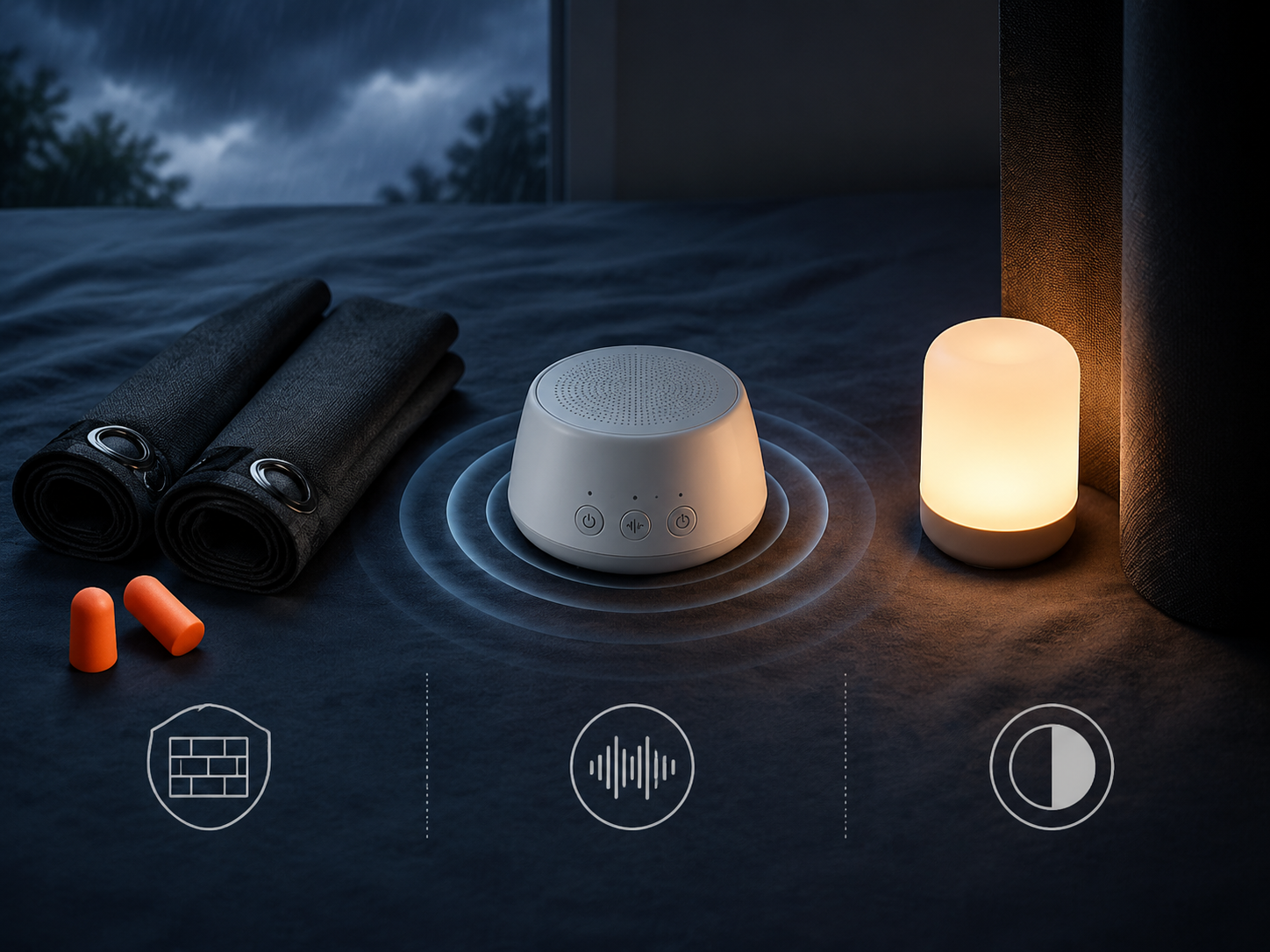
- Blocking lowers the amount of sound or light reaching you. Foam earplugs with an NRR 33 rating are a reasonable target when thunder is the main issue, assuming they fit well and are worn safely.
- Masking adds a steadier sound so thunder has less contrast against silence. Fans, rain sounds, brown noise, or a sound machine can do this.
- Contrast reduction makes the room less jumpy. Blackout curtains reduce lightning flashes; a dim warm nightlight can make remaining flashes feel less violent against total darkness.
Sound masking has real support, but it deserves more careful use than “turn it on and leave it on forever.” A 2021 study summarized by NSDR reported that sound masking reduced nighttime awakenings by up to 38% in high-noise environments.[1] That is useful when thunder keeps punching through a quiet room.
The tradeoff is that more sound is not automatically better sleep. NSDR also summarized 2026 reports on a Penn Medicine study by Basner and colleagues, published in Sleep, in which broadband or pink noise at 50 dB was associated with about 19 fewer minutes of REM sleep per night across seven nights in adults.[1] That figure should be treated as a reported finding, not a directly verified one. Still, it is enough to make all-night sound-machine use a choice, not a default.
A practical compromise is to use sound as a bridge, not a permanent weather wall. Set a sound machine, fan, or rain track on a 30- to 60-minute timer. That covers the stretch when you are trying to fall back asleep and the storm still feels near, without necessarily feeding broadband sound into the whole night.
Rain sounds may be easier for some people than static because the brain can classify them as less threatening. Dr. Orfeu Buxton has described slow, whooshing sounds such as rain as “non-threats” for the brain’s auditory threat-detection system, and a 2017 Brighton and Sussex Medical School fMRI study found that natural sounds, including rain, increased parasympathetic nervous system activity and reduced the stress response.[2][1]
If you are troubleshooting tonight, do it in this order: insert properly fitting earplugs if thunder is sharp, close curtains or shift away from the window if lightning is the trigger, add a low steady sound only loud enough to soften thunder’s edge, and use a timer if you do not need masking all night. For a deeper look at the tradeoffs of continuous masking, the related white-noise and fan sleep articles are the better place to spend time after the storm has passed.
Layer Two: Do Not Ignore Breathing If Sleep Apnea Is Part of Your Life
Most restless storm nights are not a hidden breathing disorder. But if you already have obstructive sleep apnea, or you routinely wake choking, gasping, or with heavy snoring reported by someone else, stormy weather is not the night to be casual with your CPAP or other prescribed treatment.
The best available weather-and-apnea evidence is modest but worth respecting. Doherty and colleagues published a retrospective study in the Journal of Clinical Sleep Medicine using data from 537 patients at a single sleep center. They found that lower barometric pressure during storms was associated with increased obstructive apnea events, about 0.3 events per hour for each 1 mB decrease in barometric pressure.[3]
That does not mean every thunderstorm meaningfully worsens every person’s breathing. The study was retrospective, the authors noted possible type I errors, and the effect may not be clinically significant for all individuals.[3] The sensible takeaway is narrower: if apnea is already diagnosed, do the boring things carefully on storm nights. Use CPAP as prescribed. Check the mask seal before you are exhausted. Make sure the hose is positioned so you will not rip it loose when a thunderclap startles you awake.
If you do not have diagnosed sleep apnea, do not turn one bad storm night into a self-diagnosis. Do pay attention if the pattern repeats outside storms too: waking gasping, morning headaches, extreme daytime sleepiness, or loud habitual snoring are better reasons to talk with a clinician than thunder alone.
Layer Three: Bring the Threat Response Down Before You Demand Sleep
A storm can be loud enough to wake you, then your own body keeps you awake. That second part is not weakness. It is threat detection doing its job too aggressively for the actual situation. The room is safe, the bed is safe, but the body is braced as if it may need to move.
Signs of that layer include a racing heart, sweating, shaking, nausea, rigid muscles, repeated weather checking, hiding, or seeking shelter beyond reasonable precautions. Cleveland Clinic describes astraphobia as a specific phobia, and DSM-5-TR classifies it among anxiety disorders. Cleveland Clinic also notes that about 8% of adults experience a specific phobia annually, with astraphobia among the more common types.[4] Verywell Mind similarly describes storm phobia in terms of panic-like physical symptoms and avoidance behaviors.[5]
Most people who feel alert during a thunderstorm do not need a phobia label. Severe weather deserves attention. If there is an active warning, unsafe housing, flooding risk, or tornado concern, the correct move is not “relax harder.” Get to the appropriate safe place first. For severe-weather sleep decisions, the tornado-watch FAQ is the more relevant guide than a bedroom sound tip.
Once you have checked that you are in a safe indoor location and do not need to act, the next job is to stop feeding the alarm loop. That usually means reducing inputs, slowing the body, and giving the mind a sentence it can repeat without arguing.
Use Breathing as a Brake, Not a Performance Test
Deep breathing works best when it is simple enough to do while annoyed, tired, and listening for thunder. Try this: inhale through the nose for a comfortable count, exhale a little longer than you inhaled, and repeat for several minutes. The exact count matters less than making the exhale slow and repeatable. If counting makes you more tense, place one hand on your chest and one on your belly and aim for quieter, lower breathing.
Relax the Muscles That Are Keeping Watch
Progressive muscle relaxation gives the body a job besides scanning the sky. Start with the feet, tense gently for a few seconds, then release. Move through calves, thighs, hands, shoulders, jaw, and forehead. Keep it mild; this is not a workout. The point is to let the body feel the difference between bracing and letting go.
Use Weight Carefully If Pressure Helps You Settle
A weighted blanket can help some people because deep pressure can feel organizing when the nervous system is keyed up. The strongest cited finding here should not be stretched too far: a 2020 Journal of Clinical Sleep Medicine study reported that weighted blankets reduced insomnia severity by more than 50% in 60% of psychiatric patients using deep pressure stimulation.[6] That population included people with conditions such as major depressive disorder, bipolar disorder, ADHD, and generalized anxiety disorder, so the result does not prove the same effect for every storm-anxious sleeper.
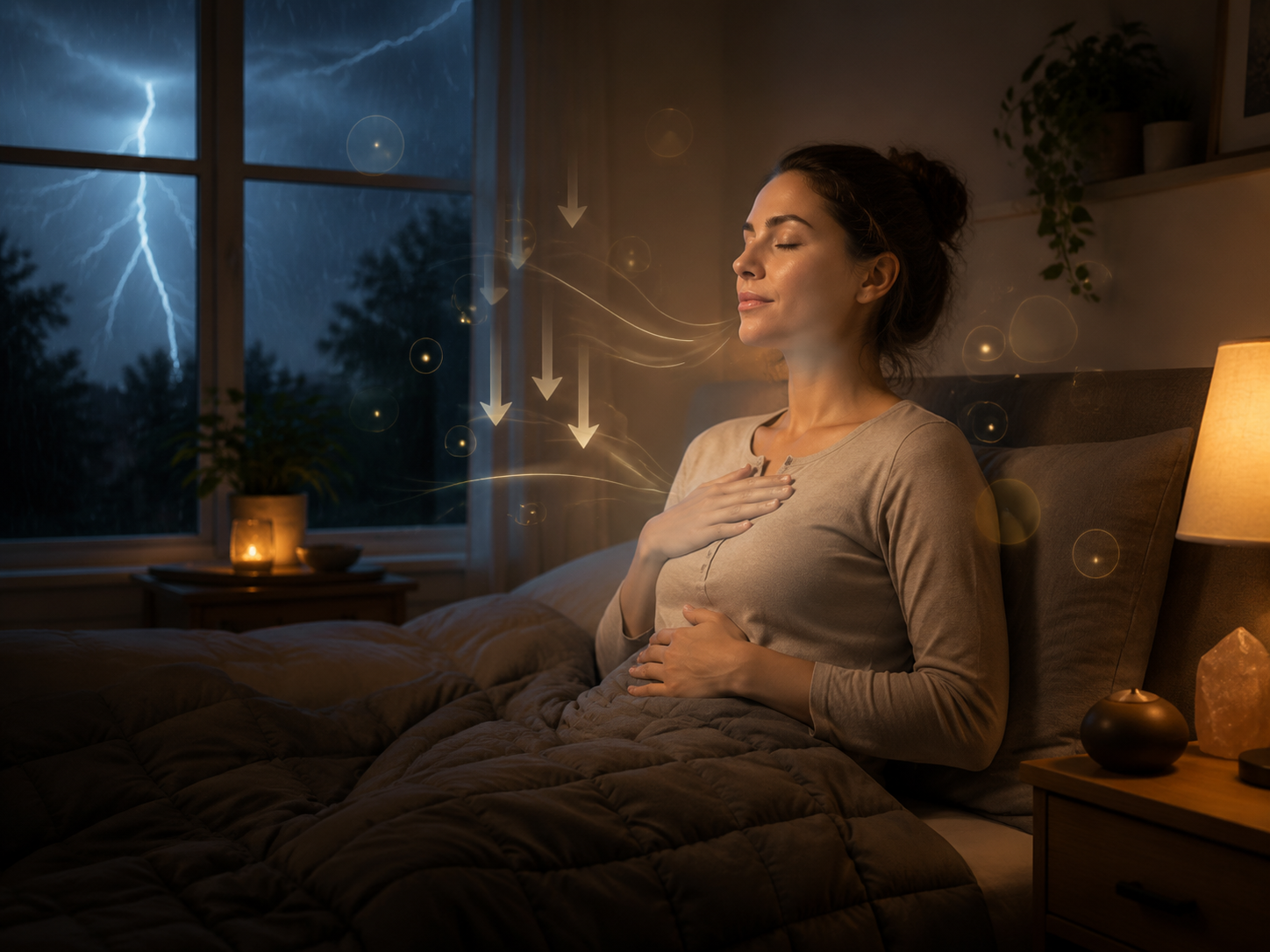
If you already own one and like it, it is reasonable to use it. Skip it if it makes you hot, trapped, short of breath, or less able to move safely during severe-weather alerts. A regular blanket tucked firmly around the body can offer a lighter version of the same pressure cue.
Give the Mind a Narrow, True Frame
Reframing is not pretending storms are pleasant. It is giving the brain a line that is both calming and believable. Try: “I am indoors and have checked what I need to check.” Or: “The storm is loud, but loud is not the same as danger in this room.” If it helps, add a time boundary: many storms pass through an area in roughly 30 to 60 minutes, though local conditions vary and official alerts matter more than a comfort phrase.
The worst version of weather checking is the kind that has no endpoint. Decide what source you trust, check it once, act on any warnings, then put the phone where it will not keep pulling you back into radar loops. If you need alerts on, leave alerts on. Just separate emergency monitoring from compulsive refreshing.
A Tonight-Ready Order of Operations
When the storm is already overhead, do not redesign your whole sleep life. Run the sequence that matches the three mechanisms.
- Check safety first. If there is a severe-weather warning, tornado risk, flooding risk, or local instruction, handle that before trying to sleep.
- Reduce sensory contrast. Close curtains, shift away from lightning, insert well-fitting earplugs if useful, and add a low steady sound on a timer.
- Protect breathing routines. If you use CPAP or another prescribed apnea treatment, use it normally and check the seal before settling back down.
- Downshift the nervous system. Use slow breathing, progressive muscle relaxation, a pressure cue if it helps, and one believable safety statement.
- Stop testing whether you are asleep. After the room is safer, quieter, darker, and calmer, give the body time to drift instead of measuring every minute.
This sequence is also a good way to troubleshoot failed advice. Earplugs that lower the thunder may still leave lightning untreated. White noise may soften the room but leave your body braced. A relaxation exercise may be too late if you are still being startled every few minutes.
When Storm Alertness Needs More Than Bedroom Fixes
Being more awake during bad weather is not automatically a disorder. Startling at thunder, checking an alert, or moving to a safer part of the home can be normal and sensible. The line changes when fear persists for more than six months, interferes with daily life, keeps you from leaving home, causes major avoidance, or repeatedly triggers panic-like symptoms. Cleveland Clinic and Verywell Mind describe treatment options for astraphobia and specific phobias that can include cognitive behavioral therapy, exposure therapy, and, in some cases, medication such as SSRIs under clinician guidance.[4][5]
If one fix has failed, that usually means it only addressed one layer. A storm can be loud, your breathing setup can need attention, and your threat response can still be running. Treat those as separate jobs.
References
- Sound Machines for Sleep: Benefits, Risks, and Research — NSDR.co — https://www.nsdr.co/
- Why Rain Sounds Help You Sleep — Oura Ring — https://ouraring.com/blog/
- The Effect of Weather on the Severity of Obstructive Sleep Apnea — Journal of Clinical Sleep Medicine — 2010 — https://pmc.ncbi.nlm.nih.gov/
- Astraphobia — Cleveland Clinic — https://my.clevelandclinic.org/
- Understanding Astraphobia, or Fear of Thunderstorms — Verywell Mind — https://www.verywellmind.com/
- A randomized controlled study of weighted chain blankets for insomnia in psychiatric disorders — Journal of Clinical Sleep Medicine — 2020 — https://jcsm.aasm.org/
Comments
Join the discussion with an anonymous comment.