
CBT-I for Insomnia FAQ: What It Is, How It Works, and Who It Helps

CBT-I at a Glance
| Feature | Details |
|---|---|
| Full name | Cognitive Behavioral Therapy for Insomnia |
| Endorsement | First-line treatment per AASM and ACP guidelines |
| Number of components | Five: sleep restriction, stimulus control, cognitive restructuring, relaxation training, sleep education |
| Typical session count | 4–8 weekly sessions of 30–60 minutes each |
| Improvement rate | 70–80% of people with primary insomnia show significant improvement |
| Recovery rate | 40–60% recover normal sleep patterns |
| Durability | Effects persist after treatment ends; medication effects typically do not |
| Delivery formats | In-person (individual or group), telehealth, digital platforms (dCBT-I), self-guided books |
| Sleep diary required? | Yes — daily sleep diary is mandatory; wearables do not substitute |
What Is CBT-I?
Cognitive Behavioral Therapy for Insomnia (CBT-I) is a structured psychological treatment that targets the behavioral patterns and thought processes that keep insomnia going — not just the circumstances that triggered it in the first place. Both the American Academy of Sleep Medicine (AASM) and the American College of Physicians (ACP) recommend CBT-I as the first-line treatment for chronic insomnia in adults — ahead of prescription sleep medications, OTC sleep aids, and supplements.
That first-line designation matters. It reflects a body of evidence showing that CBT-I produces lasting change, while most pharmacological options provide short-term relief that fades once the medication is stopped.
If you are still working out whether what you are experiencing qualifies as chronic insomnia — including the ICSD-3 diagnostic thresholds and the 3P model of how insomnia develops — the Insomnia FAQ: Causes, Duration, Treatment, Sleep Aids, and When It Becomes a Disorder covers that ground in detail. This article picks up where that one leaves off: assuming you have chronic insomnia and want to understand exactly how CBT-I works.
How Does CBT-I Work? The Five Components Explained
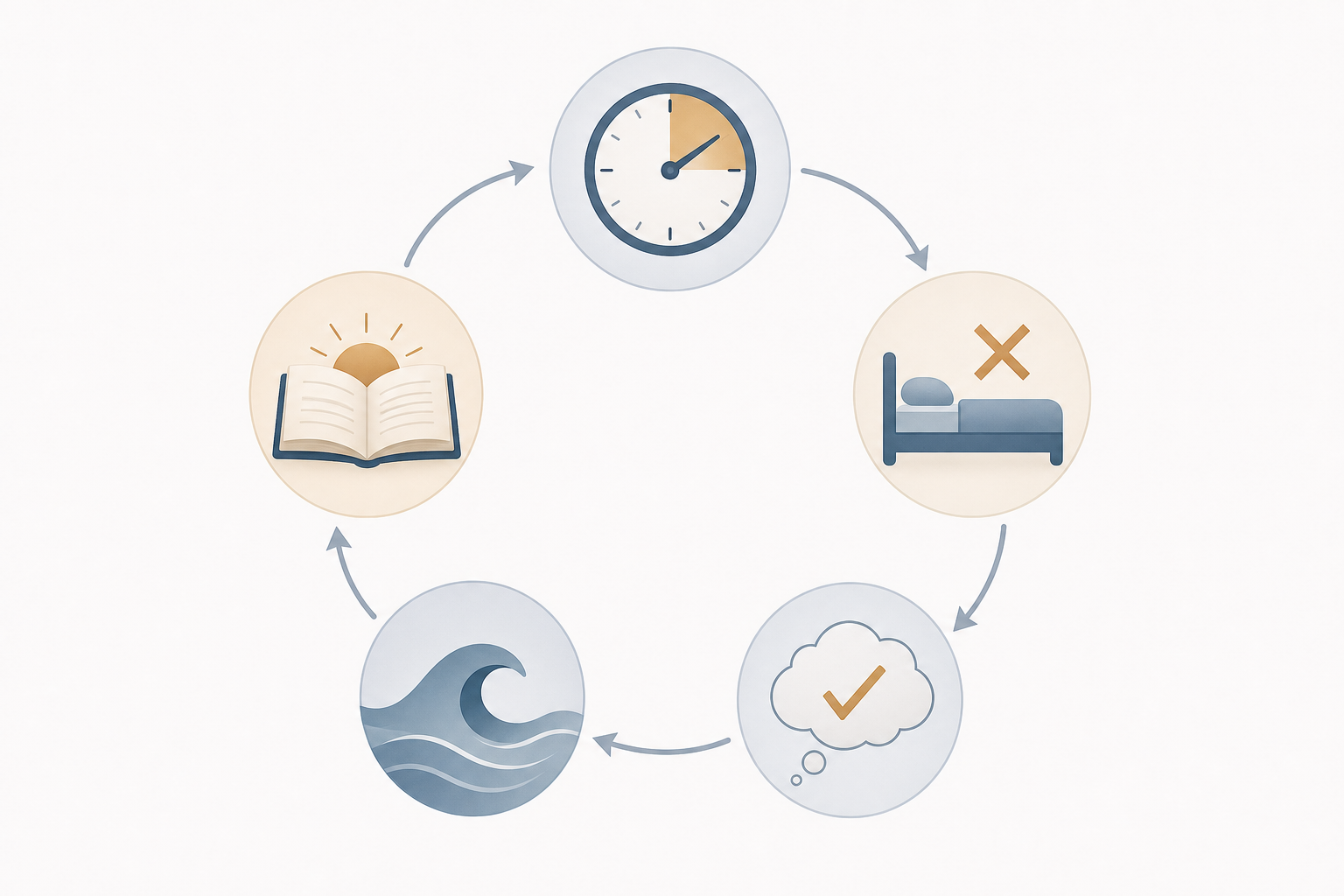
CBT-I is not a single technique — it is a package of five synergistic components, each targeting a different mechanism that sustains chronic insomnia. A trained clinician selects and sequences them based on your specific sleep pattern, but most full CBT-I protocols include all five.
1. Sleep Restriction
Sleep restriction is the most mechanistically active component of CBT-I — and the most uncomfortable in the early weeks. The idea is counterintuitive: you temporarily limit the amount of time you spend in bed to match the amount of sleep you are actually getting, not the amount you want to get.
If you are spending nine hours in bed but sleeping only five, your prescribed time in bed might start at five and a half hours. This deliberate restriction builds homeostatic sleep pressure — the biological drive to sleep that accumulates the longer you stay awake. By concentrating your sleep into a shorter window, the therapy makes sleep more efficient and more consolidated.
Once your sleep efficiency reaches roughly 85–90% (the percentage of time in bed you are actually sleeping), your clinician gradually increases your time in bed in increments — typically 15–30 minutes per week — until you reach a sustainable sleep window that meets your individual needs.
2. Stimulus Control
Stimulus control addresses a specific learning problem: for many people with chronic insomnia, the bed has become a conditioned cue for wakefulness, worry, and frustration — not for sleep. Through repeated nights of lying awake, the brain has associated the bedroom environment with arousal rather than rest.
Stimulus control breaks that association by restricting bed use to sleep and sex only. If you are not asleep within approximately 15–20 minutes, the protocol requires you to get out of bed and go to another room until you feel genuinely sleepy, then return. Over time, this retrains the brain to associate the bed with sleep onset rather than with the effort of trying to sleep.
3. Cognitive Restructuring
People with chronic insomnia often develop a set of beliefs about sleep that, while understandable, make the problem worse. Common examples include catastrophizing about the consequences of a poor night ("I will be unable to function tomorrow"), unrealistic sleep expectations ("I must get eight hours or I am failing"), and hypervigilance toward any sign of sleepiness or wakefulness during the day.
Cognitive restructuring identifies these beliefs through structured questioning and challenges them with evidence. It does not replace negative thoughts with forced positivity — it examines whether the belief is accurate and proportionate, then develops a more realistic appraisal. Reducing the emotional charge around sleep is itself sleep-promoting: pre-sleep cognitive arousal is one of the most consistent predictors of prolonged sleep onset.
4. Relaxation Training
Relaxation training targets the physiological and cognitive arousal that prevents sleep onset. Techniques include diaphragmatic breathing, progressive muscle relaxation (systematically tensing and releasing muscle groups), autogenic training, and guided meditation or imagery.
The goal is not to force sleep through relaxation — it is to reduce the autonomic arousal that keeps the brain alert at bedtime. Which technique your clinician recommends depends on whether your primary pre-sleep arousal is somatic (physical tension) or cognitive (racing thoughts).
5. Sleep Education and Psychoeducation
Sleep education is the explanatory backbone of CBT-I. It covers how homeostatic sleep drive (the pressure that builds with wakefulness) and your circadian rhythm interact to determine when and how deeply you sleep — and why certain common behaviors, like spending extra time in bed to compensate for a bad night, actually work against both systems.
Understanding the rationale behind each protocol component matters because CBT-I requires active participation. Readers who want to understand how their chronotype interacts with sleep drive may find the Chronotype Guide: Are You a Morning Person or Evening Person? a useful companion read alongside the sleep education component.
Is CBT-I Effective?
The evidence base for CBT-I is extensive and consistent. When the full multicomponent protocol is used, 70–80% of people with primary insomnia show significant improvement — including falling asleep faster, staying asleep longer, and waking less often during the night. Between 40–60% go on to recover normal sleep patterns entirely.
What distinguishes CBT-I from medication is durability. Research consistently finds that CBT-I effects are maintained — and sometimes continue to improve — after treatment ends. Medication effects, by contrast, typically fade once the drug is stopped, and abrupt discontinuation carries the risk of rebound insomnia — a temporary worsening of sleep that can feel worse than the original problem.
CBT-I is also effective for insomnia that occurs alongside other conditions — not only for insomnia that exists in isolation. Evidence supports its use in people with depression, PTSD, anxiety disorders, obstructive sleep apnea, cancer, and chronic pain. A common misconception is that comorbid conditions must be fully treated before CBT-I can begin — the evidence does not support that view.
Who Does CBT-I Help?
CBT-I has demonstrated effectiveness across a wide range of populations and insomnia presentations. You do not need to have "pure" insomnia with no other health conditions for CBT-I to work.
- Adults with primary chronic insomnia (insomnia without a clear comorbid cause)
- People with insomnia comorbid with depression or anxiety disorders
- People with insomnia comorbid with PTSD
- People experiencing insomnia during or after cancer treatment
- People with obstructive sleep apnea who also have insomnia
- Older adults (CBT-I is particularly important in this group because sedating medications carry elevated risks in people aged 65 and older)
- Pregnant people (standard dCBT-I platforms generally exclude pregnancy, but therapist-delivered CBT-I has demonstrated effectiveness in this population)
Who Should Use Caution or Needs a Modified Protocol?
The contraindications for CBT-I are mostly specific to the sleep restriction component — the temporary sleep deprivation it produces is not appropriate for everyone. The other four components (stimulus control, cognitive restructuring, relaxation training, sleep education) do not carry the same restrictions, which means the protocol can sometimes be modified to exclude sleep restriction while retaining the rest.
- Bipolar disorder: Sleep deprivation can trigger manic or hypomanic episodes. CBT-I should only be pursued under specialist supervision, and sleep restriction may be contraindicated or require significant modification.
- Epilepsy: Sleep deprivation lowers the seizure threshold. The sleep restriction component is generally contraindicated; a modified protocol may be possible.
- Untreated excessive daytime sleepiness: If you have significant daytime sleepiness from an untreated cause (such as undiagnosed narcolepsy or severe sleep apnea), sleep restriction can worsen impairment and safety risks.
- Untreated parasomnias: Sleep restriction can exacerbate sleepwalking, sleep terrors, and related parasomnias. These should be assessed and addressed before or alongside CBT-I.
- High fall risk: The combination of increased sleepiness from sleep restriction and the requirement to get out of bed during the night (stimulus control) creates fall risk for older adults or people with balance or mobility issues. Discuss this with your clinician before starting.
CBT-I vs. Sleeping Pills: How Do They Compare?
If you are weighing CBT-I against a prescription sleep medication — or wondering why your doctor is recommending therapy over a pill — the comparison below covers the dimensions that matter most for long-term decision-making.
| Dimension | CBT-I | Prescription Sleep Medication |
|---|---|---|
| Onset of benefit | Gradual; sleep may temporarily worsen in weeks 1–2 before improving | Faster; typically effective within the first few nights |
| Durability after stopping | Effects persist and often continue to improve | Effects typically fade; rebound insomnia risk on discontinuation |
| Dependency and tolerance risk | None — behavioral treatment, not pharmacological | Varies by drug class; benzodiazepines and Z-drugs carry dependency and tolerance risk |
| Rebound insomnia risk | Not applicable | Present, particularly with abrupt discontinuation |
| Side effect profile | Temporary sleep deprivation and daytime fatigue during sleep restriction phase | Varies; can include next-day sedation, cognitive effects, amnesia, and — with some classes — dependency |
| Long-term recommendation | First-line; recommended for ongoing chronic insomnia | Generally recommended for short-term use; not preferred for long-term chronic insomnia management |
| Requires active participation | Yes — homework-intensive; daily sleep diary required | No — passive consumption |
The core distinction, as Mayo Clinic summarizes, is that CBT-I addresses the causes of your sleep problems rather than just relieving symptoms. Medications manage the symptom of wakefulness; CBT-I changes the behavioral and cognitive patterns that sustain the disorder.
How to Access CBT-I
Access to CBT-I has expanded significantly in recent years, and you have more options than a single referral to a sleep clinic. The right format depends on your location, schedule, budget, and the severity of your insomnia.
In-Person Behavioral Sleep Medicine
A behavioral sleep medicine specialist is the gold standard for complex presentations — particularly if you have comorbid conditions, suspected contraindications, or have not responded to self-guided approaches. The Society of Behavioral Sleep Medicine (SBSM) maintains a provider directory at behavioralsleep.org, and the AASM's sleepeducation.org also lists accredited sleep centers. Many insurance plans cover behavioral sleep medicine visits — contact your insurer to confirm coverage before your first appointment.
Group CBT-I
Group-format CBT-I delivers the same protocol to several patients simultaneously, typically over six to eight weekly sessions. It is often more affordable than individual therapy and is offered at some sleep centers, VA facilities, and community mental health settings. Evidence supports its effectiveness.
Digital CBT-I (dCBT-I)
Digital CBT-I platforms deliver the protocol through apps or web programs, often without a therapist. A 2025 meta-analysis of 49 randomized controlled trials found that fully automated dCBT-I significantly reduces insomnia severity, making it a legitimate option when therapist access is limited.
- Somryst: The only FDA-cleared prescription digital therapeutic for chronic insomnia. Requires a physician prescription in the United States.
- Sleepio: Available in the United Kingdom and select organizations as of the AASM's March 2024 guidance; not broadly available as a consumer product in the US.
- CBT-I Coach: A free app developed by the VA, designed to be used alongside a therapist rather than as a fully self-guided program. Widely accessible.
Self-Guided Books
For people with limited access to clinicians or digital platforms, evidence-based self-help books based on the CBT-I protocol are a lower-access option. They require more self-discipline than a guided program and are best suited to people with straightforward insomnia and no significant comorbidities. Ask your primary care provider or a behavioral sleep medicine specialist for a recommendation.
What to Expect During CBT-I Treatment
CBT-I is not a passive treatment. Understanding what the process actually involves helps you prepare realistically and commit to the homework that drives the results.
- Session structure: Typically 4–8 weekly sessions, each lasting 30–60 minutes. Most people complete the full course within two months.
- Daily sleep diary: You will complete a paper or digital sleep diary every morning, recording when you went to bed, when you fell asleep, how often you woke, and when you got up. This is not optional — the sleep diary is the primary data source your clinician uses to adjust the protocol week by week.
- Wearables are not a substitute: Fitness trackers and sleep wearables do not replace the sleep diary. Clinical guidance explicitly distinguishes them: wearable data has identified accuracy concerns and does not capture the same information as a subjective sleep log.
- Sleep may temporarily worsen: During the first one to two weeks of sleep restriction, you will likely feel more tired during the day. This is expected and is part of the mechanism — the sleep pressure you are building is what drives the improvement that follows.
- Homework is mandatory: Between sessions you will implement behavioral changes — maintaining a fixed wake time, getting out of bed when you cannot sleep, practicing relaxation techniques. The in-session work is preparation; the real work happens at home.
- Medication: You do not need to stop sleep medications before starting CBT-I. CBT-I and medication can coexist. If you want to taper off medication, that process should be guided by your prescribing provider — do not stop sleep medications abruptly on your own.
More Questions About CBT-I
Do I need a sleep study (polysomnogram) before starting CBT-I?
For most people with straightforward chronic insomnia — difficulty falling or staying asleep, with no signs of other sleep disorders — a polysomnogram is not required before beginning CBT-I. A clinical interview and sleep diary are typically sufficient for diagnosis and treatment planning.
A sleep study becomes relevant if your clinician suspects a comorbid sleep disorder such as obstructive sleep apnea, periodic limb movement disorder, or a parasomnia — conditions that may need to be identified and addressed alongside or before CBT-I.
Can I do CBT-I and take sleep medication at the same time?
Yes. CBT-I and sleep medication are not mutually exclusive. Many people begin CBT-I while continuing a prescribed sleep medication. If you and your prescriber decide to taper the medication during or after CBT-I, that process should be managed by the prescribing provider — not initiated independently based on your progress in therapy.
How is CBT-I different from regular sleep hygiene advice?
Sleep hygiene addresses the environmental and behavioral conditions that support sleep — consistent schedules, light exposure, caffeine timing, bedroom environment. For people with occasional or mild sleep difficulty, this can be enough.
For people with chronic insomnia, sleep hygiene alone is rarely sufficient because it does not address the perpetuating mechanisms — the conditioned bed-wakefulness association, the homeostatic pressure disrupted by compensatory behavior, and the dysfunctional beliefs that sustain hyperarousal. CBT-I targets those perpetuating mechanisms directly. That is why the AASM and ACP recommend CBT-I as the first-line treatment for chronic insomnia, not sleep hygiene.
What if I have another sleep or mental health condition — do I need to treat that first?
Not necessarily. CBT-I has demonstrated effectiveness for insomnia comorbid with depression, anxiety, PTSD, and other conditions — and the order of treatment is guided by patient preference and symptom severity, not a fixed rule that comorbidities must be resolved first. Your clinician will assess the full picture and may recommend treating both simultaneously or sequencing them based on your specific situation.