
Most advice about yoga for better sleep starts in the wrong place. It asks which pose belongs beside your bed, as if insomnia were a tight hamstring with a spiritual vocabulary. The better question is more physiological: what does yoga repeatedly ask the body to do that sleep also requires?
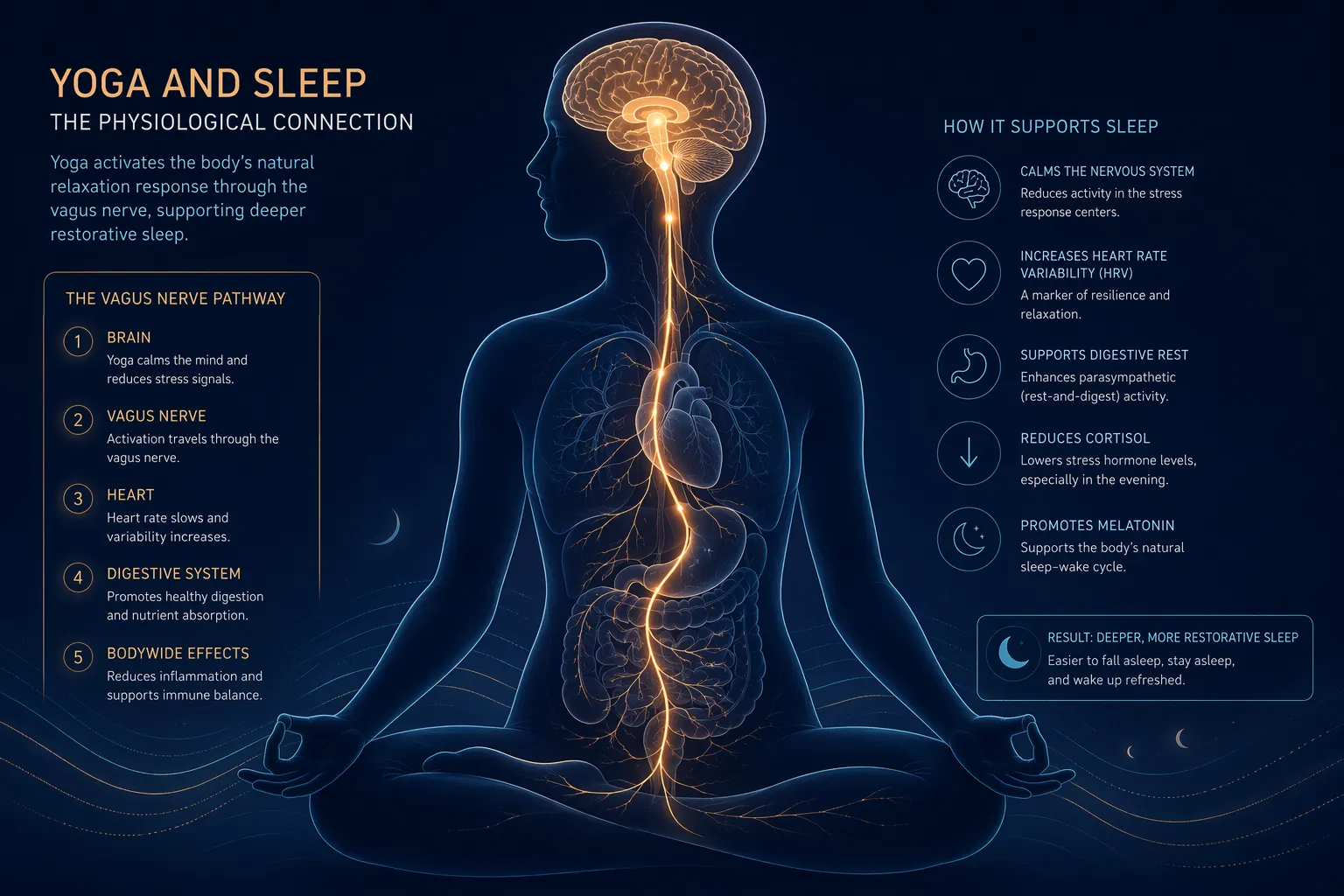
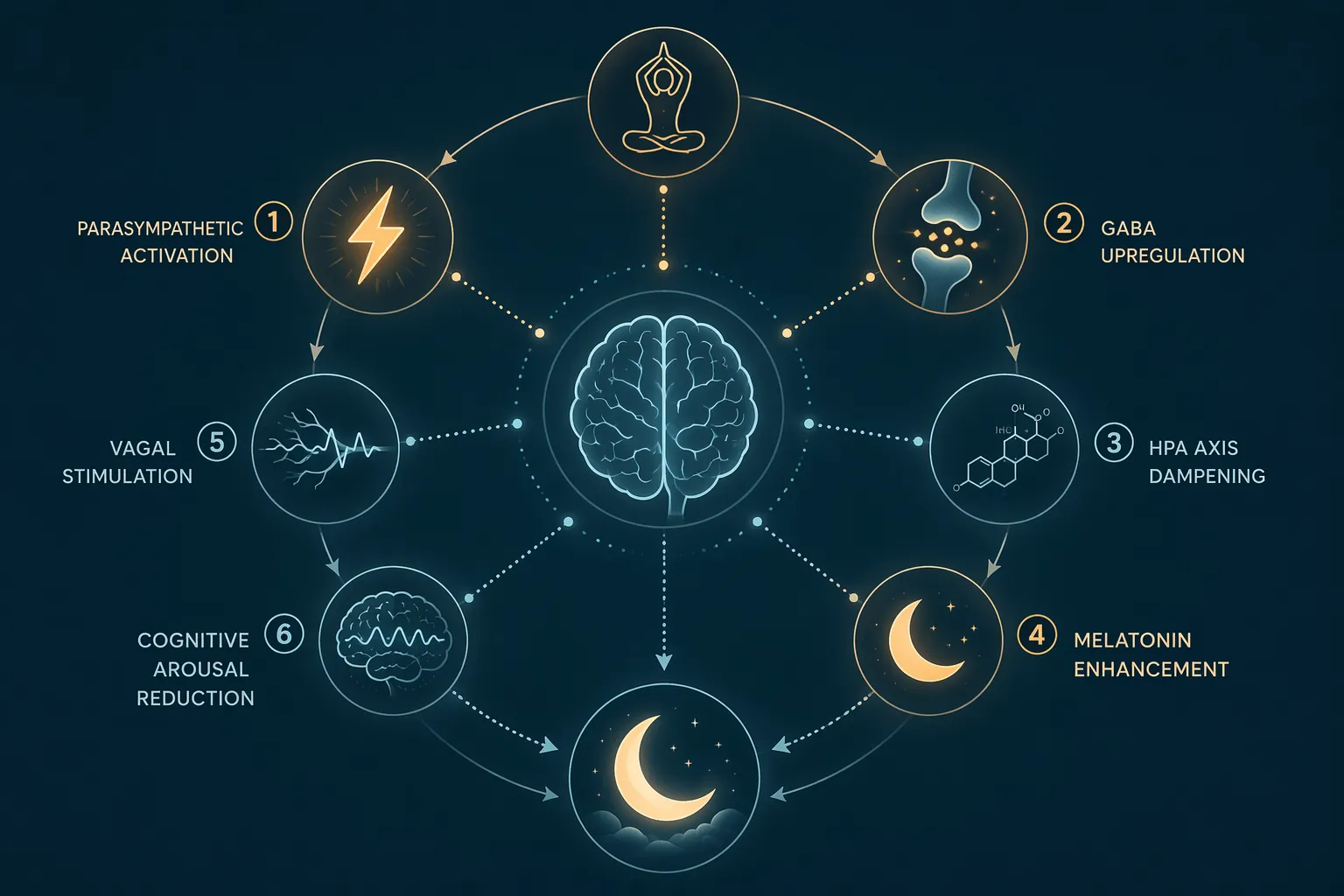
Sleep is not something the body performs on command. It arrives more easily when threat monitoring quiets, breathing slows, muscle tone drops, and the brain stops treating the next hour as a problem to solve. Yoga appears to help sleep because many forms of practice train those downshifting systems again and again: parasympathetic activation, slower exhalation, vagal signaling, stress-hormone regulation, inhibitory neurotransmission, and reduced pre-sleep rumination.
That distinction matters if you have already tried the usual sleep checklist and still lie awake. A practice can be “relaxing” in theory and still fail on a particular night. That does not mean you are bad at relaxing. It may only mean the practice did not give your nervous system enough repeated, believable signals that it was safe to stand down.
The evidence is strongest for sleep quality, not magic poses
The broadest current map comes from a 2025 scoping review of chronic yoga interventions for people with sleep disorders. It included 57 studies and 6,057 participants, and found mean sleep-quality improvements across intervention durations in the range of 7.92% to 9.41%. Medium-duration programs showed a 13.19% reduction in insomnia severity, and even low-frequency practice, defined as one to two sessions per week, was associated with an 8.13% mean improvement in sleep quality.[1]
Those numbers are useful because they push the conversation away from bedroom theater. The review does not prove that one posture, one sequence, or one aesthetic version of yoga causes sleep. It suggests something less glamorous and more actionable: repeated yoga practice, across different formats, can move the sleep-quality needle in people with sleep problems.
There is a limit to the claim. A scoping review maps a field; it is not the same thing as a pooled meta-analysis designed to produce one definitive treatment effect. Still, for a practical sleep question, its dosing signal is important. If one to two sessions per week can be associated with measurable sleep-quality improvement, the mechanism is unlikely to depend on a perfect nightly ritual. Consistency matters, but perfection is not the biological unit of change.
| Pathway | What yoga may train | Why it matters for sleep |
|---|---|---|
| Parasympathetic activation | A shift toward rest-and-digest physiology | Sleep is easier when the body is not defending against a threat |
| Vagal stimulation | Slow, controlled breathing, especially longer exhalations | Breathing can quickly influence autonomic state |
| HPA-axis dampening | Lower stress-system activation and healthier cortisol rhythm | High evening arousal works against sleep onset and continuity |
| GABA upregulation | Greater inhibitory signaling in the brain | Insomnia and anxiety often involve insufficient neural braking |
| Melatonin-related effects | Mindfulness and circadian quieting | The evidence is plausible but less directly yoga-specific |
| Cognitive arousal reduction | Less rumination and less effortful self-monitoring | Many poor sleepers are tired but mentally overactive |
The first mechanism is downshifting the autonomic nervous system
A poor sleeper often knows the strange split between exhaustion and alertness. The body is tired, but some monitoring system remains online: checking the time, evaluating how badly tomorrow will go, noticing every sound, testing whether sleep is happening yet. Yoga is relevant here because it can train the transition from sympathetic activation toward parasympathetic dominance.
The parasympathetic nervous system is often described as “rest and digest,” which is slightly too cozy but directionally right. For sleep, the point is not bliss. The point is reduced defensive readiness. Gentle movement, longer holds, slow breathing, and relaxation cues can lower the physiological cost of staying awake. The body does not have to be convinced by a slogan; it has to receive enough signals that the environment is not demanding action.
Breath-led yoga is especially direct because respiration talks to the autonomic nervous system quickly. Slow yogic breathing, often grouped under pranayama, can stimulate vagal pathways within minutes. The vagus nerve helps coordinate parasympathetic activity, and longer, slower exhalations are one practical route into that system. This is where yoga becomes less about stretching and more about giving the body a repeatable pattern: inhale, lengthen the exhale, pause without strain, and let the next breath arrive.
This also explains why intensity matters. A vigorous class may be useful exercise, but if it leaves someone physiologically keyed up near bedtime, it is not doing the sleep-specific job. For yoga for better sleep, the useful question is whether the practice reliably includes down-regulating elements: slow breathing, tolerable effort, relaxation, and enough predictability that the nervous system does not interpret the session as another performance.
Stress hormones are part of the same story
Autonomic arousal and stress-hormone regulation are not separate sleep problems. They are usually braided together. The hypothalamic-pituitary-adrenal axis, or HPA axis, helps coordinate the stress response. Cortisol should follow a daily rhythm that supports alertness at the right time and quiets at the right time. When stress physiology stays too active into the evening, sleep onset and sleep continuity become harder.
Yoga’s role is not to “turn off cortisol,” which would be biologically sloppy. Cortisol is necessary. The more defensible idea is dampening inappropriate stress-system activation and supporting rhythmicity. Slow breathing, parasympathetic activation, and relaxation practice all point in the same direction: less physiological escalation when the day is supposed to be ending.
The 2025 scoping review’s sleep-quality findings fit this mechanism well because sleep quality is not a single event. It reflects how easily someone falls asleep, how often they wake, how restorative sleep feels, and how much the night is interrupted by arousal. A repeated practice that reduces stress-system activation would be expected to show up there before it looks like a dramatic cure.[1]
GABA is memorable, but the evidence boundary matters
GABA, or gamma-aminobutyric acid, is the brain’s primary inhibitory neurotransmitter. If the nervous system has an accelerator, GABA is one of its braking systems. That makes it highly relevant to insomnia and anxiety, both of which can involve too much neural and cognitive activation when the person is trying to sleep.
A widely cited 2012 paper by Streeter and colleagues linked yoga practice to increases in thalamic GABA levels and discussed yoga’s effects on the autonomic nervous system, GABA, and allostasis in epilepsy, depression, and post-traumatic stress disorder.[2] That finding matters because it gives yoga a plausible neurochemical route into reduced arousal, not just a vague relaxation label.
But it should not be stretched beyond the study population. The GABA work was not conducted specifically as an insomnia trial. The cleaner statement is this: yoga has been associated with GABA changes in human research, GABA is relevant to arousal systems that matter for insomnia, and this makes GABA a plausible mechanism by which yoga may support sleep. It does not prove that every person with insomnia sleeps better because yoga raises GABA.
That boundary is not a reason to dismiss the mechanism. It is a reason to use it correctly. GABA helps explain why a slow, breath-led, noncompetitive practice might feel different from simply lying in bed and commanding yourself to calm down. One is a repeated physiological input. The other is often another form of effort.
Rumination is not just a thought problem
Pre-sleep rumination is usually described as mental activity, but anyone who has lived with it knows it is embodied. The jaw tightens. Breathing gets shallow. The stomach reacts. The room becomes a place where the mind audits unfinished tasks and the body behaves as if the audit is urgent.
Yoga can reduce cognitive arousal through attention training as much as through movement. A breath count, a body scan, or a simple repeated sequence gives the mind something less threatening to track. This is not the same as positive thinking. It is attentional substitution paired with physical down-regulation. The mind is not asked to become empty; it is given fewer reasons to keep escalating.
The mindfulness component may also interact with melatonin and circadian regulation, but this is the place to be modest. The melatonin pathway is biologically plausible and supported by broader mindfulness and circadian research, yet it is less directly established in yoga-specific sleep trials than the autonomic, stress-system, and arousal pathways. For choosing a practice, that means mindfulness is useful, but it should not be sold as a guaranteed hormone hack.
How much yoga is enough to matter?
The least helpful answer is “every night, perfectly, forever.” It sounds disciplined and often collapses on contact with real insomnia, because poor sleepers already carry enough performance pressure into bed.
The 2025 scoping review is more forgiving. Its moderator analysis found that one to two yoga sessions per week were associated with an 8.13% mean improvement in sleep quality.[1] That does not mean two weekly classes are the ideal dose for everyone. It does mean the practice does not have to be an all-consuming lifestyle to become biologically relevant.
For sleep, frequency and repeatability probably matter more than novelty. A ten-minute breath-led routine that someone actually does several times a week may be more useful than an elaborate sequence saved for the rare evening when motivation, time, and floor space all align. The nervous system learns from repetition, not from the aesthetic ambition of the plan.
- If hyperarousal is the main problem, choose gentle, restorative, or breath-led practices with low physical demand.
- If nighttime anxiety is prominent, prioritize slow breathing, longer exhalations, and simple attention anchors over complex sequences.
- If pain, trauma history, or chronic insomnia complicates practice, individualized instruction is safer than copying a generic routine.
- If vigorous yoga helps mood or fitness, keep it earlier in the day and separate it from the pre-sleep downshift.
What the population studies add, and what they do not
A Harvard Health article updated in 2025 reported on a BMJ Evidence-Based Medicine review of 22 trials in people with insomnia, noting a sleep-efficiency improvement of nearly 15%.[3] Sleep efficiency is a useful measure because it asks how much of the time in bed is actually spent asleep. For people who spend long nights awake in a dark room, that distinction is not academic.
Population-specific evidence is encouraging but uneven. A 2020 systematic review and meta-analysis of 19 randomized controlled trials involving 1,832 women found that yoga significantly improved sleep quality, with a standardized mean difference of -0.327 and p < 0.001.[4] The same evidence base should not be overgeneralized. Effects were weaker in breast cancer and peri- or postmenopausal subgroups, so yoga may help some women with sleep problems while being less reliable in groups where symptoms, treatments, hormonal changes, or pain add other drivers of poor sleep.[4]
Individualization becomes more important when insomnia is chronic. A tailored Viniyoga trial in people with chronic insomnia disorder reported improvements in sleep quality, fatigue, anxiety, and depression.[5] That does not make Viniyoga the secret style. It points to a more practical lesson: when sleep disturbance is persistent or entangled with mood and daytime fatigue, matching the practice to the person may matter more than naming a universally correct sequence.
Choosing yoga for better sleep without turning it into another test
The best yoga for better sleep is not the one with the most sleep-themed pose names. It is the practice that repeatedly includes the physiological ingredients sleep needs: slow breathing, manageable effort, reduced threat monitoring, parasympathetic activation, and some form of cognitive quieting.
That can look like restorative yoga, gentle yoga, yoga nidra, a short breath practice, or an individualized therapeutic sequence. Style matters only insofar as it changes the body’s state. A class that is technically “relaxing” but makes someone compare, strain, rush, or self-correct may miss the point. A plain routine that lengthens the exhale and lowers arousal may do more.
For chronic insomnia, yoga should sit beside evidence-based care rather than replace it. Cognitive behavioral therapy for insomnia remains the first-line non-drug treatment. Yoga can be a useful complement, especially for people who need a body-based way to practice down-regulation, or for those who cannot access or tolerate formal CBT-I. It should not be used to blame someone for not breathing correctly through a medical sleep disorder.
A reasonable sleep-focused practice is therefore simple: make it gentle enough to repeat, breath-led enough to affect autonomic state, and unshowy enough that it does not become one more achievement project. The physiology does not require serenity. It requires repeated signals that the body can stop guarding the night.
References
- The effect of chronic yoga interventions on sleep quality in people with sleep disorders: a scoping review — PMC, 2025.
- Effects of yoga on the autonomic nervous system, gamma-aminobutyric-acid, and allostasis in epilepsy, depression, and post-traumatic stress disorder — PubMed, 2012.
- Yoga for better sleep — Harvard Health, updated 2025.
- The effect of yoga on sleep quality and insomnia in women with sleep problems: a systematic review and meta-analysis — Springer, 2020.
- Tailored individual Yoga practice improves sleep quality, fatigue, anxiety, and depression in chronic insomnia disorder — Springer, 2022.
Comments
Join the discussion with an anonymous comment.