
For many adults 60 and older, the most useful answer is also the least punishing one: sleep benefits appear with low-to-moderate exercise, often in sessions of 30 minutes or less, about twice a week as a realistic starting rhythm, building toward roughly 300 to 527 MET-minutes per week. In the 2025 dose-response meta-analysis that gives this question its clearest number, the strongest sleep-quality effect occurred around 527 MET-min/week, while meaningful improvement was already seen around 300 MET-min/week.[1]
That matters because the practical question about exercise and sleep in later life is rarely, “Can exercise help sleep at all?” It is, “How little, how often, and how hard is enough before the advice becomes one more impossible assignment?” The answer from the current evidence is not strenuous daily workouts. It is a repeatable weekly dose that an older adult can actually keep doing.
In that meta-analysis of 26 randomized controlled trials, the estimated best point was about 527 MET-min/week, with a Hedges’ g of -0.82 and a 95% confidence interval from -1.12 to -0.52.[1] Just as important, the evidence did not reward harder exercise. Low-intensity exercise showed the largest Pittsburgh Sleep Quality Index improvement, with a weighted mean difference of -2.79 points; moderate intensity was almost identical at -2.77 points; moderate-to-high intensity was weaker at -0.86 points.[1]
The sleeper, not the spreadsheet, is the point here. PSQI scores move downward when sleep quality improves. In the same analysis, sessions of 30 minutes or less were associated with a -4.25-point PSQI change, a size that exceeds the commonly cited minimal clinically important difference of about 3 points.[1][2] In plain terms, that is the difference between a result that merely clears a statistical bar and one a person may actually notice.
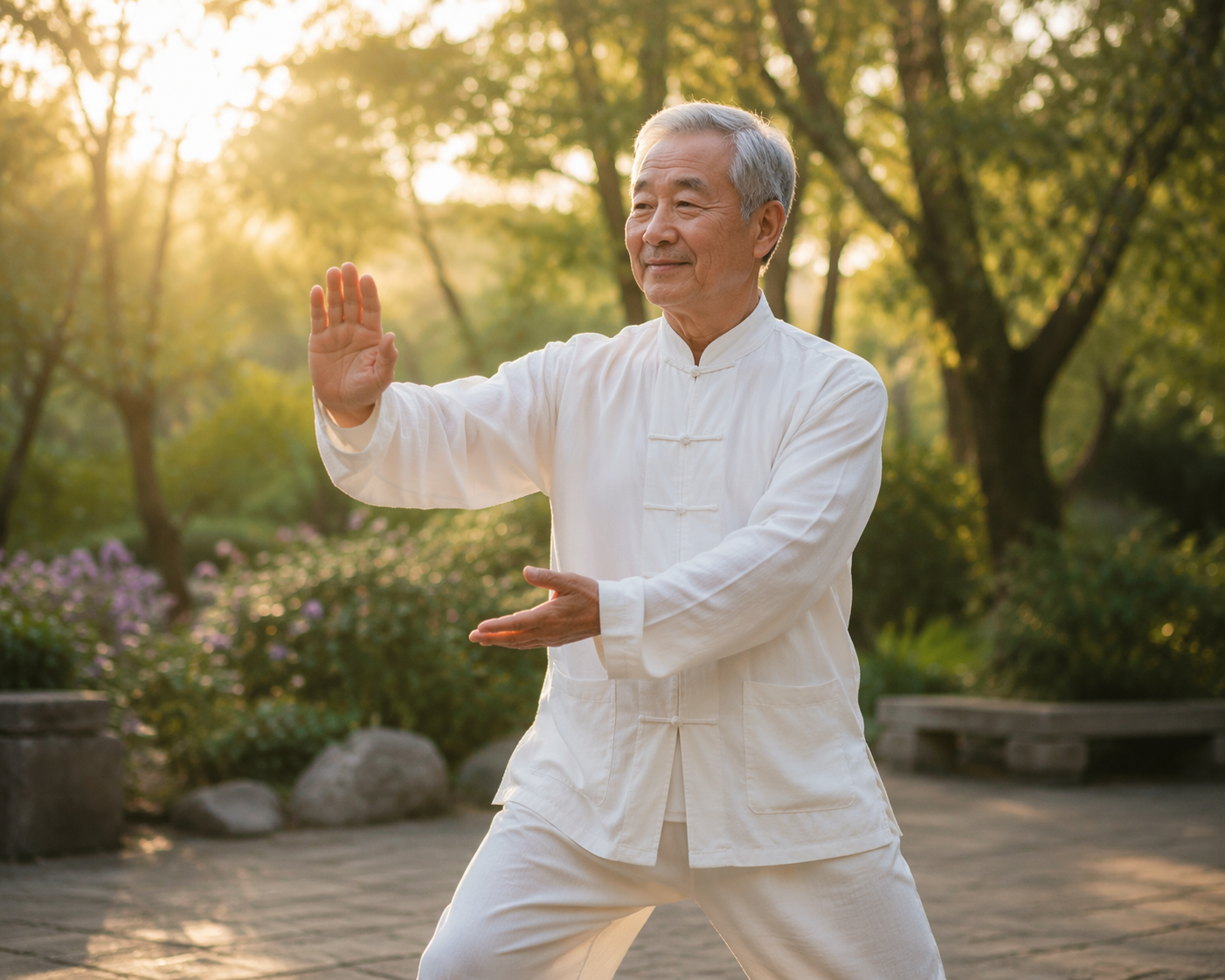
What 527 MET-Minutes Means in Real Life
MET-minutes sound more technical than they need to. A MET is a way of estimating how much energy an activity uses compared with resting. To get weekly MET-minutes, multiply the activity’s MET value by the minutes spent doing it and by the number of weekly sessions.
So the formula is simple enough:
MET value x minutes per session x sessions per week = MET-min/weekA gentle activity will not always reach 527 MET-min/week in only two sessions. That is not a failure of the person doing it; it is just arithmetic. The better way to use the number is to treat twice-weekly, short sessions as the sustainable base, then add small pieces if the person tolerates them well.
| Activity | Example weekly dose | Approximate MET-min/week |
|---|---|---|
| Brisk walking | 3 METs x 30 minutes x 2 days | 180 |
| Chair yoga | 2.5 METs x 30 minutes x 2 days | 150 |
| Tai chi | 3 METs x 30 minutes x 2 days | 180 |
| Light resistance bands | 3.5 METs x 20 minutes x 2 days | 140 |
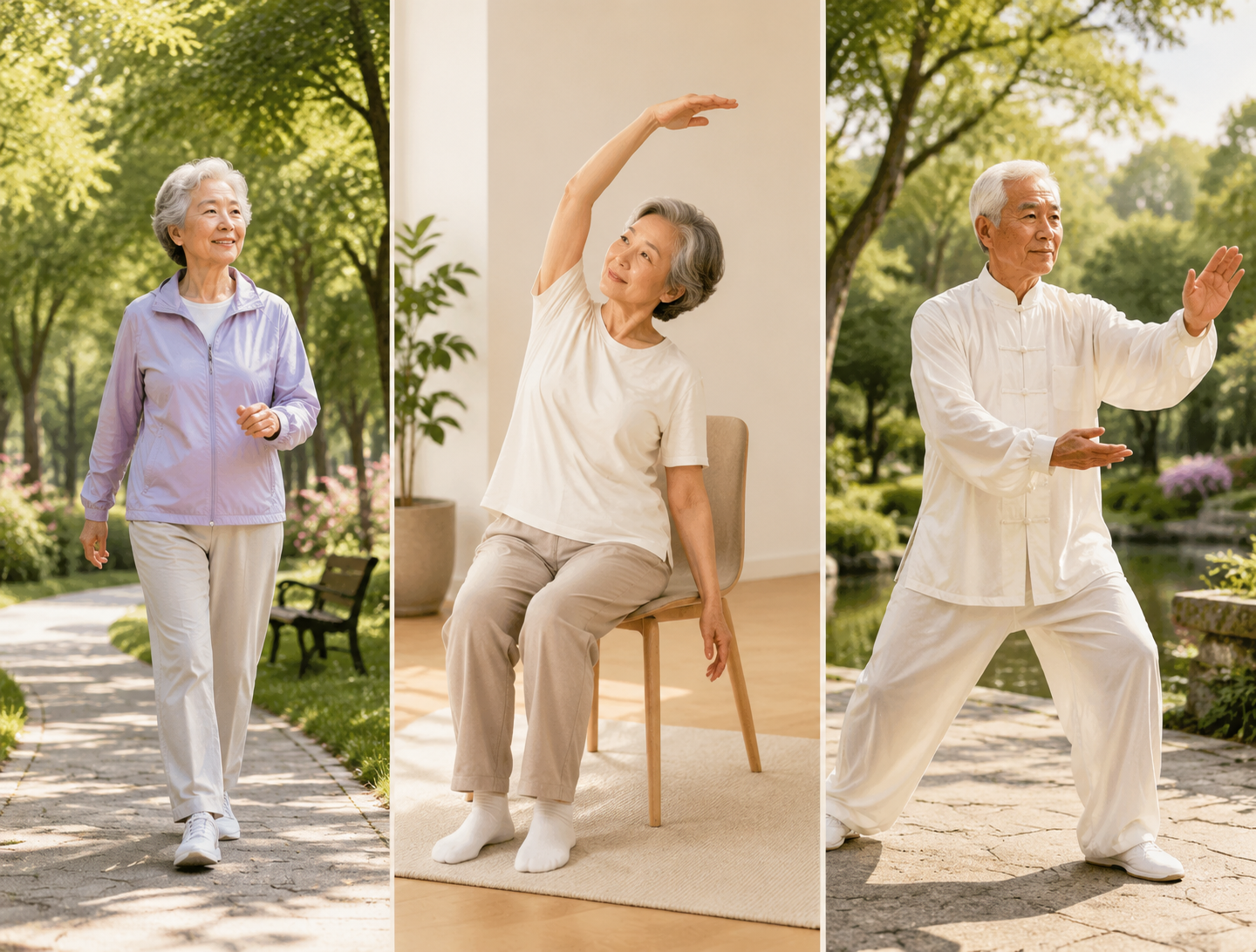
| Walking plus chair yoga | Two 30-minute walks and two 30-minute chair-yoga sessions | About 330 |
| Walking plus resistance bands plus tai chi | Two short sessions of each across the week | About 500 |
This is where the 300 MET-min/week finding becomes useful. A person who cannot manage a full 527 MET-min/week may still be in the range where sleep improves. The 2025 analysis found significant benefit around 300 MET-min/week, below the World Health Organization’s commonly cited 600 MET-min/week minimum for general physical activity guidance.[1] For an older adult with sore knees, low stamina, or a long history of abandoned exercise plans, that lower effective range is not a consolation prize. It is the doorway.
The Dose-Response Curve Is Not a Ladder
The meta-analysis found a U-shaped relationship between exercise volume and sleep improvement: benefit rose up to a moderate weekly volume, peaked around 527 MET-min/week, and did not keep improving as volume increased.[1] That does not mean 527 is a magic number. It means the best estimate in this evidence set sits in the moderate range, not at the hardest or longest end of the scale.
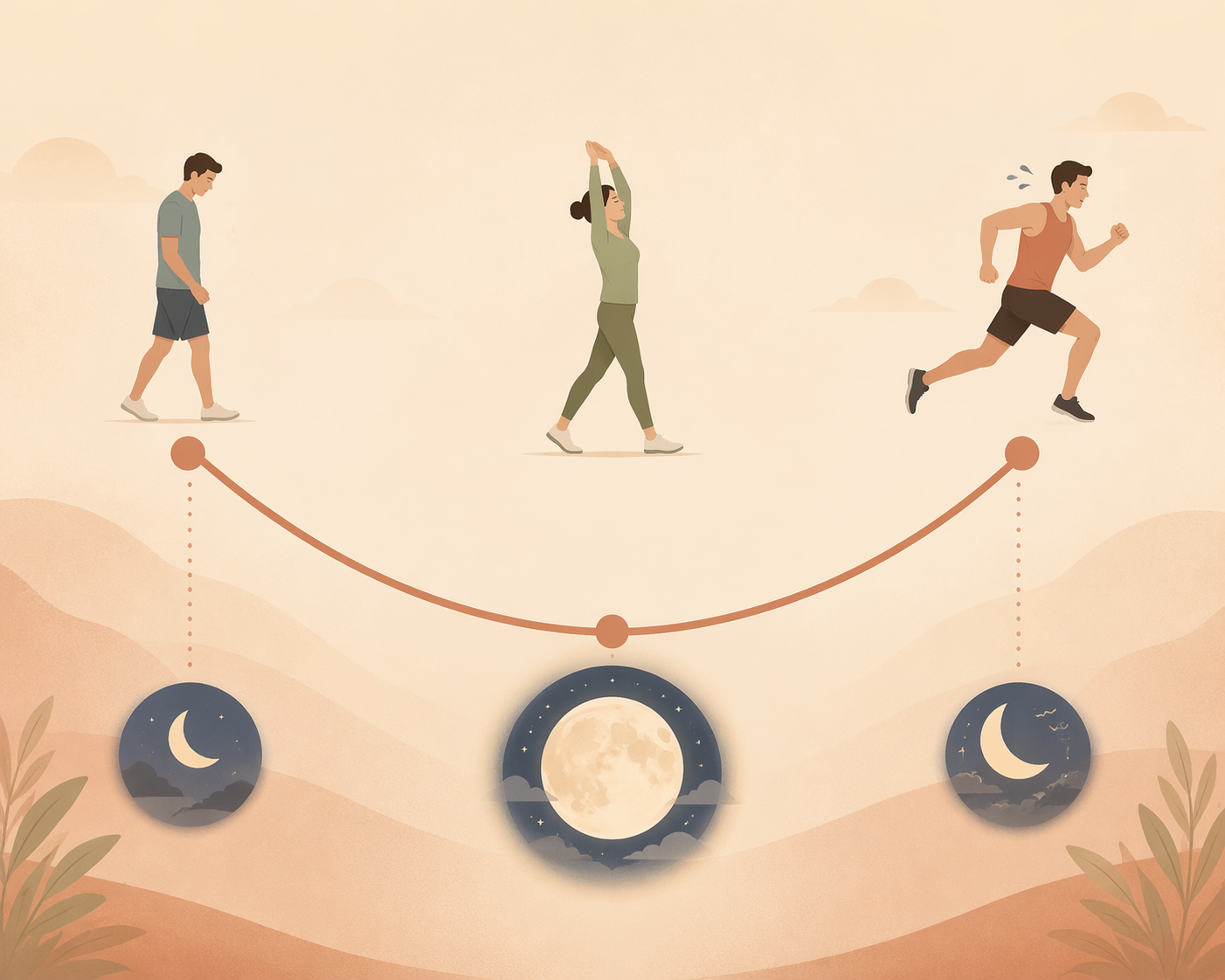
This is a useful correction to the usual fitness culture reflex. More sessions did not automatically produce better sleep. Twice-weekly exercise showed the strongest frequency subgroup result, with a weighted mean difference of -2.52 PSQI points, while higher frequencies showed diminishing returns.[1] Shorter sessions also performed well: sessions of 30 minutes or less had the largest observed PSQI improvement, outperforming longer sessions in the subgroup analysis.[1]
There are several ordinary reasons this may matter outside a trial. Longer routines are easier to skip. Higher-intensity routines can be harder on joints, harder to schedule, and more discouraging after a poor night’s sleep. A plan that depends on an older adult feeling energetic before they begin is not much of a sleep plan.
The evidence also should not be stretched past what it can carry. The 527 MET-min/week estimate comes from one 2025 nonlinear dose-response meta-analysis, not from a universal law of aging physiology. The studies included more women than men, with women making up about 66% of participants, and the evidence was stronger for community-dwelling older adults up to about age 75 than for adults over 80 or people with more complex health conditions.[1] A frail 86-year-old, a retired 62-year-old cyclist, and a 74-year-old recovering from surgery should not be handed the same target as if bodies were interchangeable.
A Practical Weekly Starting Point
For someone starting from little activity, the first goal can be modest: two sessions a week, each 20 to 30 minutes, at an intensity that feels easy to somewhat effortful. If that is tolerated for a couple of weeks, the weekly dose can be nudged toward 300 MET-min/week by adding another gentle session or pairing two activity types.
- If walking is comfortable: try two 30-minute walks per week, then add chair yoga or light band work on another day.
- If knees or balance limit walking: use chair yoga, seated stretching, tai chi, or supervised light resistance work.
- If fatigue is the main barrier: divide movement into shorter bouts, such as 10 to 15 minutes, while keeping the weekly total in view.
- If motivation fades quickly: protect the twice-weekly habit before adding volume.
A realistic week might look like two 30-minute walks and two 30-minute chair-yoga sessions, for about 330 MET-min/week using the activity values above. Another person might choose two 30-minute tai chi sessions plus two 20-minute light resistance-band sessions, for about 320 MET-min/week. Someone aiming closer to the 527 MET-min/week estimate could combine walking, tai chi, and light resistance across the week without making any one session long.
None of these examples require a gym, a perfect step count, or athletic identity. They do require enough consistency for the body to receive a weekly signal. That is a different assignment from “exercise more,” and a fairer one.
Keep the Intensity Boring
For sleep, the current evidence does not make a strong case for pushing older adults into hard sessions. In the 2025 analysis, low-intensity exercise had the largest sleep-quality effect, moderate intensity was nearly the same, and moderate-to-high intensity had the weakest effect.[1] That does not prove vigorous exercise is bad for every older adult. It does mean intensity should not be treated as the lever that automatically improves sleep.
A usable intensity test is conversational. During low-to-moderate activity, a person can breathe a little faster and feel warm, but should still be able to speak in short sentences. For many older adults, that covers a brisk but not breathless walk, slow tai chi, chair yoga, water exercise, or resistance-band work done with controlled effort.
Pain is not a sleep intervention. Chest pressure, dizziness, unusual shortness of breath, new joint swelling, or a fall risk that feels poorly controlled should change the plan and prompt medical advice. The point is to make sleep easier, not to create a second problem.
Timing Matters, but It Should Not Become Another Rulebook
Morning or early afternoon exercise is the safer default for older adults trying to improve sleep. A 2025 review in npj Biological Timing and Sleep supports avoiding vigorous exercise within 3 hours of bedtime, especially when the goal is not performance but easier sleep onset and better rest.[3]
That does not mean a quiet evening stretch is forbidden. The concern is vigorous late exercise: the kind that raises body temperature, heart rate, and alertness close to bedtime. A slow mobility routine after dinner is a different thing from a hard cycling session at 9 p.m.
For many households, the best time is the time that survives weather, transportation, caregiving schedules, and daylight. If morning walking is unsafe because sidewalks are icy, an indoor chair-yoga session after lunch is not a downgrade. It is the plan adapting to the person.
How Long Before Sleep Changes?
The 2025 analysis found that programs lasting 8 weeks or less showed the most consistent results, with I² = 0% in that subgroup, though benefits also appeared in longer programs.[1] That is a useful commitment window. It is long enough to test a routine honestly, but not so long that a person has to wait half a year to know whether it is helping.
The best tracking does not need to be elaborate. Before starting, note usual bedtime, estimated time to fall asleep, number of awakenings, wake time, and how rested the person feels in the morning. Repeat the same notes once or twice a week. If sleep improves but knee pain worsens, the routine needs changing. If walking becomes easier but sleep does not move, timing, intensity, medications, caffeine, naps, light exposure, or an undiagnosed sleep disorder may be part of the picture.
When Exercise Is Not the Whole Answer
Sleep problems are common in later life; reviews have reported that roughly half of older adults experience sleep complaints.[4] That prevalence can make poor sleep seem ordinary, but ordinary does not always mean harmless or untreatable. Exercise is a credible non-pharmacological tool, not a diagnostic test.
Medical evaluation matters when sleep trouble comes with loud snoring, witnessed pauses in breathing, morning headaches, severe daytime sleepiness, restless legs, repeated nighttime movements, new confusion, worsening mood symptoms, or sudden changes in sleep pattern. Sleep apnea, restless legs syndrome, medication effects, pain, urinary symptoms, depression, and other conditions may need specific care.
The humane reading of the evidence is not that older adults should be pushed harder. It is that they may not need to be. A repeatable routine of low-to-moderate movement, often in short sessions, can reach a weekly dose associated with noticeably better sleep. Keep it early enough in the day, gentle enough to repeat, and flexible enough to survive real life.
References
- Dose-response relationship between exercise and sleep quality in older adults: a systematic review and dose-response meta-analysis, Frontiers in Medicine, Oct. 2025.
- Minimal clinically important difference of the Pittsburgh Sleep Quality Index in adults with sleep disorders, PMC.
- Exercise timing and sleep, npj Biological Timing and Sleep, 2025.
- Sleep disorders in the elderly: diagnosis and management, PMC.
Comments
Join the discussion with an anonymous comment.