Mechanism explainer
When AI Sleep Monitoring for Well-Being Keeps You Awake
Orthosomnia is a real, clinically documented pattern where AI sleep monitoring for well-being backfires, creating anxiety that worsens sleep. This article explains how to recognize the signs and offers practical guardrails for healthier tracking.
You wake up feeling mostly okay. Maybe not magnificent, not reborn, but functional. Then you open the sleep app.
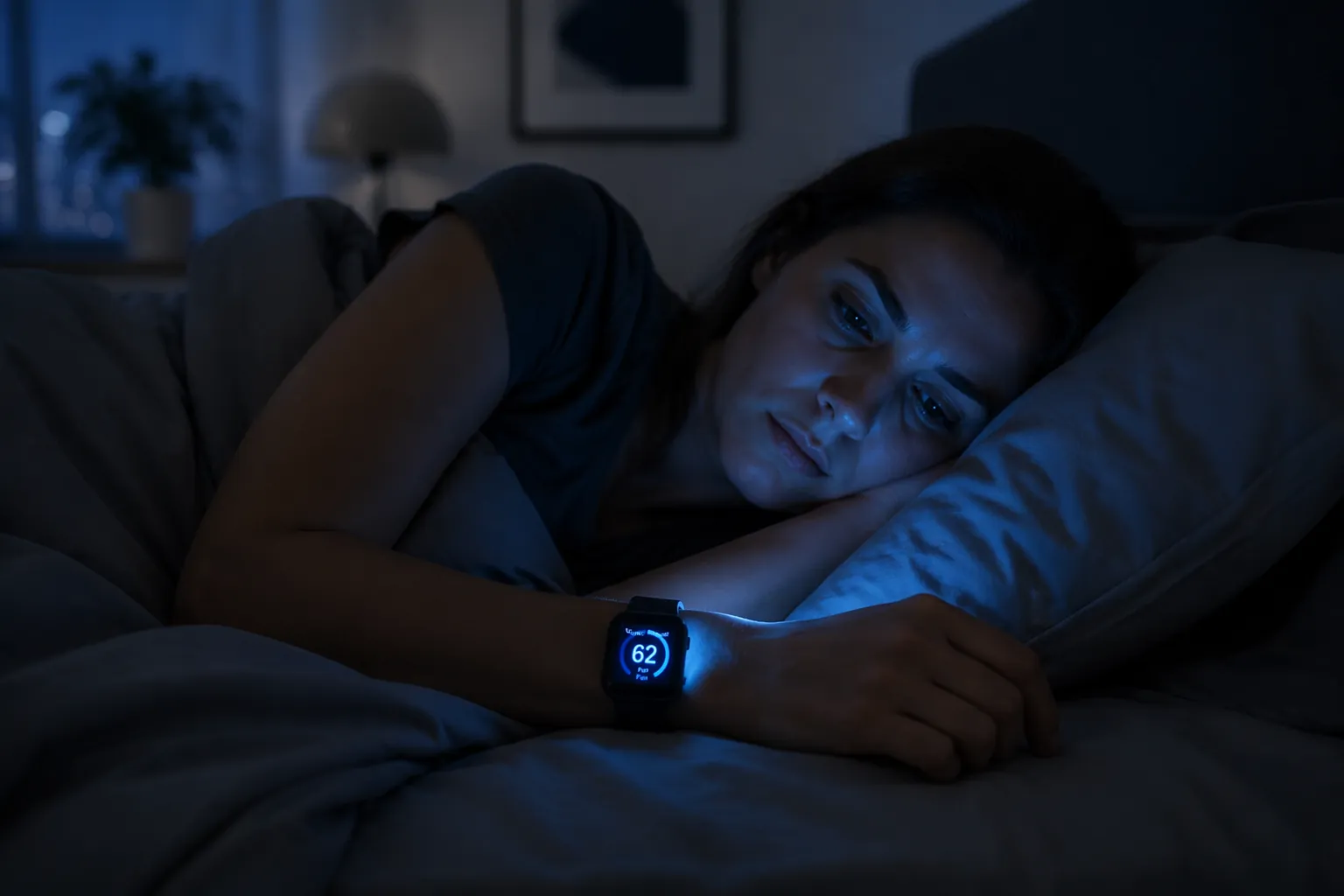
The score says 61. Deep sleep was low. Your recovery is “poor.” An AI summary explains that your night was fragmented, your readiness may be reduced, and you should prioritize rest. Within seconds, the body that felt acceptable starts to feel suspect. Was that decent night actually bad? Did you ruin tomorrow before it began?
That moment is where AI sleep monitoring for well-being can quietly turn. The problem is not that sleep trackers exist, or that caring about sleep is foolish. The problem starts when an estimate becomes the final authority on your body, and the next night becomes an attempt to perform better for the dashboard.
The clinical pattern has a name
In 2017, sleep clinicians Kelly Glazer Baron, Sabra Abbott, Nancy Jao, Natalie Manalo, and Rebecca Mullen described “orthosomnia” in the Journal of Clinical Sleep Medicine. They used the term for patients who were preoccupied or concerned with improving wearable sleep data, sometimes in ways that made their actual insomnia worse.[1]
The most important detail from that case series is painfully recognizable: patients tried to improve their tracker numbers by spending more time in bed. That sounds reasonable if the app says sleep is insufficient. Clinically, it can backfire. More time in bed can mean more time awake in bed, more monitoring, more frustration, and a stronger association between the bed and effort instead of sleep.[1]
Orthosomnia is not a formal diagnosis in the DSM or the International Classification of Sleep Disorders. Prevalence estimates remain limited and should not be treated as settled population facts. Most people who use sleep trackers do not develop this pattern. Still, it is real enough to have been observed in clinical practice and discussed in sleep-health guidance because the behavior can become self-reinforcing.[1][2]
That distinction matters. A tracker can be useful. It can help you notice that alcohol fragments your sleep, that late workouts affect your bedtime, that your schedule drifts on weekends, or that perimenopause-related wakeups are clustering in a way worth discussing with a clinician. The concern is narrower: when the tool meant to reduce uncertainty starts producing more of it.
How the score becomes the stressor
The loop usually does not announce itself as obsession. It begins as care. You want to understand why you are tired. You want evidence. You want a pattern that makes the problem solvable.
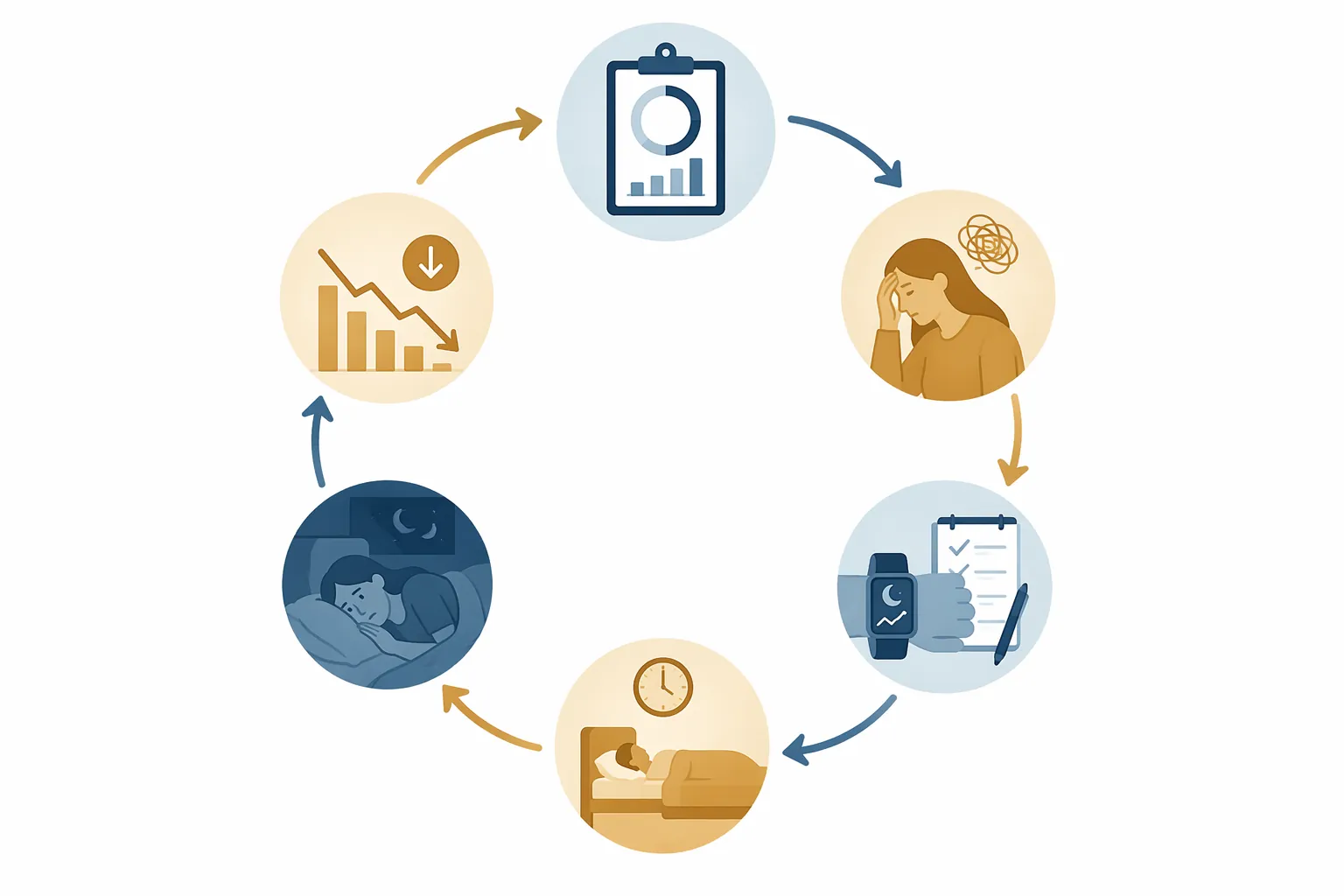
Then the app gives you a low score. Concern rises. You check more often, compare more nights, scroll through more stage graphs, and start adjusting behavior mainly to move the number. Maybe you go to bed earlier even though you are not sleepy. Maybe you stay in bed later to “catch” more sleep. Maybe you cancel a morning plan after a bad reading, even though your body feels reasonably steady.
For a person prone to metric hyperfocus, including some adults with ADHD, the dashboard can become unusually sticky. The app gives a target, a grade, a streak, a trend, and an explanation. For a perimenopausal sleeper already dealing with hot flashes, early-morning waking, or nights that feel physically unfair, the score can add a second injury: not only did sleep feel disrupted, now the device has turned it into a failure.
The behavioral cost shows up at night. You get into bed already thinking about tomorrow’s number. You notice every awakening because it might hurt the score. You become less willing to trust ordinary sleepiness or ordinary rest. The bed starts to feel like a testing site.
This is why orthosomnia is not simply “looking at your data too much.” It is a change in the relationship between sleep and effort. Sleep becomes something you try to force into compliance, and forced sleep is notoriously uncooperative.
The numbers are estimates, even when the app sounds certain
Consumer sleep trackers are not miniature sleep labs. They infer sleep and sleep stages from signals such as movement, heart rate, heart-rate variability, temperature, and breathing patterns. Some do this impressively well for broad sleep-wake patterns. Stage-by-stage sleep is harder.
Sleep Foundation reports that consumer sleep trackers correctly identify deep sleep about 59% of the time. That is useful calibration, not a reason to throw the device in a drawer. It means a deep-sleep number should be read as an estimate with error, not as a verdict on whether your body repaired itself.[2]
A 2023 validation study led by Clemson and colleagues compared 11 consumer sleep technologies against polysomnography, the clinical sleep-study method. Across devices, sleep-stage classification performance varied widely, with macro F1 scores ranging from 0.26 to 0.69.[3]
That range matters because AI summaries often make uncertain inputs feel tidier than they are. A polished paragraph saying your low readiness is “likely due to reduced deep sleep” can sound more authoritative than the underlying measurement deserves. The interface may be calm and confident; the data may still be approximate.
If you want a fuller way to interpret brand-specific scoring, Restful Ground’s guide to Fitbit Sleep Score is a useful companion. The larger principle applies across devices: the score can be informative without being sovereign.
Signs your tracker is no longer helping
The line between useful tracking and compulsive tracking is not the number of charts you open. It is what the data starts doing to your behavior, your mood, and your trust in your own day.
- You change bedtime, wake time, exercise, meals, or social plans mainly to improve the score, not because the change clearly improves how you function.
- You trust the app over your felt experience, especially on days when you feel rested but the score says the night was poor.
- You check sleep data during the night, immediately on waking, or repeatedly through the morning.
- You feel dread before bed because tomorrow’s number is already in your mind.
- You spend more time in bed trying to create better data, even as your time awake in bed increases.
- You use one bad reading as proof that the day is damaged before it begins.
None of these signs means you are irrational. Sleep is intimate. Losing it can make people desperate for control. A device that promises pattern recognition can feel like a lifeline, especially when symptoms are fluctuating and hard to explain.
But once the tracker becomes a source of bedtime threat, the purpose has changed. It is no longer only measuring sleep. It is participating in the arousal that makes sleep harder.
Why this is showing up now
Orthosomnia is not new in 2026, but the setting around it has changed. Sleep tracking has moved from step-counting novelty to wellness infrastructure: rings, watches, mattress sensors, recovery scores, readiness scores, AI coaching, and morning summaries that translate the night into instructions.
TIME covered sleep anxiety and orthosomnia in August 2025, reflecting how the term has moved beyond sleep clinics into mainstream health conversation.[4] The Global Wellness Institute’s 2026 sleep trends report also describes a shift away from extreme “sleepmaxxing” and back toward simpler sleep approaches as more people recognize that optimization can backfire for some sleepers.[5]
That cultural shift is worth taking seriously, but not inflating. The existence of orthosomnia does not mean every sleep dashboard is harmful. It means the wellness industry has made sleep visible, comparable, and gradable. For some nervous systems, that is too much pressure at exactly the wrong time of day.
Restful Ground’s From Sleepmaxxing to Simplicity looks at that broader move away from over-optimization. Orthosomnia is the clinical edge of the same issue: the point where tracking stops being neutral and starts shaping the disorder it is supposed to clarify.
A calmer way to use AI sleep monitoring for well-being
The answer is not automatically to quit tracking. If your device helps you notice patterns, communicate with a clinician, or make gentler choices, keep the useful part. Change the relationship.
| Instead of | Try |
|---|---|
| Judging every morning by one score | Reviewing weekly trends at a planned time |
| Changing bedtime after one bad reading | Waiting for a pattern across several nights |
| Treating deep sleep minutes as exact | Reading stage data as an estimate |
| Letting the app override how you feel | Comparing data with daytime functioning |
| Checking during the night | Keeping the app closed until a scheduled review |
Weekly review is often the simplest upgrade. Pick one time, preferably not in bed and not immediately after waking, to look at broad patterns. Ask boring but useful questions: Did late caffeine line up with more awakenings? Did a consistent wake time help? Did symptoms worsen around a predictable part of the month or a medication change? Did the “bad” nights actually produce bad days?
Daytime functioning deserves a vote. Mood, concentration, sleepiness, headaches, patience, exercise tolerance, and the urge to nap are not less real because they do not fit neatly into a readiness score. If you feel steady and the app looks disappointed, do not let the app retroactively ruin the night.
One bad reading should not dictate bedtime. Going to bed much earlier when you are not sleepy can increase time awake in bed, which is exactly the kind of behavior the original orthosomnia cases warned about.[1] If a schedule change is worth testing, test it deliberately for long enough to see a pattern, not as a punishment for last night’s graph.
If the score makes you anxious, hide it for a while
Some apps let you reduce notifications, hide certain metrics, skip morning reports, or wear the device without checking the dashboard daily. That can be a good middle ground: keep passive data collection if it is useful later, but remove the morning emotional ambush.
A short tracking break can also be informative. If sleep anxiety decreases when the score disappears, that is not proof that the tracker is bad. It is evidence that your current use pattern is costing too much.
When to bring in CBT-I
If sleep anxiety persists, if you are spending long stretches awake in bed, or if you feel trapped in rituals meant to secure a better score, cognitive behavioral therapy for insomnia is the next serious step. CBT-I is recommended for insomnia and is also identified in orthosomnia guidance as an appropriate treatment direction when tracker-driven sleep anxiety develops.[2][6]
CBT-I is not a penalty for failing at sleep hygiene. It is a structured treatment that works with the behaviors and thoughts that keep insomnia going: time in bed, wakefulness in bed, sleep effort, clock-watching, worry, and avoidance. Those are exactly the places where tracker anxiety can attach itself.
This is especially worth considering if your sleep disruption is layered with ADHD-related hyperfocus, anxiety, perimenopause symptoms, or a medical condition that makes sleep feel unpredictable. In those situations, the tracker may be recording a real struggle while also making the struggle louder. A clinician can help separate the sleep problem from the monitoring problem.
Let the device be a witness, not the judge
A good sleep tracker can support well-being when it helps you see patterns you would otherwise miss. It can be useful when the unit of attention is a week, a schedule experiment, a symptom cluster, or a clinician conversation. It becomes less useful when the unit of attention is tomorrow morning’s grade.
The gentler rule is simple enough to remember at 3 a.m.: do not negotiate with the score in the middle of the night. Do not stay in bed longer just to manufacture better data. Do not let an estimated sleep-stage graph overrule a reasonably rested body.
Use the trend line. Keep the context. If the score starts making sleep feel like a nightly performance review, step back before the tool becomes part of the insomnia.
References
- Orthosomnia: Are Some Patients Taking the Quantified Self Too Far?. Journal of Clinical Sleep Medicine. 2017.
- What is Orthosomnia?. Sleep Foundation.
- A Validation Study of Consumer Sleep Technologies Against Polysomnography. JMIR. 2023.
- Your Quest for Perfect Sleep Is Keeping You Awake. TIME. August 2025.
- Sleep Initiative Trends for 2026. Global Wellness Institute. March 2026.
- World Sleep Society 2025 recommendations. Sleep Medicine. 2025.
Supports these guides
Spot an error or have clinical feedback?
Because this article covers clinical, medication, or safety information, we use a moderated correction channel instead of open public comments. Let us know if something about “When AI Sleep Monitoring for Well-Being Keeps You Awake” needs a closer look.
Send feedback on this article