Mechanism explainer
Blood Moon Sleep Disruption: Science and Spiritual Significance
Explore how the blood moon affects sleep quality through both scientific evidence and spiritual meaning. This explainer reviews lunar-phase studies showing sex-differentiated sleep disruption and explains why the spiritual perspective of release and shadow work can hold alongside the physical science.
If the March 2026 blood moon left you awake, hot, alert, anxious, or emotionally overlit, the most honest answer is not that the eclipse has been proven to disturb sleep. It has not. No available sleep study has isolated a total lunar eclipse as its own biological exposure.
But that does not make the question silly. A blood moon happens during a full moon, and full-moon sleep has been studied. The best evidence is mixed and limited, but one sleep-lab analysis found a striking sex difference: in that clinical sample, women slept less efficiently and spent less time in deep sleep at full moon than men did. For someone already dealing with perimenopause sleep fragmentation or third-trimester pregnancy insomnia, even a small lunar-phase effect could feel much larger in the body.
What a blood moon can and cannot explain
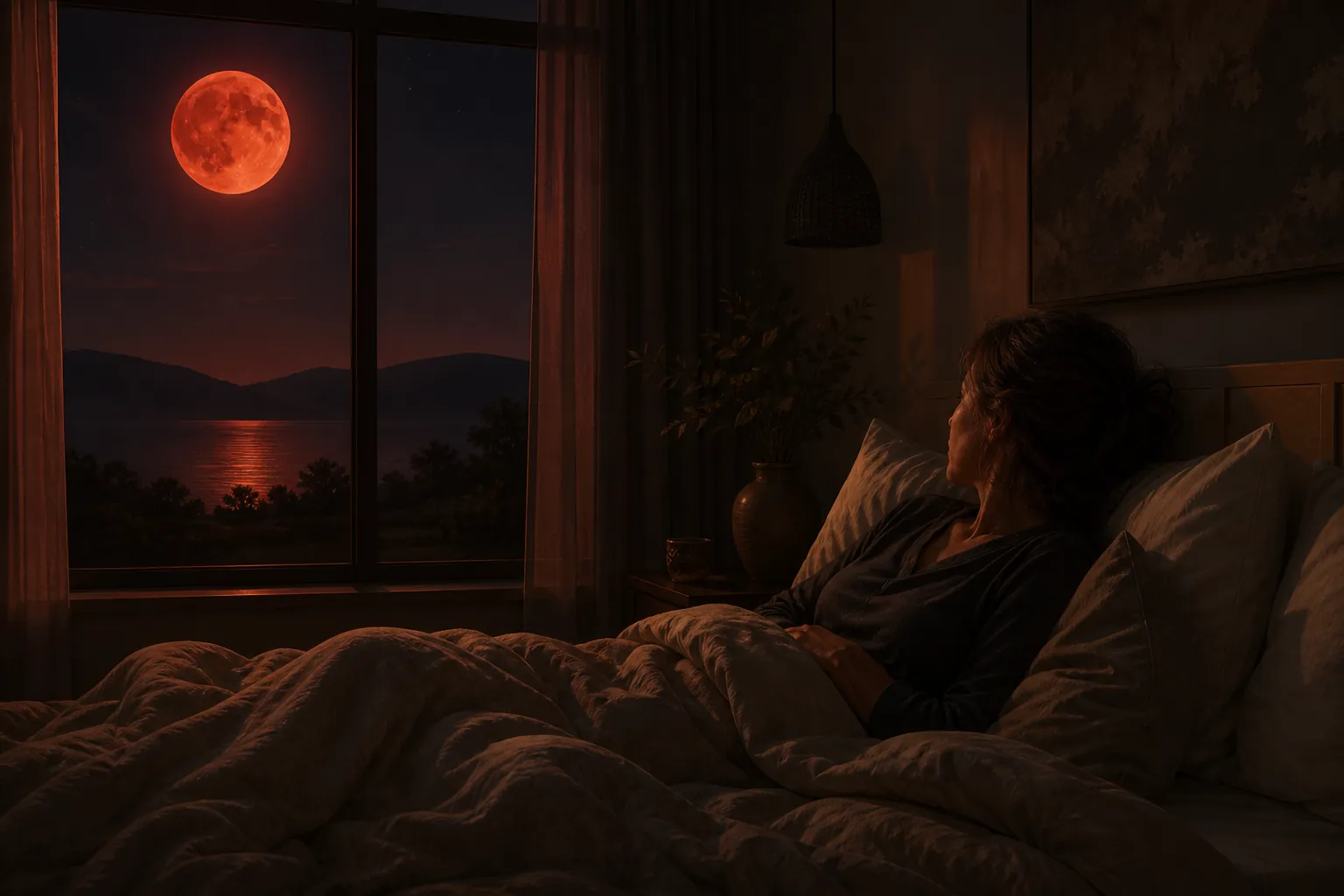
A blood moon is the visual effect of a total lunar eclipse, when Earth’s shadow falls across the moon and scattered sunlight can make the lunar surface appear red or copper. For sleep, the important point is simpler: a blood moon occurs at full moon. That is why full-moon sleep studies are relevant, while still imperfect.
The distinction matters. If you slept badly that night, it is reasonable to ask whether full-moon biology, bright-night timing, emotional anticipation, hormonal vulnerability, or ordinary bad luck played a role. It is not reasonable for an article to tell you the eclipse itself has been clinically proven to disrupt sleep. The evidence has not gone that far.
The full-moon study that matters most for women’s sleep
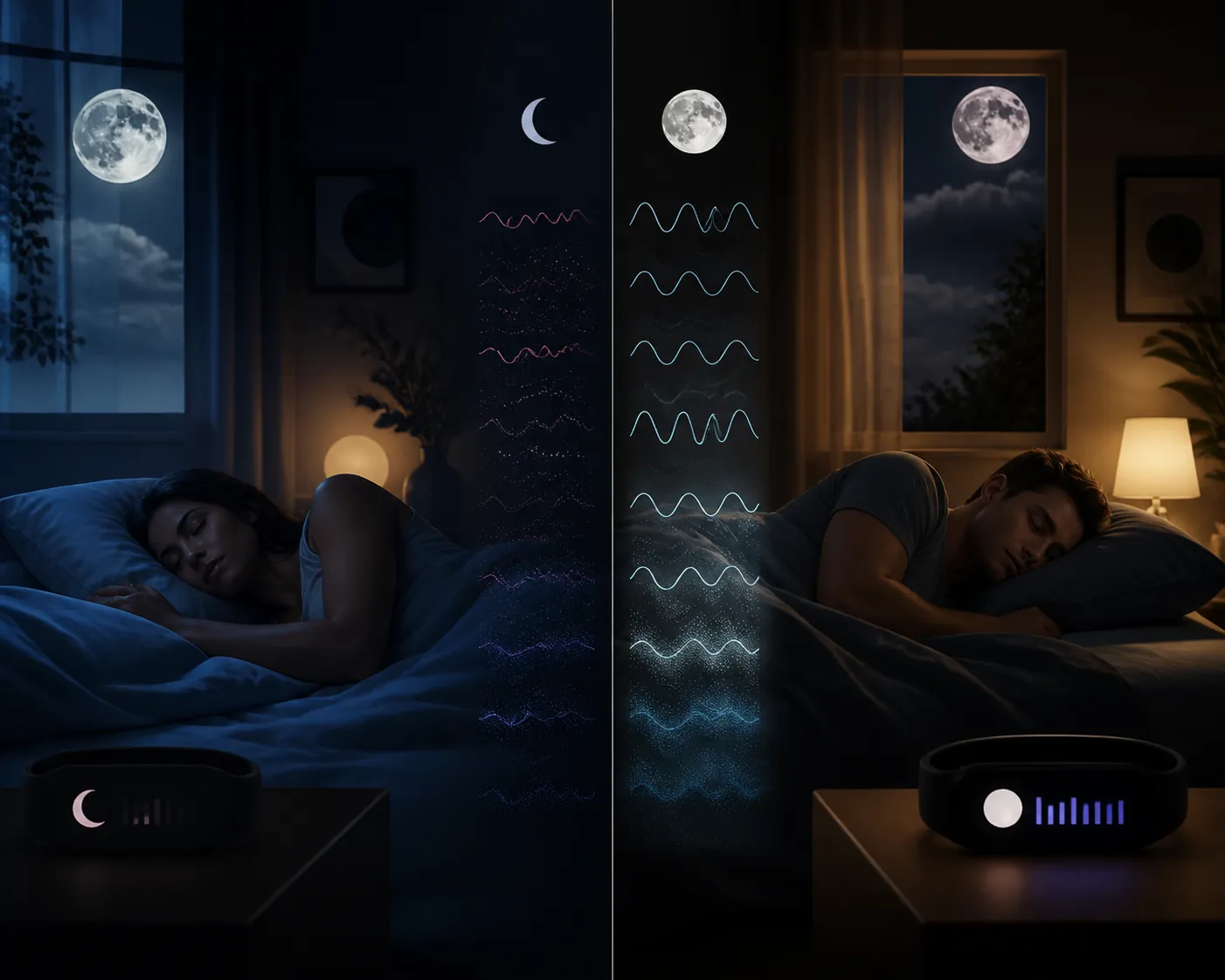
The most reader-relevant finding comes from a 2014 retrospective analysis in Sleep Medicine. The study looked at 319 people referred to a clinical sleep laboratory and examined whether sleep variables differed by lunar phase. At full moon, women in the sample had lower sleep efficiency than men, 74% versus 82%, and less deep sleep, 6% versus 11% of total sleep time. Their REM latency was also longer, 137 minutes versus 97 minutes.[1]
Those numbers are not a casual “I felt off” measure. Sleep efficiency describes how much of the time in bed is actually spent asleep. Deep sleep is the slow-wave stage many people experience as physically restorative. REM latency measures how long it takes to reach the first REM period. In practical terms, the women in this sample were not merely reporting a mood about the full moon; their recorded sleep architecture looked different.
Still, the limits are important. This was not a general-population study of healthy sleepers randomly observed across many lunar cycles. It was a retrospective analysis of people sent to a sleep lab, which means the participants already had enough sleep concern to be evaluated. The sex-differentiated result is specific and worth taking seriously, but it needs replication before anyone treats it as a universal rule.
| Sleep measure at full moon | Women | Men | Why it matters |
|---|---|---|---|
| Sleep efficiency | 74% | 82% | Lower efficiency means more of the night in bed was spent awake. |
| Deep sleep | 6% of total sleep time | 11% of total sleep time | Less deep sleep can leave the next day feeling less physically restored. |
| REM latency | 137 minutes | 97 minutes | Longer REM latency suggests a shift in normal sleep-stage timing. |
A possible biological pathway: deep sleep and melatonin
Another frequently cited study gives a possible mechanism. In a 2013 Current Biology analysis, researchers reported that around the full moon, deep-sleep EEG delta activity fell by 30%, sleep took longer to begin, total sleep time was shorter, and evening melatonin levels were lower.[2]
That does not prove the blood moon lowered your melatonin in March 2026. It does show why some researchers have treated lunar-phase sleep effects as more than folklore. Delta activity is not a horoscope term; it is a measurable feature of deep sleep. Melatonin is not a metaphor for darkness; it is a hormone involved in circadian timing. If either one shifts on a night when sleep is already unstable, the felt result may be very real even when the trigger is uncertain.
A 2021 Science Advances study widened the frame beyond the lab. Across indigenous and urban populations, sleep duration varied by 46 to 58 minutes across the lunar cycle, and bedtimes shifted up to 30 minutes later before the full moon.[3] That kind of timing shift does not say “the moon causes insomnia” for every sleeper. It does suggest that lunar timing can coincide with measurable changes in when people sleep and how long they sleep, across very different settings.
Why perimenopause can make a small sleep nudge feel large
Perimenopause is not a neutral sleep background. Clinically significant sleep disturbance affects an estimated 30% to 50% of people during this transition. Night sweats, temperature instability, menstrual-cycle irregularity, anxiety, early-morning waking, and changing sensitivity to alcohol or stress can all crowd into the same night.
That is the reason the full-moon evidence lands differently for a perimenopausal reader than it might for someone who usually sleeps cleanly through the night. If your baseline sleep is already thin, a later bedtime, lower sleep efficiency, or less deep sleep does not need to be dramatic on paper to become dramatic at 3:40 a.m.
The careful wording is this: no direct study proves that lunar phase worsens perimenopause sleep specifically. The plausible connection comes from layering separate findings — full-moon sleep changes in some studies, sex-differentiated disruption in one clinical sample, and high rates of perimenopausal sleep disturbance. That is enough to plan around a vulnerable night. It is not enough to diagnose the moon as the cause.
For deeper perimenopause-specific coverage, Why the Full Moon Disrupts Perimenopause Sleep More is the more focused companion piece.
Pregnancy adds another layer of sleep pressure
Pregnancy can make the blood moon question feel even more loaded because the night is rarely only about the moon. In the third trimester, up to 80% of pregnant people report insomnia symptoms. Reflux, fetal movement, pelvic discomfort, frequent urination, restless legs, anxiety, and difficulty finding a safe comfortable position can all interrupt sleep before lunar timing enters the conversation.
Here, too, the evidence has to stay in its lane. There is no direct research showing that a blood moon disrupts pregnancy sleep, and no direct study showing that lunar-phase melatonin changes operate differently in pregnancy. The more grounded claim is cumulative: when sleep is already fragmented, any extra delay in bedtime, arousal, light exposure, emotional anticipation, or physiologic restlessness may be easier to notice.
That distinction is not just academic. A pregnant person who slept badly after watching the eclipse does not need to be told she imagined it. She also should not be encouraged to treat a single dramatic night as a sign that something is wrong. If insomnia is frequent, severe, or paired with mood symptoms, breathing pauses, high blood pressure concerns, or reduced fetal movement, it belongs in a clinical conversation rather than a lunar explanation.
Where spiritual meaning can help without pretending to be biology
The spiritual meaning of a blood moon is usually described in terms of release, shadow work, endings, revelation, and emotional surfacing. Spirituality+Health frames the blood moon as a moment associated with letting go and transformation, while Yoga Journal describes blood moon symbolism through eclipse intensity, unconscious material, and change.[4][5]
Those are cultural and experiential interpretations, not sleep-medicine evidence. They do not prove why you woke up, and they should not be used to override physical explanations such as hot flashes, reflux, fetal movement, anxiety, medication timing, sleep apnea, or pain.
They can still be useful. A symbolic framework gives shape to the part of a bad night that sleep tracking cannot measure: the grief that surfaced, the old argument replaying itself, the sudden clarity that a pattern has become intolerable, the sense that the body refused to stay quiet. For some readers, naming that as “release” or “shadow work” is not an escape from reality. It is a way of noticing what the night brought up without turning it into a medical certainty.
How to treat the next one as a vulnerable sleep window
The March 2026 blood moon is past. The next total lunar eclipse is Dec. 31, 2028. You do not need to wait for proof that the eclipse caused your bad night before you protect the next one.
A practical approach is to treat the blood moon as a possible sleep-vulnerability window, especially if you are perimenopausal, pregnant, or already sleeping lightly. That means reducing the obvious amplifiers: late alcohol, heavy meals close to bed, bright screens, intense social media, overchecking sleep data, and emotionally charged conversations that can wait until morning.
- If you want to watch the eclipse, decide ahead of time when the viewing ends and when the bedroom gets dark again.
- If heat is your main disruptor, prioritize cooling the room, bedding, and clothing before adding supplements.
- If pregnancy discomfort is the issue, focus on positioning, reflux prevention, and symptom patterns worth discussing with a clinician.
- If emotional material surfaces, write enough down to stop rehearsing it in bed, then return to a low-stimulation cue such as breathing, prayer, or a body scan.
- If bad sleep clusters around many nights, look beyond the moon and ask what condition, medication, stressor, or breathing issue might be keeping sleep fragmented.
The useful middle ground is not “the blood moon did it” or “nothing happened.” It is this: full-moon sleep evidence gives a plausible reason some people, especially women in one clinical sleep-lab sample, may sleep worse around that lunar phase. Perimenopause and late pregnancy can make the same night more fragile. Spiritual meaning can help you understand why the night felt emotionally charged. None of that requires turning one eclipse into a diagnosis.
References
- Lunar phase and sleep characteristics, Sleep Medicine, 2014.
- Evidence that the Lunar Cycle Influences Human Sleep, Current Biology, 2013.
- Moonstruck sleep: Synchronization of human sleep with the moon cycle under field conditions, Science Advances, 2021.
- Spiritual Meaning of the Blood Moon, Spirituality+Health.
- What Is a Blood Moon?, Yoga Journal.
Supports these guides
Spot an error or have clinical feedback?
Because this article covers clinical, medication, or safety information, we use a moderated correction channel instead of open public comments. Let us know if something about “Blood Moon Sleep Disruption: Science and Spiritual Significance” needs a closer look.
Send feedback on this article