
Mechanism explainer
Why hot nights disrupt sleep more for older adults and women
Explains why older adults and perimenopausal women lose two to three times more sleep per degree of nighttime temperature rise than younger adults, and provides evidence-based cooling strategies tailored to these populations' specific thermoregulatory limitations.
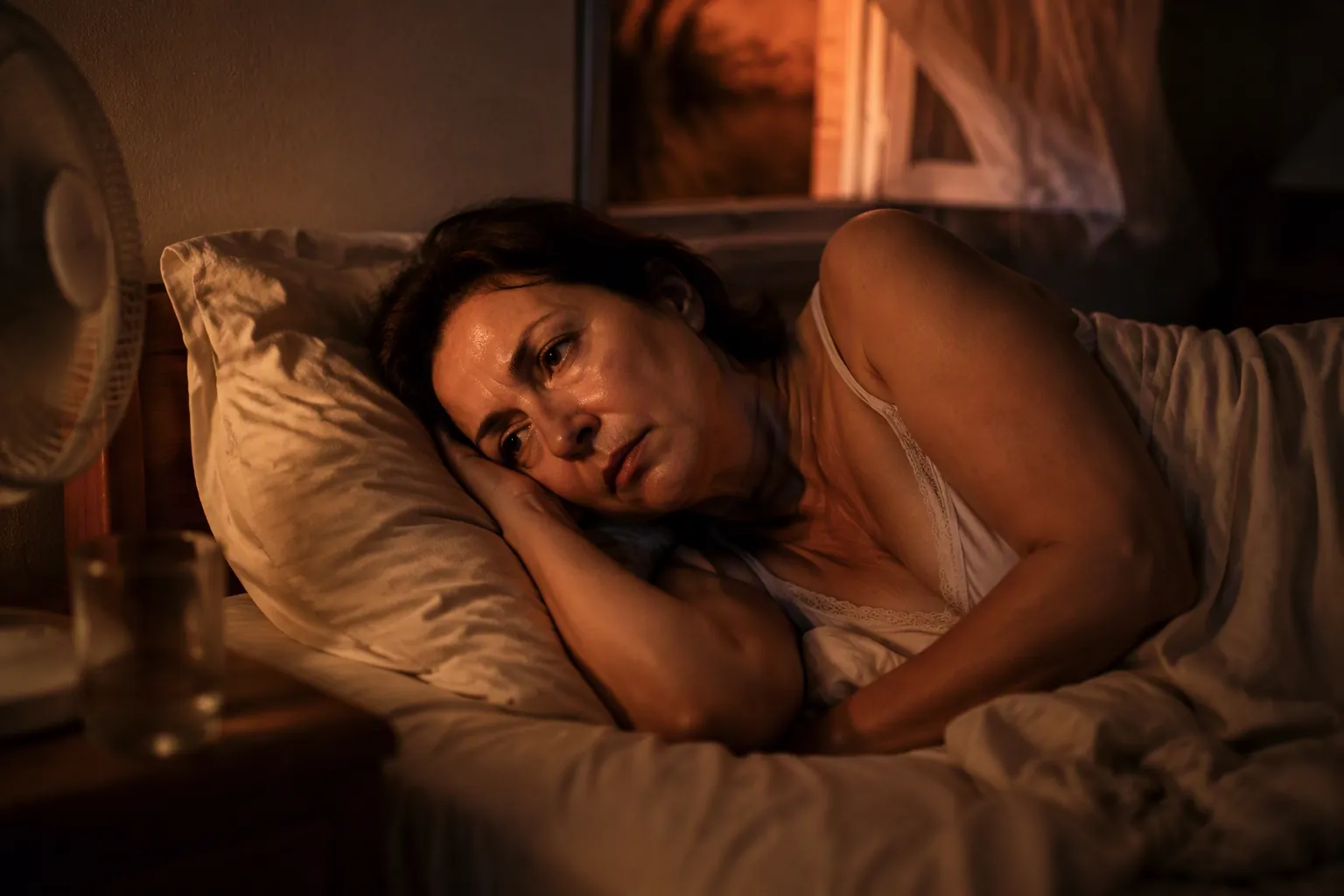
A hot bedroom is not an equal-opportunity sleep problem. One person may throw off the sheet, grumble, and still sleep. Another may wake at 2 a.m. soaked through, chilled from sweat, then too warm again ten minutes later. For older adults and many women in midlife, that difference is not a failure of willpower or a missed sleep-hygiene tip. It is a different thermal load on the body.
The strongest recent evidence comes from a large wearable-data study by Li and colleagues, published in 2025, that analyzed 23 million sleep records from a Chinese population. As nighttime temperature rose, participants over 45 and women lost about two to three times more sleep per degree than younger men did.[1] For people trying to sleep when overnight temperatures are high, the room strategy has to match the sleeper’s physiology, not just the thermostat number.
A second 2025 analysis using All of Us data points in the same direction: sleep loss from high nighttime temperatures was greater among females and people with chronic conditions. The same paper projected that, by 2099, annual sleep loss attributable to warming could fall in the range of 8.5 to 24 hours, depending on climate and population assumptions.[2] That projection deserves attention, but not theatrical certainty. It is modeling, and future air-conditioning access, housing changes, and behavior could alter the eventual burden. The near-term clinical point is narrower and more useful: vulnerability is not evenly distributed.
Why the same warm room costs some sleepers more
Sleep begins with a thermal negotiation. To settle into deeper sleep, the body usually needs to lose heat from the core. Blood flow to the skin helps move heat outward. Sweat can help if it evaporates. Bedding, pajamas, humidity, room temperature, and air movement either help that process or trap heat close to the body.
The first three to four hours of the night are especially exposed. Slow-wave sleep is more concentrated early in the night, and the normal decline in core body temperature is steepest during that first sleep segment. If the room stays warm then, the body is trying to deepen sleep at the same time it is struggling to dump heat. Cooling the room at 4 a.m. may still help comfort, but it misses the period when heat can do the most damage to sleep architecture.
Older adults face this task with less margin. Thermoregulatory responses can be blunted with age, including the vascular and sweating responses that help move heat away from the core. Raymann and Van Someren also reported that older adults may have a diminished ability to recognize the sleep temperature that is actually optimal for them.[3] That matters because “I don’t feel that hot when I go to bed” is not always a reliable guide to what the body will be able to handle at 1 or 2 a.m.
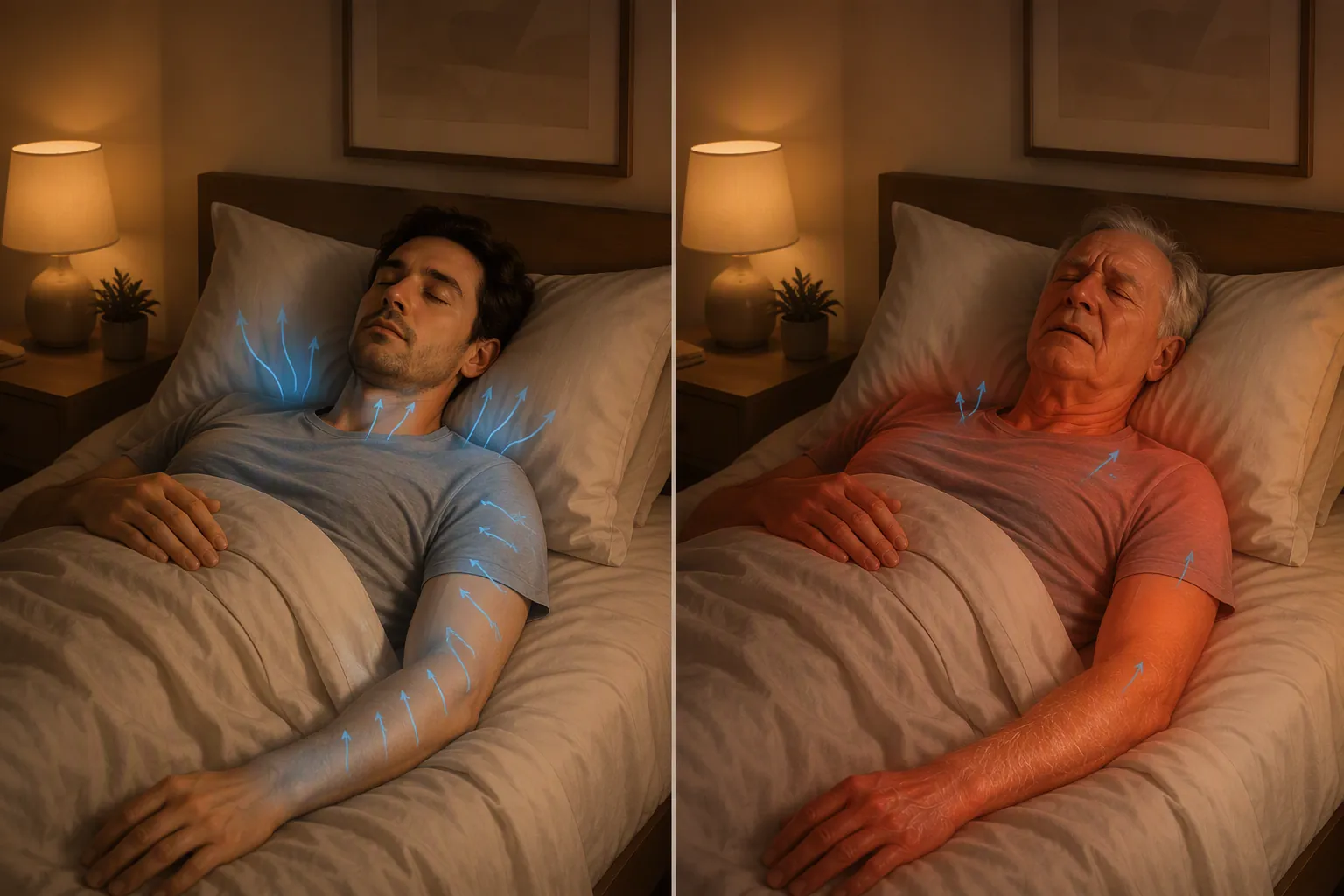
A small but concrete physiology study helps explain why a room that sounds only mildly warm can still be disruptive. Okamoto-Mizuno and colleagues studied older men sleeping in mild heat at 26°C and found increased wakefulness and a doubling of whole-body sweat loss during sleep.[4] More sweat did not mean better sleep. It meant the body was working harder and still waking more.
Humidity makes that problem worse. Sweat cools only when it evaporates. In humid air, sweat can sit on the skin or soak bedding without removing enough heat. The sleeper then gets the miserable combination many readers recognize: damp sheets, repeated waking, and no real cooling payoff.
For perimenopausal and menopausal women, ambient heat can stack on top of vasomotor symptoms. A hot flash is not simply “feeling warm.” It is a thermoregulatory event that can bring sudden heat, sweating, heart pounding, and full awakening. If the bedroom is already warm, the recovery period after a hot flash becomes harder: the body has less cool air to shed heat into, sweat evaporates less efficiently, and damp bedding can keep triggering discomfort after the flash itself passes.
Do not count on “getting used to it”
One of the more unhelpful reassurances about summer sleep is that the body will adapt after a few nights. Libert and colleagues tested repeated exposure and found no habituation after five consecutive hot nights.[5] That does not mean no one ever adapts behaviorally over a season. People change bedding, move rooms, use air conditioning, or learn when to open windows. But the sleep disruption itself should not be waved away as something the body will automatically solve by Friday.
A hot-night plan for older adults and midlife women
The goal is not to make the bedroom extremely cold. The goal is to help the body lose heat before and during the first sleep segment, keep sweat useful rather than trapped, and reduce the number of awakenings that cascade into a broken night.
| When | What to prioritize |
|---|---|
| Late afternoon or early evening | Limit heat buildup indoors; close sun-facing coverings; plan hydration before bedtime rather than all at once. |
| About 90 minutes before bed | Use a warm bath or shower if it suits you, then allow time for post-bath heat loss. |
| Bedtime | Pre-cool the room and choose moisture-wicking layers if night sweats are likely. |
| First 3–4 hours of sleep | Prioritize air conditioning, fan use, cross-breeze, or other active cooling during this most vulnerable segment. |
| After a wake-up | Change wet layers promptly; avoid turning the bed into a damp heat trap. |
| Next morning | Treat repeated heat-related awakenings as data, especially if symptoms persist after cooling changes. |
Start cooling earlier than you think
For vulnerable sleepers, pre-cooling is not a luxury step. If the bedroom has absorbed heat all day, turning on a fan at lights-out may only move warm air across warm walls, warm bedding, and a warm body. Begin reducing heat before the normal bedtime routine: block late sun, open windows only if outdoor air is cooler and less humid, and use air conditioning early enough that the mattress and surrounding surfaces are not radiating heat back at you.
The same timing logic applies to bathing. A warm bath or shower can help sleep when it is timed to allow heat to leave the body afterward. For vulnerable sleepers in this group, the safer window is roughly 90 minutes before bed rather than a rushed rinse immediately before lying down. The bath should not be punishingly hot, and it should leave enough time for the skin to cool before the first sleep segment begins.
Protect the first sleep segment
If energy costs, noise, or household preferences make all-night cooling difficult, spend the cooling budget where it matters most: the first three to four hours. That may mean setting air conditioning or a fan to run through the early night rather than saving it for later, using a timer, or arranging a cross-breeze before bed and closing the room once outdoor air turns muggy.
A fan can help when it increases evaporation and moves cooler air across the skin. It helps less when the room is very humid or when it is simply circulating hot air. In those conditions, humidity control becomes part of cooling, not a separate comfort preference. A dehumidifier, air conditioner, or a less humid sleeping area may do more than another layer of “breathable” fabric.
Choose bedding for sweat management, not just breathability
Breathable bedding is a start, but night sweats ask for more. The practical question is what happens after the sweat appears. If fabric holds moisture against the skin, the sleeper may wake cold, sticky, and then overheat again under damp covers. Moisture-wicking sleepwear, washable light layers, and a spare dry top or pillowcase within reach can shorten the awake period after a hot flash or sweat episode.
For caregivers, this is one place where dignity matters. An older adult who wakes wet is not being fussy about linens. Wet bedding can turn a brief thermal stress into a long awakening, especially if changing clothes or sheets requires help, light, and effort. Make the dry replacement easy to reach before bedtime.
Plan fluids without turning the night into bathroom trips
Older adults deserve more careful hydration advice than “drink a big glass before bed.” Kenney and Chiu described overnight fasting as a contributor to mild dehydration risk at baseline in older adults.[6] Heat, sweating, medications, and reduced thirst cues can add to that risk. At the same time, loading fluids right before sleep may increase nighttime urination and falls risk for some people.
A more useful approach is to move hydration earlier: drink steadily through the day, include fluids with the evening meal, and keep a small amount of water available overnight for thirst or after a sweat episode. People with heart failure, kidney disease, fluid restrictions, or diuretic schedules should follow clinician guidance rather than general summer advice.
The familiar basics still have a place: lighter sleepwear, fewer heavy blankets, avoiding a heavy late meal, and keeping sun-facing curtains closed during the day. They just should not be treated as the whole solution for someone whose body has less thermal reserve or whose night is being interrupted by hot flashes.
When heat is not the whole explanation
Hot nights can explain a pattern: worse sleep during warm spells, more awakenings in the first part of the night, sweat-related discomfort, and improvement when cooling and humidity control are better. They should not become a catch-all explanation for every broken night.
Seek clinical evaluation if sleep remains severely disrupted after cooling changes, or if nights include gasping, choking, loud snoring with pauses, morning headaches, restless or painful legs, persistent inability to fall asleep, early-morning awakenings with distress, chest symptoms, faintness, fever, unexplained weight loss, or drenching sweats that do not track with room temperature or menopausal symptoms. Sleep apnea, restless legs syndrome, chronic insomnia, medication effects, and other medical conditions commonly overlap with the same life stages that make heat harder to tolerate.
The fairest reading of the evidence is not that every older adult or every woman will lose the same amount of sleep on a hot night. It is that the average penalty is larger in these groups, and the reason is physiological enough to take seriously. If ordinary “cool, dark, quiet” advice has not been enough, the next step is not self-blame. It is a cooling plan built around the body that actually has to sleep in that room.
References
- Li et al. 2025 wearable sleep and nighttime temperature study, Nature Communications, 2025.
- Liao et al. 2025 nighttime temperature and sleep loss study, Environment International, 2025.
- Raymann & Van Someren 2008 older adults and optimal sleep temperature study, 2008.
- Okamoto-Mizuno 2004 mild heat exposure and sleep in older men study, Springer, 2004.
- Libert et al. 1988 repeated hot-night exposure and sleep habituation study, 1988.
- Kenney & Chiu 2001 dehydration and aging study, 2001.
Supports these guides
Spot an error or have clinical feedback?
Because this article covers clinical, medication, or safety information, we use a moderated correction channel instead of open public comments. Let us know if something about “Why hot nights disrupt sleep more for older adults and women” needs a closer look.
Send feedback on this article