
Mechanism explainer
How Brain Injury Affects Sleep Quality by Life Stage
How brain injury disrupts sleep depends on your age. This article explains the distinct mechanisms and treatment considerations for older adults, children, and adults with TBI, helping caregivers and patients understand why sleep changes after injury and what to expect.
After a brain injury, sleep can become one of the first problems handed back to the household. An older parent is awake at 2 a.m. and unsteady on the way to the bathroom. A child sleeps at odd hours after discharge, and the family cannot tell whether the long naps are recovery or a warning sign. An adult with a concussion is told to keep a regular bedtime, but the body no longer seems to obey ordinary bedtime rules.
That is why the question of how brain injury affects sleep quality needs an age attached to it. Traumatic brain injury can disturb sleep timing, sleep depth, breathing during sleep, daytime alertness, and the ability to return to work, school, or caregiving. But the same symptom can carry different risks in an 82-year-old after a fall, a 9-year-old after critical injury, and a 35-year-old recovering from mild TBI.

The Older-Adult Pattern Is Not Just Insomnia After Injury
The strongest life-stage evidence comes from a large study of older adults. Among 78,044 older adults with TBI, 22.7% received a new sleep disorder diagnosis in the 12 months after injury, compared with 14.1% of matched controls without TBI. After adjustment, TBI was associated with a 17% increased risk of insomnia, measured as an adjusted difference-in-differences rate ratio of 1.17 with a 95% confidence interval of 1.08 to 1.26.[1]
Those numbers matter because they give shape to a problem families often describe in looser terms: sleep was different after the fall, and it did not simply settle once the stitches healed or the scan looked stable. The study design is also more useful than a simple before-and-after count because it compared older adults with TBI against matched controls and used a difference-in-differences approach to reduce some obvious confounding.[1]
Still, it is not a perfect window into every older adult's bedroom. The study used insurance claims from OptumLabs and Medicare Advantage data, identified TBI and sleep disorders through ICD-9-CM codes, and counted diagnoses that made it into claims. Sleep problems that were never reported, never coded, or managed informally at home could be missed. The results also may not generalize cleanly to older adults in fee-for-service Medicare, uninsured people, or those receiving care outside the captured system.[1]
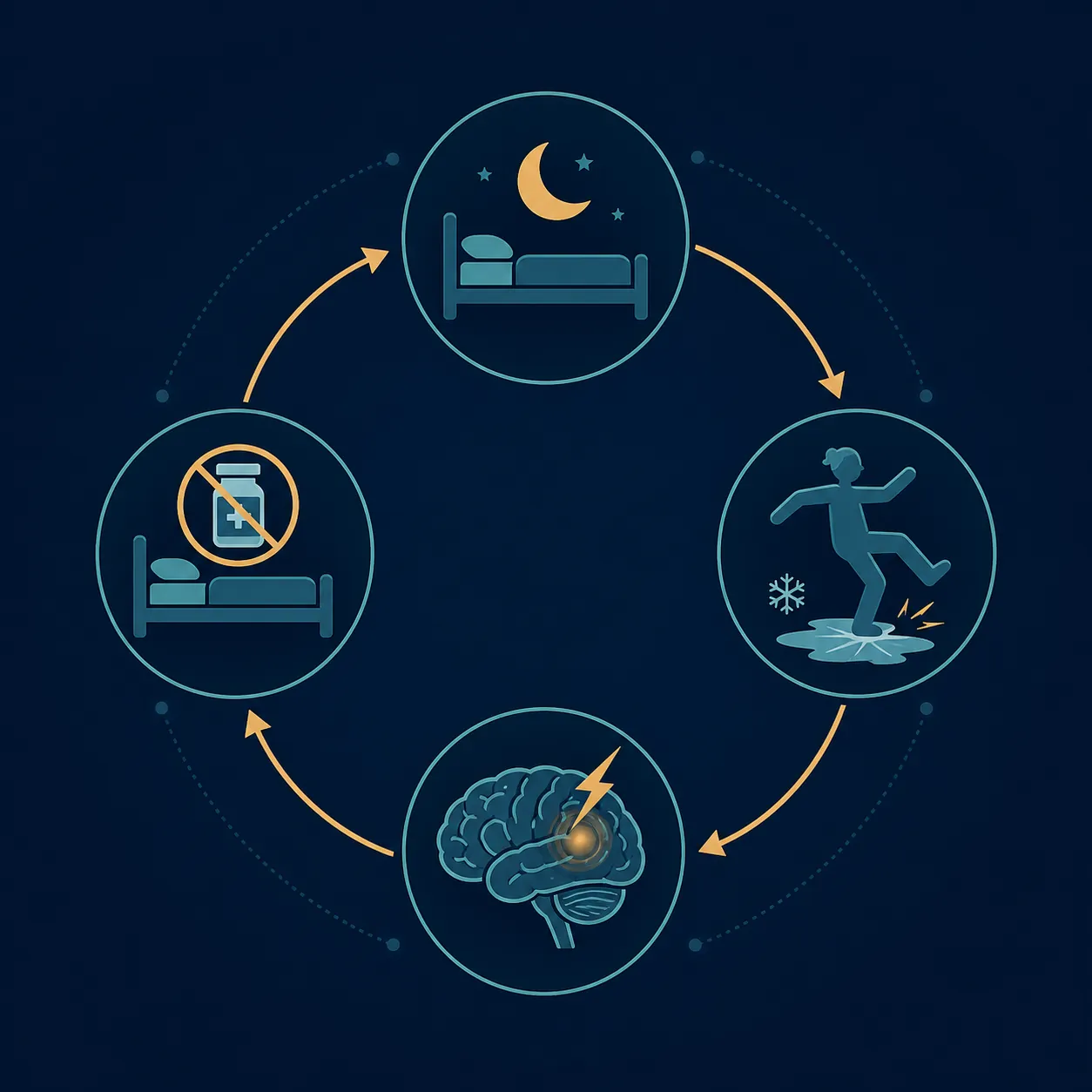
The clinical problem is bigger than whether the older adult now meets criteria for insomnia. Poor sleep can leave a person groggy, slower to react, and more likely to move through the house at night when lighting is poor and balance is already fragile. A fall can cause TBI. TBI can then worsen sleep again. By the time the family asks for help, they may be managing both the injury and the conditions that make another injury more likely.
Treatment is constrained in a way generic sleep advice rarely admits. Sedating medications may quiet a night, but in older adults they can also raise concerns about confusion, next-day impairment, and falls. That does not mean medication is never used. It means the tradeoff is different from the one facing a younger adult who is otherwise steady, driving, working, and recovering without the same baseline fall risk.
The caregiver's questions become practical and specific: Is the person waking because of pain, urinary urgency, anxiety, sleep apnea, medication timing, daytime napping, or a shifted sleep-wake rhythm after injury? Is the bedroom path safe at night? Is the person sleeping in a chair during the day and then wandering at midnight? Does the treatment reduce risk, or simply move it from sleeplessness to sedation?
What Sleep Disruption Can Do To Recovery
Sleep after TBI is not just comfort. The Model Systems Knowledge Translation Center describes sleep problems after traumatic brain injury as relevant to thinking, mood, fatigue, and return to daily roles, including return to work.[2] That is a sober kind of evidence: not a promise that fixing sleep fixes the brain, but a reminder that sleep disturbance can sit in the middle of recovery rather than at the edge of it.
Mechanisms are still being studied. TBI may affect brain regions and networks involved in circadian timing, arousal, breathing stability, pain regulation, and mood. Poor sleep can then make attention, memory, irritability, and fatigue harder to manage. In mild concussion, readers often meet this as a tension between needing rest and avoiding a sleep pattern that drifts so far it slows return to normal life.
There is also interest in the glymphatic system, a waste-clearance pathway that appears to be more active during sleep. Some researchers have proposed that sleep disruption after TBI could matter for longer-term brain health through this pathway. That idea is biologically plausible and worth watching, but it should not be treated as proof that a specific sleep intervention prevents later neurodegeneration.
The Adult Baseline: Common, Mixed, And Often Misread
Across adult TBI studies, sleep disorders are common enough that a new sleep complaint should not be brushed aside as unrelated. A 2019 review and meta-analysis reported an overall sleep disorder rate of 46% after TBI. In mild TBI specifically, the reported pattern included 29% insomnia, 28% hypersomnia, 25% sleep apnea, and 4% narcolepsy.[3]
| Sleep problem after mild TBI | Reported prevalence |
|---|---|
| Insomnia | 29% |
| Hypersomnia | 28% |
| Sleep apnea | 25% |
| Narcolepsy | 4% |
That table is useful as a map, not as a forecast for one person. Insomnia and hypersomnia can sound like opposites, yet both can appear after TBI. Sleep apnea may have existed before the injury and become more visible during recovery, or it may complicate recovery because fragmented breathing fragments sleep. Narcolepsy is less common, but the estimate reminds clinicians not to reduce every daytime sleepiness complaint to poor motivation or depression.
Adult prevalence data helps orient the conversation, especially for mild TBI and concussion recovery. It does not answer the older-adult fall loop by itself, and it does not tell parents what to expect after a child's severe or critical injury. A generic adult percentage can steady the room, but it can also flatten the person in the bed.
Children Need More Than Adult Sleep Categories Shrunk Down
Pediatric TBI raises a different kind of concern. A child is not only recovering from an injury; the child is still developing. Sleep supports learning, emotional regulation, growth, school participation, and family rhythms. When sleep-wake timing changes after TBI, the question is not simply whether the child is tired. It is whether the disruption is interfering with the developmental work the child is supposed to be doing.
The evidence base is thinner exactly where families may need it most. Williams and colleagues noted that more than half of pediatric critical TBI survivors may have multiple sleep-wake disturbances months after discharge, yet many children do not receive systematic sleep follow-up.[4] That finding should be read carefully. It does not mean every child with TBI will have persistent sleep disruption, and it does not provide a complete set of long-term pediatric treatment answers. It does show that the problem can remain present after the hospital phase ends.
Much pediatric sleep-and-TBI literature is weighted toward mild TBI and concussion, while severe and critical pediatric TBI sleep outcomes remain under-studied.[4] That imbalance matters. A child recovering from a mild concussion and a child who survived critical TBI may both nap more, wake at night, or struggle with school-day alertness, but the meaning of those symptoms may not be the same.
Parents are often left interpreting behavior before a specialist has enough longitudinal data to guide them. Longer sleep may be part of early recovery. Irregular sleep may reflect pain, medications, hospital disruption, anxiety, neurologic changes, or a return-to-school schedule that is too demanding. Daytime sleepiness may be mistaken for avoidance. Night waking may be treated as a household discipline problem when it deserves clinical review.
The safest language here is also the most useful: pediatric post-TBI sleep changes deserve follow-up, especially when they persist, multiply, or interfere with school, mood, rehabilitation, or family safety. The gap in evidence is not a reason to reassure families too quickly. It is a reason to ask better questions after discharge.
What To Watch Without Turning Sleep Into A Checklist
A sleep diary can be more useful than a vague report of "bad sleep." It does not need to be elaborate. For one or two weeks, families can track bedtime, wake time, night wakings, naps, pain, medication timing, caffeine or stimulant exposure, breathing concerns, and daytime consequences. The point is not to prove a theory at home; it is to give the clinician something more specific than exhaustion.
- For an older adult: note nighttime walking, bathroom trips, dizziness, confusion, near-falls, and next-day sedation.
- For a child: note naps, school-day alertness, emotional outbursts, headaches, therapy tolerance, and changes from the child's usual sleep pattern.
- For an adult with mild TBI: note whether the main problem is trouble falling asleep, waking too early, sleeping too much, unrefreshing sleep, or sleepiness that feels sudden and hard to resist.
- For anyone: flag loud snoring, witnessed pauses in breathing, unsafe wandering, worsening confusion, or sleepiness that creates driving, school, work, or caregiving risk.
Basic sleep routines still have a place: regular wake time, light exposure during the day, a calmer evening, and fewer long late-day naps. But after TBI, those steps are not the whole treatment plan. They are the floor. If the sleep change is persistent, severe, unsafe, or interfering with rehabilitation, it belongs in the medical conversation, not just in a bedtime-routine conversation.
The Same Symptom Can Mean Different Risks
A long nap after TBI may be recovery sleep, medication effect, depression, poor nighttime sleep, or a sign that the brain's sleep-wake regulation has changed. In an older adult, it may also set up a sleepless and unsafe night. In a child, it may collide with school reintegration and development. In a working-age adult, it may delay return to driving, work, or caregiving responsibilities.
This is the narrow judgment the evidence supports: brain injury often affects sleep quality, but it does not do so in one uniform way across the lifespan. Older adults have the clearest data showing increased diagnosed sleep disorders after TBI and face a practical loop between sleep, falls, injury, and treatment limits. Adults provide the broad prevalence baseline. Children may face meaningful sleep-wake disruption after serious injury, while the evidence base remains too thin for easy reassurance. Age does not change whether sleep matters after TBI. It changes what the sleep problem may cost, who notices it first, and how carefully treatment has to be chosen.
References
- Traumatic brain injury and sleep disorders in older adults, PMC, 2019.
- Sleep and Traumatic Brain Injury, Model Systems Knowledge Translation Center.
- A Review of Sleep Disorders Following Traumatic Brain Injury, PMC, 2019.
- Sleep-wake disturbances after pediatric traumatic brain injury: a knowledge gap, PMC, 2018.
Supports these guides
Spot an error or have clinical feedback?
Because this article covers clinical, medication, or safety information, we use a moderated correction channel instead of open public comments. Let us know if something about “How Brain Injury Affects Sleep Quality by Life Stage” needs a closer look.
Send feedback on this article