
Mechanism explainer
How CTE tau pathology disrupts sleep and elevates suicide risk
CTE's hallmark tau pathology damages brainstem regions that control REM sleep and mood regulation, explaining why REM sleep behavior disorder and elevated suicide risk converge in the same patients through a shared neuropathological mechanism rather than as separate comorbidities.
The first sign may not look like a psychiatric crisis. It may look like a bed partner ducking an elbow at 2 a.m., or waking to shouting, punching, kicking, or a fall from bed during a dream. In REM sleep behavior disorder, the usual paralysis of REM sleep fails, so the dream has a body. For families of former contact-sport athletes, that can be one of the clearest nighttime clues that a problem is not simply poor sleep hygiene, stress, or aging.
That matters for anyone trying to understand how CTE affects sleep quality and suicide risk. The useful question is not whether every tragic outcome in a former athlete can be reduced to CTE. It cannot. The better question is anatomical: what damaged circuitry could make violent dream enactment, mood instability, impulsivity, and suicidality appear in the same disease process?
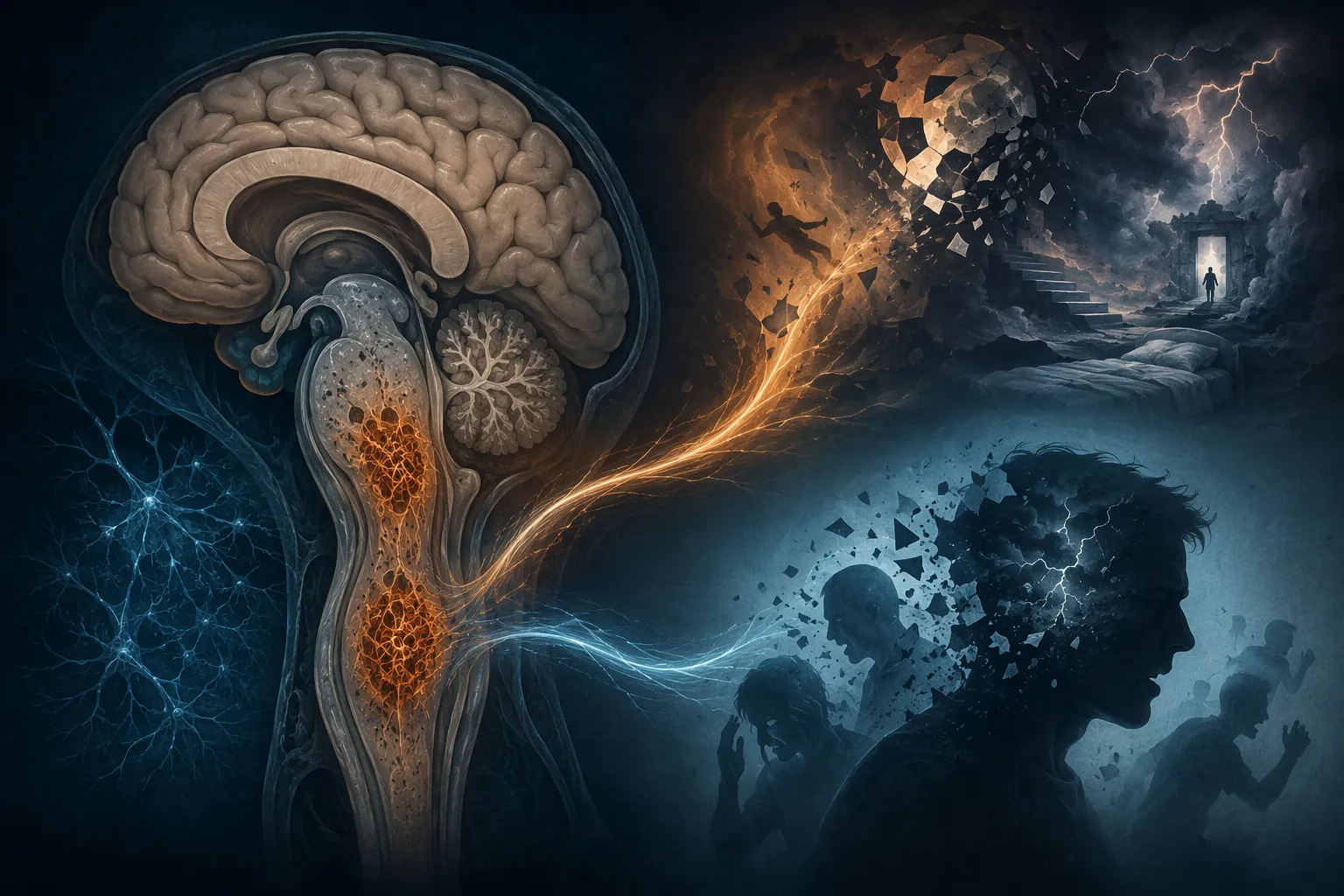
The nighttime clue that points to the brainstem
In the largest clinical-pathological study focused on this question, Adams and colleagues examined 247 brains from the VA-BU-CLF Brain Bank and found that 32% of contact-sport athletes with CTE had probable REM sleep behavior disorder during life, compared with roughly 1% in the general population.[1] That contrast is too large to treat dream enactment as an incidental complaint.
The same study found that the odds of reporting RBD symptoms increased by approximately 4% for each additional year of contact-sport play.[1] Years of exposure did not merely sit beside the sleep symptom in a table; they tracked with it. In a brain-bank sample, that still does not tell us population prevalence among all athletes. It does tell us that, among donated brains enriched for neurological concern, lifetime exposure and a specific REM sleep syndrome moved in the same direction.
The most important finding was deeper than the percentage. Participants with probable RBD were more strongly tied to tau pathology in the brainstem raphe nuclei than to Lewy body pathology; the study reported that CTE participants with probable RBD were 4 times more likely to have tau pathology within those brainstem nuclei than Lewy body pathology.[1] That is the hinge of the CTE sleep story.
At the bedside, CTE-related RBD can resemble the dream enactment seen in Parkinson’s disease or Lewy body dementia. A partner hears shouting, sees flailing, or starts sleeping defensively. But the disease biology does not have to be the same. In Parkinson’s disease and Lewy body dementia, RBD is classically linked to alpha-synuclein pathology; in the Adams CTE cohort, the stronger signal pointed to tau in brainstem sleep-regulating nuclei. For readers comparing conditions, this distinction is worth keeping separate from broader discussions of Lewy body dementia sleep disorders or Parkinson’s sleep burden on partners.
Why raphe nuclei and locus coeruleus damage can connect sleep and mood
The raphe nuclei are not decorative anatomy. They are major serotonergic centers, and serotonin systems are involved in arousal, REM regulation, mood, behavioral inhibition, and emotional control. The locus coeruleus, another vulnerable brainstem region in neurodegenerative disease, is a major noradrenergic center that helps regulate arousal, threat responsiveness, attention, and stress physiology. Damage in this territory can plausibly disturb both the sleeping brain and the waking person who is trying to regulate emotion under load.
This is where sleep quality becomes more than a lifestyle outcome. A person with RBD may have fragmented sleep from repeated motor episodes, injury risk, fear of sleeping, bed-partner separation, and daytime fatigue. But in CTE, the symptom also points backward to damaged circuitry. The same brainstem tau burden that interferes with REM atonia may sit near systems that help restrain impulsive action, smooth emotional transitions, and modulate despair.
That does not mean RBD causes suicide. It does not mean every athlete with violent dreams has CTE. It means that in a contact-sport athlete with prominent dream enactment, depression, irritability, impulsivity, or escalating risk behavior, the sleep symptom deserves neurological attention rather than dismissal as a strange bedroom anecdote.
Other dementia syndromes can also disrupt sleep through movement symptoms, circadian breakdown, pain, medications, breathing instability, or nighttime confusion. Those pathways are discussed more broadly in dementia-related sleep disruption. The CTE point is narrower: the Adams data give a clinicopathological bridge between a specific parasomnia, years of contact-sport exposure, and tau pathology in brainstem nuclei central to REM and affect regulation.
Where suicide risk enters the same circuit
The suicide data in CTE need careful handling because the samples are often not population samples, and because suicide is never a single-cause event. Still, the pathology cannot be waved away. In a JAMA Neurology study of 152 contact-sport athletes who died before age 30, McKee and colleagues reported that 41.4% had autopsy-confirmed CTE, and 87 of the 152 athletes, or 57%, died by suicide.[2] Suicide was the most common cause of death regardless of CTE status, but the CTE-positive brains showed more severe pathology.[2]
The amateur-athlete detail is easy to miss and clinically important. Among the 63 young athletes diagnosed with CTE in that study, 71.4% were amateurs who played only at the youth, high school, or college level.[2] That does not prove that CTE is common in amateur football players. Brain donation is strongly shaped by family concern, observed symptoms, and the circumstances of death. But the finding does undercut the casual assumption that CTE pathology belongs only to long-career professionals.
The same restraint has to apply to living-player studies. Grashow and colleagues studied 1,980 living former professional football players and found that 25.4% of those with perceived CTE reported suicidality in the preceding 2 weeks, compared with 5.0% of those without perceived CTE.[3] That is a large difference in distress. It is not autopsy confirmation. “Perceived CTE” measures a person’s belief or concern that they have the disease, and that belief can overlap with depression, anxiety, pain, cognitive symptoms, media exposure, and fear about the future.
Keeping those categories separate is not academic fussiness. Autopsy-confirmed CTE tells us about tissue pathology after death. Perceived CTE tells us about lived suffering and risk in people who are still reachable by clinicians. Both matter, but they answer different questions. A former player who believes he has CTE and reports suicidal thoughts needs immediate clinical attention whether or not his brain would meet neuropathological criteria decades later.
A plausible cascade, not a finished causal proof
The most defensible model is a shared-pathology model. Repetitive head impacts are associated with CTE tau pathology. In affected brains, tau involves regions that include brainstem nuclei relevant to REM sleep, arousal, serotonin, norepinephrine, and affective control. The clinical surface can then include dream enactment, fragmented sleep, irritability, impulsivity, depression, and suicidal thoughts. Mayo Clinic and StatPearls both list suicidal thoughts among documented CTE features.[4][5]
| Observed problem | Most relevant CTE-linked mechanism | What it does and does not prove |
|---|---|---|
| Violent dream enactment or probable RBD | Tau pathology in brainstem REM-regulating nuclei, especially raphe nuclei in the Adams study | Supports neurological evaluation; does not diagnose CTE during life |
| Severe sleep fragmentation | REM disruption, injury fear, bed-partner disruption, and possible neurodegenerative arousal instability | Can worsen daytime function; has not been proven to drive CTE progression |
| Mood dysregulation and impulsivity | Involvement of serotonergic and noradrenergic brainstem systems that influence emotional control | Provides a plausible circuit link; does not reduce suicide to one brain lesion |
| Suicidal thoughts or behavior | Overlap of neurodegenerative pathology, distress, psychiatric symptoms, pain, cognition, and perceived or confirmed disease | Requires urgent risk assessment; cannot be inferred from CTE status alone |
There is also a possible clearance loop, though it should be described cautiously. StatPearls notes that perivascular polarization of astroglial aquaporin-4 is impaired in CTE, a change that may reduce glymphatic clearance of tau.[4] If tau clearance is impaired, sleep disruption and protein accumulation could theoretically reinforce each other, because sleep is one period when waste-clearance biology is often discussed in neurodegenerative disease. That idea fits with broader conversations about glymphatic clearance and neurodegenerative risk, but it has not been proven as a treatment target in CTE.
That boundary matters. It is reasonable to treat RBD, insomnia, nightmares, sleep apnea, pain, and circadian disruption because they injure quality of life and may worsen daytime judgment. It is not yet evidence-based to promise that treating those sleep problems will lower suicide risk or slow CTE progression. No prospective longitudinal treatment trials in this population have demonstrated that.
What families and clinicians should not miss
In practice, the warning pattern is not one bad night. It is a cluster: repeated dream enactment, injuries or near-injuries during sleep, a bed partner who no longer feels safe, worsening insomnia, heavy daytime sleepiness, abrupt irritability, disinhibition, depression, substance misuse, reckless behavior, or any suicidal thinking. Severe short sleep can add its own burden, as discussed in broader terms in the health risks of sleeping only 3 hours a night, but a contact-sport history changes the level of concern when REM dream enactment is prominent.
A sleep evaluation can document whether the behavior is true RBD, obstructive sleep apnea with arousals, nocturnal seizures, trauma-related nightmares, medication effects, alcohol-related parasomnia, or another disorder. That distinction affects safety planning. True RBD often calls for injury prevention in the sleep environment and medication review; suicidal thoughts call for immediate risk assessment, not watchful waiting.
In CTE, sleep disturbance and suicide risk may be connected downstream effects of shared brainstem tau pathology rather than unrelated comorbidities pasted onto a neurodegenerative diagnosis. The evidence is strongest for the RBD-brainstem tau link in brain-bank material, meaningful but selection-biased for young-athlete autopsy data, and clinically urgent but diagnostically uncertain for living players who perceive they have CTE. Prominent REM sleep behavior disorder or severe sleep disruption in a contact-sport athlete deserves neurological attention and suicide-risk awareness before certainty is available.
References
- Association of probable REM sleep behavior disorder with pathology and years of contact sports play in chronic traumatic encephalopathy. Acta Neuropathologica. 2020.
- Clinicopathological Evaluation of Chronic Traumatic Encephalopathy in Players of American Football. JAMA Neurology. 2023.
- Perceived CTE in Former Professional Football Players. JAMA Neurology. 2024.
- Chronic Traumatic Encephalopathy. NCBI Bookshelf. Updated 2024.
- Chronic traumatic encephalopathy - Symptoms and causes. Mayo Clinic.
Supports these guides
Spot an error or have clinical feedback?
Because this article covers clinical, medication, or safety information, we use a moderated correction channel instead of open public comments. Let us know if something about “How CTE tau pathology disrupts sleep and elevates suicide risk” needs a closer look.
Send feedback on this article