
Mechanism explainer
Why Celiac Disease Causes Fatigue and Sleep Problems
Fatigue affects up to half of newly diagnosed celiac patients, and insomnia is roughly twice as common in this population. The mechanisms span inflammation, iron-deficiency restless legs, and gut-brain disruption — and a gluten-free diet improves fatigue without fully normalizing it, so sleep and nutrient status need active follow-up.
If you are searching for celiac disease symptoms, fatigue and sleep problems should not be treated as fringe complaints. In a controlled study of newly diagnosed adults, clinically relevant fatigue appeared in about 41–50% of patients with celiac disease depending on the validated fatigue instrument used, compared with 0–2.2% of matched healthy controls [1]. A 2024 meta-analysis also found higher odds of insomnia in people with celiac disease, with a pooled odds ratio of 1.83 [2].
Those numbers do not mean every tired person has celiac disease, or that celiac disease explains every poor night of sleep. They do mean that exhaustion and insomnia deserve active follow-up in celiac care. The pattern is too consistent to wave away as stress, yet too biologically tangled to reduce to one neat explanation.
That distinction matters for someone who has already done the difficult part: got tested, accepted the diagnosis, changed the food environment, checked labels, and still wakes up unrefreshed. Celiac disease is an autoimmune response to gluten that injures the small intestine and can interfere with nutrient absorption. But the fatigue story does not end at the intestine, and the sleep story does not always resolve just because the diet has started.
Fatigue and sleep disturbance overlap, but they are not the same complaint
Fatigue in celiac disease is not just sleepiness. People describe heavy limbs, reduced stamina, brain fog, unrefreshing rest, and the feeling that ordinary tasks require abnormal effort. Sleep problems can feed that fatigue, but they are only one route into it.
The strongest fatigue comparison is useful because it did not simply ask whether patients felt “tired.” It used the Fatigue Severity Scale, Chalder Fatigue Questionnaire, and the fatigue dimension of the Giessener Complaint List, then compared newly diagnosed celiac patients with matched healthy controls. Across those measures, the gap was large: roughly 41–50% of patients met thresholds for clinically relevant fatigue, while controls were near zero [1].
Sleep evidence is also real, though less tidy. The Gut Liver meta-analysis estimated that people with celiac disease had 1.83 times the odds of insomnia compared with people without celiac disease, and the confidence interval did not cross 1 [2]. A Swedish nationwide registry study found that hypnotic-treated poor sleep was 33% more likely before celiac diagnosis and 36% more likely after diagnosis, even after accounting for psychiatric comorbidity, sleep apnea, and restless legs syndrome [3].
That Swedish result is important, but it is also narrower than “everyone slept badly.” It measured poor sleep treated with hypnotic medication in registry data. People who never sought care, were not prescribed medication, or had fragmented sleep for reasons not captured in the registry would not be measured the same way.

Do not remove gluten before testing if celiac disease is only suspected
There is one practical boundary to put near the top: if celiac disease is suspected but not diagnosed, talk with a clinician about appropriate testing before starting a gluten-free diet. Celiac testing depends on the body still reacting to gluten. Removing gluten first can make the diagnosis harder to confirm.
That is not a small administrative detail. A confirmed diagnosis changes long-term follow-up: nutritional monitoring, family risk discussions, repeat assessment when symptoms persist, and the seriousness with which cross-contact and hidden gluten are handled. A self-directed gluten-free trial may seem harmless, but it can blur the evidence just when clarity is needed.
The fatigue mechanism is not just “damaged gut equals tired”
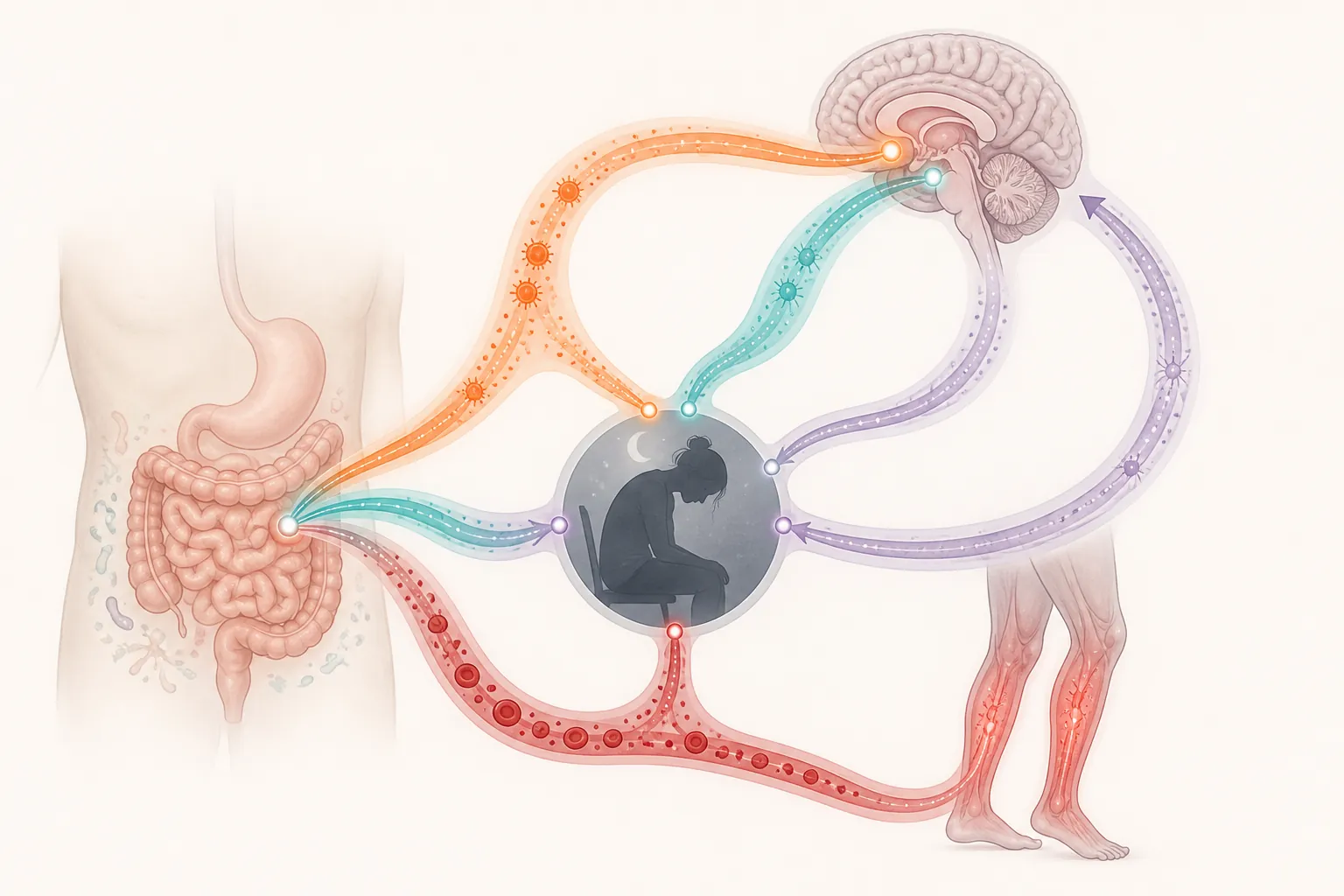
Intestinal injury matters, especially when it leads to nutrient deficiencies. But it cannot explain every tired celiac patient. The more useful model is several overlapping pathways: immune signaling, iron deficiency and restless legs, gut-brain communication, nighttime gastrointestinal symptoms, pain, and mood. In a real body, those pathways do not politely take turns.
Inflammation can produce “sickness behavior”
One of the more plausible links between celiac disease and fatigue is cytokine-driven sickness behavior. In immune activation, inflammatory signals such as IL-1β can affect the brain and produce a recognizable package of low energy, sleepiness, reduced motivation, and withdrawal. The point is not that the patient is choosing inactivity. The point is that the immune system can change how energy, alertness, and effort feel [1].
This helps explain why fatigue may be present at diagnosis even when the person is not obviously underweight or severely anemic. It also explains why the symptom can feel disproportionate to the visible workload of the day. The body is not only losing nutrients; it may also be running inflammatory signaling that makes wakefulness feel expensive.
Iron deficiency can fragment sleep through restless legs
Restless legs syndrome is one of the clearest bridges between celiac disease, nutrient absorption, sleep disruption, and daytime fatigue. When iron status is poor, some people develop an uncomfortable urge to move the legs, often worse in the evening or at rest. The result may not look like classic insomnia from the outside. The person may go to bed on time, spend enough hours in bed, and still have sleep repeatedly broken by leg discomfort or movement.
Method matters here. In registry-coded data, restless legs syndrome can look rare; the Swedish study reported a coded prevalence of 0.6% [3]. But when researchers actively screened a celiac cohort, 35% had restless legs syndrome, compared with 25% of spouses; iron deficiency was present in 40% of those with active restless legs syndrome versus 6% without it [4]. Those are not the same kind of measurement, so they should not be treated as interchangeable.

The restless legs pathway is also actionable. In the same active-screening study, restless legs syndrome improved in half of 28 patients after six months on a gluten-free diet [4]. That does not prove diet alone fixes restless legs, and it does not replace iron evaluation. It does show why asking about leg sensations, repeated awakenings, and iron status is more useful than simply telling a patient to wait longer.
Gut-brain signaling and nighttime symptoms can keep the system alert
Celiac disease is centered in the small intestine, but the intestine is not an isolated tube. Immune activity, gut hormone signaling, serotonin production in intestinal enterochromaffin cells, microbiome shifts, and vagal communication all give the gut ways to influence alertness, discomfort, and sleep regulation. The evidence here is less cleanly measurable than a ferritin result or a fatigue scale, but it fits the clinical pattern: some people feel wired, foggy, unsettled, or unrefreshed even when they cannot identify one dramatic symptom keeping them awake.
There is also the plain version: abdominal pain, bloating, reflux-like discomfort, diarrhea, or urgent trips to the bathroom can interrupt sleep directly. A night does not need to contain a two-hour insomnia episode to be biologically poor sleep. Repeated brief awakenings can be enough to leave the next day damaged.
Depression, anxiety, and pain are part of the loop, not a dismissal
Mood symptoms often get used badly in fatigue conversations. Once depression or anxiety is mentioned, the physical complaint can be quietly downgraded. The better reading is feedback: chronic inflammation, pain, dietary vigilance, social restriction, poor sleep, and fear of symptoms can all affect mood; mood and pain can then worsen sleep and fatigue.
This is not theoretical hand-waving. In the prospective celiac fatigue study, residual fatigue after treatment tracked with depression and pain rather than with villous atrophy or tTG-IgA levels [5]. That finding should make clinicians more curious, not less. A patient can be following the diet and still need assessment for pain, mood, sleep fragmentation, and nutrient status.
Why the gluten-free diet helps fatigue but may not finish the job
A strict gluten-free diet is the core treatment for celiac disease. The question is not whether it matters. It does. The more honest question is what remains after it begins.
In the prospective study following patients after diagnosis, median Fatigue Severity Score fell from 3.8 to 1.9 after 12 months on a gluten-free diet. That is a substantial improvement. But fatigue still remained significantly higher than in healthy controls [5].
The most clinically useful part of that study is what did not predict the leftover fatigue. Residual fatigue was not associated with persistent villous atrophy or tTG-IgA levels. It was associated with depression and pain [5]. In everyday terms: persistent fatigue after diagnosis is not automatically proof that the person is secretly eating gluten, failing at the diet, or exaggerating. It may mean the celiac disease has improved while other fatigue-maintaining pathways still need attention.
That does not mean gluten exposure should be ignored. Ongoing symptoms can still require review of cross-contact, hidden gluten, diet quality, and whether the diagnosis or follow-up testing has been handled correctly. But “check the diet” should not be the only move. If fatigue remains severe, the follow-up has to widen.
Sleep improves less predictably than fatigue
Sleep studies in celiac disease are messier than fatigue studies. Some show improvement after a gluten-free diet, especially in children. One pediatric study found sleep-disturbance rates falling from 71.8% to 38.8% after six months on a gluten-free diet, although 37.8% of children still remained above the clinical cutoff [6].
Adult data are less reassuring. One adult study found no improvement in Pittsburgh Sleep Quality Index scores on a gluten-free diet, and sleep quality correlated significantly with depression, with r=0.633 [7]. A US NHANES-based study also found no significant association between diagnosed celiac disease and depression or insomnia in a small sample [8].
Those conflicts should narrow the claim, not erase it. The best summary is that insomnia appears elevated at the population level, but sleep response to a gluten-free diet is inconsistent. Pediatric findings should not be casually imported into adult care. A small null study should not wipe out larger or more targeted work. And a registry study, a questionnaire study, and an active screening study may all be measuring different pieces of the same lived problem.
What persistent fatigue or poor sleep should prompt after diagnosis
Once celiac disease is diagnosed, the gluten-free diet is necessary care, not a sleep treatment plan by itself. If exhaustion or fragmented sleep continues, the next clinical questions should be specific enough to find a mechanism.
- Is the gluten-free diet being followed strictly enough, and has a celiac-informed dietitian reviewed hidden gluten or cross-contact risks?
- Has iron status been checked, especially if there is leg discomfort, an urge to move the legs at rest, repeated awakenings, or heavy daytime sleepiness?
- Are there ongoing gastrointestinal symptoms at night, such as pain, bloating, diarrhea, urgency, or reflux-like discomfort?
- Is pain present elsewhere, including headaches, joint pain, abdominal pain, or widespread body pain?
- Are depression, anxiety, or heightened stress reactions worsening sleep and fatigue, without being mistaken for the whole explanation?
- Is the sleep problem insomnia, restless legs, frequent awakenings, unrefreshing sleep, circadian disruption, or another sleep disorder that needs its own evaluation?
The point is not to turn every tired celiac patient into a bundle of separate diagnoses. It is to stop treating diet initiation as the end of the conversation. Fatigue can improve while sleep remains poor. Intestinal healing can progress while pain or mood keeps fatigue alive. Iron deficiency can be missed if nobody asks about the legs.
For someone still undiagnosed, the safest next step is testing before gluten removal. For someone already diagnosed, the more useful standard is this: keep the gluten-free diet, but follow the remaining symptoms. Sleep quality, iron deficiency and restless legs, pain, mood, and persistent fatigue all deserve to be checked rather than left to fade on their own.
References
- Fatigue in patients with celiac disease: a cross-sectional study. Scientific Reports, 2022.
- Association between Celiac Disease and Sleep Disorders: A Systematic Review and Meta-Analysis. Gut and Liver, 2024.
- Celiac disease and sleep disturbances: a nationwide case-control study. BMC Gastroenterology, 2015.
- Restless legs syndrome is associated with celiac disease. Digestive Diseases and Sciences, 2010.
- Fatigue in celiac disease: a prospective controlled study. Frontiers in Medicine, 2023.
- Evaluation of sleep problems in children with celiac disease and the effect of gluten-free diet. Nature and Science of Sleep, 2022.
- Psychological morbidity of celiac disease: A review of the literature. Alimentary Pharmacology & Therapeutics, 2010.
- Depression and insomnia among individuals with celiac disease or on a gluten-free diet in the USA: results from the National Health and Nutrition Examination Survey. European Journal of Gastroenterology & Hepatology, 2017.
Supports these guides
Spot an error or have clinical feedback?
Because this article covers clinical, medication, or safety information, we use a moderated correction channel instead of open public comments. Let us know if something about “Why Celiac Disease Causes Fatigue and Sleep Problems” needs a closer look.
Send feedback on this article