
Mechanism explainer
Why Lyme Disease Causes Both Insomnia and Fatigue
Lyme disease can cause crushing daytime fatigue and nighttime insomnia at the same time, and the two feed the same cycle. Find out why they're linked, why finishing antibiotics often doesn't restore sleep, and which insomnia treatments the evidence actually supports.
The cruel part of the Lyme disease insomnia and fatigue connection is that it often feels contradictory. All day, the body asks to lie down. At night, the nervous system refuses to power down. A person can sleep for many hours and still wake as if the night never reached the places that needed repair. That pattern is not rare enough to dismiss as poor habits, anxiety, or over-reading symptoms online. Sleep disturbance has been documented in Lyme disease and in post-treatment Lyme disease syndrome, even though the exact pathway is not fully settled.[1][2]
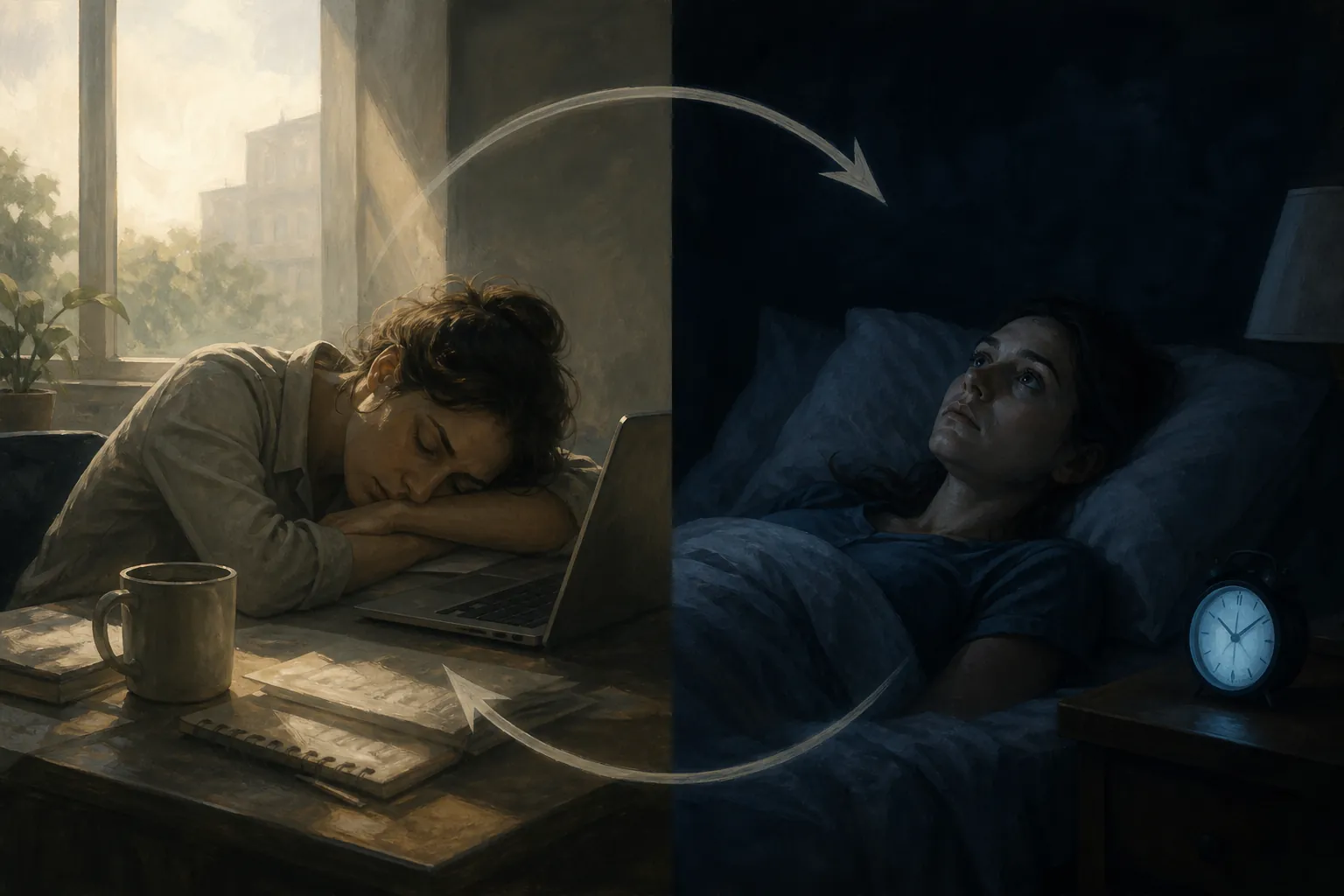
The most useful starting point is not a generic list of Lyme symptoms. It is the sleep itself: what happens when the night is long enough on paper, but broken enough that the brain and body do not experience it as restorative.
The old sleep study that still explains the paradox
A small 1995 polysomnography study by Greenberg and colleagues remains one of the clearest windows into this problem because it measured sleep directly rather than relying only on symptom reports. The study included 11 patients with late Lyme disease and 10 controls. Compared with controls, the Lyme group had more fragmented sleep: shorter uninterrupted runs of stage 2 and stage 4 non-REM sleep, longer sleep latency, lower sleep efficiency, and a higher arousal index.[1]
Those details matter. Stage 2 and stage 4 non-REM sleep are not just decorative labels in a sleep report. Consolidated stretches of non-REM sleep are part of how the sleeping brain maintains continuity, reduces sensory monitoring, and allows the body to stay in deeper recovery states. When sleep is repeatedly interrupted, a person may not remember every arousal, but the night becomes physiologically choppy.
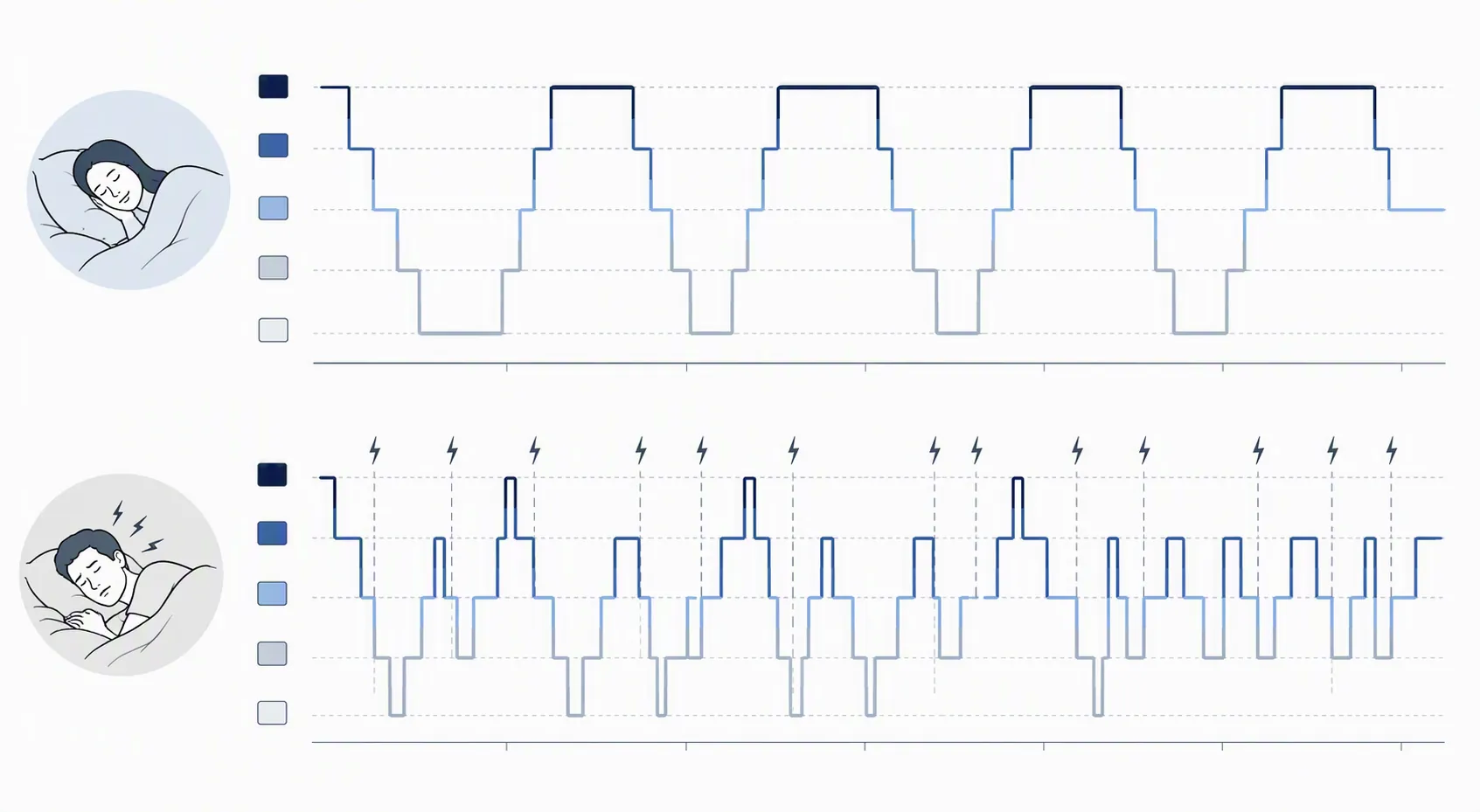
This is where the paradox becomes more understandable. In the same Greenberg study, 73% of the patients reported excessive daytime sleepiness, yet their multiple sleep latency test, or MSLT, was normal.[1] That does not mean the patients were inventing the exhaustion. It means the standard daytime test did not show pathological sleepiness in the narrow way that test measures it: how quickly someone falls asleep during scheduled nap opportunities.
| What the patient may say | What it may reflect | Why it can be missed |
|---|---|---|
| “I’m sleepy all day.” | A felt need to shut down, often mixed with fatigue and brain fog. | A daytime sleepiness test may be normal if the main problem is not irresistible sleep onset. |
| “I slept, but I didn’t recover.” | Fragmented, inefficient, non-restorative sleep. | Total hours in bed can look adequate while sleep continuity is poor. |
| “I’m exhausted but wired at night.” | A loop involving arousal, pain, immune signaling, circadian disruption, and conditioned wakefulness. | Insomnia and fatigue may be treated as separate complaints instead of one reinforcing pattern. |
Fatigue and sleepiness overlap in ordinary speech, but clinically they are not the same thing. Sleepiness is the tendency to fall asleep. Fatigue is reduced capacity: heaviness, low stamina, slowed thinking, and the sense that ordinary tasks cost more than they should. A person with Lyme disease or PTLDS can be profoundly fatigued without showing abnormal sleep latency on a daytime nap test. That is exactly why the Greenberg finding is so valuable. It shows a route by which a person can be depleted all day and still not look “sleepy” by one objective measure.
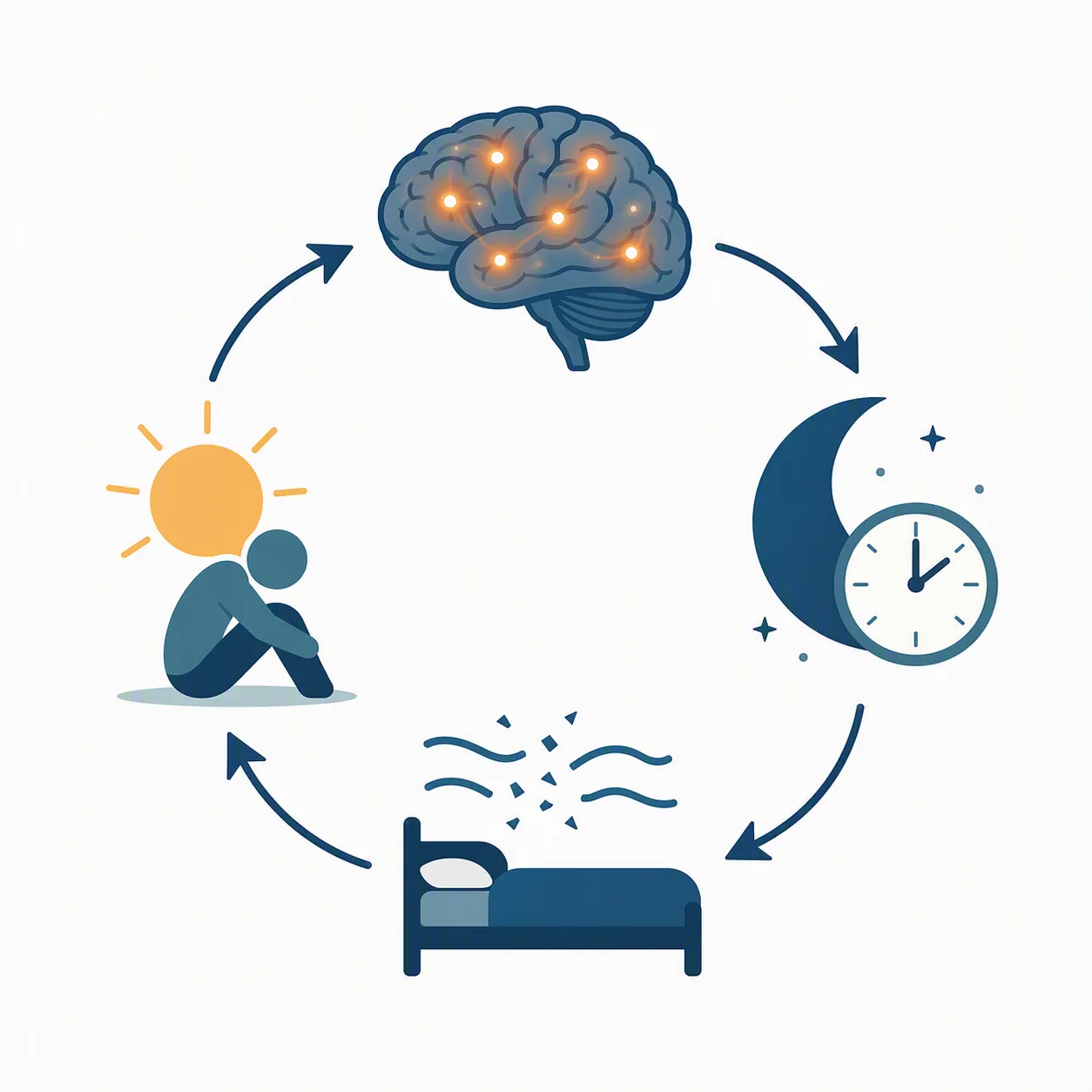
The study is small and old, so it should not be asked to prove every mechanism behind Lyme-related insomnia. But it gives a concrete model: fragmented non-REM sleep produces non-restorative nights; non-restorative nights worsen daytime fatigue, pain sensitivity, mood regulation, and cognitive load; daytime inactivity, napping, worry about sleep, and circadian drift can then make the next night harder. The loop does not need to be imaginary to be self-reinforcing.
Why finishing antibiotics may not restore sleep
The next hard question is the one many patients are left with after doing the recommended treatment: if the infection was treated, why is sleep still broken?
A 2018 prospective cohort from Weinstein and colleagues followed 122 people with early Lyme disease and compared their sleep quality with controls. Before treatment, the Lyme group had worse Pittsburgh Sleep Quality Index scores. For most patients, sleep quality improved toward control levels by 6 months. The exception was the subgroup that developed post-treatment Lyme disease syndrome; their global sleep scores remained significantly worse for up to a year.[2]
That pattern is clinically important because it separates two ideas that often get blurred. Antibiotics can be appropriate and effective for treating Lyme infection. That does not mean they automatically repair every downstream sleep, immune, pain, cognitive, or circadian consequence that may have developed around the illness. In the Weinstein cohort, sleep improved for many after treatment, but persistent poor sleep identified a subgroup still struggling after the infection phase had been addressed.[2]
The best-supported explanation is not a single tidy cause. Bai and Richardson’s 2023 systematic review found substantial symptom overlap between PTLDS and ME/CFS, including unrefreshing sleep, fatigue, pain, and cognitive complaints. The review also discussed shared inflammatory findings, including C-reactive protein, IL-23, CCL19, and anti-neural antibodies, as possible clues to immune-driven persistence.[3] That is not the same as saying PTLDS is identical to ME/CFS. It is a narrower and more defensible point: after treatment, some patients remain in a state where sleep and fatigue stay biologically tangled.
A 2024 mechanisms review described PTLDS using the familiar clinical cluster of fatigue, pain, and/or cognitive complaints with functional impact persisting for more than 6 months after appropriate treatment, and noted that estimates often fall around 10% to 20% of treated patients, depending on study design and definition.[4] The CDC uses more cautious language, reporting that prolonged symptoms are 5% to 10% more common among people treated for Lyme disease than among people who did not have Lyme disease at 6 months, and it prefers “post-treatment Lyme disease syndrome” over “chronic Lyme disease” because the cause of persistent symptoms is not known.[5]
That caution is not semantic fussiness. If persistent insomnia and fatigue are assumed to prove ongoing infection, the treatment path can drift toward repeated or prolonged antibiotics. The CDC warns that extended antibiotic treatment carries serious risks, including sepsis and colitis, and has not been shown to be better than placebo for prolonged symptoms after recommended Lyme treatment.[5] Recognition of the symptom pattern should not be used to sell certainty that the evidence does not provide.
The loop is biological, but it can also become behavioral
Once sleep has been unstable for weeks or months, the brain learns the pattern. Bed becomes the place where symptoms are monitored. Pain feels louder because there is less daytime distraction. The clock becomes threatening. Naps may become necessary for survival, then weaken the next night’s sleep drive. Light exposure, meal timing, activity, and medication schedules may drift because the day no longer has a reliable start.
None of that means the problem is “just behavioral.” It means behavior becomes one layer of a larger loop. Immune activation, nervous-system arousal, pain, autonomic symptoms, and circadian disruption can push sleep off course. Then months of disrupted sleep can train the body to expect wakefulness at the wrong time. The patient experiences one fused problem: exhausted all day, alert at night, and never restored.
The same logic appears in other complex sleep conditions: more time in bed does not guarantee better sleep if the sleep is fragmented. We discuss a similar distinction in our explainer on frontotemporal dementia and sleep disruption, where the issue is not simply the number of hours but the integrity of the sleep-wake system.
What should be evaluated when sleep does not recover
After appropriate Lyme treatment, persistent insomnia deserves its own evaluation. That starts with a less dramatic, more useful question than “Is the infection still there?”: what is currently breaking the sleep?
- Sleep apnea: snoring, witnessed pauses, morning headaches, dry mouth, high blood pressure, or waking unrefreshed despite enough time in bed.
- Restless legs or periodic limb movements: an urge to move the legs at night, crawling sensations, or a bed partner noticing repeated kicking.
- Pain and sensory arousal: joint pain, neuropathic sensations, temperature intolerance, or sound and light sensitivity that repeatedly trigger awakenings.
- Nocturia: frequent nighttime urination that fragments sleep even when the person falls asleep easily.
- Medication and substance effects: activating medications, steroid timing, decongestants, caffeine, alcohol, cannabis withdrawal, or sedatives that worsen sleep architecture.
- Circadian disruption: irregular wake times, long daytime naps, low morning light, excessive evening light, or a sleep schedule that has shifted later and later.
- Hormonal or endocrine contributors: thyroid problems, perimenopausal symptoms, cortisol-pattern concerns, or other medical issues that can mimic or amplify fatigue with broken sleep.
This is where a sleep clinician, primary care clinician, or relevant specialist can be more useful than another round of self-experimentation. The goal is not to label every symptom as a separate disorder. It is to find treatable contributors that are easy to miss when everything is attributed to Lyme. That same “screen before assuming” approach matters in other conditions with neurological or systemic symptoms, including the sleep disorders discussed in our article on veterans, head trauma, and sleep.
Treat the insomnia directly, not as a leftover symptom
For chronic insomnia, the best-supported first-line treatment is cognitive behavioral therapy for insomnia, or CBT-I. The American Academy of Sleep Medicine describes CBT-I as first-line care for chronic insomnia in adults. In the same guidance, AASM notes that melatonin is not recommended for chronic insomnia, and it cites a 2017 study in which more than 71% of melatonin supplements failed to meet their label claims within 10%.[6]
That guidance is general adult insomnia guidance, not Lyme-specific evidence. Still, it is more grounded than trying to solve PTLDS sleep disturbance with supplement stacks, escalating sleep hygiene rules, or the assumption that more antimicrobial treatment will normalize sleep. CBT-I is not simply advice to relax. It works on sleep timing, sleep drive, conditioned arousal, time in bed, and the habits that keep insomnia active after the original trigger has passed.
Melatonin may have a role in circadian rhythm problems for some people, but that is different from treating chronic insomnia as a whole. If timing, dose, age, drug interactions, or supplement quality are concerns, those questions should be handled carefully rather than treated as harmless trial-and-error. We take the same cautious approach in our guide to melatonin evidence, dosage, and safety by population.
The practical judgment is this: Lyme-related insomnia and fatigue can form a self-reinforcing loop, and that loop may persist after the infection has been appropriately treated. Once that happens, sleep should not be treated as a vague leftover symptom that will necessarily fade on its own. It deserves direct assessment, attention to hidden sleep disorders, and insomnia treatment that is evidence-based enough to protect patients from both dismissal and false certainty.
References
- Sleep quality in Lyme disease — PubMed, 1995.
- Poor Sleep Quality Shown for Lyme Disease Patients — Johns Hopkins Lyme Disease Research Center, 2018.
- Post-Treatment Lyme Disease Syndrome and Myalgic Encephalomyelitis/Chronic Fatigue Syndrome: A Systematic Review and Comparison of Pathogenesis — PMC, 2023.
- Post-Treatment Lyme Disease Syndrome: A Review — PMC, 2024.
- Chronic Symptoms and Lyme Disease — Centers for Disease Control and Prevention.
- Missing the mark with melatonin: Finding the best treatment for insomnia — American Academy of Sleep Medicine.
Supports these guides
Spot an error or have clinical feedback?
Because this article covers clinical, medication, or safety information, we use a moderated correction channel instead of open public comments. Let us know if something about “Why Lyme Disease Causes Both Insomnia and Fatigue” needs a closer look.
Send feedback on this article