Mechanism explainer
Galaxy Z Fold 8 sleep features: gaps for perimenopause
The Galaxy Z Fold 8 has no built-in sleep sensors—all sleep tracking requires a separate Galaxy Watch or Ring. This guide examines which features are validated for perimenopausal women, pregnant people, and older adults, and highlights the accuracy gaps these populations should know before acting on the data.
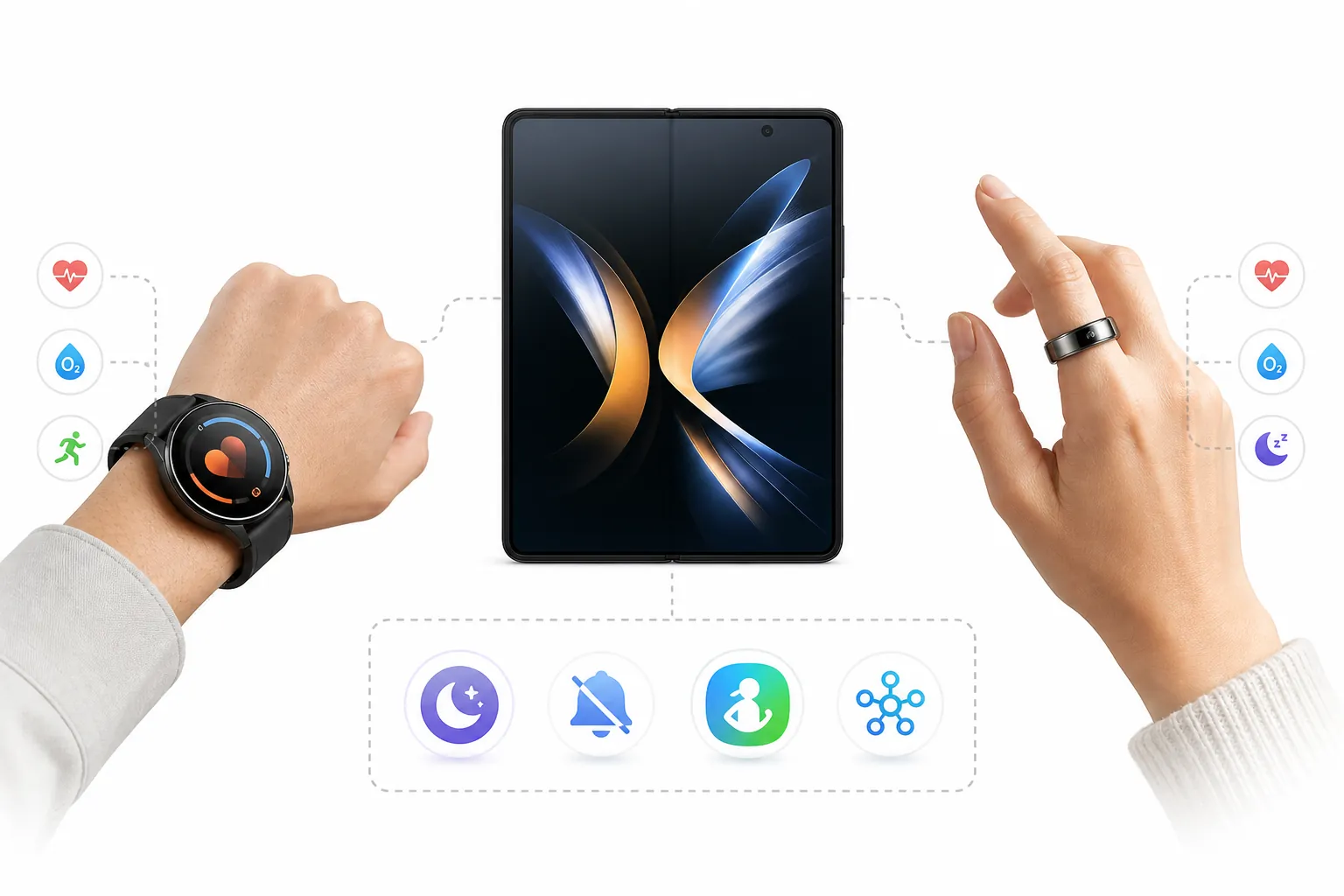
The most important thing to know about Galaxy Z Fold 8 sleep tracking features is that the phone is not the sleep tracker. The Fold is the screen, control panel, and routine engine. The biometric data comes from a separately worn Galaxy Watch or Galaxy Ring, and that distinction matters more if your bad nights are tied to hot flashes, pregnancy discomfort, nocturia, or age-related sleep fragmentation.
That does not make the phone irrelevant. A foldable phone can be a very good sleep hub: it can silence notifications, dim visual stimulation, show Samsung Health trends on a larger display, and trigger connected-home routines. But those are behavior tools. They are not evidence that your body slept well, recovered fully, or avoided clinically meaningful disruption.
The Fold 8 is the hub, not the sensor
On the phone side, the useful sleep features are mostly about reducing friction before bed and making the data easier to review afterward. Bedtime Mode can mute interruptions, shift the display toward grayscale, and reduce blue-light exposure. Samsung Health can collect sleep summaries from a paired wearable. SmartThings can automate a darker, quieter room by linking bedtime routines to lights, thermostats, or other connected devices. Samsung describes these tools as part of its broader sleep-support ecosystem rather than as phone-native physiologic measurement.[1]
Those features are worth using if your nights are being stretched by scrolling, alerts, or an inconsistent wind-down routine. A 2020 randomized trial found that restricting mobile phone use before bed reduced sleep latency and increased total sleep duration in young adults, with a mean participant age of 22.[2] That finding supports a modest behavioral claim: less phone use at bedtime can help some people fall asleep faster. It does not prove that screen restriction will resolve sleep disruption in perimenopause, pregnancy, or older adulthood.
Blue light deserves the same kind of proportion. It can affect circadian timing and alertness, and reducing evening light exposure is a reasonable default habit.[3] But if someone wakes drenched at 2:40 a.m., gets up to urinate three times, or cannot find a position that relieves pelvic pressure, the phone’s grayscale setting is not the main event.
What a paired Watch or Ring can plausibly show
With a Galaxy Watch or Galaxy Ring, Samsung Health can estimate sleep duration, sleep stages, sleep score, blood oxygen patterns, heart-rate-related metrics, snoring when configured, and in eligible users, signs associated with obstructive sleep apnea. The phone makes those signals readable. The wearable collects them.
| Feature area | What it may help you notice | Where caution is needed |
|---|---|---|
| Bedtime Mode and notification controls | Whether a quieter phone routine reduces avoidable wakefulness before bed | It cannot distinguish behavioral insomnia from physiologic arousals |
| Samsung Health sleep duration and sleep score | Night-to-night trend changes after schedule, medication, room temperature, or routine shifts | The score can look tidy even when the cause of waking is not identified |
| Sleep onset estimates | A rough pattern of whether sleep is taking longer than usual | Published validation has shown weak performance for sleep-onset latency |
| Blood oxygen and sleep apnea screening | Possible signs of moderate-to-severe obstructive sleep apnea in eligible, undiagnosed adults | It is a screening feature, not a diagnostic sleep study |
This is where the ecosystem becomes practically useful and easy to overread at the same time. A wearable can show that your sleep became more fragmented after a hot week, a new medication, late meals, or a shift in pregnancy discomfort. It can show a trend. It can prompt a better conversation with a clinician. It cannot, from the available public validation evidence, reliably tell a perimenopausal reader that vasomotor arousals are mild, or a pregnant reader that repeated awakenings are harmless, or an older adult that a “fair” score rules out a breathing disorder.
The validation gap is not a footnote
The strongest caution comes from the difference between sleep-wake detection and more delicate sleep timing. Oxford Neuroscience summarized validation evidence showing Samsung smartwatch sleep-versus-wake detection at roughly 78% accuracy against polysomnography, while sleep-onset latency estimation was much weaker, around 38%.[4] That gap matters because “how long did it take me to fall asleep?” is often the question people ask when they feel wired, hormonally unsettled, or repeatedly pulled out of sleep.
A device can be decent at separating broad sleep from wake and still struggle with the exact boundary where wakefulness becomes sleep. If you lie still because you are exhausted, overheated, anxious about the next bathroom trip, or simply trying not to wake a partner, wrist movement may not tell the whole story. A clean sleep-onset number can feel more precise than the evidence behind it.
This is also why a sleep score should not become the final word on whether a night was clinically meaningful. Sleep scores compress many signals into a digestible rating. That is useful for trend awareness, but compression hides cause. A low score does not explain why sleep broke apart. A moderate score does not mean the disruption was trivial.
Perimenopause is exactly where generic sleep scoring gets thin
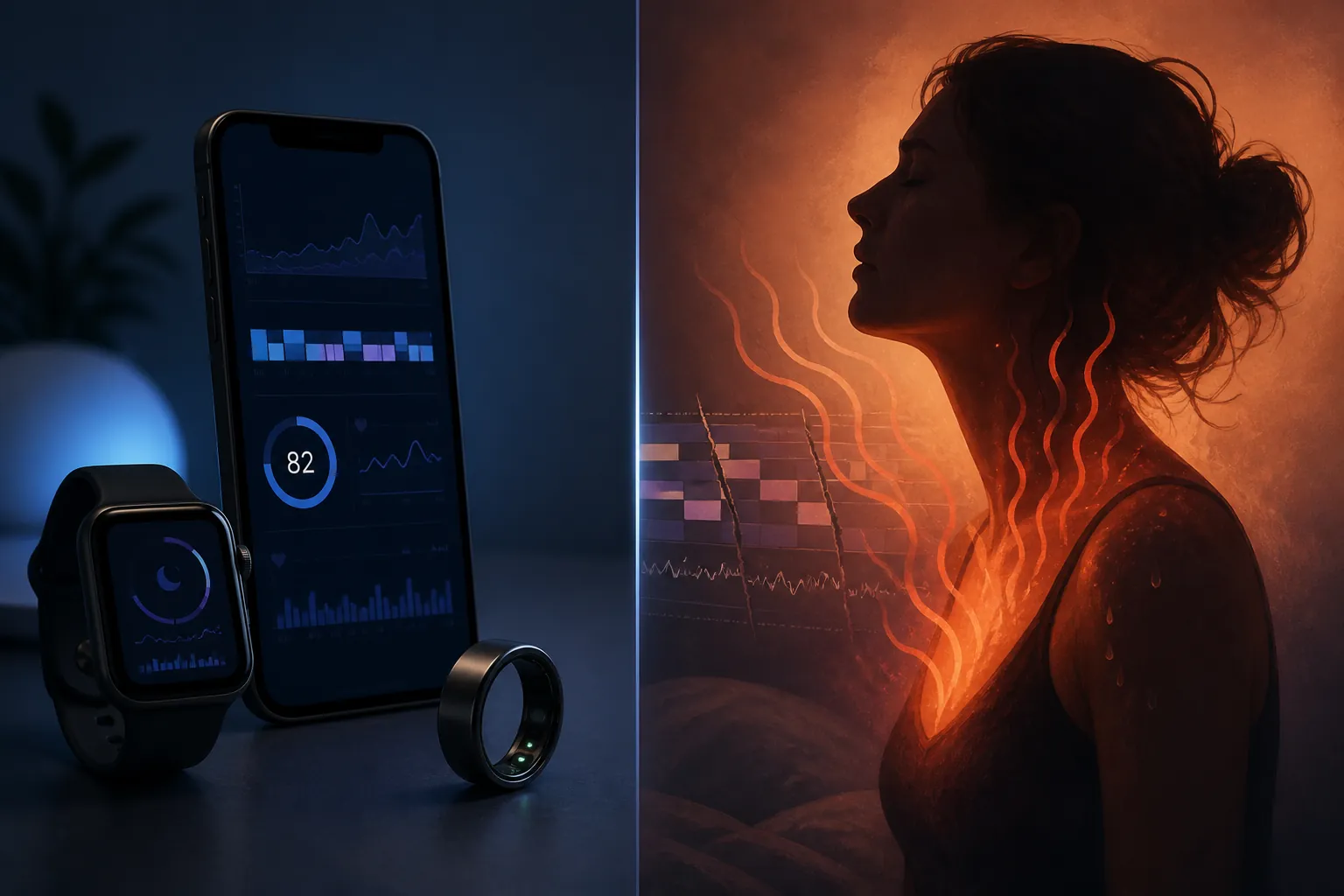
Perimenopausal sleep disruption is often driven by vasomotor symptoms: hot flashes and night sweats that reflect thermoregulatory changes, not simply poor bedtime discipline. A wearable may register the aftermath as restlessness, wake time, heart-rate change, or reduced sleep quality. That is not the same as identifying the hot flash as the cause.
For someone in the 40–55 range, this distinction can change the next step. If Samsung Health shows repeated wake periods around the same time each night, the useful interpretation may be, “there is a recurring disruption worth tracking alongside symptoms.” The risky interpretation is, “my sleep score is acceptable, so the night sweats are not seriously affecting my sleep.” The ecosystem has not been publicly validated as a perimenopause-specific sleep assessment tool.
That does not mean the data is useless. Trend lines can help you compare nights with alcohol, late exercise, room-temperature changes, hormone therapy discussions, or different bedding. The safer use is pattern recognition. The weaker use is treating the score as a severity rating for vasomotor symptom burden.
Pregnancy adds awakenings the algorithm may flatten
Pregnancy sleep is not just regular sleep with a larger belly. In the third trimester, nocturia and physical discomfort commonly produce several awakenings per night, often in the range of 3–5 awakenings. A wearable may record wake bouts, movement, or shorter sleep duration, but it will not understand bladder pressure, hip pain, reflux, fetal movement, anxiety before delivery, or the practical reality of repositioning a pregnant body at 3 a.m.
This matters because pregnancy already comes with a lot of monitoring. Adding another score can feel reassuring when it matches lived experience and strangely invalidating when it does not. If the Watch or Ring says the night was “fair” after five bathroom trips, the score has not captured the full cost of that sleep fragmentation. It has summarized detectable signals within its model.
The phone-side tools can still help around the edges. Bedtime Mode can keep a late notification from turning one bathroom trip into 40 minutes of wakefulness. A SmartThings routine can lower lights before bed or keep a hallway path dim. Those are sensible supports. They should not be mistaken for pregnancy-specific sleep validation.
Older adults should separate fragmentation from apnea screening
For older adults, the Galaxy ecosystem has two very different sleep uses. One is everyday tracking: duration, restlessness, sleep score, and trends. The other is Samsung’s sleep apnea screening feature, which received FDA De Novo authorization in February 2024 as an over-the-counter, software-only mobile medical app for detecting signs associated with moderate-to-severe obstructive sleep apnea.[5][6]
The apnea feature is the more clinically meaningful exception in Samsung’s sleep stack, but it is tightly bounded. It is intended for adults age 22 and older who have not already been diagnosed with sleep apnea. It monitors blood oxygen saturation dips over two nights, with at least 4 hours of sleep each night, within a 10-day period.[5][6] It is not a diagnostic device, and a notification should lead to medical follow-up rather than self-treatment.
That boundary is especially important for older adults because sleep can fragment for many reasons: medications, pain, circadian timing changes, caregiving schedules, bladder symptoms, and breathing disorders can overlap. A possible apnea notification is useful because it can push an undiagnosed person toward evaluation. A lack of notification should not be treated as proof that fragmented sleep is explained.
The broader wearable-AI evidence points in the same direction. A 2024 systematic review and meta-analysis of 38 studies with 2,015 participants found pooled accuracy of 86.9%, sensitivity of 93.8%, and specificity of 75.2% for wearable AI sleep apnea detection, but severity classification accuracy was lower at 65.1%.[7] Detection is not the same as grading severity, and neither replaces a diagnostic sleep evaluation.
For a broader device-comparison view, a separate guide to FDA-cleared sleep apnea notifications is the better place to compare Samsung and Apple ecosystems. Here, the practical point is narrower: the Fold 8 can help display and organize apnea-screening results from a compatible wearable, but the clinically relevant work belongs to the authorized software feature and the follow-up it prompts.
What to do with the data without giving it too much authority
The safest way to use the Galaxy Z Fold 8 sleep ecosystem is to treat it as a pattern notebook with automation, not as a verdict. Look for repeated timing, repeated triggers, and changes after a specific intervention. Did wakefulness cluster after night sweats? Did a cooler room coincide with fewer long wake periods? Did late notifications turn brief awakenings into long ones? Did an apnea prompt appear after two qualifying nights? These are useful observations.
- Use Bedtime Mode and notification silencing to remove avoidable arousal before sleep.
- Use Samsung Health trends to compare nights, not to declare a symptom mild or solved.
- Be cautious with sleep-onset estimates, especially when you spend long periods lying still.
- Treat apnea notifications as prompts for medical evaluation, not as diagnoses.
- Bring symptom notes with the wearable data when discussing perimenopause, pregnancy, or older-adult sleep changes with a clinician.
The missing validation is not a small technicality. Publicly available evidence does not establish Samsung Health sleep tracking as specifically accurate for perimenopausal people, pregnant people, or older adults with physiologically fragmented sleep. The latest Watch and Ring algorithms may improve over older models, but improvement should not be assumed without independent validation in the populations most likely to be misread.
So the practical judgment is simple: use the Galaxy Z Fold 8 ecosystem for routines, trend awareness, dashboard review, and eligible apnea-screening prompts from a paired wearable. Do not use Samsung Health sleep scores as evidence that hot-flash arousals, pregnancy awakenings, nocturia, or age-related fragmentation are mild, solved, or clinically explained.
References
- “Things to Know: How to Get Your Sleep Back on Track with Smart Tools,” Samsung Newsroom US.
- “Effect of restricting bedtime mobile phone use on sleep,” PLOS ONE, 2020.
- “How Does Blue Light From Electronic Devices Affect Sleep?,” Sleep Foundation.
- “Are sleep trackers accurate? Here’s what researchers currently know,” Oxford Neuroscience, 2021.
- “Samsung’s Sleep Apnea Feature on Galaxy Watch First of Its Kind Authorized by US FDA,” Samsung Global Newsroom, February 2024.
- “Samsung Galaxy Watch sleep apnea feature receives FDA authorization,” American Academy of Sleep Medicine.
- “Detection of Sleep Apnea Using Wearable AI: Systematic Review and Meta-Analysis,” PMC, 2024.
Supports these guides
Spot an error or have clinical feedback?
Because this article covers clinical, medication, or safety information, we use a moderated correction channel instead of open public comments. Let us know if something about “Galaxy Z Fold 8 sleep features: gaps for perimenopause” needs a closer look.
Send feedback on this article