
Mechanism explainer
Feng Shui Bedroom Placement for Better Perimenopause Sleep
Feng shui principles like natural breathable materials, bed placement for airflow, and cool-toned colors align with perimenopause thermoregulation needs, but evidence supports these individual components rather than feng shui as a unified system. This article bridges traditional feng shui with sleep science to help readers make evidence-aligned environmental changes.
The promise behind feng shui bedroom furniture placement for better sleep becomes more interesting in perimenopause for one very practical reason: the room that felt fine at 38 can suddenly feel like a heat trap at 48. Night sweats, temperature swings, lighter sleep, and stress arousal make small environmental details more consequential. A mattress shoved into a corner, storage bins under the bed, heavy bedding, dusty clutter, and a visually busy room may not cause the 3 a.m. wake-up, but they can make it harder to cool down once it starts.
That is where feng shui is useful if it is handled carefully. The strongest case is not that feng shui treats perimenopause insomnia. No study in the available research tests feng shui placement specifically in perimenopausal or menopausal women. The better case is narrower: several traditional bedroom placement ideas overlap with changes that make sense for hot sleepers—more air around the bed, clear space underneath it, fewer heat- and dust-trapping surfaces, breathable materials, and calmer visual cues.
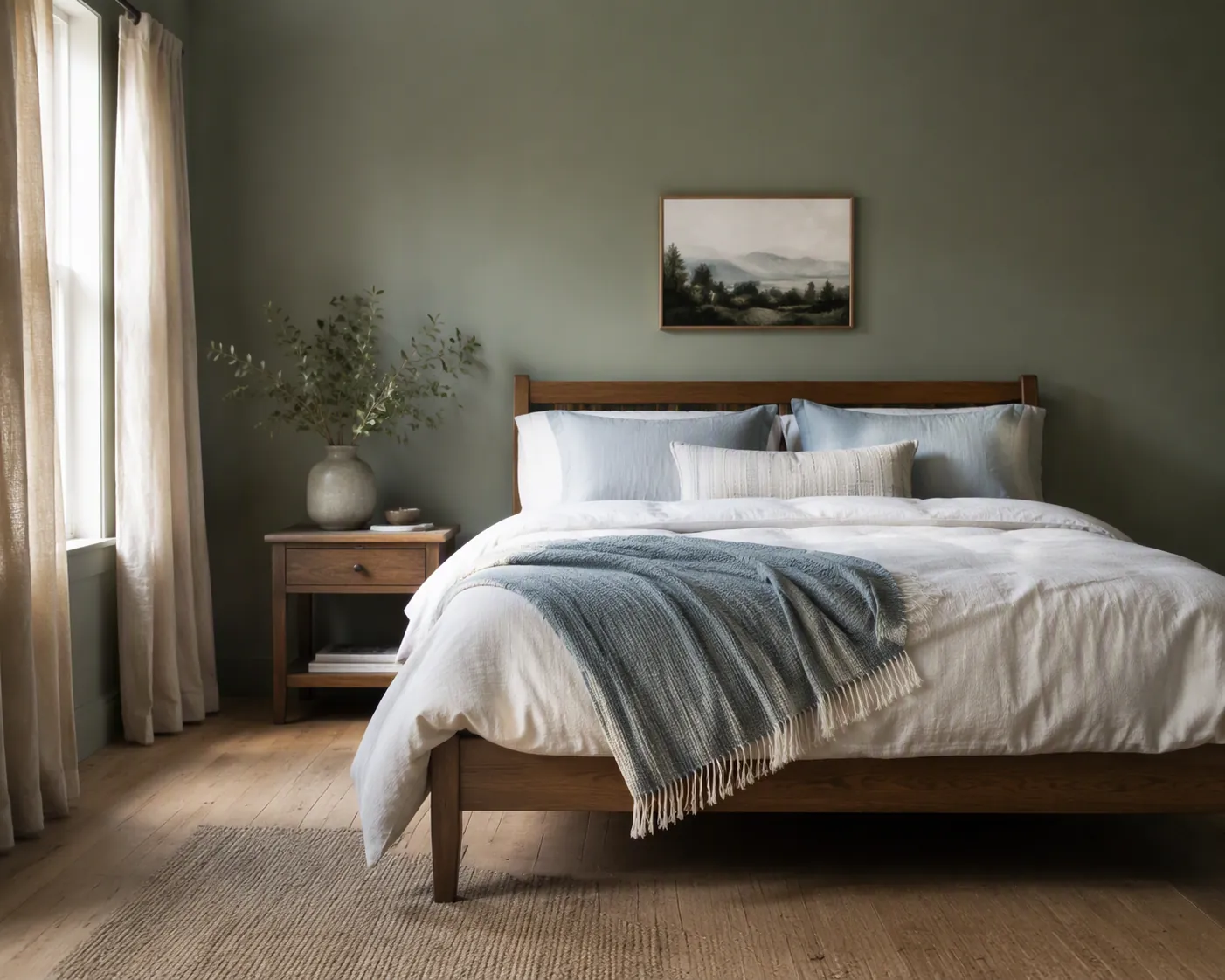
Start With Air Around the Bed
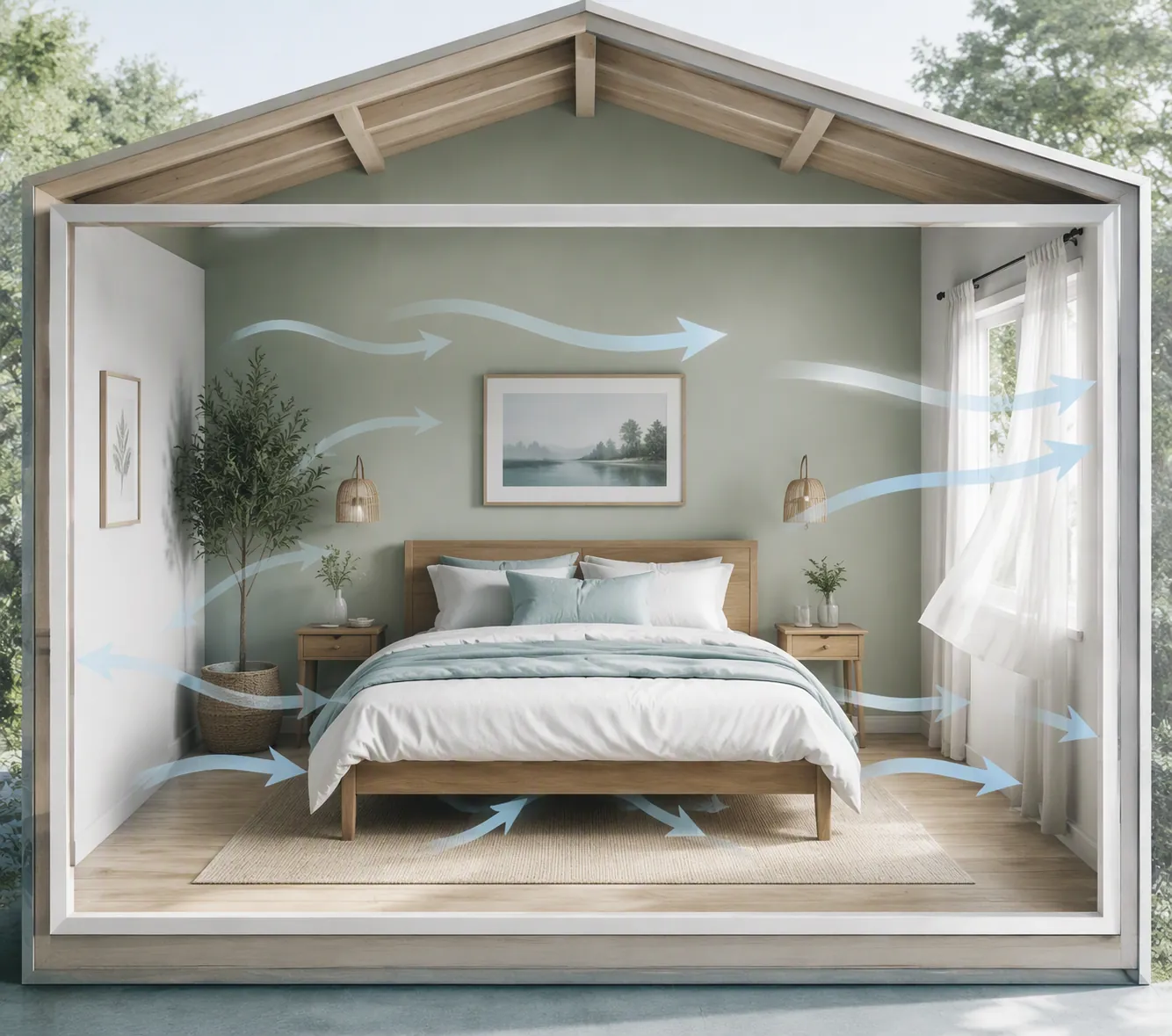
The first furniture move is also the least mystical: pull the bed out of the corner if the room allows it. A common feng shui placement rule is to leave at least 18 inches of clearance on both sides of the bed. For a hot sleeper, the point is not symmetry for its own sake. It is that air can move around both sides of the mattress, bedding can breathe instead of being pressed against a wall, and one partner does not have to climb over the other during an already-fragmented night.
This matters most in rooms where the bed is wedged into a corner, pushed tight against a radiator wall, boxed in by tall furniture, or surrounded by piles of laundry. When the mattress is pressed against two walls, the sleeper on the inside gets the least air movement and the most trapped warmth. In perimenopause, that can turn a manageable temperature wave into a full bedding change.
If the room is small, do not treat 18 inches as a moral test. The practical target is a bed that is accessible from both sides and not sealed into a pocket of stagnant air. Even a narrower gap can help if it lets you clean, move bedding away from the wall, and keep a fan or open doorway from sending air into a dead end.
Clear the Space Under the Bed Before Buying Anything Else
Under-bed storage is where a lot of good sleep advice quietly dies. Feng shui often discourages keeping boxes, shoes, papers, or seasonal clothing under the bed. That can sound symbolic, but the physical version is plain: packed storage blocks airflow under the mattress platform, collects dust, and makes the bed harder to clean around.
For someone waking damp, the under-bed zone is not wasted space; it is part of the bed’s microclimate. A clear floor under a raised bed allows air to circulate below the mattress and bed frame. A bed skirt that hangs heavily to the floor, stacked plastic bins, or fabric storage bags can trap warmth and dust where the sleeper is spending seven or eight hours trying to cool down.
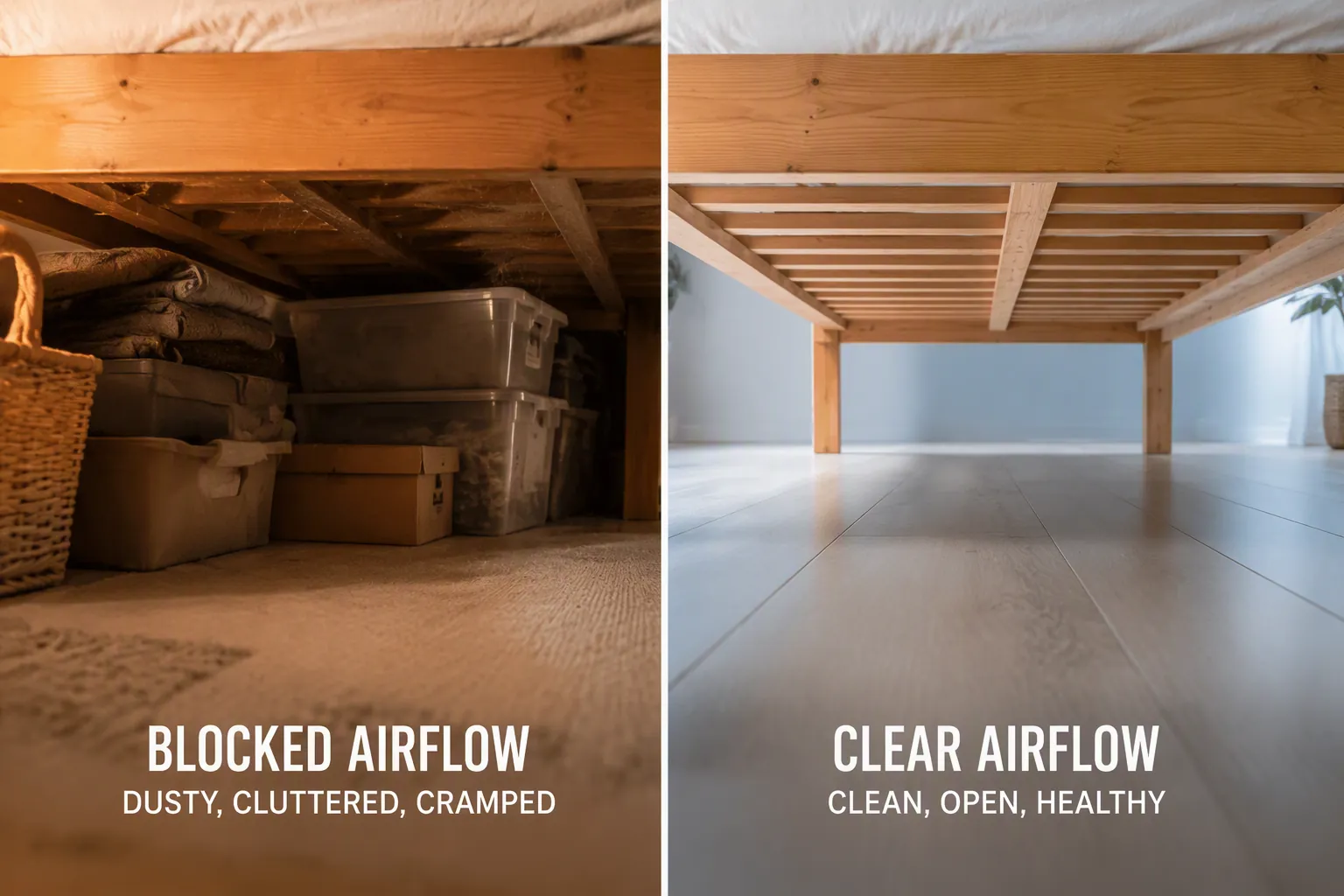
The best test is boring and effective: remove everything under the bed for two weeks. Vacuum the floor, wash or remove the bed skirt, and see whether the room feels easier to cool. If you must store items there, choose low, hard-sided containers that leave open channels for air rather than soft bags packed tightly from wall to wall.
What the Evidence Can—and Cannot—Say About Feng Shui
The most useful evidence here is not a clinical trial promising better menopause sleep. It is a 2023 systematic review by Han and Lin that examined 36 empirical and quantitative feng shui studies. The review concluded that feng shui has good reliability and validity when it evaluates environmental characteristics such as air quality, sunlight, and wind fields, while its effects on humans remain inconclusive. The authors described feng shui as “neither a superstition nor a science” but a “quasi-science.” [1]
That distinction is exactly the useful boundary. Wind fields, sunlight, and air quality are measurable environmental features. Whether a full feng shui system improves hormone-related sleep disruption is a much larger claim, and the available research does not establish it. For this article, the safer reading is that feng shui can point attention toward parts of the bedroom that standard sleep hygiene sometimes treats too generally.
There is one feng shui sleep study that often gets repeated in design content. Kryžanowski’s 2021 randomized double-blind field study reported that feng shui bedroom adjustments improved self-assessed sleep scores by 0.36 on a 1–5 Likert scale over 120 days in 134 participants, with p<0.001. But the study used an “instrumental biocommunication device” to deliver long-distance feng shui recommendations through a white-noise diode, and it appeared in an architecture/design journal rather than a sleep medicine journal. [2]
Medical News Today, summarizing feng shui bedroom claims, notes that this methodology does not meet modern medical research standards. [3] So the study is interesting as a design-world data point, not strong evidence that feng shui placement treats insomnia, night sweats, or vasomotor symptoms.
Use Feng Shui’s Material Preference in a Very Literal Way
Traditional feng shui bedroom advice often favors natural materials: wood furniture, cotton, linen, wool, bamboo, and other fibers that feel less sealed-off than plastic-heavy or synthetic surfaces. For perimenopause sleep, this is one of the easiest places to translate the idea into something testable.
Start with the textiles nearest the skin. A breathable fitted sheet, a lighter top layer, and a washable blanket usually matter more than a decorative headboard or matching lamps. Cotton and linen tend to release moisture better than many synthetic blends. Wool can be useful as a temperature-buffering layer for some sleepers, though anyone who finds wool itchy or too warm should not force it because a tradition says it is natural.
Furniture-adjacent textiles count too. Heavy upholstered headboards, thick bed skirts, dense area rugs under the entire bed, and layered decorative pillows can all hold warmth and dust. A calmer feng shui bedroom does not need to be bare, but a hot-sleeper version should be easy to wash, easy to vacuum, and light enough that the bed can release heat rather than store it.
For a deeper bedding-specific approach, Restful Ground’s guide to layering cooling bedding for menopause night sweats is the better place to compare layers, fibers, and removable covers.
The Commanding Position Is Secondary to Heat and Air
Most feng shui bedroom articles spend a long time on the commanding position: place the bed where you can see the door without lying directly in line with it. As a comfort preference, that can be reasonable. Many people do settle better when the room feels legible and they are not startled by movement at the doorway.
But if the “ideal” commanding position puts the bed against a sun-baked wall, blocks the only window, presses one side into a corner, or places the sleeper directly beside a heat source, it is the wrong priority for perimenopause sleep. A symbolic best position that makes the bed hotter is not better sleep design.
A useful order of operations looks like this:
- Choose the coolest wall or the wall least affected by direct afternoon heat.
- Keep the bed accessible from both sides when possible.
- Leave the under-bed space open enough for cleaning and airflow.
- Avoid blocking windows, vents, returns, or the path from a fan to the bed.
- Then, if there is still flexibility, choose the arrangement that feels most secure from the doorway.
This approach keeps the part of feng shui that can reduce nervous-system vigilance without letting it override the room’s thermal behavior.
Decluttering Helps Most When It Removes Heat, Dust, and Bedtime Friction
Decluttering is easy to oversell because it sounds virtuous. The useful question is more specific: what in the room is making sleep hotter, dustier, brighter, louder, or more mentally activating?
A chair stacked with clothes becomes a humidity trap and a morning problem waiting at bedtime. Open shelving near the bed collects dust. A nightstand crowded with receipts, medications, chargers, books, and half-finished tasks keeps the day visually present. Heavy drapes may block light well, but they can also make a room feel sealed and stale if they are rarely opened or cleaned.
The goal is not a showroom bedroom. It is a room that does not ask your brain to keep processing problems after lights-out. For someone already prone to waking with a racing heart, the fewer visual cues that say “unfinished,” the better. That is a stress-management argument, not proof that clutter directly causes perimenopause insomnia.
| Bedroom feature | Evidence-aligned reason to change it | Useful adjustment |
|---|---|---|
| Storage under the bed | Blocks airflow, collects dust, makes cleaning harder | Clear it for a trial period; keep only low storage that leaves open air channels if storage is unavoidable |
| Bed pushed into a corner | Limits air movement and makes one side harder to cool | Pull the bed away from the wall enough to access and ventilate both sides |
| Synthetic or heavy bedding | Can trap sweat and warmth near the skin | Use breathable, washable layers that can be removed quickly during a night sweat |
| Heavy drapes and dense rugs | Can hold dust and make the room feel sealed | Use washable window coverings and keep airflow paths open |
| Busy wall art or cluttered nightstands | Can increase visual stimulation at bedtime | Keep the sleep zone visually quiet and reserve storage for closed drawers or another room |
Cool Colors Can Change the Feel of the Room, Not the Biology of a Hot Flash
Feng shui bedroom palettes often lean toward soft blues, pale aquas, muted greens, creams, and natural wood tones while discouraging reds, oranges, and bold “fire” colors. For a perimenopause bedroom, that advice is most useful as a perception and arousal tool. Cool-toned colors can make a room feel calmer and less visually hot, while high-contrast patterns and saturated warm colors may feel more activating.
Color alone does not lower core body temperature or stop vasomotor symptoms. A pale blue wall cannot do the work of lighter bedding, better airflow, or a cooler room. But if a bedroom currently has red bedding, busy patterned curtains, bright art facing the bed, and warm lighting, shifting the palette can reduce the feeling that the room is pushing stimulation back at you.
Keep the color move low-cost if you are experimenting: a cooler duvet cover, lighter curtains, a less busy throw, or moving intense art out of direct sightline from the bed. Paint can wait until the airflow and bedding problems are solved.
What to Leave in the Symbolic Category
Some feng shui ideas may be meaningful, beautiful, or culturally important without having evidence as sleep interventions. Kua numbers, personal birth-element directions, exact color-element prescriptions, and decorative “energy cure” objects do not have the same practical footing as airflow, dust reduction, breathable fibers, and light control.
That does not mean you need to reject them. If a pair of nightstands makes the bed feel settled, use them. If a particular direction feels comforting and does not worsen heat, airflow, noise, or light, there is little harm in honoring that preference. The line to watch is treatment language. A bedroom choice can support rest without being sold as a fix for hormone-related insomnia.
Water features are a good example of where symbolism can conflict with sleep needs. A tabletop fountain might be recommended in some decorative interpretations, but in a hot or humid bedroom it can add noise, moisture, maintenance, and another object to clean. For a night-sweat sleeper, that tradeoff deserves skepticism.
A Practical Feng Shui Placement Workflow for Hot Sleepers
If you want to try feng shui bedroom placement without turning the room into a belief test, work in the order that affects heat and arousal first.
- Map the room’s heat: notice which wall gets afternoon sun, where vents or windows are blocked, and whether the bed sits in a stagnant corner.
- Move the bed for airflow: center it enough that air can move around both sides, even if the clearance is imperfect.
- Empty the under-bed space: remove bins, bags, shoes, papers, and bed skirts that seal off the floor.
- Strip back heat-holding textiles: reduce decorative pillows, heavy throws, dense rugs, and synthetic layers near the bed.
- Shift to breathable materials: prioritize cotton, linen, wool where it suits you, washable covers, and lighter bedding layers.
- Calm the sightline: remove work clutter, loud patterns, and unfinished-task piles from the view you see when lying down.
- Only then refine the symbolic layer: commanding position, paired nightstands, artwork, and preferred directions should support the physical room, not overrule it.
Try the physical changes for long enough to notice patterns, not just one good or bad night. Perimenopause sleep can vary for reasons that have nothing to do with the room, so a single wake-up does not prove the placement failed.
Where This Fits With Other Cooling Strategies
Furniture placement is the scaffold. It determines whether the cooler air you create can actually reach the bed, whether bedding can release heat, and whether dust and clutter keep accumulating in the sleep zone. It works best alongside more direct cooling choices: lighter bedding layers, better ventilation, humidity management, and a plan for night-sweat wake-ups.
If the room still runs hot after the bed is moved and cleared, continue with more targeted guidance: cooling a bedroom without AC, improving air quality for sleep, or working through product-specific IKEA sleep tips for perimenopause night sweats. For the broader physiology behind why heat hits sleep harder in this life stage, start with hot nights, older adults, and women or the full perimenopause sleep hub.
The useful verdict is modest. Feng shui bedroom furniture placement can support perimenopause sleep when it improves airflow, keeps the under-bed area clear, reduces heat retention, favors breathable materials, and lowers visual stress. It is not a tested treatment for vasomotor symptoms or hormone-related insomnia, and it should not replace medical care when night sweats, racing-heart awakenings, or sleeplessness become severe or persistent.
References
- Empirical and quantitative studies of Feng Shui: A systematic review (PRISMA 2009 item 1) — PMC, 2023
- Impact of Feng Shui Bedrooms on Self-Assessed Sleep and Well-Being: A Randomized Double-Blind Field Research — South East European Journal of Architecture and Design, 2021
- Feng Shui tips for the bedroom: Benefits and what to avoid — Medical News Today
Supports these guides
Spot an error or have clinical feedback?
Because this article covers clinical, medication, or safety information, we use a moderated correction channel instead of open public comments. Let us know if something about “Feng Shui Bedroom Placement for Better Perimenopause Sleep” needs a closer look.
Send feedback on this article