Mechanism explainer
Is the Galaxy Z Fold 8’s Sleep Tracking Useful for Perimenopause?
This article examines whether the Samsung Galaxy Z Fold 8, paired with the Galaxy Watch 8, can help perimenopausal and menopausal women understand hormonally driven sleep changes. It compares the ecosystem's FDA-cleared sleep apnea screening, cycle tracking, and sleep coaching against practical limitations and alternatives like the Oura Ring 4.
The first thing to clear up in a Galaxy Z Fold 8 review of sleep tracking is that the phone does not track your sleep. It is the screen you open in the morning, the place Samsung Health turns a night into charts, scores, coaching prompts, and alerts. The actual sleep data comes from a wearable: most likely the Galaxy Watch 8, or in some cases the Galaxy Ring.
That distinction matters more for a perimenopausal or menopausal buyer than it might for a general gadget review. A large folding phone can make trends easier to read, and Samsung’s ecosystem can be convenient if you already live in it. But the more important question is whether the wearable on your wrist can separate ordinary bad sleep from a pattern worth taking to a clinician: repeated fragmentation, oxygen-related breathing concerns, snoring context, cycle-related temperature shifts, or fatigue that does not match the cheerful language of a daily score.
Why Sleep Tracking Gets More Serious Around Menopause
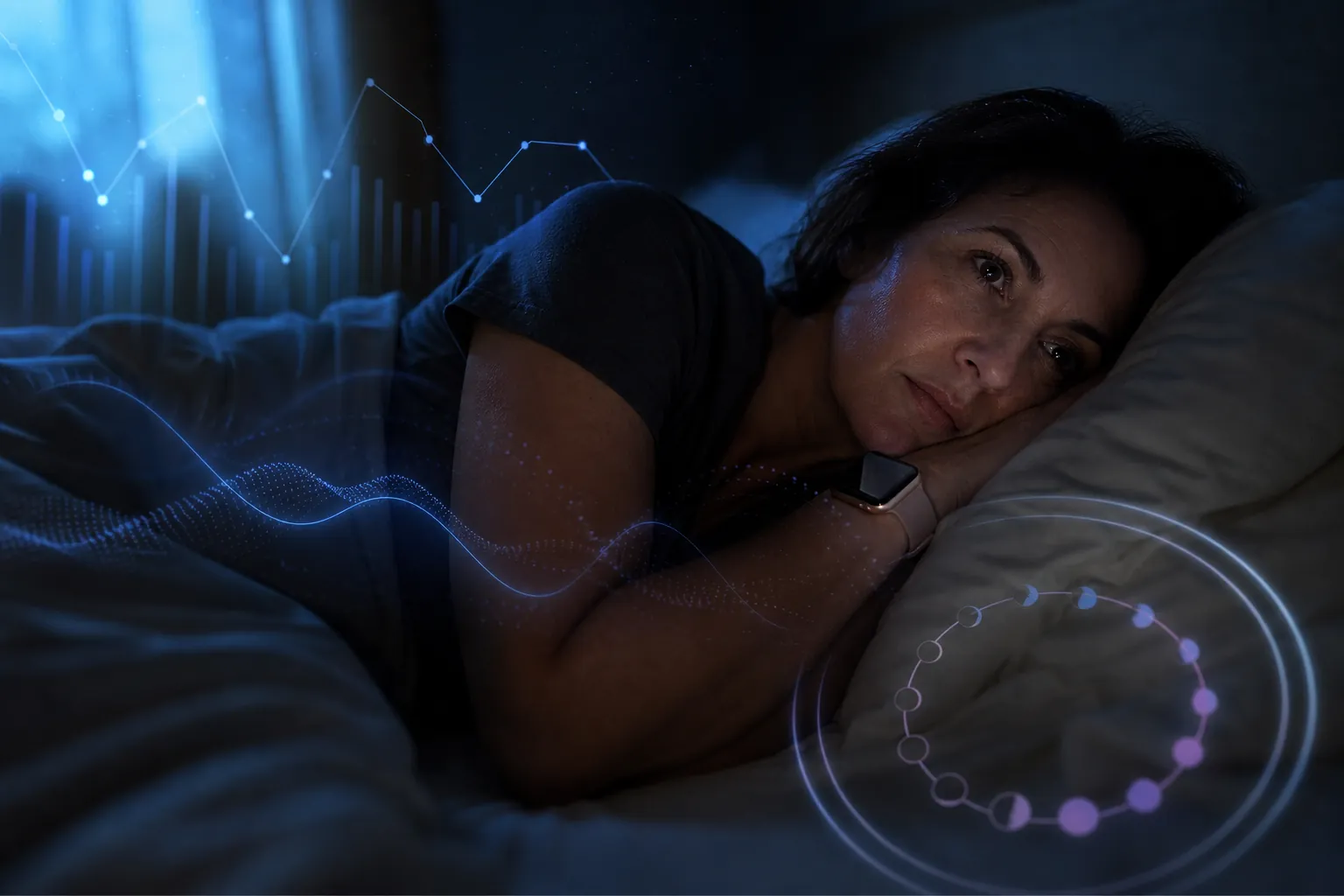
For women in their 40s and 50s, sleep tracking is not just a productivity hobby dressed up as wellness. Postmenopausal sleep problems are common enough that a wearable’s ability to flag the right pattern can matter. A systematic review and meta-analysis reported a 51.6% prevalence of sleep disorders among postmenopausal women, with a confidence interval of 44.6% to 58.5%; within the included literature, obstructive sleep apnea prevalence ranged from 47% to 67%.[1]
That does not mean every woman waking at 3 a.m. has sleep apnea. Hot flashes, anxiety, caregiving, alcohol, medications, pain, and cycle changes can all disturb sleep. It does mean that a device which can raise a reasonably specific apnea concern is doing something more useful than telling a tired person to keep a consistent bedtime.
This is where Samsung’s strongest sleep feature deserves real credit. The Galaxy Watch line received FDA authorization for a sleep apnea detection feature through the de novo pathway. In Samsung’s FDA submission for DEN230041, the feature showed 82.7% sensitivity and 91.1% specificity for detecting moderate-to-severe obstructive sleep apnea.[2]
The Best Samsung Sleep Feature Is Not the Sleep Score
Samsung’s sleep apnea feature is not a diagnosis. It is a screening tool, and its FDA-cleared boundary matters: it is intended to identify signs of moderate-to-severe obstructive sleep apnea in adults 22 and older.[2] It is not designed to rule out mild apnea, explain insomnia, diagnose perimenopause, or tell you whether a hot flash woke you before the watch noticed movement.
Even with those limits, this is the most clinically meaningful part of the Galaxy Watch 8 sleep story. A perimenopausal woman who has started snoring, wakes unrefreshed, sees repeated nighttime awakenings, or has a partner reporting breathing pauses needs more than a cute sleep animal. A wearable alert cannot replace a sleep study, but it can give her a concrete reason to ask for one.
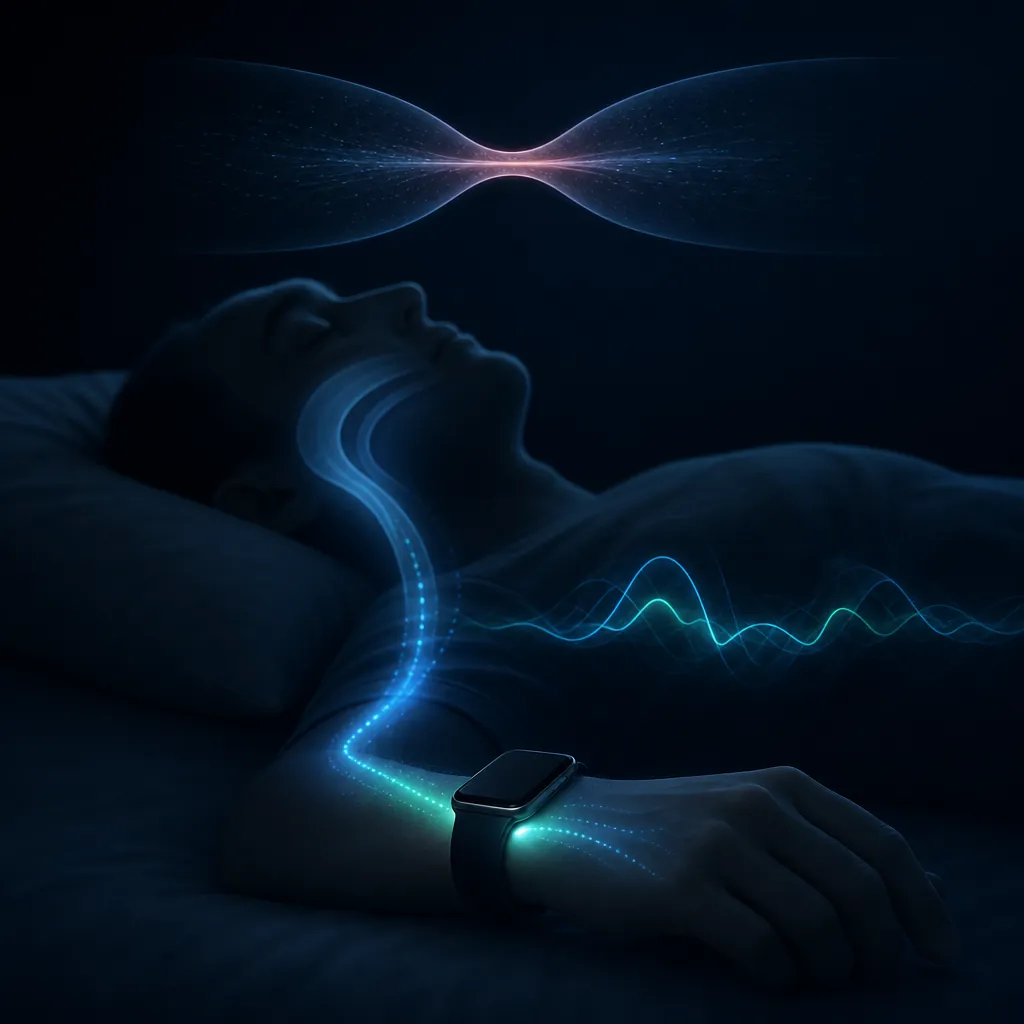
Samsung’s broader sleep system also includes sleep duration, sleep stages, blood oxygen during sleep, skin temperature, snore detection, sleep coaching, and an Energy Score inside Samsung Health.[3] Some of those are helpful as pattern-finders. Some are more fragile when a hormonally disrupted sleeper is trying to understand why she feels awful despite a dashboard that looks acceptable.
| Feature | What It Can Help With | What It Cannot Prove |
|---|---|---|
| Sleep apnea detection | Flags possible moderate-to-severe obstructive sleep apnea in adults 22+ | Does not diagnose apnea or rule out mild disease |
| Sleep stages and awakenings | Shows fragmentation patterns over time | Does not reliably identify the hormonal cause of an awakening |
| Skin temperature and cycle tracking | Helps compare sleep changes with cycle phase or temperature shifts | Does not directly diagnose perimenopause |
| Energy Score | Summarizes sleep, activity, and recovery signals | May reassure when the lived night was clearly poor |
| Sleep coaching | Gives behavioral guidance based on Samsung’s system | Is not a menopause-specific clinical program |
Fragmented Sleep Is the Pattern to Watch
For this audience, the most useful nightly readout is often not the total score. It is the shape of the night: how often sleep breaks, whether wake periods cluster after a temperature rise, whether oxygen dips accompany snoring, whether a supposedly full night still leaves a long trail of restlessness.
Android Authority’s Galaxy Watch 8 sleep-tracking review is valuable because it describes exactly that kind of real-world fragmentation rather than only reporting polished feature lists. The reviewer found the watch captured disrupted sleep with unusual sensitivity, including fragmented nights and naps, and noted that it did not falsely log naps during physiotherapy sessions.[4] That kind of distinction matters: a wearable that mistakes stillness for sleep can make a rough perimenopause night look cleaner than it was.
Independent wearable research still puts a ceiling on how much confidence to place in sleep stages. In a 2024 study comparing consumer sleep trackers with polysomnography, devices generally showed high sleep/wake sensitivity of at least 95%, while sleep-stage classification accuracy ranged from 50% to 86%.[5] In plain terms: a watch may be quite good at noticing that you were probably asleep, awake, or restless, while being less dependable when it divides the night into light, deep, and REM sleep.
That is not a reason to ignore the data. It is a reason to use it properly. A week of repeated wake-ups, oxygen concerns, or snoring markers is more useful than a single REM percentage. A trend you can describe to a clinician is more useful than a badge telling you that you are a “lion” or a “penguin.”
Cycle Tracking Helps, But It Does Not Explain Perimenopause by Itself
Samsung’s cycle tracking is one of the more relevant features for women trying to connect irregular nights with hormonal timing. The Galaxy Watch uses overnight skin temperature data to support cycle tracking, and Samsung highlights integration with Natural Cycles for temperature-based period prediction.[3]
The practical value is correlation. If your watch shows worse sleep during the late luteal phase, around irregular bleeding, or during nights with temperature changes, that gives you a pattern to bring into a menopause visit. It may help you say, “This is happening repeatedly around this part of my cycle,” instead of trying to reconstruct three months of broken nights from memory.
The limitation is just as important. Skin temperature is not a perimenopause diagnosis. It does not measure estrogen swings directly, and it cannot tell whether a 2:40 a.m. awakening came from a vasomotor symptom, anxiety, apnea, reflux, or the dog. Samsung’s cycle tools are useful when they help you compare sleep against a hormonal timeline. They become less useful if the app treats the timeline as ordinary reproductive-cycle tracking while the user is already in the messier territory of skipped cycles, heavier or lighter bleeding, night sweats, and unpredictable symptoms.
Energy Score Can Smooth Over a Bad Night
Samsung’s Energy Score combines sleep and activity signals into a daily readiness-style number, while sleep coaching uses a proprietary system built around National Sleep Foundation guidelines and assigns one of eight animal types after enough sleep data is collected.[3] SlashGear has cataloged Samsung’s eight sleep animals and their meanings, from “unconcerned lion” to “sensitive hedgehog.”[6]
There is nothing inherently wrong with simplifying sleep data. A tired user does not always want to read a lab report before coffee. The problem is that perimenopausal sleep is often bad in ways that averages can soften. If someone usually has strong recovery metrics, a four- or five-hour night can still produce a score that looks less alarming than the body feels. The number may be mathematically consistent with the system and still clinically unhelpful for the person staring at it after another night of heat, wakefulness, and 5 a.m. resignation.
The sleep-animal system has a similar problem. It may encourage better habits, and the National Sleep Foundation basis is more respectable than a random gamified badge.[3] But it is still Samsung’s proprietary coaching layer, not a clinically validated menopause sleep phenotype. A woman whose sleep changed sharply in her late 40s does not only need to be told what kind of sleeper she resembles. She needs to know whether her pattern suggests breathing trouble, vasomotor disruption, medication effects, pain, stress, or something else that deserves care.
The Fold 8 Is a Good Dashboard, But the Watch Does the Work
The Galaxy Z Fold 8’s main advantage for sleep tracking is not a sensor. It is screen space. A folding phone is better suited than a small slab phone to reviewing weekly sleep graphs, comparing cycle notes, opening Samsung Health beside a calendar, or preparing screenshots before an appointment. If you already use Samsung’s notes, reminders, and health apps, that convenience is real.
But this is also where ecosystem lock-in starts to matter. Samsung notes that some health and watch features depend on a Samsung phone, and the broader Galaxy Watch experience is strongest inside the Galaxy ecosystem.[3] Snore detection also requires the phone to be charging nearby overnight, because the phone microphone is part of the setup.[3] That is a small nuisance for some people and a meaningful failure point for others: the phone is on the wrong nightstand, not charging, or simply not something a person wants listening by the bed.
The ordinary smartwatch features are not irrelevant. ECG, alerts, workouts, gestures, app integration, and a bright display can all make the Watch 8 a better daily companion. They just do not answer the perimenopause sleep question by themselves. The sleep case rises or falls on whether the watch can capture the right overnight signals often enough to reveal a pattern.
Charging Is Not a Minor Detail When You Are Already Tired
PCMag measured the Galaxy Watch 8 at 26 hours of battery life in testing.[7] That is workable, but it means the user has to build charging into the day with some discipline. For someone tracking sleep, the watch cannot be on the charger at night. For someone tracking perimenopausal sleep, missing nights are not a small inconvenience, because the whole point is to catch irregularity across time.
Daily charging is the kind of burden tech reviews often underweight. It is easy to manage when sleep is fine, routines are stable, and the charger is exactly where it should be. It is less charming when a person has been awake since 3:17 a.m., forgot to top up the watch before bed, and now has no data from the one night she most wanted to understand.
Where Oura Ring 4 Becomes the Clearer Perimenopause Tool
Samsung deserves to be judged on its strongest evidence before being compared with Oura. On sleep apnea screening, Samsung is stronger. On phone-watch integration, it is stronger if the rest of your life is already on Galaxy devices. On a large Fold screen, Samsung Health can be easier to review than a phone-only dashboard.
Oura Ring 4 becomes more compelling when the question narrows to perimenopause itself. Oprah Daily reported Oura’s Perimenopause Check-In feature, including symptom tracking connected to the Menopause Rating Scale, known as MRS.[8] That matters because the product names the life stage Samsung’s coaching layer mostly works around. Instead of asking a woman to infer hormonal context from generic sleep coaching, Oura gives her a structure for tracking menopausal symptoms alongside rest and recovery.
That does not make Oura a doctor, and it does not make Samsung a bad sleep tracker. It clarifies the job. If the priority is possible sleep apnea, Samsung’s FDA-authorized screening is the more important feature. If the priority is understanding sleep disruption in the broader symptom pattern of perimenopause, Oura is built closer to that question.
Who Should Choose the Galaxy Z Fold 8 and Watch 8 for Sleep
The Galaxy Z Fold 8 paired with Galaxy Watch 8 is useful for sleep tracking if you want a Samsung-centered system that can surface possible moderate-to-severe obstructive sleep apnea, show fragmented sleep patterns, connect skin-temperature cycle tracking with sleep changes, and give you a large dashboard for reviewing trends. That is a real set of benefits, especially for a woman who has new snoring, morning fatigue, repeated awakenings, or a clinician who responds better to patterns than to verbal summaries.
It is less convincing if you are mainly looking for a perimenopause-specific sleep companion. Samsung’s Energy Score and sleep coaching may be pleasant, but they are not designed around hormonally mediated sleep fragmentation. The sleep animals can encourage habits, but they do not name vasomotor symptoms, irregular cycles, or the clinical texture of menopause transition. The 26-hour tested battery life also means you have to keep solving the charging problem every day.[7]
So the answer is not that the Galaxy Z Fold 8 has good sleep tracking. The phone has a good place to read sleep tracking. The Galaxy Watch 8 is the device doing the medically interesting work. Choose Samsung if apnea screening, Galaxy integration, and a large health dashboard are your priorities. Choose Oura Ring 4 if the central problem is making perimenopausal sleep disruption visible in its hormonal and symptom context.
References
- Prevalence of sleep disorders in postmenopausal women: a systematic review and meta-analysis, PMC.
- DEN230041, U.S. Food and Drug Administration.
- Galaxy Watch8, Samsung.
- I tested the Galaxy Watch 8’s sleep tracking for a week: Here’s what surprised me, Android Authority.
- Performance of seven consumer sleep-tracking devices compared with polysomnography, PMC, 2024.
- What Do Samsung Galaxy Watch Sleep Animals Mean?, SlashGear.
- Samsung Galaxy Watch 8 Review, PCMag.
- Oura Ring Is Launching New Perimenopause and Pregnancy Features, Oprah Daily.
Supports these guides
Spot an error or have clinical feedback?
Because this article covers clinical, medication, or safety information, we use a moderated correction channel instead of open public comments. Let us know if something about “Is the Galaxy Z Fold 8’s Sleep Tracking Useful for Perimenopause?” needs a closer look.
Send feedback on this article