
Mechanism explainer
Why focused ultrasound may or may not help Parkinson's sleep
Curious whether focused ultrasound can treat the sleep problems that come with Parkinson's disease? This article breaks down what the evidence shows — and why the answer depends on which brain target is treated and whether the procedure is unilateral or bilateral.
Focused ultrasound is usually introduced to people with Parkinson's disease through tremor: an incisionless procedure, a visible target, and a motor symptom that can be measured in the exam room. Sleep enters the conversation differently. It is the symptom that decides whether a spouse sleeps in the same bed, whether someone is safe walking to the bathroom at 3 a.m., and whether the next day begins already exhausted.
So the patient-facing question is reasonable: if focused ultrasound can calm Parkinson's tremor, can it also improve Parkinson's sleep problems? The careful answer is that focused ultrasound is not one sleep-relevant treatment. Its likely effect depends on the brain target, whether treatment is one-sided or two-sided, and whether sleep was actually measured rather than folded into a broad hope for better quality of life.

Parkinson's Sleep Problems Are Not a Side Issue
Sleep disorders affect an estimated 71% to 98% of people with Parkinson's disease, depending on disease stage, and they can appear early rather than waiting for advanced disease. In early Parkinson's, insomnia affects about 41% of patients; REM sleep behavior disorder affects about one-quarter; and excessive daytime sleepiness affects roughly 25% to 50% across Parkinson's populations.[1]
Those labels describe very different burdens. Insomnia may mean long wakeful stretches after midnight. REM sleep behavior disorder, or RBD, may mean dream enactment that can injure the person with Parkinson's or a bed partner. Daytime sleepiness may turn reading, driving, meals, or conversation into safety questions. For readers who want the broader sleep landscape before focusing on procedures, How Parkinson's Disease Disrupts Your Sleep is the better starting point.
But burden is not proof of treatment benefit. A treatment can improve tremor and leave insomnia unchanged. It can reduce medication needs and indirectly help sleep in some people. It can also touch a circuit that has little reason to affect dream enactment or daytime alertness. That is why the target matters.
The First Sorting Rule: Which Circuit Was Treated?
Patient materials often say "focused ultrasound" as if the phrase names one Parkinson's treatment. It does not. MR-guided focused ultrasound can create a lesion in different deep brain targets. In Parkinson's disease, the target most patients hear about is the ventral intermediate nucleus of the thalamus, often shortened to VIM, for tremor-dominant disease. Other approaches aim at pallidal circuitry, including pallidothalamic tractotomy and pallidotomy.
| Focused ultrasound approach | Main Parkinson's context in the evidence here | What the sleep evidence suggests |
|---|---|---|
| Unilateral VIM thalamotomy | Tremor-dominant Parkinson's; the common FDA-approved focused ultrasound pathway in the U.S. | No significant change in daytime sleepiness or RBD screening scores at 6 or 12 months in the available study |
| Bilateral pallidothalamic tractotomy | Small single-center series treating broader Parkinson's motor symptoms through pallidal outflow circuitry | Sleep disorders improved in 3 of 4 affected patients at 1 year, but sleep was not the primary endpoint |
| Staged bilateral pallidotomy | Single published case involving Parkinson-related facial dyskinesia | RBD improved after the second-side treatment; this is a mechanistic clue, not generalizable proof |
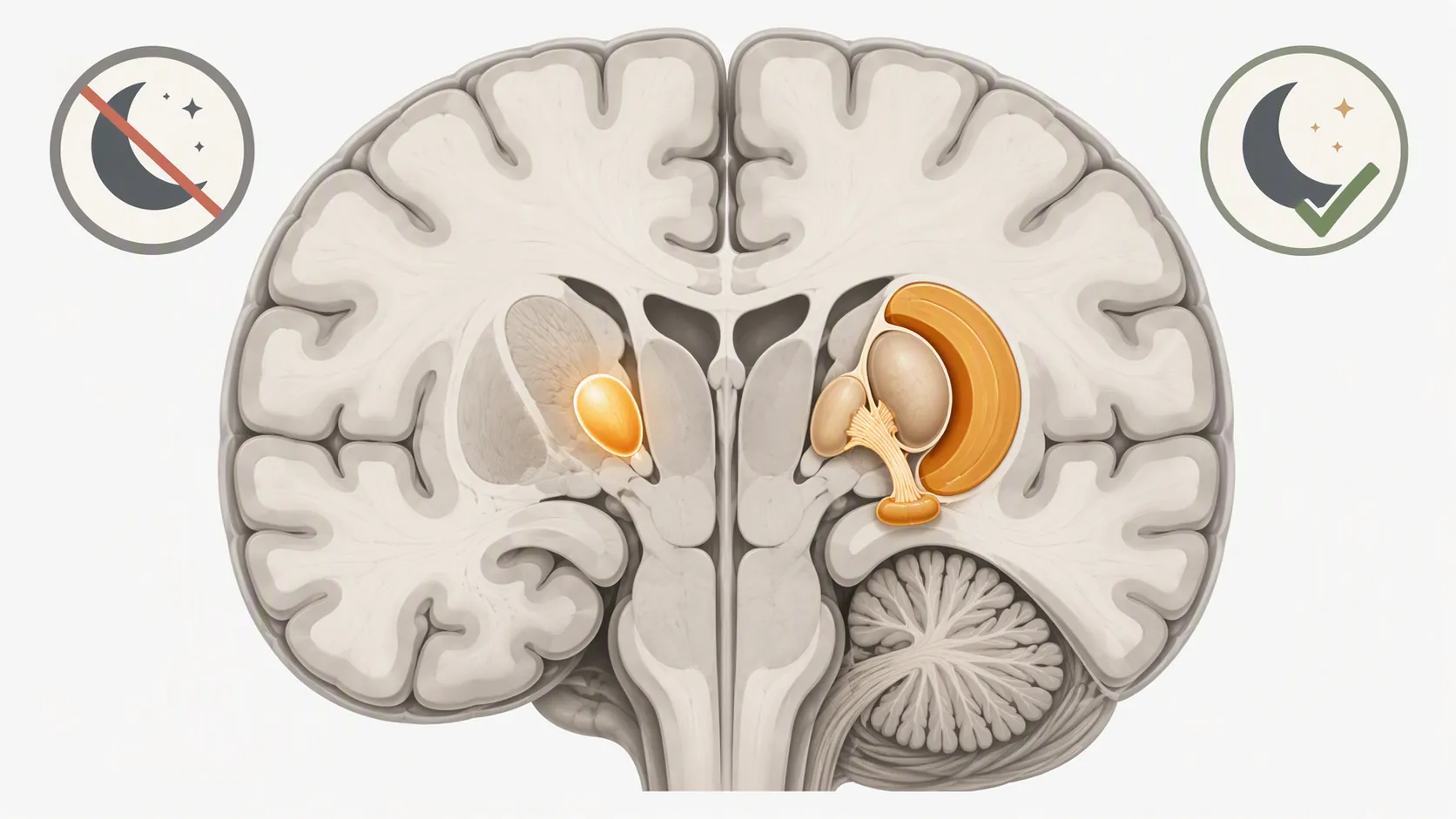
That distinction is not academic. VIM thalamotomy and pallidal-circuit procedures are aimed at different pathways. A sleep claim attached to one target should not drift over to another target just because both use focused ultrasound energy.
For Unilateral VIM Thalamotomy, Sleep Improvement Should Not Be Expected
The most clinically useful evidence for many patients is the least glamorous: a null result. Purrer and colleagues studied 25 people with tremor-dominant Parkinson's disease who underwent unilateral MR-guided focused ultrasound thalamotomy at University Hospital Bonn. They measured non-motor outcomes before treatment and again at 6 and 12 months, including the Epworth Sleepiness Scale for daytime sleepiness and the REM Sleep Behavior Disorder Screening Questionnaire for RBD risk.[2]
The study found no significant change in sleep-related scores after unilateral thalamotomy. It also found no adverse effects on mood, anxiety, apathy, or cognition over the same follow-up period.[2] For someone considering this procedure primarily for tremor, that is reassuring in one direction and limiting in another: the available evidence does not suggest that unilateral VIM thalamotomy worsens these measured non-motor domains, but it also does not support expecting better sleep.
This matters because unilateral VIM thalamotomy is the focused ultrasound procedure most likely to be discussed in routine tremor-dominant Parkinson's care in the United States. It treats a tremor circuit. If the household's hardest problem is dream enactment, sleep fragmentation, or a partner staying half-awake to monitor nighttime movement, the VIM evidence should slow the conversation down.
There is also a measurement caution. The Epworth Sleepiness Scale is about the chance of dozing in daytime situations, and the RBD questionnaire screens for REM sleep behavior disorder risk. Those tools do not fully describe insomnia severity, awakenings, sleep efficiency, leg discomfort, nighttime urination, medication wearing-off, or the care partner's sleep. So "no sleep change" here should be read as no significant change on the measured sleep-related screening outcomes, not as a complete laboratory map of every night symptom.
Still, it is the right evidence to give weight. It asks the question closest to the real-world scenario many readers have in mind: after a one-sided focused ultrasound thalamotomy for Parkinson's tremor, do daytime sleepiness or RBD screening scores improve? In this study, they did not.[2]
Why Bilateral Pallidal Procedures Are a Different Conversation
The more intriguing sleep signal comes from procedures that do not simply repeat VIM thalamotomy under another name. Gallay and colleagues reported a 10-patient, single-center Swiss series of bilateral MR-guided focused ultrasound pallidothalamic tractotomy, or PTT, with 1-year follow-up. In that series, sleep disorders were suppressed in 3 of 4 patients who had them at baseline.[3]
The same series reported an 89% reduction in pain and 82% global symptom relief, which suggests the intervention affected more than one narrow tremor measure.[3] But the limits are just as important as the signal. This was a small, open-label, retrospective series from one center. Sleep was not the primary endpoint. There was no control group. Three out of four affected patients is worth noticing; it is not enough to turn bilateral PTT into an established sleep treatment.
The reason this finding should not be collapsed with the VIM thalamotomy result is anatomical. Pallidothalamic tractotomy targets pallidal efferent fibers, part of a circuit that is more plausibly connected with broader motor state, nocturnal movement, medication effects, and sleep-wake regulation than a unilateral tremor thalamotomy target. That does not prove causation. It does explain why the positive signal belongs in a separate bucket.
A single case report points in a similar direction without being able to carry much weight by itself. Stieglitz and colleagues described staged bilateral MR-guided focused ultrasound pallidotomy for Parkinson-related facial dyskinesia. REM sleep behavior disorder improved after the second-side treatment, and the report noted no cognitive decline.[4]
That case is useful mainly because of its timing and target: RBD improved after bilateral pallidal treatment, not after a unilateral VIM thalamotomy. But it remains one person. It should generate hypotheses for careful study, not expectations for a clinic visit.
What This Means If You Are Comparing Options
If a clinician is discussing unilateral VIM focused ultrasound thalamotomy for tremor-dominant Parkinson's, sleep improvement should not be part of the expected benefit based on current evidence. Tremor may improve; the measured sleep-related outcomes in the available unilateral thalamotomy study did not.[2]
If someone is discussing bilateral pallidothalamic tractotomy or pallidotomy, the sleep question is more open, but also more conditional. The published signal is procedure-specific and preliminary: a 10-patient PTT series with sleep improvement in 3 of 4 affected patients, and a single bilateral pallidotomy case with RBD improvement after the second-side procedure.[3][4]
This is also where access and candidacy become part of the answer. Bilateral focused ultrasound procedures for Parkinson's are not the same as the unilateral FDA-approved thalamotomy pathway for tremor-dominant disease in the U.S. They may be available only through research protocols or off-label settings, and eligibility depends on factors such as skull density ratio, symptom profile, candidacy for bilateral treatment, regulatory status, and risk tolerance.
A useful appointment question is therefore not, "Will focused ultrasound help my sleep?" It is more precise: "Which target are we treating, on one side or both sides, and what sleep outcome has evidence for that exact procedure?" The answer may be different for tremor, daytime sleepiness, RBD risk, insomnia, nighttime movement, and the sleep of the person sharing the room. Care partners reading because their own nights have changed may also find Why your sleep suffers when your partner has Parkinson's relevant.
RBD deserves particular care in this discussion because it is not just a nuisance symptom. It can be part of the Parkinson's disease course and may also appear in relation to Lewy body disorders; readers comparing those conditions can look at Every sleep disorder linked to Lewy body dementia. In the focused ultrasound evidence, though, the strongest RBD-related point is narrow: unilateral VIM thalamotomy did not significantly change RBD screening risk, while bilateral pallidal treatment has only early, small signals.
The Practical Bottom Line
Focused ultrasound may or may not help Parkinson's sleep problems depending on the exact procedure. For unilateral VIM thalamotomy, the best available evidence says not to expect improvement in the measured sleep-related outcomes. For bilateral pallidal-circuit procedures, the early reports are interesting enough to discuss with a movement-disorders team, but they remain investigational signals rather than a settled sleep indication.
References
- Sleep disorders in Parkinson's disease, an early and multiple problem, npj Parkinson's Disease, 2024.
- Motor and non-motor outcome in tremor dominant Parkinson's disease after MR-guided focused ultrasound thalamotomy, 2024.
- Bilateral MR-Guided Focused Ultrasound Pallidothalamic Tractotomy for Parkinson's Disease With 1-Year Follow-Up, Frontiers in Neurology, 2021.
- Bilateral Focused Ultrasound Pallidotomy for Parkinson-Related Facial Dyskinesia—A Case Report, Movement Disorders Clinical Practice, 2022.
Supports these guides
Spot an error or have clinical feedback?
Because this article covers clinical, medication, or safety information, we use a moderated correction channel instead of open public comments. Let us know if something about “Why focused ultrasound may or may not help Parkinson's sleep” needs a closer look.
Send feedback on this article