
Mechanism explainer
Heart attack or sleep problem? Signs at night in women
Nighttime chest pressure, racing heart, or sweating can be heart attack signs in women — or a sleep problem. Learn the call-911 red flags and the path to a sleep or cardiac evaluation.
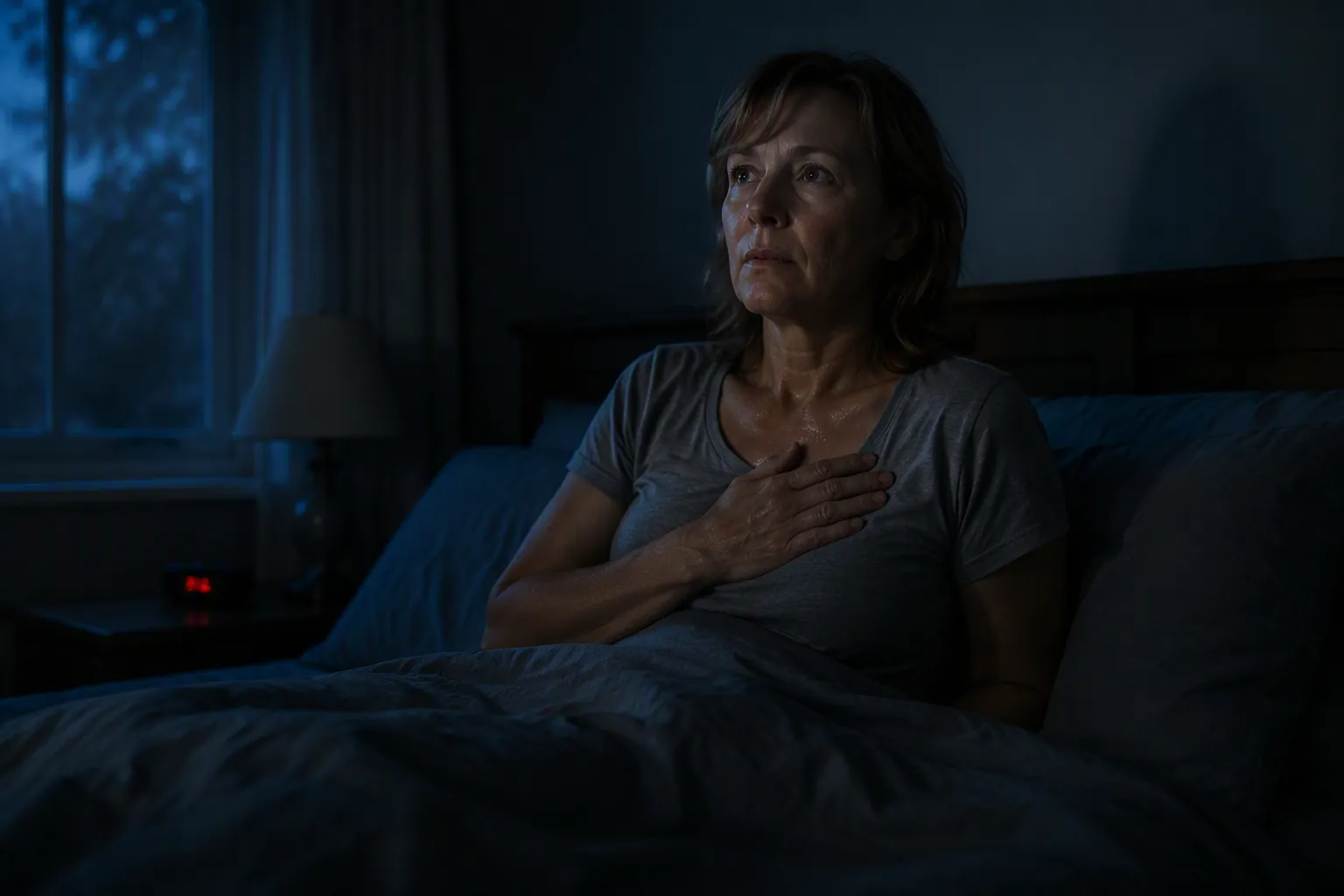
If you wake at night with chest pressure, a racing heart, sweating, shortness of breath, gasping, nausea, or a heavy unusual fatigue, do not begin by deciding whether it is “just sleep.” Begin with the emergency fork. Some heart attack signs at night in women overlap almost perfectly with sleep apnea, panic awakenings, reflux, and perimenopause night sweats. The safe first move is to ask whether the symptoms meet a call-911 threshold.
This article is informational and cannot diagnose your symptoms. If symptoms are happening now and you are unsure, use emergency medical services rather than waiting for an online explanation to become certain.
The first question is whether to call 911
Call 911 now if symptoms last more than five minutes, are new or severe, or include chest pressure, pressure or pain spreading to the arm, jaw, neck, back, or stomach, severe shortness of breath, cold sweat, nausea, lightheadedness, faintness, or a strong sense that something is seriously wrong. The American Heart Association lists women’s heart attack symptoms as including chest pain or discomfort, shortness of breath, nausea or vomiting, back or jaw pain, cold sweat, lightheadedness, and unusual fatigue; Go Red for Women advises calling 911 for symptoms lasting more than five minutes and saying, “I think I’m having a heart attack.” [1][2]
- Call 911 rather than driving yourself.
- Say clearly: “I think I may be having a heart attack.”
- Unlock the door if you can do so safely.
- Sit or lie down while you wait.
- Wake someone in the house if you are not alone.
- Do not spend the next 20 minutes trying to prove it is reflux, panic, a hot flash, or bad sleep.
That last point matters because delay is not a harmless pause. In a 2017 Journal of the American Heart Association registry study of 6,022 patients with ST-segment–elevation myocardial infarction, women had a longer median symptom-onset-to-presentation time than men, 270 minutes versus 240 minutes. Female sex was independently associated with higher 30-day mortality, with an odds ratio of 1.58; the mortality difference disappeared when presentation occurred within about one hour of symptom onset. [3]
That study does not mean every woman who wakes sweaty at 3 a.m. is having a heart attack. It means the cost of sitting with possible heart attack symptoms can be high, and women are already more likely to lose time in the gap between symptom and care. The clock on the nightstand is not diagnostic. The symptom pattern and the emergency threshold are what matter.
| If this is happening tonight | Treat it as |
|---|---|
| New chest pressure, squeezing, fullness, or heaviness, especially if it lasts more than five minutes | Possible heart attack: call 911 |
| Pressure or pain spreading to arm, shoulder, jaw, neck, back, or upper stomach | Possible heart attack: call 911 |
| Severe shortness of breath, faintness, cold sweat, nausea, or a sense of impending danger with chest symptoms | Possible heart attack: call 911 |
| Chest discomfort at rest that is new, worsening, or different from prior episodes | Possible unstable angina or heart attack: urgent evaluation |
| A familiar hot flash without chest pressure, spreading pain, severe breathlessness, faintness, or nausea | Not automatically an emergency, but track the pattern and discuss care if recurrent |
| Repeated gasping awake, loud snoring, witnessed pauses in breathing, morning headaches, or daytime sleepiness without emergency red flags | Book a sleep-apnea evaluation |
Chest discomfort at rest deserves special respect even when it fades. Mayo Clinic describes unstable angina as chest pain that occurs at rest, is new, worsens, or lasts longer than expected; it is a medical emergency because it may signal an impending heart attack. [4]
When the red flags are absent, the sleep side is not one thing
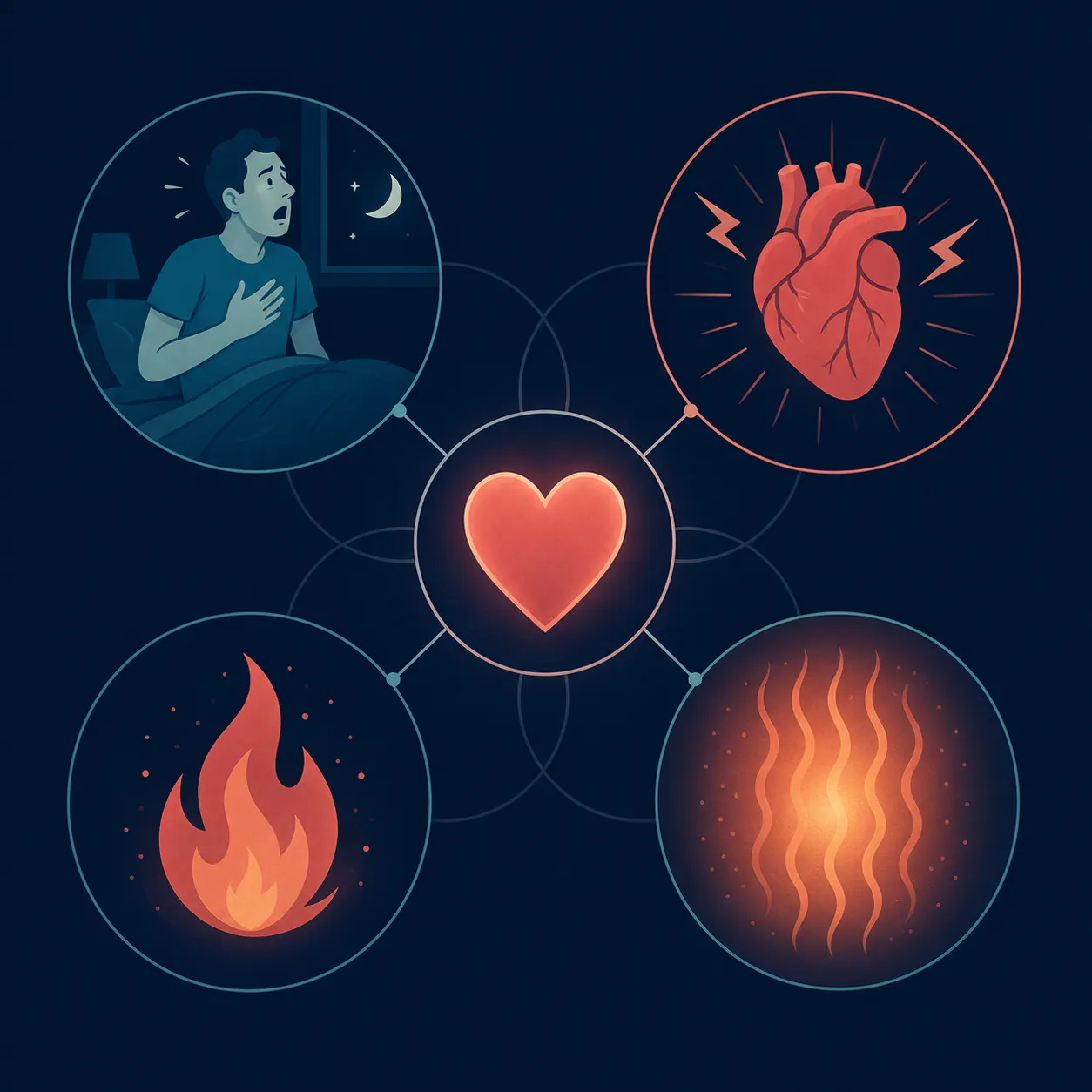
Once the 911 threshold is cleared, the next mistake is to file every nighttime episode under one comforting label. “Sleep problem” can mean obstructive sleep apnea, a panic awakening, reflux, a perimenopause hot flash, medication effects, alcohol-related sleep disruption, or an arrhythmia that happened to wake you from sleep. Those branches point to different evaluations.
Sleep apnea can feel cardiac because the body is fighting for air
A sleep-apnea pattern is more likely when the episode includes gasping or choking awake, loud snoring, witnessed pauses in breathing, dry mouth, morning headaches, daytime sleepiness, or repeated awakenings with a pounding heart. The important clinical point is that this does not make the heart irrelevant. WomenHeart notes that about 25 million Americans have sleep apnea and that untreated obstructive sleep apnea increases the risk of stroke, heart attack, and sudden cardiac arrest; it also highlights women ages 50 to 70 and people with higher BMI as groups at higher risk. [5]
Sleep-clinic materials usefully describe the overlap: gasping awake, a racing heart, sudden shortness of breath while lying down, and nocturnal chest discomfort can occur with sleep apnea, but new chest pressure spreading to the arm or jaw or severe breathlessness still belongs in emergency territory. These sources are helpful for differential framing, not for ruling out a heart attack at home. [6][7]
If this pattern recurs without emergency red flags, book a sleep evaluation. A home sleep apnea test or in-lab sleep study can answer a question that a 3 a.m. symptom inventory cannot: whether breathing repeatedly drops or stops during sleep.
Panic awakenings can be real and still not be safe to assume
A panic awakening may arrive abruptly: pounding heart, trembling, sweating, chest tightness, air hunger, tingling, fear, and a feeling of being trapped in the body. It can happen from sleep, before there is any obvious anxious thought. The American Heart Association’s discussion of panic attacks and heart attacks emphasizes the problem patients already know in their bones: symptoms can be similar, and medical care is needed when there is doubt, especially with chest pain, shortness of breath, nausea, or pain spreading beyond the chest. [8]
A previous panic diagnosis can help clinicians recognize a pattern, but it should not become a blindfold. If the episode is different from prior panic attacks, occurs with exertion, includes pressure radiating to the jaw, back, or arm, or comes with faintness or cold sweat, do not negotiate with it in the dark.
Reflux has clues, but cardiac pain can borrow the costume
GERD is common at night because lying flat makes reflux easier. Burning behind the breastbone, sour taste, burping, symptoms after a late meal, or relief after sitting upright can point toward reflux. Differential guides distinguish these positional and burning features from cardiac warning patterns, while still noting that chest pain at night has a broad cause list and should not be self-diagnosed when severe, new, or accompanied by shortness of breath, sweating, nausea, faintness, or spreading pressure. [9]
The practical rule is not “reflux is harmless.” It is narrower: familiar burning reflux without cardiac red flags can be discussed with a clinician, especially if it is recurrent or disrupting sleep. New pressure, heaviness, or symptoms that do not fit your usual reflux pattern should be treated differently.
Perimenopause night sweats are common, but they can normalize the wrong symptom
Midlife women are often trained by repetition to explain nighttime heat as hormones: waking drenched, throwing off the blanket, waiting for the wave to pass, then trying to return to sleep before the alarm. A familiar hot flash that arrives as heat, flushing, sweating, and sleep disruption, without chest pressure, severe shortness of breath, nausea, faintness, or spreading pain, points toward perimenopause sleep care rather than an ambulance.
The danger is the word “familiar.” A cold sweat with chest pressure is not the same as a heat wave through the upper body. Palpitations during a hot flash are not the same as palpitations with breathlessness and nausea. If your pattern fits hormone-related night sweats and the cardiac red flags are absent, it is reasonable to work through perimenopause-specific sleep supports, including the site’s perimenopause night-sweat guides. If the episode has changed character, escalate the evaluation.
What to do after a non-emergency night
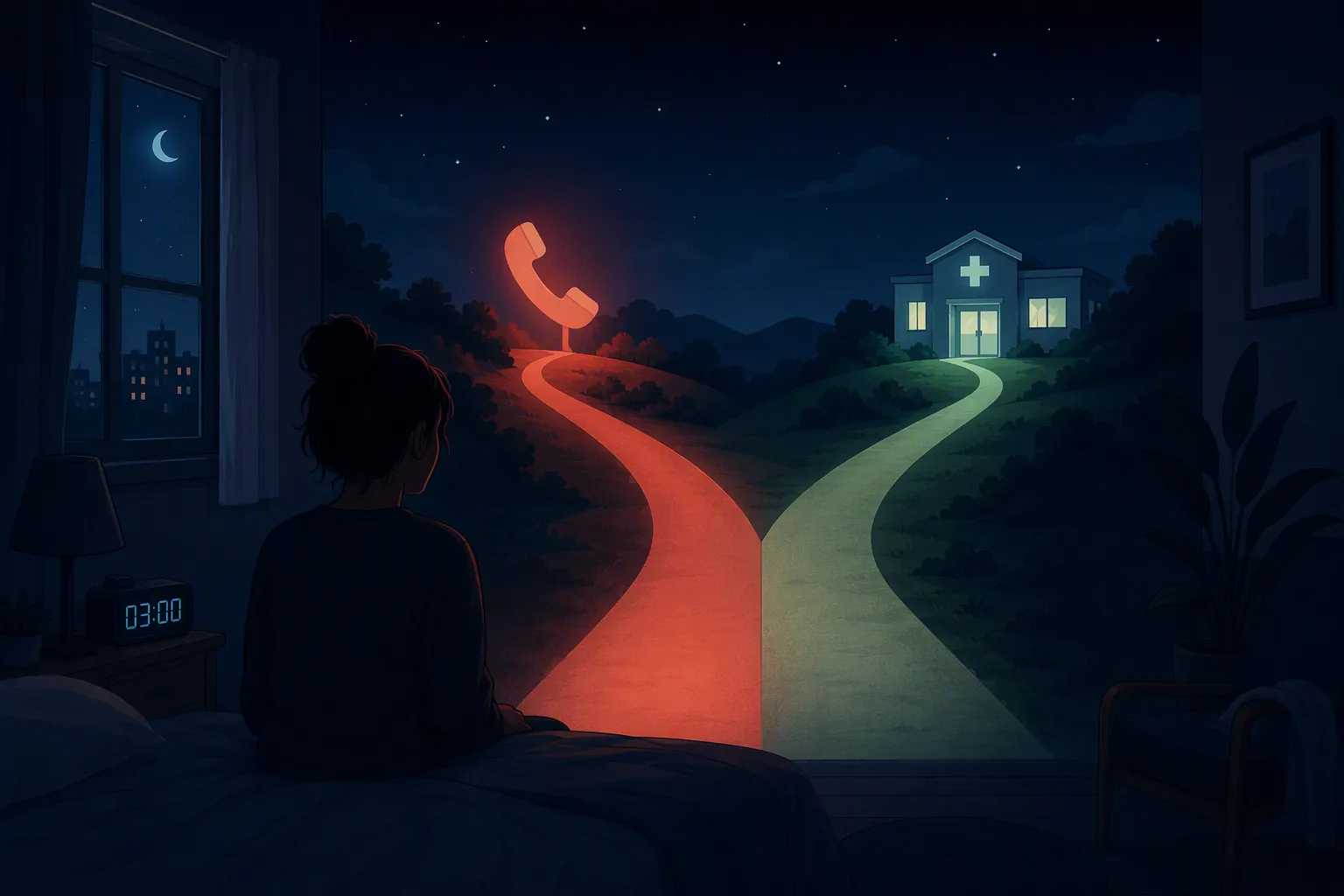
If you did not meet the 911 threshold and the episode passed, the next step is not to forget it by breakfast. Write down what happened while it is still fresh: time, symptom order, duration, whether you were lying flat, whether there was chest pressure or burning, whether symptoms spread, whether you were short of breath, whether anyone has noticed snoring or breathing pauses, and what you were doing the day before.
| Pattern after the emergency fork is cleared | Reasonable follow-up |
|---|---|
| Gasping awake, snoring, witnessed pauses, morning headaches, daytime sleepiness, recurrent pounding heart at night | Ask for a sleep-apnea evaluation or sleep study |
| Chest discomfort with exertion, recurrent nocturnal chest pressure, risk factors, or episodes that feel like possible angina | Book primary-care or cardiology evaluation promptly |
| New, worsening, or resting chest discomfort, even if it eased | Seek urgent medical evaluation; do not wait for a routine visit |
| Abrupt fear, trembling, racing heart, and repeated similar episodes without cardiac red flags | Discuss panic awakenings with a clinician, while keeping a plan for symptoms that change |
| Burning reflux after late meals or lying flat, sour taste, positional relief, no cardiac warning signs | Discuss GERD management, especially if recurrent |
| Familiar hot flashes or night sweats without chest pressure, severe breathlessness, nausea, faintness, or spreading pain | Use perimenopause-focused sleep care and discuss treatment options if sleep is repeatedly disrupted |
For a clinician, the follow-up question is not simply “Did it happen at night?” It is whether the episode suggests ischemia, arrhythmia, obstructed breathing, reflux, panic physiology, hormone-related vasomotor symptoms, or more than one of these. Sleep apnea and heart disease can coexist. Reflux and angina can both disturb sleep. Panic can occur in a person who also has cardiac risk factors.
The evidence does not give women a perfect sorting rule
There is no single study that takes women waking at night with chest pressure, sweating, racing heart, gasping, nausea, and fatigue and cleanly sorts them into “heart attack” versus “sleep problem.” The best available approach is a synthesis: emergency guidance for heart attack symptoms, observational evidence showing the harm of delayed presentation in women, sleep-medicine consensus around obstructive sleep apnea, and clinical differential reasoning for panic, reflux, and perimenopause.
That is less tidy than a symptom-matching chart, but it is safer. The same nighttime symptom can be a heart attack sign or a sleep problem. Use the low, explicit 911 threshold first. If the red flags are absent, pursue the sleep or cardiac workup that fits the pattern instead of letting “it happened at night” become the reason it is dismissed.
References
- Heart Attack Symptoms in Women, American Heart Association.
- Symptoms of a Heart Attack, Go Red for Women.
- Sex-Based Differences in Clinical Outcomes After ST-Segment–Elevation Myocardial Infarction, Journal of the American Heart Association, 2017.
- Angina, Mayo Clinic.
- The Impact of Sleep on Heart Health, WomenHeart.
- Sleep Apnea & Heart Attack Warning Signs at Night, SleepVA.
- Chest Pain and Sleep Apnea in Women, SleepQuest.
- How to tell the difference between a heart attack and panic attack, American Heart Association News, July 13, 2022.
- Chest Pain at Night: Heartburn, Anxiety, Sleep, and 42 Causes, Ubie.
Supports these guides
Spot an error or have clinical feedback?
Because this article covers clinical, medication, or safety information, we use a moderated correction channel instead of open public comments. Let us know if something about “Heart attack or sleep problem? Signs at night in women” needs a closer look.
Send feedback on this article