
Mechanism explainer
Does poor midlife sleep raise women's heart disease risk?
Perimenopause and menopause sleep problems are more than a nuisance: women whose insomnia symptoms stay high across midlife face roughly a 70% higher risk of later cardiovascular events, even after accounting for hot flashes, snoring, and standard heart-risk factors. Here's what the women-specific evidence actually supports — and when midlife sleep problems are worth raising with a clinician.
If insomnia, night sweats, or broken sleep have become a chronic midlife pattern, yes: they belong in the same medical conversation as blood pressure, cholesterol, blood sugar, weight, smoking history, and family history. The best women-specific evidence does not prove that poor sleep causes heart disease. It does show something too important to wave away: in the SWAN sleep-trajectory study, women whose insomnia symptoms stayed persistently high across midlife had a 71% higher risk of later cardiovascular events than women with consistently low insomnia symptoms, even after accounting for vasomotor symptoms, snoring, depressive symptoms, and standard cardiovascular risk factors [1].
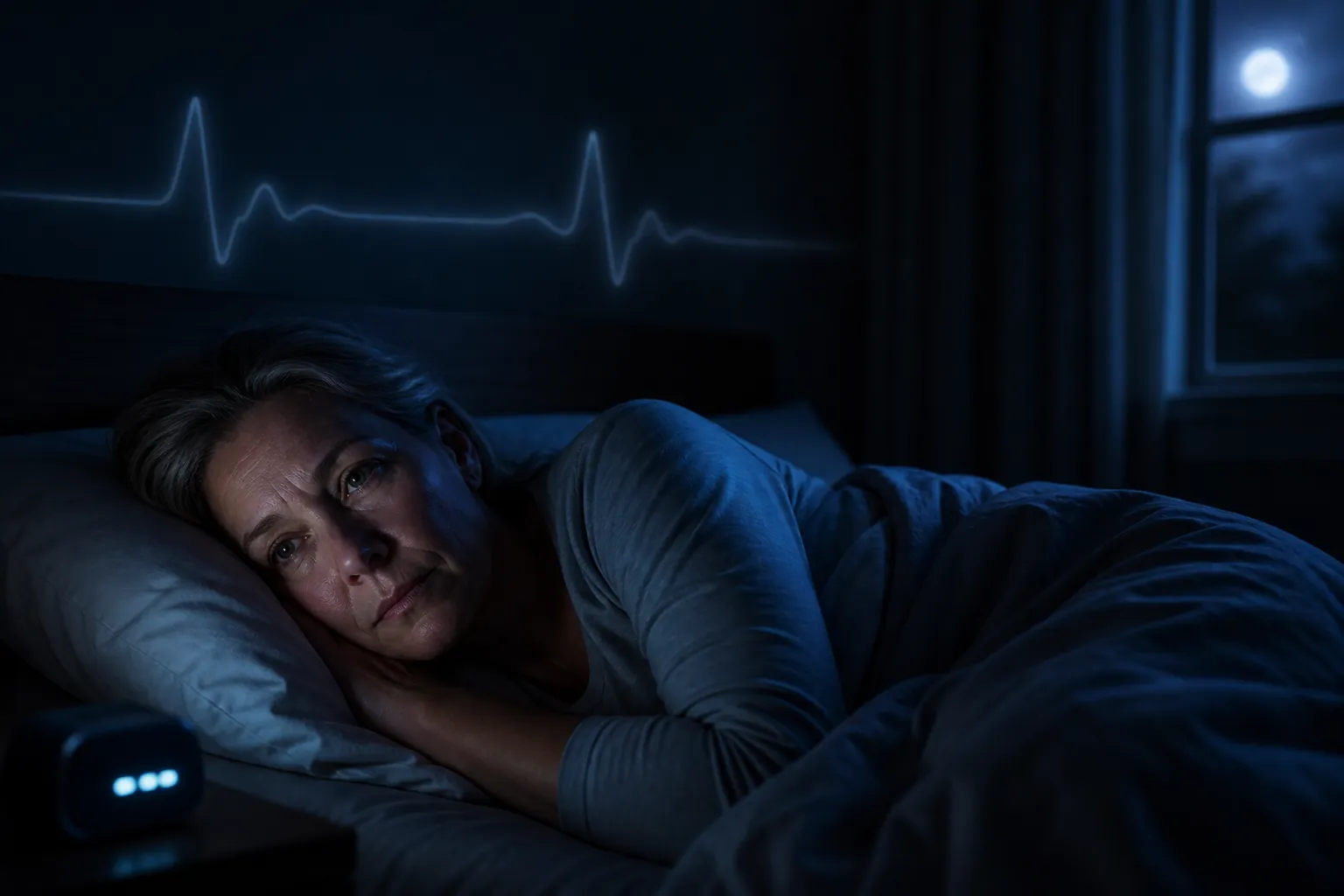
That is the practical answer before anyone gets lost in generic sleep advice. Persistent midlife insomnia symptoms are a risk signal, not a prediction. They should not make you assume heart disease is coming. They should make you stop treating years of poor sleep as background noise.
Why the SWAN sleep study deserves more weight than a one-time sleep survey
The most useful study here is not useful because it produced a dramatic number. It is useful because it watched sleep change — or fail to change — across the menopause transition.
SWAN, the Study of Women’s Health Across the Nation, followed 2,964 women with up to 16 sleep assessments over about 22 years. During follow-up, researchers identified 202 incident cardiovascular disease events. Instead of asking once whether women slept badly, the study grouped women by trajectories: whether insomnia symptoms stayed low, rose, fell, or remained persistently high across midlife [1].

That design matters because midlife sleep is rarely static. A woman may have a few bad months during a stressful year, then recover. Another may spend a decade cycling through trouble falling asleep, waking at 3 a.m., night sweats, and unrefreshing sleep. Those are not the same exposure. SWAN is valuable because it separates temporary disturbance from a persistent pattern.
The finding that should make clinicians listen is the persistent high-insomnia trajectory. Twenty-three percent of women in SWAN fell into that group. Compared with women whose insomnia symptoms stayed low, they had a hazard ratio of 1.71 for later cardiovascular events, with a 95% confidence interval from 1.19 to 2.46, after adjustment for demographics and cardiovascular risk factors [1].
A hazard ratio is a relative measure. It does not mean that 71% of women with chronic insomnia symptoms will have a cardiovascular event. It means that, in this cohort and model, their event rate over time was higher than the rate among women with low insomnia symptoms. That distinction is not a technicality. It is the difference between using sleep as a clinical clue and turning it into a frightening forecast.
The sleep pattern that looks most concerning
The strongest signal in SWAN was not one rough night, one stressful season, or one symptom in isolation. It was persistent insomnia symptoms across midlife. The study’s insomnia questions covered trouble falling asleep, waking several times, and waking earlier than planned. Those are the complaints many women learn to narrate as “just menopause,” especially when they are still working, caregiving, and functioning well enough that no one asks much more.
SWAN also looked at sleep duration. A more severe-looking pattern — persistent high insomnia symptoms combined with about 5 hours of sleep — was associated with a hazard ratio of 1.75 for cardiovascular events, with a 95% confidence interval from 1.03 to 2.98 [1]. That number is worth noticing, but it needs the label attached: the combined insomnia-plus-short-sleep result came from minimally adjusted models, so it should be read more cautiously than the main persistent-insomnia finding.
Still, the direction is clinically sensible. A woman who has insomnia symptoms and routinely sleeps around 5 hours is not merely reporting annoyance. She is describing a pattern that may overlap with stress physiology, mood symptoms, snoring or sleep apnea risk, blood pressure, glucose regulation, weight change, and vasomotor symptoms. The hard part is that these factors travel together. The useful part is that a clinician does not need to prove which one came first before deciding the pattern deserves attention.
| Sleep pattern | What the women-specific evidence suggests | How to interpret it |
|---|---|---|
| Persistently high insomnia symptoms across midlife | HR 1.71 for later cardiovascular events versus low insomnia symptoms in SWAN; 23% of women followed this trajectory [1] | The clearest midlife signal in the evidence; worth raising in a heart-risk conversation |
| Persistent insomnia symptoms plus about 5 hours of sleep | HR 1.75 in SWAN minimally adjusted models [1] | Potentially concerning, but the adjustment context makes the estimate less definitive |
| High insomnia scores in postmenopausal women | WHI found an independent association with coronary heart disease, HR 1.19 after full adjustment [4] | Supports the broader pattern, with a smaller effect size in an older postmenopausal cohort |
| Very short sleep duration | Nurses’ Health Study found ≤5 hours associated with higher coronary heart disease risk, RR 1.45 versus 8 hours [5] | Older supportive evidence, but sleep duration alone is less consistent after adjustment in some cohorts |
Where heart disease prevention enters the sleep conversation
The stakes are not abstract. Cardiovascular disease is the leading cause of death in women, and the American Heart Association notes that up to 40% to 50% of women report sleep problems at midlife [2]. Sleep is also now included in the AHA’s Life’s Essential 8, its set of cardiovascular health metrics [3].
That does not mean sleep should replace the usual cardiovascular risk assessment. It means poor sleep can sharpen the questions around it. If insomnia has been persistent, a medical visit should not stop at “try to relax before bed.” It should also ask what else is present: elevated blood pressure, cholesterol changes, prediabetes or diabetes, weight changes, smoking history, pregnancy-related cardiovascular risk history, family history, depression symptoms, snoring, and possible sleep apnea.
Traditional risk tools may still drive medication decisions, including statin discussions. If you are trying to understand how menopause sleep problems can intersect with ASCVD risk calculations, the related piece on menopause sleep and statin eligibility is the more specific route. The point here is simpler: chronic poor sleep is not a formal diagnosis of future heart disease, but it can be a reason to look more carefully at the risks that are already measurable.
What WHI and the Nurses’ Health Study add — and what they complicate
SWAN is the anchor because it follows women through midlife repeatedly. Two other large women’s cohorts help show that the signal is not isolated, while also keeping the interpretation honest.
In the Women’s Health Initiative, researchers studied 86,329 postmenopausal women. High insomnia scores were independently associated with coronary heart disease after full adjustment, with a hazard ratio of 1.19 and a 95% confidence interval from 1.08 to 1.30 [4]. That is a smaller effect than the SWAN persistent-trajectory estimate, but it points in the same direction: insomnia symptoms in women are not just a quality-of-life footnote.
WHI also shows why sleep-duration claims need restraint. Short sleep of 5 hours or less and long sleep of 10 hours or more were associated with coronary heart disease in less adjusted analyses, but those associations attenuated after adjustment for comorbidities [4]. In plain language: short sleep may be part of the risk picture, but in that cohort it was hard to separate from other health conditions that also raise heart risk.
The Nurses’ Health Study adds older prospective evidence on very short sleep. Among 71,617 women followed for 10 years, with 934 coronary events, women reporting 5 hours or less of sleep had a multivariable relative risk of 1.45 for coronary heart disease compared with women reporting 8 hours [5]. Useful, yes. Definitive, no. It was still self-reported sleep, and it did not track midlife sleep trajectories in the way SWAN later did.
Night sweats and hot flashes are part of the same risk conversation
Vasomotor symptoms — hot flashes and night sweats — deserve a specific mention because they are often treated as the obvious explanation for poor sleep and then the conversation ends. In the cardiovascular literature, they are also being studied as female-specific risk markers.
In SWAN research on vasomotor symptoms, frequent or persistent symptoms were associated with later cardiovascular disease, with hazard ratios of 1.51 and 1.77, and the associations were not explained by standard cardiovascular risk factors or estradiol levels [6]. That does not mean night sweats cause heart disease. It means a woman with persistent night sweats and chronic insomnia is describing a pattern that should not be dismissed as merely inconvenient.
This is especially relevant for the reader who has been told, explicitly or indirectly, that menopause symptoms are expected and therefore medically uninteresting. Expected does not mean irrelevant. Common does not mean harmless. A symptom can be part of a normal life stage and still carry information worth using.
For symptom-specific reading, the practical sleep side is separate from the heart-risk evidence. You may want the perimenopause guide to sleeping through heat-wave night sweats or the piece on Buck Moon night sweats and perimenopause sleep if your immediate problem is waking soaked and overheated. If your pattern is more classic middle-of-the-night insomnia, the perimenopause insomnia ritual guide may be the more relevant next step.
What the evidence cannot prove
The biggest limitation is also the easiest one to blur: these are observational studies. They can show that sleep patterns and later cardiovascular events travel together. They cannot prove that insomnia directly caused the events.
Self-reported sleep is another limitation. Large cohorts often rely on what participants report about insomnia symptoms and sleep duration. That is not worthless; symptoms are exactly what bring people to care. But self-report is not the same as objective sleep measurement, and it may not capture sleep apnea, sleep architecture, or night-to-night variability with precision.
Residual confounding is the other caution. Depression symptoms, chronic stress, pain, caregiving load, shift work, metabolic syndrome, snoring, and hot flashes can overlap with both poor sleep and cardiovascular risk. SWAN adjusted for many important factors, which strengthens the finding, but adjustment is not a magic eraser. Some uncertainty remains.
When poor sleep should prompt action
You do not need to wait until sleep is unbearable to mention it. The threshold is lower than many women have been taught. Bring sleep into a clinician conversation if any of these describe your usual pattern:
- Insomnia symptoms have persisted for months or years, especially trouble falling asleep, repeated awakenings, or waking too early.
- You commonly sleep around 5 hours, particularly when short sleep is paired with insomnia symptoms.
- Night sweats or hot flashes are frequent, persistent, or tightly linked to sleep disruption.
- You snore, wake gasping, have morning headaches, or feel very sleepy during the day, because sleep apnea can look different in women and may be missed.
- You also have elevated blood pressure, cholesterol changes, diabetes or prediabetes, smoking history, strong family history, or other cardiovascular risk factors.

A useful way to phrase it is concrete, not dramatic: “For the past year, I’ve had trouble staying asleep most nights, and I’m often getting about 5 hours. I’m also having night sweats. Given my blood pressure and family history, should we look at this as part of my heart-risk picture?”
That kind of sentence gives the clinician something to work with. It names duration, frequency, sleep duration, menopause-related symptoms, and cardiovascular context. It also opens the door to practical next steps: checking blood pressure and labs, screening for sleep apnea when symptoms fit, reviewing medications and alcohol use, addressing vasomotor symptoms, and asking whether cognitive behavioral therapy for insomnia, often called CBT-I, is appropriate.
The bottom line for women in midlife
Poor midlife sleep in women is not merely a nuisance, and it is not a standalone diagnosis of future heart disease. The best evidence supports a more useful middle ground: persistent insomnia symptoms across the menopause transition are associated with later cardiovascular events, especially when sleep is chronically short or when vasomotor symptoms are frequent or persistent.
Track the pattern. Notice whether it is occasional or chronic. Bring it up alongside blood pressure, cholesterol, blood sugar, snoring, hot flashes, mood, and family history. Ask about evidence-supported insomnia care rather than accepting years of broken sleep as the cost of midlife. Sleep is one lever for cardiovascular health, not the whole machine — but for many women, it is the lever that has been ignored the longest.
References
- Trajectories of Sleep Over Midlife and Incident Cardiovascular Disease Events in the Study of Women’s Health Across the Nation, Circulation, 2024
- Sleep, Women and Heart Disease, American Heart Association
- Life’s Essential 8, American Heart Association
- Sleep Duration, Insomnia, and Coronary Heart Disease Among Postmenopausal Women in the Women’s Health Initiative, 2013
- A prospective study of sleep duration and coronary heart disease in women, 2003
- Vasomotor Symptoms and Cardiovascular Disease in the Study of Women’s Health Across the Nation, Journal of the American Heart Association, 2021
Supports these guides
Spot an error or have clinical feedback?
Because this article covers clinical, medication, or safety information, we use a moderated correction channel instead of open public comments. Let us know if something about “Does poor midlife sleep raise women's heart disease risk?” needs a closer look.
Send feedback on this article