
Before sleep can settle in, the body has to cool itself in a very specific way. Core body temperature does not simply drift downward after you fall asleep; the decline is part of how sleep begins. In the normal pre-sleep sequence, heat moves from the body’s center toward the skin, blood vessels in the hands and feet dilate, distal skin temperature rises, and core temperature falls by roughly 0.5–1°C. When that drop is suppressed, sleep onset is delayed.[1]
That is the first reason heat affects sleep quality: a hot room is not merely irritating the sleeper. It interferes with the body’s attempt to export heat at the moment sleep depends on that export. The familiar advice to “keep the room cool” is often presented as atmosphere. Physiologically, it is closer to making room for a required thermal transition.
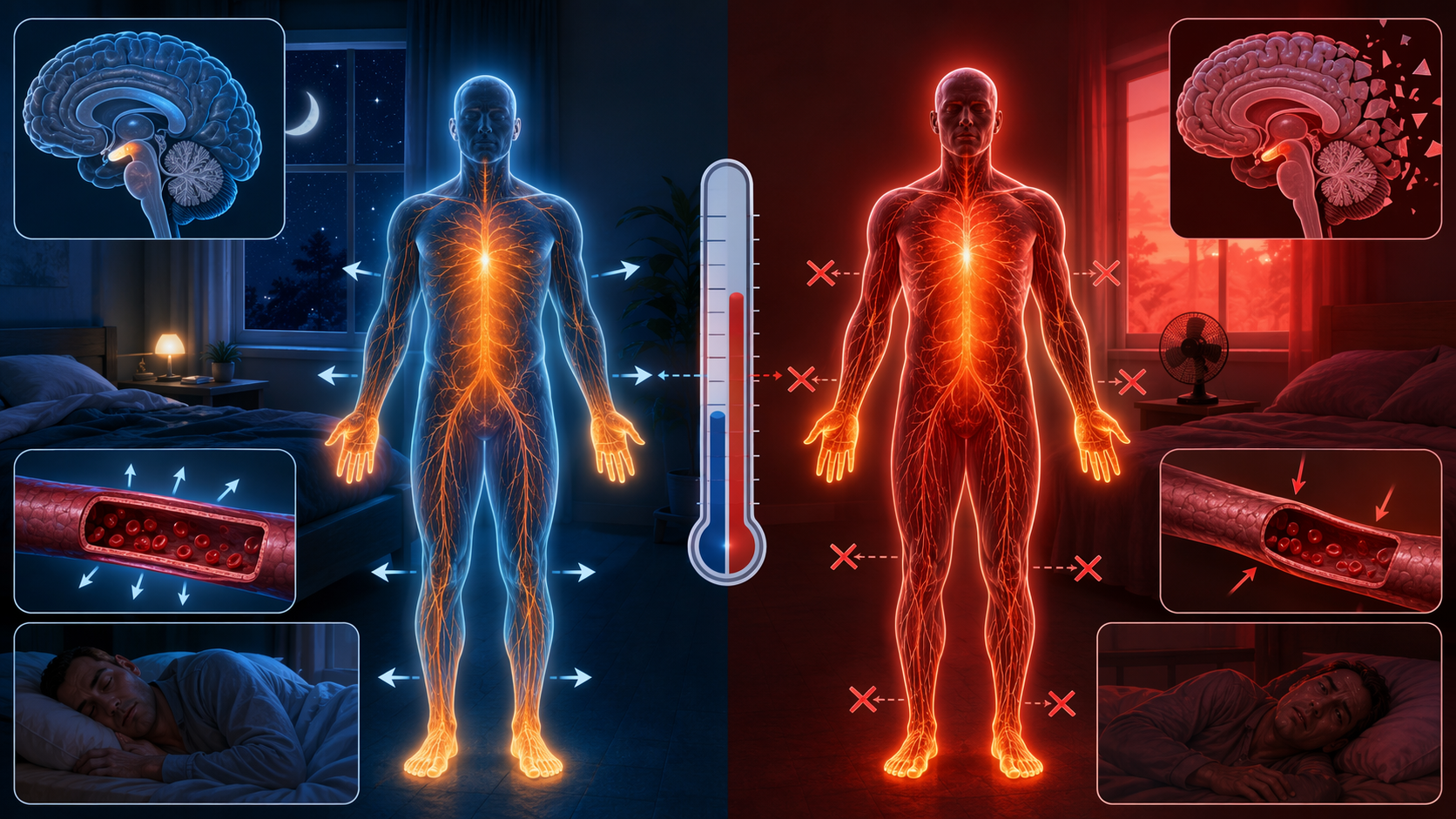
Sleep starts with heat leaving the core
The useful detail is the direction of heat movement. The body does not prepare for sleep by making every surface cold. It warms the periphery so heat can leave the core. Hands and feet matter because they are efficient heat exchangers: when distal blood vessels dilate, more warm blood reaches the skin, the distal-to-proximal skin temperature gradient shifts, and sleep becomes more likely. Work from the Kräuchi laboratory, summarized in Harding and colleagues’ review, found warm foot temperature to be one of the strongest physiological predictors of falling asleep quickly.[2]
This is why a simplistic “colder is always better” reading can go wrong. The immediate bed microclimate around the body is not supposed to resemble refrigerator air. Okamoto-Mizuno and Mizuno describe an optimal bed microclimate of about 32–34°C with 40–60% relative humidity, a range that is warmer than typical room air because the skin surface still needs to support heat transfer rather than clamp down against cold.[1]
Room-temperature numbers are therefore less universal than many sleep articles imply. Study ranges differ by population, exposure design, bedding, clothing, and measurement method. The steadier claim is mechanistic: whatever the exact room setting, sleep onset is favored when the body can dilate peripheral vessels and let core temperature fall.
Where heat blocks the sequence
A hot environment narrows the gradient the body is relying on. If the surrounding air, bedding, or humid microclimate is already holding too much heat, the skin has less capacity to unload warmth from the core. The result is not only a sensation of being too warm. The pre-sleep decline in core temperature is blunted, and sleep onset becomes harder.[1]
This helps separate two experiences people often combine. One is delayed sleep onset: lying awake because the body has not completed enough of the cooling transition. The other is sleep fragmentation: falling asleep, then waking repeatedly or moving into lighter sleep because the thermal load remains. Heat can do both, but it does not do them through a single vague pathway.
| What the sleeper notices | What the thermal problem may be |
|---|---|
| It takes longer to fall asleep | Core temperature decline is suppressed during the pre-sleep window |
| Sleep feels lighter or more broken | Wakefulness increases after sleep has begun |
| Sleep is less restorative | Slow-wave sleep is reduced |
| Dream-heavy sleep feels interrupted or unstable | REM sleep is more vulnerable because thermoregulatory responses are blunted |
Heat changes sleep architecture, not just comfort
Once sleep begins, heat still has work to disrupt. Across the studies reviewed by Okamoto-Mizuno and Mizuno, heat exposure follows a recognizable pattern: wakefulness increases, slow-wave sleep decreases, and REM sleep decreases.[1] These are different losses. A night can be shorter because it starts late, shallower because deep sleep is reduced, and more interrupted because the sleeper wakes more often.
Slow-wave sleep is the deep non-REM stage many readers loosely mean when they say they “slept hard.” Reducing it changes the texture of the night even when total time in bed looks adequate. The person may not remember being awake for long stretches, yet the architecture has shifted away from the deeper stage that normally occupies an important part of early-night sleep.
Wakefulness is a separate measure. Heat can increase the amount of time spent awake after sleep onset, which means the night becomes more perforated. This matters because the sleeper’s morning judgment—“I was in bed for eight hours”—does not capture how much of that period was spent transitioning back from wakefulness or lighter sleep.
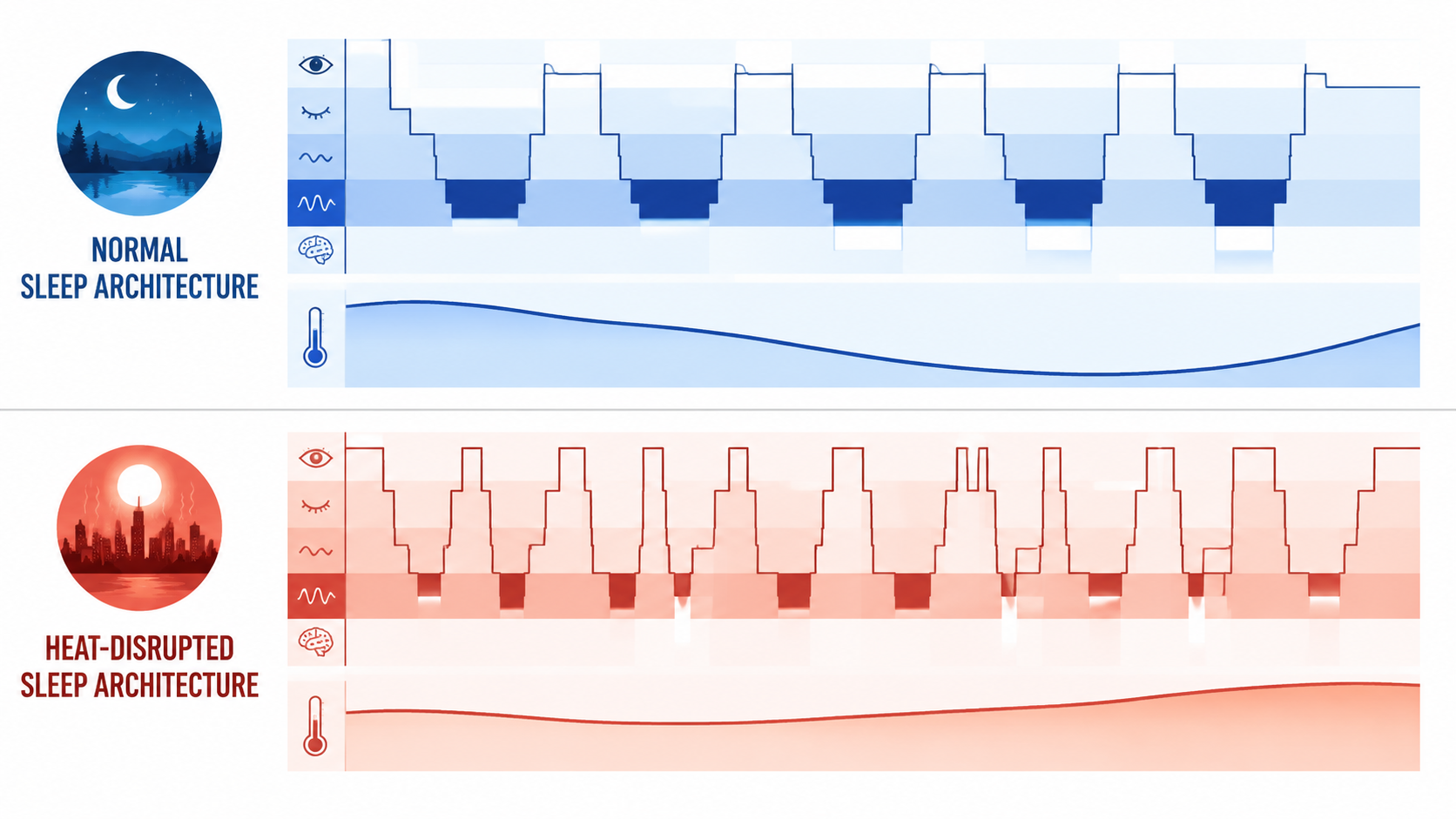
REM sleep deserves its own attention because it is not merely another stage that happens to shrink under heat. During REM, normal thermoregulatory defenses are reduced or absent. Harding and colleagues describe REM sleep as a state in which responses such as sweating and shivering are blunted, leaving the sleeper less able to compensate for thermal stress.[2]
That vulnerability helps explain why a room can feel tolerable at bedtime and still disrupt sleep later. The body may manage the early transition well enough to fall asleep, then enter a stage in which its usual temperature-control tools are muted. If the environment is still imposing heat, REM becomes a poor time to absorb that burden.
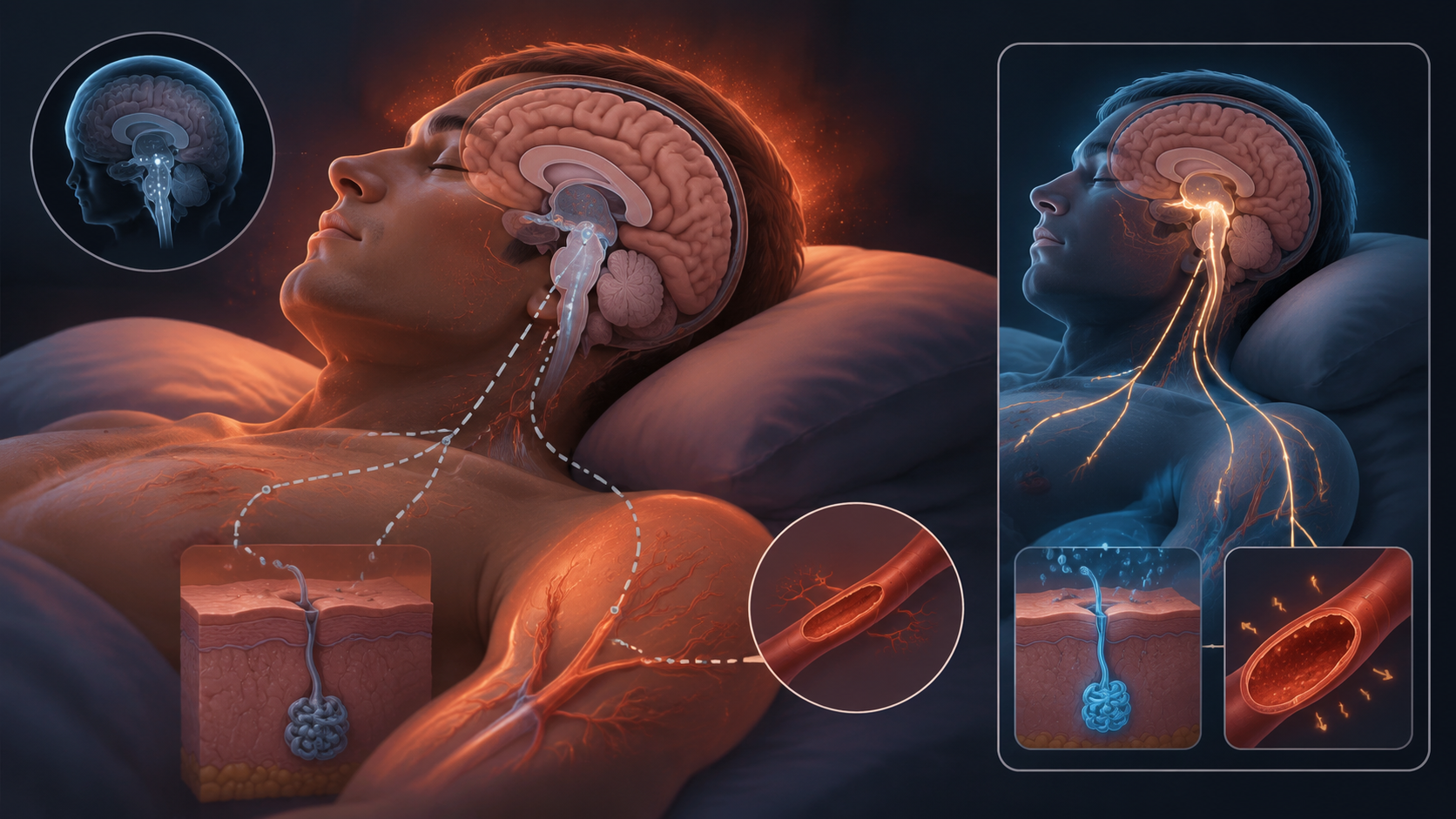
Humidity makes the same heat harder to shed
Humidity worsens the problem because sweating only cools effectively when sweat can evaporate. In humid heat, sweat remains a less useful exit route for body heat. The review by Okamoto-Mizuno and Mizuno links humid heat with further suppression of the core temperature decline and increased wakefulness.[1]
This distinction matters in bedrooms because the relevant environment is not only the thermostat reading across the room. Bedding, sleepwear, mattress materials, ventilation, and moisture can create a warmer, more humid layer immediately around the skin. A room that seems acceptable by air temperature can still leave the body negotiating a poor heat-transfer boundary.
The body does not reliably get used to hot nights
One of the more useful findings is also one of the least comforting: repeated exposure does not necessarily erase the sleep disruption. Okamoto-Mizuno and Mizuno cite studies in which heat-related sleep disruption did not diminish after 5 continuous nights of exposure.[1]
That finding should be kept narrow. It does not mean no human ever adapts to any heat condition in any context. It means the available experimental evidence does not support the reassuring assumption that several hot nights are enough for sleep architecture to normalize. For someone sleeping poorly through a heatwave, continued difficulty is not evidence of weak discipline or failure to adjust. The physiological load may still be present.
A restrained practical reading
The practical point is not to chase a single universal bedroom temperature. The better target is to protect the body’s cooling route: allow heat to leave the core before sleep, avoid a bed microclimate that traps warmth and moisture, and remember that humid heat imposes a different burden than dry heat at the same air temperature.
This is also why the “warm bath paradox” is not actually a contradiction. Briefly warming the skin before bed can, in some circumstances, encourage peripheral heat loss afterward. That is different from spending the night in an environment that prevents heat from leaving the core. The first may assist the cooling cascade; the second competes with it.
Heat affects sleep quality because sleep is built around timed thermoregulation. The body needs peripheral warming, core cooling, and stage-specific temperature control. When the environment blocks those steps, the night changes in measurable ways: sleep begins later, wakefulness rises, slow-wave sleep shrinks, and REM becomes more fragile. Several hot nights do not reliably make that interference disappear.
References
- Effects of thermal environment on sleep and circadian rhythm. Journal of Physiological Anthropology, 2012.
- Sleep and thermoregulation. Current Opinion in Physiology, 2020.
Comments
Join the discussion with an anonymous comment.