Hurricane forecasting affects sleep before the first squall line reaches the coast because the forecast itself is a threat cue. Not a fake threat, and not an overreaction. A cone on a screen tells the body that something important may happen, that the timing may change, and that the safest decision may depend on the next advisory. That is useful information for evacuation, supplies, shutters, work, school, and family calls. It is also the kind of uncertain information the sleeping brain is poorly built to set aside.
The National Hurricane Center’s track forecast cone does not show every place that could feel storm impacts. It represents the probable track of the storm center, with the center expected to remain inside the cone about two-thirds of the time, based on past forecast errors over the previous five years.[1] That means the graphic is both a planning tool and a visible reminder of what cannot be pinned down yet. For someone trying to sleep on the Gulf Coast or along the Atlantic seaboard, that remaining uncertainty is not an abstract statistical footnote. It is the space where the mind starts running scenarios.

That is the first piece to get straight in any honest explanation of how hurricane forecasting affects sleep: the forecast is not the same as the storm. Forecast uncertainty can disturb sleep even before landfall, but the direct sleep effects of forecast-watching itself have not been cleanly separated from the effects of storm impact in hurricane research. Most disaster studies measure people after the event or during the longer recovery period. So the strongest case here is mechanistic, not a neat hurricane-specific causation claim.
The cone gives the threat system something unfinished to solve
A finished danger is often easier for the brain to categorize than an unfinished one. If the wind is already here, the task is concrete: stay away from windows, monitor warnings, manage power loss, protect people. Forecast uncertainty is different. It asks the brain to keep updating: west shift, east wobble, faster forward speed, higher surge risk, later landfall, new watch, new warning.
That updating has a cost at night. Bedtime depends on the brain being willing to lower vigilance. Hurricane forecasting invites the opposite. The mind does not merely “think about the storm.” It keeps a watch schedule: one more model run, one more local meteorologist, one more emergency management update, one more check of whether the cone moved while the house got quiet.
The key word is anticipatory. The body is reacting to a possible future state, not only to present danger. A useful forecast can therefore become biologically noisy information: it helps a household make decisions while also keeping threat prediction circuits awake.
What sleep loss does to the alarm system
The most important evidence for this loop does not come from a hurricane lab. It comes from sleep and anxiety research that explains why the next day’s forecast can feel worse after a bad night.
In a UC Berkeley study published in the Journal of Neuroscience, researchers found that sleep deprivation increased anticipatory anxiety and amplified activity in the amygdala and insular cortex, brain regions involved in processing threat and bodily alarm signals. Berkeley’s summary described the effect as a more than 30% increase in activity in these emotion-related regions under sleep deprivation.[2]
That matters for storm season because those are not decorative brain areas. The amygdala helps assign emotional salience to possible threats. The insular cortex helps register internal body states — the tight chest, the unsettled gut, the sense that something is wrong even before there is a clear action to take. When those systems are more reactive, an updated cone is not processed as calmly as a map. It lands more like an alarm.
This is where many casual explanations of storm insomnia get the order too simple. Anxiety can disturb sleep, yes. But poor sleep can also make the next round of uncertainty feel more threatening. A restless night does not merely leave someone tired while they check the 5 a.m. advisory. It can make the brain more sensitive to the advisory itself.
The Berkeley study used controlled image-viewing tasks, not hurricane forecast maps, evacuation orders, or late-night radar loops. That boundary is important. It does not prove that the NHC cone directly causes insomnia. What it does show is the biological shape of anticipatory anxiety after sleep loss. For a person already monitoring uncertain storm information, that shape is painfully recognizable.
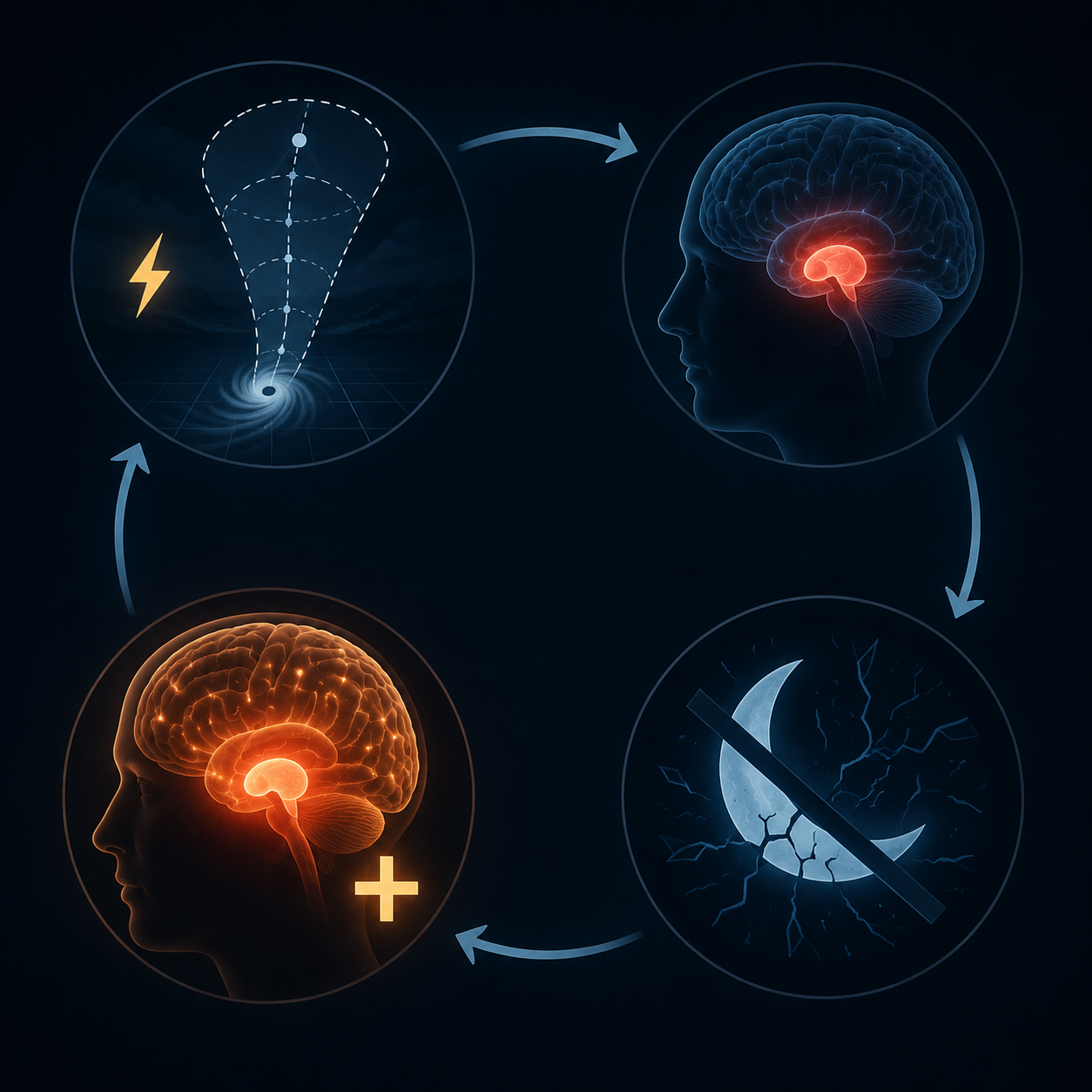
The feedback loop is the real problem
A single bad storm-season night is unpleasant. The loop is worse because each part feeds the next.
- A forecast update introduces uncertainty about timing, track, intensity, or local impacts.
- The brain treats that uncertainty as a threat to keep monitoring.
- Sleep onset gets delayed, or sleep becomes lighter and more fragmented.
- Sleep loss makes threat-processing regions more reactive.
- The next forecast update feels more urgent, even if the actual forecast has not become more dangerous.
Anyone who has watched a storm slow down offshore knows this pattern. The house may be physically ready. The bathtub may be filled, the cooler packed, the documents bagged, the gas tank topped off. But the mind keeps acting as if preparedness is incomplete because the forecast is incomplete. The body stays on call.
This is also why the same forecast can feel different at noon and at midnight. During the day, uncertainty competes with errands, calls, work, and visible tasks. At night, there is less competition. The phone is close. The room is dark. Each check feels practical, and sometimes it is. But repeated checking can train the evening brain to expect one more piece of danger-relevant information before it is allowed to power down.
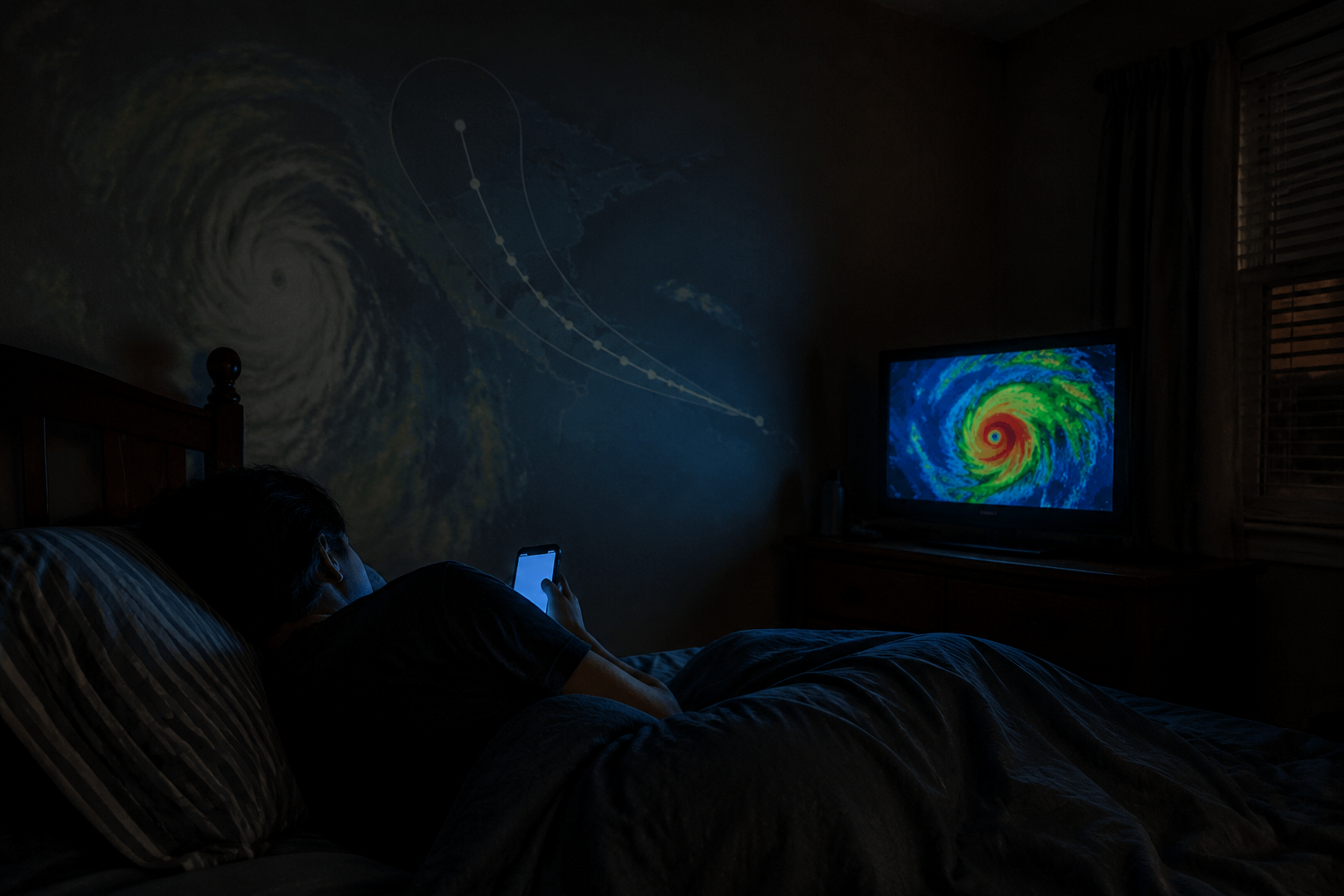
Checking can feel protective while keeping the brain on watch
Storm checking is not irrational by default. People in hurricane zones need reliable warnings, and a changing forecast can require real decisions. The trouble starts when checking becomes the only way the nervous system knows how to get temporary relief. The relief fades quickly, so the next check moves closer. Bedtime becomes a series of small safety rituals.
This is why practical alert planning matters to sleep, even though it sounds like emergency-management housekeeping. The National Weather Service recommends having three or more ways to receive warnings, a setup that reduces the need to personally monitor every update all night.[3] The Anxiety and Depression Association of America also advises limiting repeated exposure to hurricane news as one way to reduce storm-related anxiety.[4] Neither point means ignoring the forecast. It means separating being reachable from staying manually vigilant.
There is a difference between checking because a scheduled advisory or official alert requires action and checking because the body is trying to feel certain. The first can support safety. The second often feeds the same uncertainty it is trying to settle, because hurricane forecasts do not become final just because someone refreshes them at 12:47 a.m.
Storm research shows sleep is not just a side effect
The real-world hurricane evidence is strongest after storms, not during the forecast window. That still matters, because it shows sleep quality behaving less like background comfort and more like part of the stress system.
A longitudinal study after Hurricane Ike followed 296 low-income young women in southeast Texas over an 18-month period. One month after the hurricane, 39% were classified as poor sleepers using a Pittsburgh Sleep Quality Index score of 5 or higher. Poor sleepers reported significantly higher perceived stress across the full 18-month window, while good sleepers were the group that showed a decrease in stress after the event.[5]
That study does not isolate forecast watching from landfall, damage, displacement, financial strain, or recovery. It also studied a specific group, so it should not be stretched into a claim about every coastal household. But it supports the more cautious and useful point: under hurricane-related stress, sleep quality appears to act as a buffer. People who slept better were not simply more comfortable. Their stress trajectory looked different.
Disaster sleep problems can also last beyond the immediate emergency. In a Korean disaster study of 1,358 survivors, 23% reported poor subjective sleep quality and 10.4% reported using sleep medication; post-traumatic stress disorder was a significant predictor of poor sleep quality.[6] That evidence comes from a broader disaster context rather than hurricane forecasting specifically, but it reinforces the same boundary: sleep disruption can become part of the longer stress burden, especially when threat and recovery do not end neatly when the weather clears.
Forecast uncertainty is not landfall trauma, and the distinction matters
It is tempting to put every storm-season sleep problem under one label: hurricane anxiety. That label is too blunt. A person lying awake three days before landfall because the track may shift is not in the same situation as someone trying to sleep after a roof leak, a flooded street, a power outage, or a frightening night of wind. Both can involve anxiety. Both can disrupt sleep. The mechanisms overlap, but the evidence is not identical.
Forecast uncertainty asks the brain to predict and prepare. Landfall and aftermath ask the brain to process impact, loss, danger, heat, noise, financial strain, and sometimes trauma. If those are blurred together, the explanation becomes less useful. The sleeplessness that starts while watching the cone is not proof that someone is fragile. It is a sign that the brain has been given uncertain threat information at exactly the time it is supposed to stand down.
That distinction also keeps the science honest. There is no need to pretend that hurricane forecasting has been directly measured as a clean, standalone sleep disruptor when the better-supported claim is narrower: forecast uncertainty plausibly activates anticipatory threat systems; sleep deprivation is known to heighten those systems; post-hurricane research shows poor sleep tracking with greater stress over time.
Why the next advisory can feel worse after a bad night
The practical consequence of the loop is that the forecast does not have to worsen for the body to feel worse. After fragmented sleep, the same uncertainty can arrive in a more reactive nervous system. A cone that looked manageable yesterday afternoon may feel ominous after four hours of broken sleep. A small track shift may feel like a personal emergency. A routine advisory may make the chest tighten before the reader has even finished the first paragraph.
That does not mean the risk is imaginary. It means risk information is being filtered through a tired alarm system. The forecast may deserve attention; the body’s volume knob may still be turned too high. Both can be true on the same night.
A cleaner mental model helps: forecasting creates uncertainty, uncertainty recruits threat circuitry, threat circuitry interferes with sleep, and poor sleep makes the next uncertainty signal louder. Sleep is not merely collateral damage during storm season. It is one of the systems being pressured by the forecast, and once it weakens, it can feed pressure back into the forecast-watching mind.
The loop is interruptible, but the point here is the mechanism: forecast uncertainty, threat circuitry, and broken sleep can keep amplifying one another.
References
- Definition of the NHC Track Forecast Cone, National Hurricane Center, link
- Tired and Edgy? Sleep Deprivation Boosts Anticipatory Anxiety, UC Berkeley, link
- Storm Anxiety, National Weather Service, link
- Hurricane Season Is Here: How to Reduce Your Anxiety, Anxiety and Depression Association of America, link
- Sleep Quality among Low-Income Young Women after Hurricane Ike, SLEEP, 2015, link
- Sleep Disturbance among Disaster Survivors, link
Comments
Join the discussion with an anonymous comment.