
If you sleep seven or eight hours and still wake up thick-headed, the usual advice can start to sound a little insulting. You already know about caffeine, screens, a regular bedtime, and blackout curtains. What is easier to miss is that a closed bedroom is an active gas and particle environment for the entire night. You are breathing out CO2 for hours. Fine particles can drift in from outdoors or come from indoor sources. Heat and humidity can make both the room and your sleep physiology less forgiving.
The short answer is this: elevated CO2 and PM2.5 can fragment sleep, reduce deep sleep, and leave measurable effects the next morning. CO2 is mostly a ventilation problem. PM2.5 is mostly a filtration problem. Temperature and humidity sit on top of both, because comfort affects sleep directly while also shaping what happens when you open or seal the room.
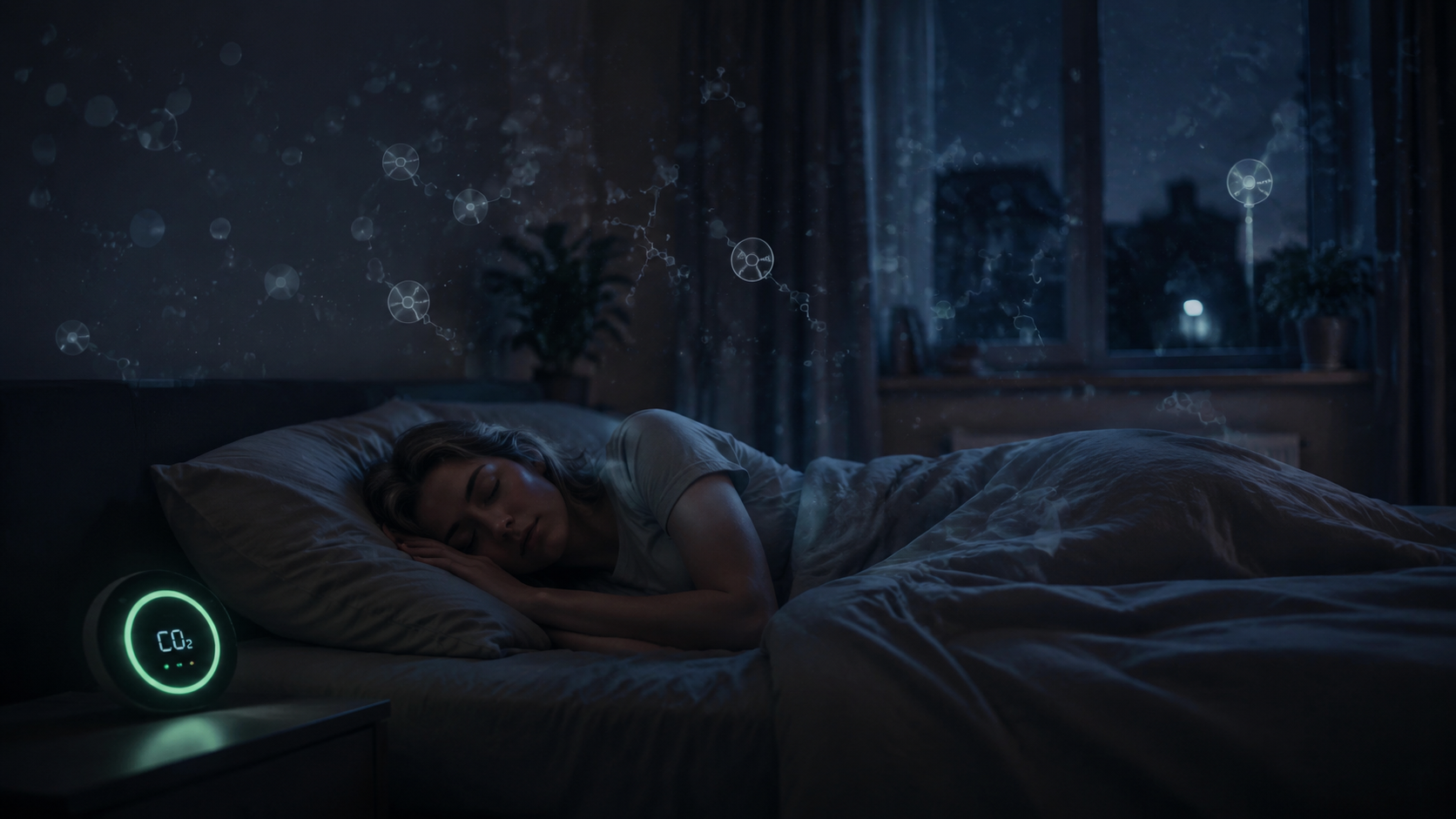
The Bedroom Can Get Stale Enough to Matter
CO2 is not a toxin at ordinary bedroom levels in the dramatic sense. The problem is subtler: it is a marker of how much rebreathed air is accumulating, and controlled sleep studies suggest it can affect sleep before the room feels obviously bad.
The cleanest anchor here is a 2024 field-lab study by Kang and colleagues with 36 participants. Compared with 750 ppm CO2, an average of 1,000 ppm reduced sleep efficiency by 1.3% and increased awake time by 5 minutes. At 1,300 ppm, deep sleep decreased and morning salivary cortisol increased.[1]
Those are not apocalyptic numbers. They are also not nothing. A few extra minutes awake can be easy to forget by morning, especially if you never fully register the awakenings. A small reduction in sleep efficiency can matter more to the person who is already on the edge: a warm room, a restless partner, allergies, stress, or an early alarm.
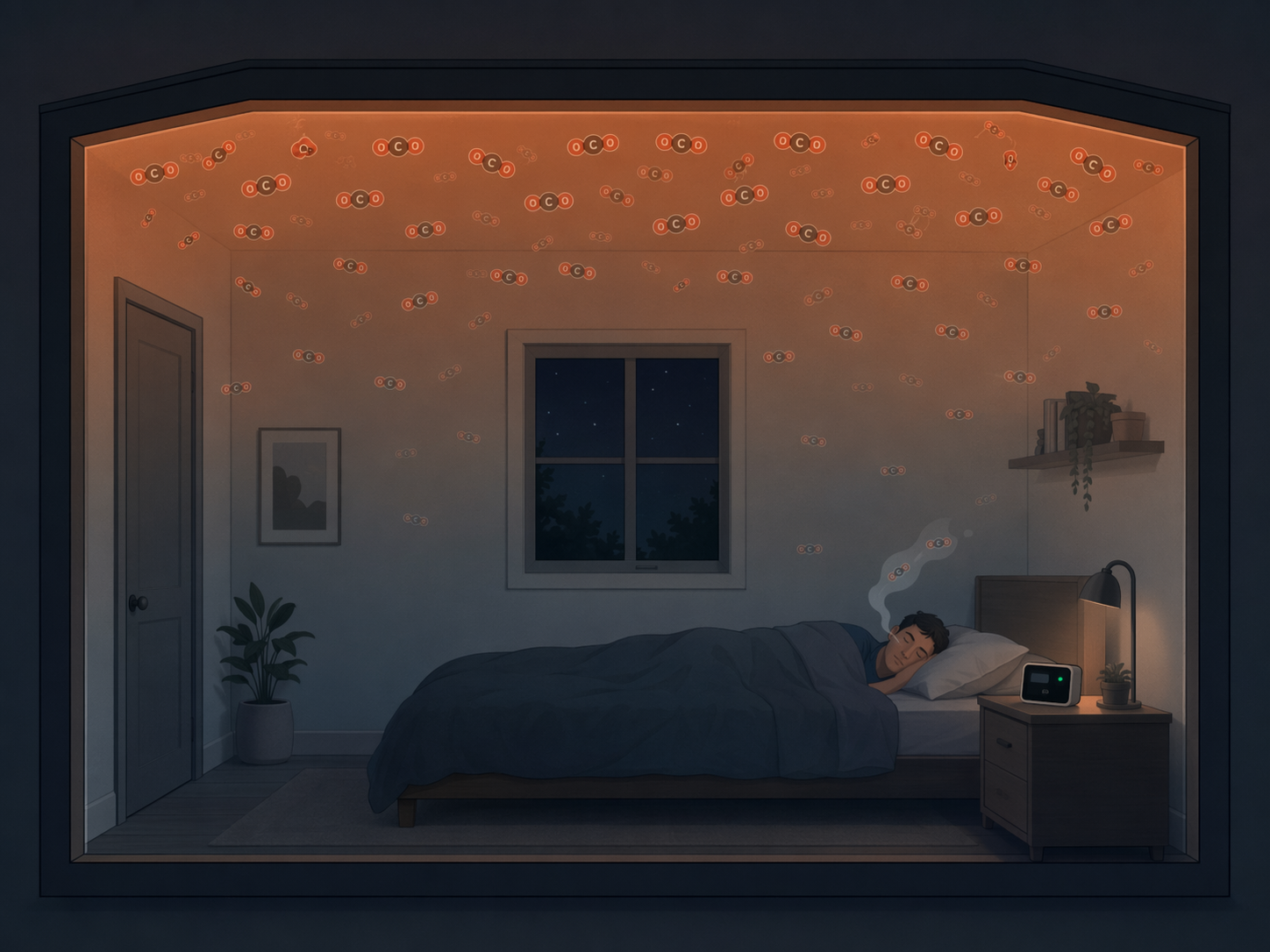
The practical point is not that every bedroom over 1,000 ppm is ruining sleep. It is that 1,000 ppm is a plausible threshold where sleep quality can start to measurably degrade, and closed bedrooms can go well beyond that. Some closed bedrooms routinely reach 2,500 to 3,000 ppm, which is exactly the kind of ordinary, non-obvious condition that never shows up in a bedtime checklist.
A related ventilation study cited by ASHRAE found that when bedroom CO2 averaged 835 ppm rather than 2,395 ppm under low ventilation, students spent more time asleep and performed better on cognitive tests the next day.[2] That matters because the complaint is often not only “I woke up” but “my brain did not come back online.”
There are limits. Much of the strongest CO2 evidence comes from controlled rooms, dormitory rooms, or simulated bedrooms, not every possible home layout. A person sleeping alone in a leaky older house is not in the same situation as two adults, a dog, and a closed door in a modern tight bedroom. Still, if a CO2 monitor shows your room sitting above 1,000 ppm for long stretches, the result is worth treating as a sleep variable rather than trivia.
Particles Are a Different Problem
CO2 gets attention because it is easy to measure and rises in a sealed room. PM2.5 deserves attention because it is small enough to be inhaled deeply, and the sleep evidence points in the same general direction from a different pathway.
A 2025 metastudy reported by The Guardian pooled 25 studies covering 1.2 million people across 6 countries. Its estimate: cutting PM2.5 in half, from busy roadside levels to World Health Organization guideline levels, could reduce the likelihood of poor sleep by roughly 1 in 10 among middle-aged and older adults.[3]
That is an estimate of association across a large body of work, not proof that a purifier will make any one person sleep 10% better next week. But it is large enough to make PM2.5 hard to dismiss, especially when paired with more granular sleep-stage findings.
In a 2025 Taipei study of 8,611 people, each 1-microgram-per-cubic-meter increase in PM2.5 was consistently associated with less deep sleep, more light sleep, and a higher arousal index across seasons. The same study found that PM2.5 mediated some of the observed effects of temperature and humidity on sleep, meaning that part of what looks like a weather effect may be moving through particle exposure.[4]
That last detail is useful because bedrooms rarely offer one clean variable. A hot night may lead you to open a window. An open window may lower CO2 while letting in outdoor particles. A humid night may make the room feel worse and change particle behavior. If the air outside is clean, ventilation can be the obvious move. If smoke, traffic pollution, or a poor AQI is the reason the window is closed, ventilation and filtration start competing.
For more on interpreting outdoor readings before deciding whether to open windows, see what AQI means for sleep tonight. For smoke-specific nights, the cleaner-room approach in how to protect sleep from wildfire smoke is the more relevant playbook.
Ventilation and Filtration Are Not Interchangeable
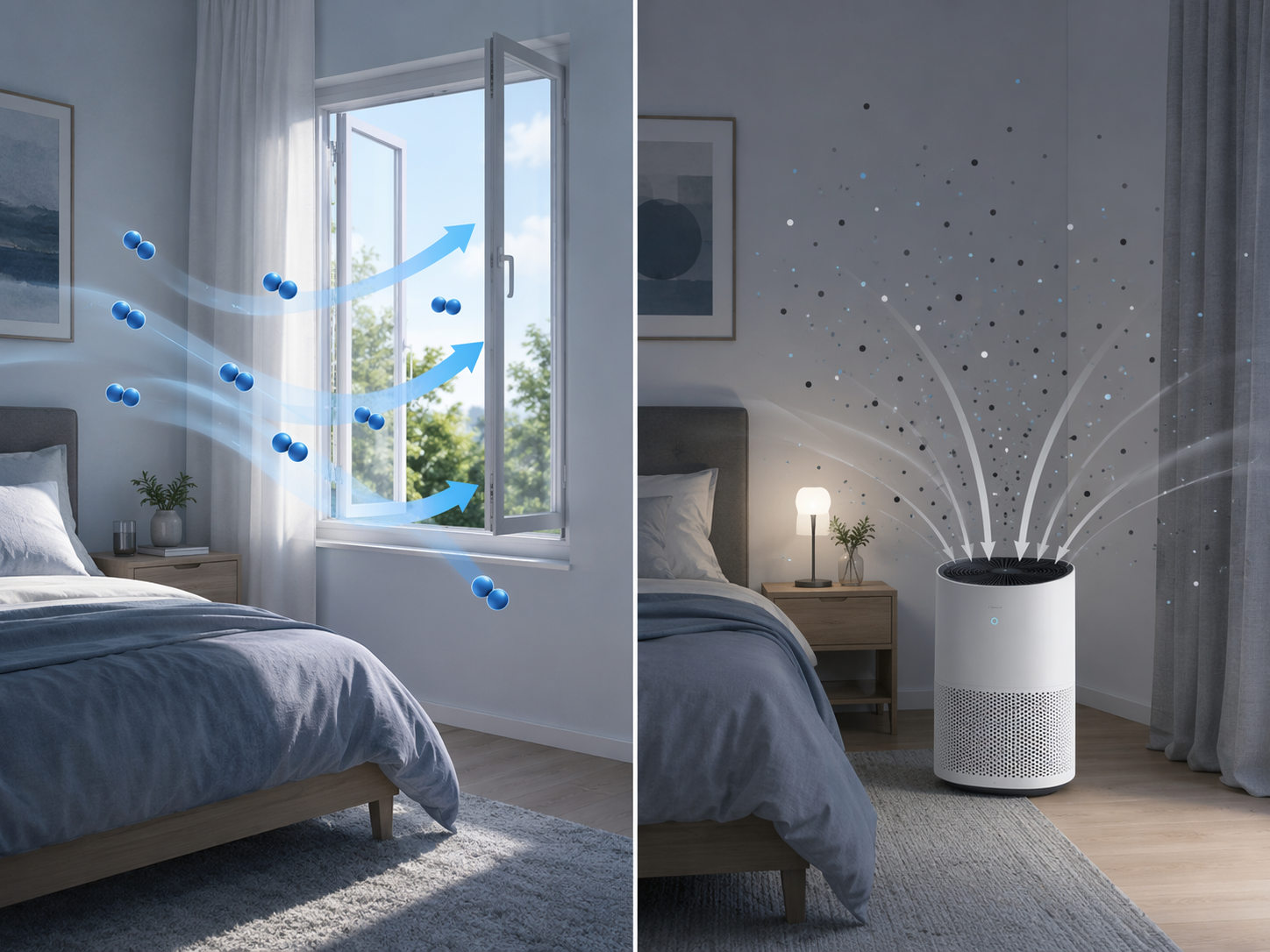
This is where a lot of bedroom air advice gets sloppy. A HEPA purifier can reduce particles. It does not remove CO2. Opening a window can dilute CO2. It may increase PM2.5 if the outdoor air is polluted. A carbon filter may help with some VOCs, but a basic HEPA-only unit is not a gas-removal device.
| Bedroom issue | What usually helps | What it does not solve |
|---|---|---|
| CO2 buildup from breathing in a closed room | More outdoor air or better whole-home ventilation | PM2.5 if incoming air is polluted |
| PM2.5 from smoke, traffic, cooking residue, or indoor sources | Properly sized HEPA filtration | CO2 buildup |
| Heat or humidity that worsens sleep comfort | Cooling, dehumidifying, bedding changes, or timed ventilation | Particle exposure by itself |
That distinction matters most on the nights when there is no perfect choice. During wildfire smoke, opening a window may improve CO2 while making particle exposure worse. During a clean, cool night, keeping the room sealed because “closed is controlled” may be the mistake. During a hot, stagnant night, the best available move may be partial: keep filtration running, crack the door, use mechanical ventilation if you have it, and reduce heat load where you can.
The same tradeoff shows up in summer heat and smoke events, where the window that would relieve one problem can worsen another. The practical answer changes with outdoor air, indoor CO2, and whether you have filtration already running; the combined-risk scenario is covered more directly in summer heat and wildfire smoke.
Temperature Still Counts, But It Is Not Separate From Air
A cool bedroom is not just a comfort preference. Sleep depends partly on the body’s ability to shed heat at night, which is why heat can make sleep lighter and more broken. In a large 2017 analysis of 765,000 US adults, each 1°C increase in nighttime temperature was associated with about 3 additional nights of insufficient sleep per 100 people per month.[5]
The usual target of about 68°F, or 20°C, is a useful starting point, not a moral law. Bedding, sleepwear, mattress materials, age, medications, and whether someone runs hot or cold can all shift the comfortable range. The point is to avoid treating temperature as decoration. A room that is too warm can push sleep toward lighter stages, and it can also change the ventilation decision: people close windows for outdoor noise, smoke, pollen, security, or air conditioning, then CO2 rises while they sleep.
Humidity belongs in the same practical layer. A middle range of 30% to 60% is usually more comfortable than very dry or very damp air. But humidity is not a standalone sleep cure. The Taipei findings are a useful warning here: some temperature and humidity effects were mediated by PM2.5, so what feels like “bad weather sleep” may partly be particle exposure traveling with the weather.[4]
For the thermoregulation side of the problem, how heat disrupts sleep quality goes deeper. Here, the important bedroom-level judgment is simpler: temperature, humidity, ventilation, and filtration interact. Fixing one while ignoring the others can leave the sleeper with a room that looks optimized on paper and still feels bad at 4 a.m.
What to Try First
Start with the variables that can be measured or changed without redesigning the house. The goal is not to turn the bedroom into a lab. It is to stop guessing whether the room is quietly working against sleep.
- Measure overnight CO2 for several nights if you can. A brief daytime reading is less useful than seeing what happens with the door closed, windows closed, and normal occupancy.
- Aim to keep bedroom CO2 below 800 ppm when feasible. If readings climb above 1,000 ppm for long periods, try a cracked door, a window trickle vent, or an ERV/HRV if your home has one.
- Use HEPA filtration for PM2.5, especially when outdoor AQI is poor, smoke is present, or indoor particle sources are hard to avoid.
- Keep the room near 68°F, or 20°C, as a starting point, then adjust for bedding, sleepwear, and personal comfort.
- Keep humidity in a comfortable middle range, roughly 30% to 60%, rather than chasing an exact number.
If you buy only one device, choose based on the suspected problem. A CO2 monitor tells you whether the closed-room ventilation problem is real. A HEPA purifier reduces particles but will not tell you whether CO2 is building up. In a bedroom with both high CO2 and outdoor smoke, the answer may be a combination: filtration plus the least-polluting ventilation option available.
The evidence for air purifiers and sleep is promising but uneven. Some purifier studies are small, and several are industry-sponsored. That does not make the results useless, but it does mean the strongest claim is narrower: HEPA filtration is a sensible way to reduce PM2.5 exposure, and PM2.5 exposure is associated with worse sleep outcomes. It is less honest to promise that a purifier alone will fix insomnia.
For a more detailed CO2 and ventilation angle, see how bedroom air quality affects sleep quality. For nights when alerts are already active, how to sleep well during an air quality health advisory is the better checklist.
Where the Evidence Is Strongest
The CO2 case is strongest when it stays close to the human sleep data: controlled bedroom-like conditions, measured CO2, measurable changes in sleep efficiency, awake time, deep sleep, cortisol, and next-day cognition. It is not a claim that CO2 explains every bad night.
The PM2.5 case is strongest as a converging body of evidence. A 2020 systematic review covering 22 studies across 17 countries found that 21 of the 22 studies reported a positive association between air pollution exposure and poor sleep. Proposed mechanisms included central nervous system serotonin dysregulation and respiratory inflammation.[6]
That does not make every mechanism settled. The Taipei study used ambient PM2.5 monitoring stations rather than in-bedroom measurements, so personal exposure could differ.[4] Pooled studies can estimate population-level associations without proving that one home intervention will produce the same effect in one bedroom. And purifier studies need to be read with attention to size, sponsorship, and what the filter actually removes.
Still, the bedroom implication is practical enough: once basic sleep hygiene is already handled, indoor air quality is not a side issue. A closed room with elevated CO2 can make sleep more fragmented. Fine particles are associated with lighter sleep and more arousals. Heat and humidity can worsen the situation directly and indirectly. The useful fix is specific rather than grand: ventilate for CO2, filter for PM2.5, keep the room cool enough to sleep, and check the numbers when your body keeps telling you the night was not as restorative as the clock says.
References
- Ventilation causing an average CO2 concentration of 1,000 ppm negatively affects sleep. ScienceDirect. 2024.
- Wargocki bedroom CO2 ventilation study. ASHRAE Journal.
- Li/Johns Hopkins 2025 metastudy on PM2.5 and sleep. The Guardian. 2025.
- Tung et al. Taipei cross-sectional study on PM2.5, temperature, humidity, and sleep. Annals of Medicine. 2025.
- Obradovich et al. 2017 nighttime temperature and insufficient sleep study. 2017.
- Liu et al. systematic review on air pollution exposure and sleep. PMC. 2020.
Comments
Join the discussion with an anonymous comment.