
Mechanism explainer
Yes, a Red Alert Heatwave Makes Insomnia Worse
Red-alert heatwaves measurably worsen insomnia: heat blocks the core-body-temperature drop that initiates and maintains sleep, cutting deep and REM sleep. This explainer details the mechanism, who is most affected, the evidence-graded response that works, and when to seek clinical care.
Yes. A red-alert heatwave can make insomnia worse, and the main reason is physical: a warm bedroom can block the roughly 0.5–1°C drop in core body temperature the body normally needs to initiate and maintain sleep, delaying sleep onset and reducing deep sleep and REM sleep.[1]
For U.S. readers, “red alert heatwave” is mostly UK language. In the UK Heat-health Alert system, a red alert means a severe heat-health situation with “significant risk to life” even for healthy people, and it is issued alongside a red extreme-heat warning.[2] In U.S. terms, think of conditions comparable to an Excessive Heat Warning or a high HeatRisk situation: not just “it will be hot,” but “the heat itself is a health hazard.”

One distinction matters before anything else: the quantitative studies do not show that the color of the government warning bulletin directly causes insomnia. They show that hotter nights, heatwaves, and high nighttime temperatures are associated with worse sleep. If the alert makes you worry, that worry can plausibly feed insomnia through hyperarousal, but that is an inference from insomnia science, not a separately measured “red alert anxiety” effect.
Evidence status
| Claim | Evidence tier | What to trust it for |
|---|---|---|
| Heat disrupts sleep by interfering with thermoregulation and the normal core-temperature drop at sleep onset. | Controlled physiology plus expert consensus | Mechanism, expected sleep-stage disruption, and practical sleep-protection rules.[1] |
| Hotter nights are associated with shorter sleep and delayed sleep onset. | Large observational wearable datasets | Real-world dose-response patterns, with bias because wearable users are not the whole population.[3][4] |
| The heat-sleep relationship is consistent across many settings. | Systematic review | Confidence that the pattern is not limited to one country or one device dataset.[5] |
| Older adults and already-vulnerable sleepers lose more sleep in heat. | Observational cohort data plus consensus | Risk ranking, not a guarantee that every individual will respond the same way.[3][7] |
| Cooling the room, reducing daytime heat gain, cautious fan use, and protecting insomnia routines are the right first response. | Consensus guidance and public-health safety guidance | Practical action where randomized heatwave trials are limited.[1][10][11] |
Why heat blocks sleep instead of merely making it uncomfortable
Sleep onset is partly a cooling event. In the evening, the body shifts heat toward the skin and extremities so core temperature can fall. That decline is not decorative; it helps the brain move into sleep. The European Insomnia Network describes a normal core-temperature drop of about 0.5–1°C at sleep onset and notes that sleep quality begins to degrade when bedroom temperature rises above roughly 24–25°C, or about 75–77°F.[1]
That is why a hot bedroom can feel so different from a noisy one. Noise may wake you or irritate you. Heat can obstruct the bodily transition that makes sleep possible. In controlled heat exposure summarized by the European Insomnia Network, a 35°C room compared with a 29°C room suppressed the normal temperature decline, increased wakefulness, and reduced Stage 3 deep sleep and REM sleep.[1]
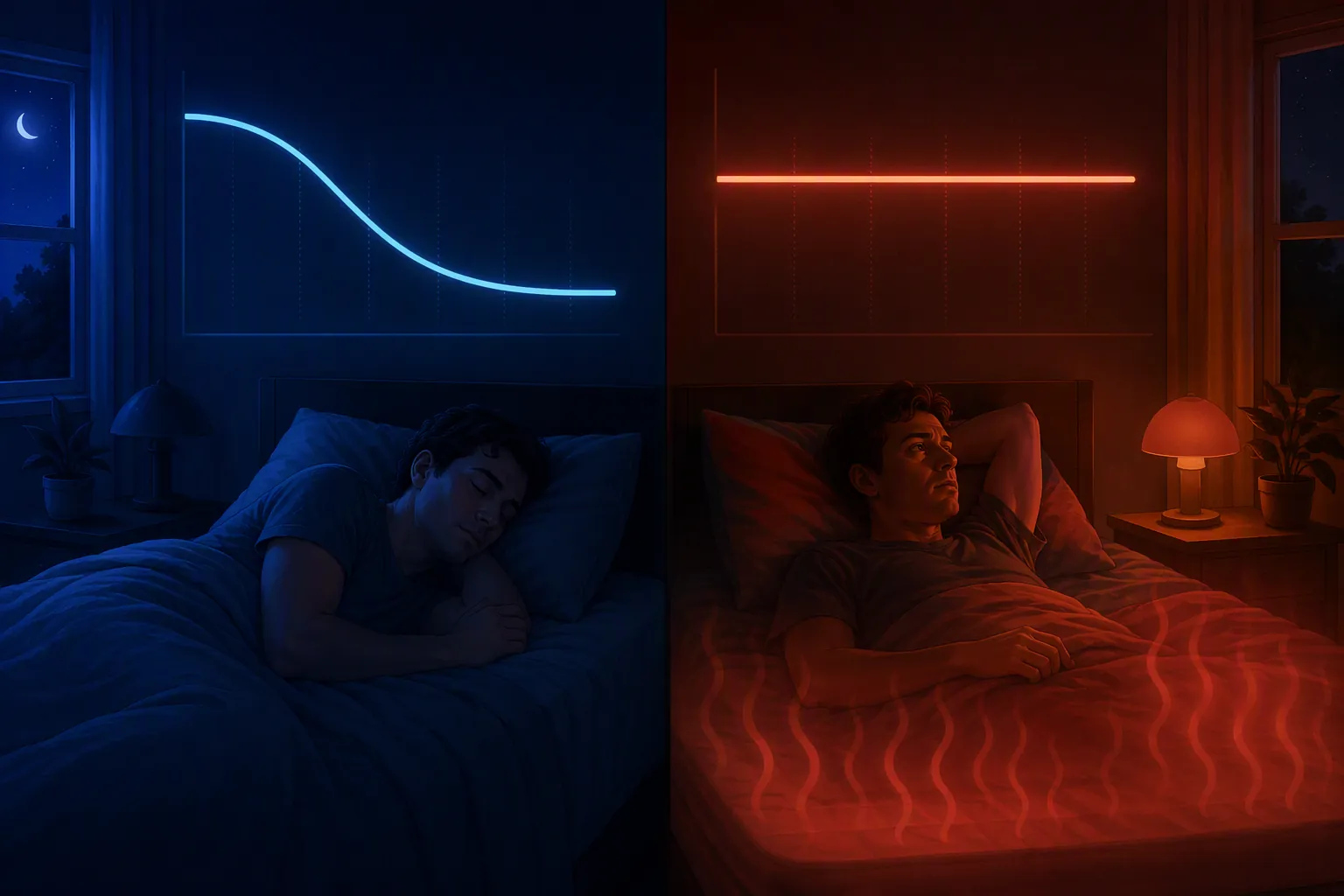
For someone with insomnia, that extra heat load lands on an already narrow margin. Insomnia is not just “not sleeping enough”; it often includes conditioned arousal around the bed, worry about consequences, and a nervous system that is too ready to monitor the night. Add a bedroom that prevents cooling, and the usual advice to “just relax” becomes biologically unfair.
This is also why the worst night of a heatwave may not be the hottest afternoon. Sleep depends heavily on nighttime relief. If the apartment, mattress, walls, and air never cool, the body keeps trying to shed heat into an environment that is not taking it.
What the real-world data show
The largest real-world studies do not ask people, “Did a red alert make you anxious?” They compare sleep timing and duration with ambient temperature. That narrower question is also the more useful one during an active heat event, because it points to the bedroom as the target.
In a 2022 analysis of sleep-tracking data from 68 countries, nights above 30°C were associated with about 14 minutes less sleep. Minimum nighttime temperatures above 25°C increased the probability of sleeping less than 7 hours by 3.5 percentage points, mainly because people fell asleep later.[3]
Those numbers can look small until you are the person who needed sleep at 11:30 p.m. and is still awake at 1:00 a.m. A 14-minute average is not a promise that everyone loses only 14 minutes. It is an average across many people and many nights, including people with air conditioning, people without it, people who sleep easily, and people who already dread bedtime.
A 2025 Nature Communications study using wearable data in China found that each 10°C rise in daily mean temperature was associated with 20.1% higher odds of sleep insufficiency and 9.67 fewer minutes of total sleep. Deep sleep showed the largest proportional decline, with the deep-sleep proportion falling by 2.82%.[4]
Wearable data are valuable because they catch ordinary nights outside a lab, at a scale sleep researchers could not have managed a generation ago. They also miss people. Device owners tend to be wealthier, more connected, and often healthier than the people most exposed to dangerous indoor heat. These datasets also usually lack direct indoor bedroom temperature and air-conditioning data. That means the estimates are useful for dose-response, but they may understate the burden for people in poorly cooled housing, older adults living alone, and people without control over their sleep environment.
The broader literature points in the same direction. A 2024 systematic review concluded that higher ambient temperatures are linked with degraded sleep globally, with stronger effects in hot months, hot regions, and vulnerable populations, and with little evidence that people rapidly adapt their sleep to repeated heat exposure.[5] Earlier work also connected warmer nighttime temperatures with more self-reported insufficient sleep, helping establish the heat-sleep link before wearable datasets became common.[6]
Who has the least margin
Existing insomnia belongs near the top of the list, even when a heatwave study does not enroll “insomnia patients” as a separate group. If your sleep system already depends on strict timing, low arousal, and careful stimulus control, a hot bedroom disrupts several supports at once: you get sleepy later, you spend more time awake in bed, and the bed can become associated with another night of effort.
Older adults are also consistently exposed to more risk. In the 2022 global wearable study, adults older than 65 lost more than twice as much sleep per degree as middle-aged adults, with reported coefficients of −0.61 for older adults and −0.28 for middle-aged adults.[3] A 2024 study of 7,240 older adults in the China Health and Retirement Longitudinal Study found that heatwaves, including low-intensity heatwaves lasting at least 3 days, raised the odds of losing at least 1 hour of sleep.[7]
Perimenopause and menopause add another layer, especially when night sweats collide with a room that never cools. Menopause sleep guidance commonly notes that insomnia is frequent during this transition, and expert commentary from Let’s Talk Menopause describes an approximately 50% insomnia rate in this population.[8] That does not prove heatwaves cause menopausal insomnia. It does mean that a person already waking hot has less room for an external heat load before the night fragments.
Pregnancy, chronic illness, certain medications, dehydration risk, limited mobility, and living in an overheated top-floor or poorly ventilated home also shift the problem from sleep discomfort toward safety. In those cases, protecting sleep is still important, but preventing heat illness comes first.
The climate-era numbers are real, but they are not tonight’s diagnosis
Climate Central has framed hot nights as costing sleep across the year, including an estimate of 56 hours of sleep loss per year and roughly 5–6 hours per year attributable to climate change.[9] That is a modeled extrapolation from temperature-sleep functions, not a direct measurement of your bedroom tonight.
It is useful context, especially because hotter nights are becoming harder to treat as rare. But if you are awake during a red-alert heatwave, the immediate clinical question is smaller and more practical: can you reduce the heat your body has to shed, and can you avoid turning one bad heat night into a reinforced insomnia pattern?
What actually helps during the alert
The useful response is not a novelty sleep hack. It is heat-load reduction plus insomnia protection. Some of these actions are boring; that is a strength during dangerous weather.
- Keep heat out before bedtime. Close curtains, blinds, and windows during the hottest part of the day when indoor air is cooler than outdoor air, then open windows at night only when outside air becomes cooler.[10]
- Move sleep to the coolest safe room. A lower floor, shaded room, or cross-ventilated space may matter more than staying in the usual bedroom during the alert.
- Aim cool, not cold. The European Insomnia Network cites about 19°C, or 66°F, as a favorable bedroom target, but during a severe heatwave the goal is to lower heat stress, not to reach a perfect lab temperature.[1]
- Use a lukewarm shower rather than an icy one. Consensus guidance favors lukewarm cooling because very cold exposure can provoke a rebound response and may not help the body settle into sleep.[1]
- Be cautious with alcohol. It can make sleep shallower and worsen dehydration risk, exactly when the night is already thermally stressful.[1]
- Use fans intelligently. NHS guidance says fans can help when indoor temperatures are below 35°C, or 95°F, but they should not be relied on as the main cooling strategy above that threshold.[10]
- Do not assume a fan is safe for every vulnerable person. Home-overheating guidance notes that fans have limits for older or dehydrated people, especially when they only move hot air around.[11]
Fans still have a place. The European Insomnia Network notes that fans use roughly 50 times less electricity than air conditioning, which matters for people trying to cool a room without heavy energy use.[1] But a fan is not a medical shield. If the room is dangerously hot, the better intervention may be a cooler part of the home, a cooling center, a relative’s air-conditioned room, or medical advice for a high-risk person.
Protect the insomnia routine, even if sleep is imperfect
Heatwaves tempt people into desperate sleep behavior: going to bed very early “just in case,” staying in bed for hours while alert, drinking alcohol to force sleep, or napping long and late after a bad night. Those moves can make sense emotionally and still keep insomnia going.
The European Insomnia Network’s heatwave guidance adapts familiar CBT-I principles: go to bed when sleepy, keep a stable rise time, limit naps to 20 minutes and keep them before about 2 p.m., avoid alcohol, and leave the bed if you are awake and activated rather than teaching the brain that bed is where you fight the night.[1]
That does not mean forcing yourself to be strict while overheated. If the bed is the hottest place in the home, move. If a couch near a cross-breeze is cooler, use it. The insomnia principle is not loyalty to a mattress; it is reducing wakeful struggle in the place you are trying to associate with sleep.
If heat has been cutting your deep sleep, it may also be useful after the alert has passed to review evidence-graded strategies for sleep depth rather than adding supplements or gadgets at random. This site’s guide to natural remedies that may increase deep sleep separates stronger from weaker claims.
When this stops being a sleep problem only
During a red-alert heatwave, do not chase perfect sleep at the expense of safety. Seek medical help urgently if there are signs of heat illness, confusion, fainting, severe weakness, worsening dehydration, chest pain, severe breathlessness, or a high-risk person who cannot cool down. NHS heatwave guidance emphasizes staying out of the heat, cooling the home, using fans only within safe limits, and taking extra care with people at higher risk.[10]
Also contact a clinician if insomnia remains severe after the heat breaks, if you are pregnant, older, medically fragile, taking medications that affect hydration or temperature regulation, or if sleep loss is worsening anxiety, depression, panic, or thoughts of self-harm. The red alert did not invent your insomnia, but the heat can aggravate it enough that support is warranted.
The most defensible target is the bedroom temperature and the body’s heat load. Cool the room, lower solar gain, protect the insomnia routine, and prioritize heat safety over a perfect night.
References
- How to deal with sleep problems during heatwaves: practical recommendations from the European Insomnia Network, Journal of Sleep Research, 2023.
- Heat-health Alert service, Met Office.
- Rising temperatures erode human sleep globally, One Earth, 2022.
- Ambient temperature and sleep health in China, Nature Communications, 2025.
- Ambient temperature and sleep: A systematic review, Sleep Medicine Reviews, 2024.
- Nighttime temperature and human sleep loss in a changing climate, Science Advances, 2017.
- Heatwaves and sleep loss among older adults in China, Environment International, 2024.
- Insomnia, Let’s Talk Menopause.
- Climate Change and Sleep Loss, Climate Central.
- Heatwave: how to cope in hot weather, NHS.
- Why homes overheat — and how to keep them cool, ScienceDaily, July 29, 2026.
Supports these guides
Spot an error or have clinical feedback?
Because this article covers clinical, medication, or safety information, we use a moderated correction channel instead of open public comments. Let us know if something about “Yes, a Red Alert Heatwave Makes Insomnia Worse” needs a closer look.
Send feedback on this article