Mechanism explainer
Is satellite light pollution a genuine threat to sleep?
Learn how proposed satellite mega-constellations could elevate night-sky brightness enough to disrupt your circadian rhythm and melatonin production, and why sleep scientists have formally warned the FCC about this global light pollution threat.
The sleep question is not whether you personally notice a satellite streaking over your house. It is whether thousands, or eventually far more, reflective and luminous objects in orbit could raise the background brightness of the night sky enough for human biology to register it. That distinction matters. The eye can shrug at faint light long before the circadian system is finished responding.
That is why the 2026 regulatory moment deserves attention from sleep scientists, not only astronomers. In March 2026, Northwestern’s Center for Circadian and Sleep Medicine and four international chronobiology societies warned the Federal Communications Commission that proposed satellite systems could threaten sleep, circadian rhythms, and seasonal biological cycles through orbital light pollution.[1] As of Q3 2026, proposals such as Reflect Orbital’s mirrored satellites and SpaceX’s orbital data center concept remain under FCC review; they are not a finished sky above anyone’s bedroom.
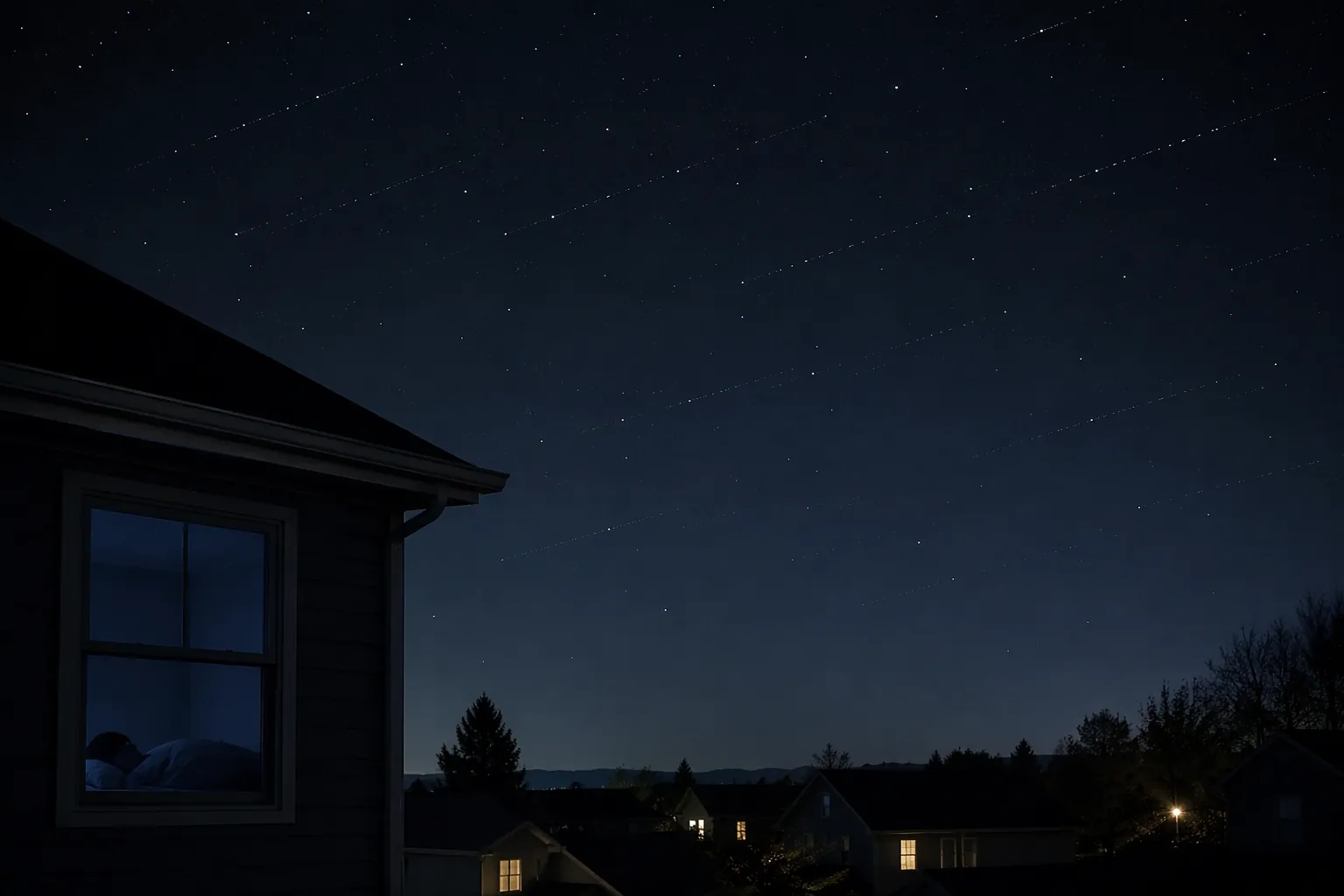
The strongest version of the concern is therefore conditional, but not imaginary: if proposed mega-constellations substantially increase night-sky brightness, satellite light pollution could become a biologically plausible sleep threat through melatonin suppression and circadian timing effects. The opposite overstatement should be rejected too: there is no direct human trial showing that satellite skyglow has already disrupted sleep.
What makes satellite light pollution different
Most people think of light pollution as a local problem: streetlights, stadium lighting, porch lights, commercial signage, car headlights, a neighbor’s security lamp. Those exposures can often be reduced, at least partly, by bedroom design or by moving away from dense urban lighting.
Satellite skyglow is harder to put in that category. The concern is not just isolated bright points crossing the sky. It is light reflected or emitted by many objects in orbit, scattered through the atmosphere, and added to the night-sky background. Kocifaj, cited in The Guardian, estimated that current satellites already add about 3–8 microcandela per square meter to night-sky brightness, with projections of 5–19 microcandela per square meter by 2035.[2]
That is a small number in ordinary visual terms. It is also the wrong instinct to dismiss it only because it sounds small. Circadian biology is not governed by whether a person would describe the sky as bright.
The other difference is reach. Kocifaj’s warning was blunt: unlike terrestrial light pollution, satellite skyglow cannot be escaped by going to a remote area.[2] A rural cabin may get you away from streetlights. It does not remove the orbital contribution overhead.
The modeled brightness increases are large enough to take seriously
The clearest quantitative warning comes from Olivier Hainaut’s 2026 modeling of mirrored satellites. In that preprint, 5,000 Reflect Orbital satellites could elevate scattered sky brightness by about 20–30% above natural levels, while 50,000 could reach a 200–300% increase.[3]
Those figures do not directly say, “this many people will sleep worse.” They describe modeled sky-brightness changes in an astronomy framework. Translating telescope-relevant sky brightness into human retinal exposure requires additional steps. But the scale is still important: a 20–30% increase is not the same kind of claim as “someone saw a bright satellite once,” and a 200–300% modeled increase would be difficult to treat as a purely aesthetic nuisance.
| Evidence | What it supports | What it does not prove |
|---|---|---|
| Hainaut 2026 modeling | Proposed mirrored satellite constellations could substantially increase scattered night-sky brightness | Direct human sleep disruption from satellite light |
| Kocifaj estimates cited in The Guardian | Existing and projected satellites add measurable sky brightness, and the contribution is globally additive | That every individual receives a sleep-relevant dose |
| Melatonin and artificial-light-at-night literature | Human circadian systems can respond to low nighttime light, with sensitive individuals affected at lower levels | That satellite skyglow alone reaches a known suppression threshold indoors |
| FCC petition from sleep and circadian scientists | The concern has entered formal regulatory review as a sleep and circadian issue | That the proposed systems will be approved or deployed as proposed |
The useful reading is neither complacent nor apocalyptic. The proposals are under review and may be modified, delayed, or rejected. The modeled increases are not a measurement of tonight’s sky over your bed. But if regulators are asked to approve systems that could globally add to nighttime light exposure, the burden should not fall on sleepers to prove harm after deployment.
How a faintly brighter sky could reach sleep biology
The proposed pathway is straightforward, even if the size of each step remains uncertain: satellites increase skyglow; skyglow adds to nighttime light exposure; retinal cells involved in circadian signaling detect some of that light; the brain adjusts melatonin timing and circadian phase; sleep timing, sleep continuity, or next-day alertness may shift.
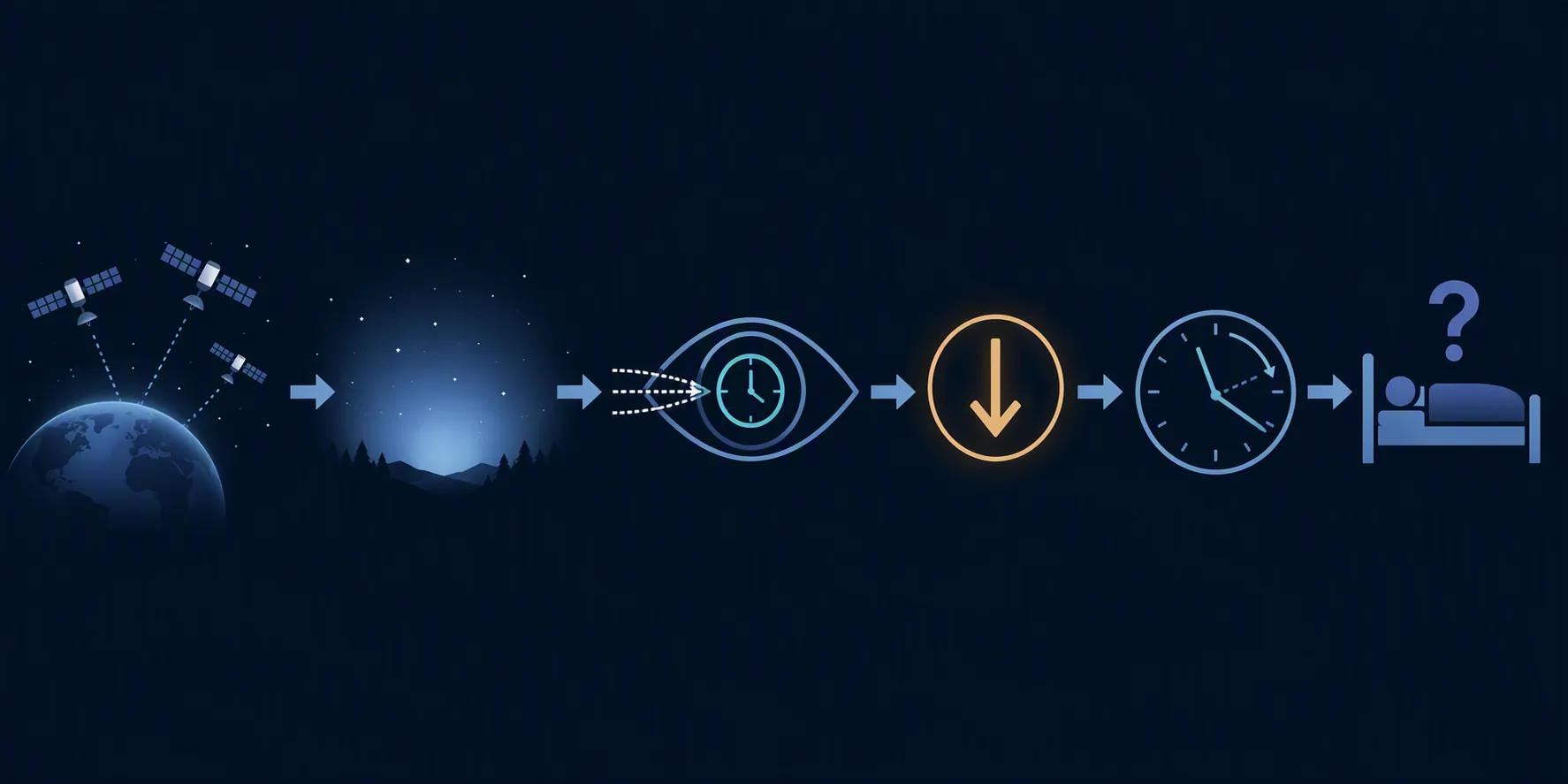
This pathway depends less on conscious brightness perception than many readers expect. The circadian system receives light information through intrinsically photosensitive retinal ganglion cells, often discussed in relation to melanopsin and blue-weighted light sensitivity. For the broader light-biology framework, including how melanopsin, ipRGCs, and timing shape sleep, see Circadian Rhythm and Light Exposure: How Light Affects Sleep.
Melatonin is the practical marker people recognize, but it is not a sleeping pill made by the body. It is a timing signal. Light at night can delay or suppress that signal, telling the circadian system that night is less dark than it should be. A 2019 review from Grubisic and colleagues reported that melatonin suppression in sensitive individuals can begin at levels as low as 6 lux, while city skyglow can already reach 0.1 lux.[4]
That 6-lux figure should be handled carefully. It is not a satellite-specific threshold, and it does not mean a small increase in skyglow automatically suppresses melatonin in every person. It does mean the margin between “too dim to worry about” and “biologically relevant for someone” is narrower than ordinary intuition suggests.
The important exposure question is cumulative. A bedroom may already contain outdoor light leakage, device light, hallway light, standby LEDs, or early-morning sky brightness. Satellite skyglow would not need to be the dominant source in every home to matter at population scale. It could be an added layer on top of light environments that are already too bright at the wrong time.
Why “I cannot see the difference” is not a safety test
Human visual judgment is a poor screening tool for circadian exposure. A person may not notice a modest lift in sky brightness, especially in a city where the night is already washed out. The retina, however, integrates light across time, spectrum, timing, and direction. A faint dawn-like signal at the wrong biological time can matter more than a brief bright flash at a less sensitive time.
This is also why phone-screen evidence is relevant but limited. In a randomized controlled trial, reducing blue light from smartphone screens improved Pittsburgh Sleep Quality Index scores from 6.83 to 3.93, with p<0.0001 and an effect size of d=1.02.[5] That study does not tell us what satellites do. It supports the narrower and more useful point that spectrum and timing of nighttime light can affect sleep-related outcomes.
Who might be more vulnerable?
The honest answer is that satellite-specific vulnerability studies were not found. There is no solid basis for saying that older adults, pregnant people, people in perimenopause, people with ADHD, or people with mood disorders have been shown to lose sleep because of satellite light pollution.
There is still a reason these readers may be paying closer attention. Many sleep and mood conditions involve circadian timing, light sensitivity, irregular sleep windows, or fragile sleep continuity. Pregnancy and later life can also change sleep architecture, nighttime awakenings, and light exposure patterns. Those are reasons to treat extra nighttime light as potentially relevant, not reasons to invent satellite-specific certainty.
For a person already struggling with delayed sleep, early waking, seasonal mood changes, or fragmented nights, the practical question is not whether satellites are the single cause. It is whether society should approve a global light source that could make circadian protection harder for people who already have less room for error.
What the FCC warning adds
The FCC petition changes the tone of the issue. Satellite brightness has often been framed around astronomy: telescope interference, ruined exposures, loss of dark skies. Those concerns are real, but sleep medicine adds a different standard. It asks whether a public infrastructure decision could alter a biological environmental cue shared by nearly everyone.
The Northwestern-led warning specifically placed orbital light pollution in the domain of sleep, circadian rhythms, and seasonal biological cycles.[1] That does not transform modeled risk into proven harm. It does mean regulators were formally told, before approval, that the light environment is a health-relevant exposure, not only a backdrop for astronomy.
This timing matters. Once a global orbital system is deployed, personal avoidance becomes weak. A household can dim lamps, choose warmer bulbs, wear an eye mask, or install blackout curtains. It cannot opt out of skyglow scattered through the atmosphere.
What you can control, and what you cannot
Bedroom-level steps still matter because indoor retinal exposure is the part an individual can most directly reduce. Blackout curtains and eye masks can reduce light reaching the sleeper, and warmer, low-intensity night lighting is generally preferable to bright white or blue-rich LEDs when light is needed overnight.[6]
- Use blackout curtains or a well-fitting sleep mask if outdoor light enters the bedroom.
- Keep nighttime lighting dim and warm when safety lighting is necessary.
- Avoid treating device-light changes as a complete substitute for a dark sleep environment.
- If you have a circadian rhythm disorder, bipolar disorder, severe insomnia, or another condition affected by light timing, discuss light exposure strategy with a clinician rather than relying on generic sleep tips.
Those measures are worth taking, but they should not be used to shrink the policy question into a shopping list. Personal mitigation can reduce indoor exposure. It does not solve a globally additive light source.
So, is it a genuine sleep threat?
Yes, in the sense that the proposed mechanism is biologically plausible, the modeled exposure changes are large enough to warrant precaution, and the scale would be unusually hard to escape. Satellite light pollution is not just a stargazing concern if it meaningfully raises the nighttime light environment that helps set human circadian timing.
No, in the stronger sense that we cannot yet say satellites have been shown to disrupt human sleep. The direct study has not been done. The current case combines orbital brightness modeling, existing skyglow estimates, terrestrial artificial-light-at-night research, and circadian biology. That is enough for regulatory caution. It is not enough for certainty.
The cleanest conclusion is also the least dramatic: if proposed mega-constellations substantially raise night-sky brightness, satellite light pollution could become a real sleep and circadian health concern, especially because the added exposure would be global. Treating that possibility seriously now is not alarmism. Treating it as proven harm would be overreach.
References
- Sleep experts warn FCC: Satellites could dramatically increase light pollution, Northwestern Now, March 2026
- Satellite mirror plans could disrupt sleep and ecosystems worldwide, scientists say, The Guardian, April 2026
- arXiv:2604.09427v1
- Light pollution can suppress melatonin production in humans and animals, IGB Berlin
- Blue light reduction from smartphone screens and sleep quality, Chronobiology International, 2023
- Satellite megaconstellations and the night sky, DarkSky International
Supports these guides
Spot an error or have clinical feedback?
Because this article covers clinical, medication, or safety information, we use a moderated correction channel instead of open public comments. Let us know if something about “Is satellite light pollution a genuine threat to sleep?” needs a closer look.
Send feedback on this article