
When severe weather keeps someone awake, the problem is rarely just “the storm.” A hot bedroom asks the body to do heat work it normally finishes quietly before sleep. A falling pressure front may turn into sinus pressure, headache, or joint pain for some people. A dark, overcast day can blur the light signal that helps anchor sleep timing. And when thunder, warnings, or past storm memories put the nervous system on watch, the body may stay too alert to hand itself over to sleep.
That is the practical answer to how severe weather disrupts sleep: it can arrive through several physiological pathways at once. The same thunderstorm can be mostly a temperature problem for one sleeper, mostly an anxiety problem for another, and mostly a pressure-headache problem for someone else. The useful question is not whether weather “affects sleep” in general. It is which system in the body is carrying the load.

Heat is the strongest pathway because sleep depends on losing heat
Sleep onset is not only a brain event. It is also a temperature event. To fall asleep and maintain stable sleep, the body normally sheds heat and allows core body temperature to drop by about 0.5°C. That cooling is helped by heat moving out through the skin, especially the hands, feet, and other surface blood vessels. When the room stays hot, that gradient narrows. The body is tired, but it cannot unload heat efficiently enough to settle.
This is where the evidence is much stronger than the usual weather-and-sleep chatter. A 2025 Nature Communications study by Li and colleagues analyzed 23 million sleep records from 214,445 people and found that each 10°C increase in ambient temperature was associated with 9.67 fewer minutes of sleep, 20.1% higher odds of sleep insufficiency, and a 2.82% decline in deep sleep, with heat at or above 80°F especially relevant for sleep disruption.[1]
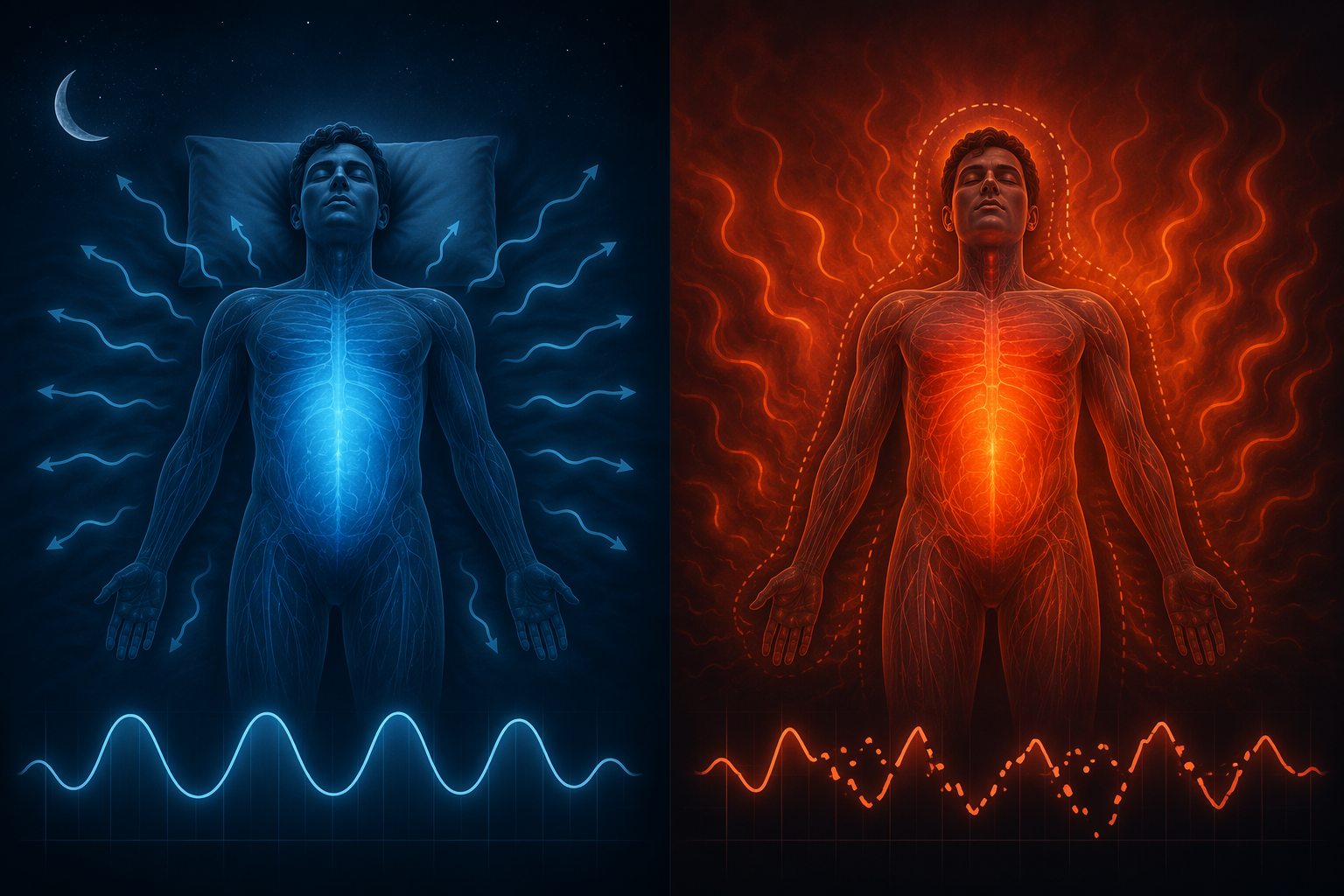
The deep-sleep finding matters. Deep sleep is not just “more sleep”; it is a phase in which the sleeping body is especially synchronized, less responsive, and busy with restoration. If heat keeps nudging the body back toward lighter, more fragmented sleep, a person may spend enough hours in bed and still wake as if the night never fully landed.
Hot sleepers often recognize this pattern without needing a wearable to tell them. They may fall asleep late because the room never cools, kick bedding off and pull it back on repeatedly, wake with a damp shirt, or feel oddly restless even when the storm itself has passed. The body is not being dramatic. It is trying to solve a heat-transfer problem while also trying to sleep.
Humidity can make this worse, though it does not need to become its own grand theory. When the air is heavy and evaporation is less effective, sweating becomes a less useful cooling tool. Humid conditions may also increase breathing effort during sleep and can be more noticeable for people already vulnerable to sleep-disordered breathing, though that is a narrower clinical pathway than ordinary storm-related insomnia.[2]
Pressure changes may matter, but the evidence is thinner
Before some storms, barometric pressure drops. In plain body terms, that means the air pressing on tissues changes. Some people report sinus pressure, headache, ear pressure, or joint pain around those shifts. The proposed mechanism is modest tissue expansion or pressure-sensitive irritation that becomes enough to keep the body uncomfortable at the exact time it is supposed to become less vigilant.
There is older peer-reviewed support for a pressure-sleep connection: Webb and Ades reported in Science in 1964 that barometric pressure deviations shifted sleep onset.[3] That finding is worth taking seriously, but it should not be inflated into the same category as the large modern temperature data. It is older, narrower evidence, and it does not prove that every storm-related bad night is pressure-driven.
Commercial sleep sites such as Amerisleep and Dreams UK describe related pressure pathways, including sinus and headache discomfort and possible breathing or oxygen-saturation effects, but those explanations are better treated as plausible clinical descriptions than as definitive population-level proof.[4][5] The useful test for a sleeper is pattern recognition: if the bad night begins as facial pressure, migraine warning signs, ear fullness, or aching joints before the storm arrives, pressure may be part of the story. If the room is also hot, heat may still be doing the larger share of damage.
A dark storm day can blur the timing signal
Overcast weather is not just scenery. Light is one of the body’s main timing cues, and a dim day can make some people feel sleepy earlier than usual. The plausible circadian problem is that low daytime light may encourage daytime drowsiness while weakening the contrast between day and night, so the evening melatonin rhythm is less cleanly timed.
This pathway should be held with more caution than the heat pathway. Dreams UK and Amerisleep both discuss storm-related low light and melatonin timing, but the article-level evidence available here is largely commercial and explanatory rather than direct experimental evidence showing that overcast storm days reliably cause insomnia across sleepers.[4][5] It is still a reasonable mechanism, especially for people who get unusually drowsy on gray afternoons, nap unintentionally, and then feel wide awake at their normal bedtime.
The practical implication is also narrower. If a storm day makes someone nap long or late, the problem may show up at bedtime as reduced sleep pressure rather than as fear or pain. If the day is dim but the person keeps a stable wake time, gets bright indoor light in the morning, and avoids late naps, the circadian effect may be small. Weather is not overriding biology by magic; it is changing the cues biology uses.
Storm anxiety keeps the body on duty
A cool room does not help much if the nervous system believes the night is unsafe. Severe weather is a threat cue: thunder startles, wind pressure changes the sound of a house, phones issue alerts, and radar maps make danger feel both distant and immediate. The National Weather Service describes storm anxiety as a real problem for people who become distressed before or during severe weather, and its guidance emphasizes planning, reliable information sources, and support rather than dismissing the fear as irrational.[6]
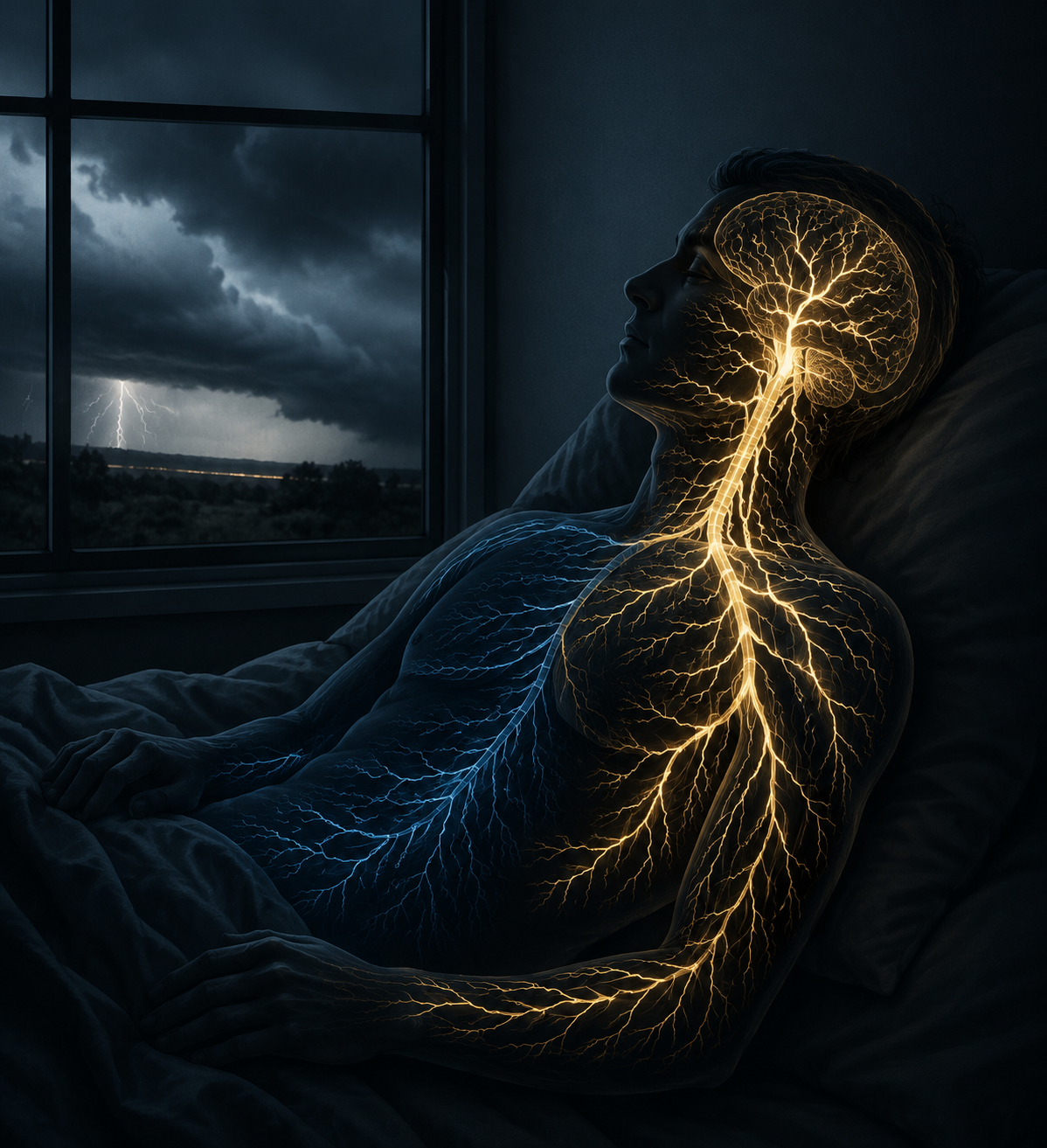
Physiologically, this pathway is a mismatch between sleep and surveillance. Sleep onset needs a shift toward parasympathetic dominance: slower breathing, reduced muscle readiness, less threat scanning. Storm anxiety pushes the other way. The sympathetic nervous system prepares the body to respond, and that preparation can feel like a racing heart, shallow breathing, stomach tension, listening for the next sound, or repeatedly checking the forecast.
That kind of arousal can also explain why ordinary sleep hygiene feels insulting during severe weather. A person may have avoided caffeine, dimmed the lights, and kept the room cool, yet still be unable to sleep because the brain is assigning a job: stay available. If the sleeper has lived through a frightening storm, evacuation, flooding, roof damage, or a night of warnings, the body may not treat new weather as background noise.
This is where storm-specific preparation matters more than generic relaxation. A charged phone, shoes and medication in a known place, a shelter plan, and one trusted alert source can reduce the number of open loops the brain keeps checking. For readers dealing specifically with tropical systems, hurricane anxiety and sleep disruption deserves its own attention because the anticipatory period can last for days, not just one noisy night. The cortisol-melatonin conflict described in nighttime anxiety can also overlap with storm anxiety when alertness rises just as the body is trying to transition into sleep.
Why one storm bothers one sleeper and not another
Weather-sleep effects vary because the pathways do not load the same body systems. A person with a well-cooled bedroom and no storm fear may sleep through thunder but feel pressure-related migraine symptoms before rain. Someone else may have no headache vulnerability but lose sleep every time the overnight low stays high. Another person may sleep well during ordinary rain and unravel only when warnings mention rotation, flooding, or evacuation.
This variation is also visible in broader weather-sleep research. Mattingly and colleagues found modest seasonal and weather-related effects in a study population of college-educated U.S. information workers, but that kind of sample limits how far the finding can be generalized to all sleepers, climates, housing conditions, and health vulnerabilities.[7] A person sleeping in a poorly cooled apartment during a heat wave is not having the same exposure as someone watching rain from a climate-controlled room.
| If the bad night feels like this | The likely pathway | What deserves priority |
|---|---|---|
| Sweating, tossing covers off, waking damp, unrest after a hot night | Thermoregulation failure | Cooling the sleep environment and reducing trapped body heat |
| Sinus pressure, migraine warning signs, ear fullness, aching joints before a storm | Barometric pressure sensitivity | Managing the pain or pressure trigger, with cautious expectations |
| Sleepy on a gray afternoon, late nap, then difficulty falling asleep | Circadian light-timing disruption | Protecting daytime light exposure and avoiding late sleep pressure loss |
| Checking alerts, startling at thunder, racing heart, listening for danger | Storm anxiety and sympathetic hyperarousal | Storm planning, arousal reduction, and reliable alert boundaries |
The table is not meant to turn bodies into neat categories. More than one pathway can be active on the same night. Heat can fragment sleep first, then thunder can make each awakening feel threatening. A pressure headache can raise arousal. A dim day can lead to an accidental nap, leaving the person more awake when the storm arrives after midnight.
Mismatched remedies fail for predictable reasons
If heat is the dominant pathway, a calming playlist will not fix the blocked temperature drop. It may make the room feel less hostile, but the body still has to shed heat. Cooling the room, reducing insulating bedding, choosing breathable sleepwear, and lowering heat buildup before bed are more directly matched to the physiology.
If storm anxiety is dominant, the opposite mistake happens. People keep adjusting pillows, temperature, or supplements while the nervous system is still waiting for danger instructions. In that case, the useful work often happens before bedtime: decide where to go if an alert sounds, choose which alerts are allowed to wake you, limit repeated radar checking, and make the room feel prepared rather than abandoned.
If pressure or low-light timing seems dominant, the expectations should be more modest because the evidence is less direct. Pressure-sensitive sleepers may benefit most from treating the associated symptom pattern they already recognize, such as headache or sinus discomfort, while tracking whether it actually predicts bad sleep. Low-light sleepers may learn more from watching nap timing and morning light exposure than from blaming the storm itself.
References
- Temperature-sleep study, Nature Communications, 2025
- How Weather Impacts Insomnia, Behavioral Sleep Solutions
- Sleep Studies: Effects of Barometric Pressure, Science, 1964
- How Weather Affects Your Sleep, Amerisleep
- How Does the Weather Affect Your Sleep?, Dreams UK
- Storm Anxiety, National Weather Service
- The effects of seasons and weather on sleep patterns measured through longitudinal multimodal sensing, Scientific Reports, 2021
Comments
Join the discussion with an anonymous comment.