Mechanism explainer
How Technology Affects Sleep: Three Mechanisms of Disruption and Three Ways to Use Tech Better
This evidence-based guide for adults aged 25–55 explains the three distinct ways screens and devices disrupt sleep — blue light, bedtime procrastination, and cognitive arousal — and shows how the same tools can be used intentionally to improve rest.
Introduction: The Paradox of Technology and Sleep
If you have ever scrolled social media in bed, watched "one more episode" until midnight, or checked your sleep score the moment you woke up, you have lived the central paradox of modern sleep: the same device in your hand can both undermine your rest and help you understand it. The question is not whether to use technology at night — for most adults, that ship has sailed — but how to separate the mechanisms that harm sleep from the features that can genuinely improve it.
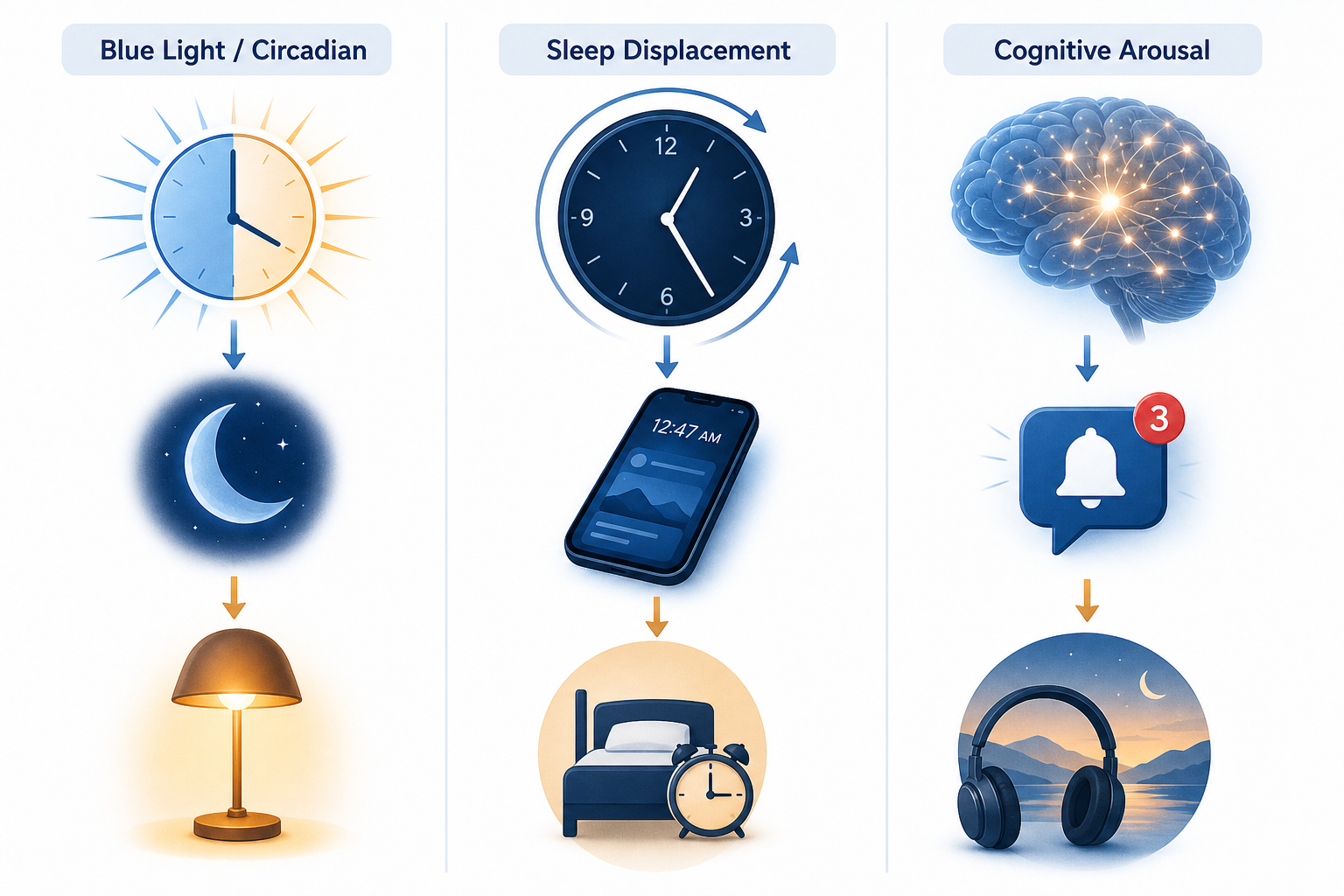
This guide maps three distinct pathways through which screens and devices affect sleep: circadian disruption from light, sleep displacement from bedtime procrastination, and cognitive arousal from interactive content. Each mechanism requires a different countermeasure, and each also has a flip side — a way the same technology can be turned toward better sleep when used intentionally. The goal is not to eliminate screens from the bedroom but to build a decision framework that lets you keep what helps and drop what hurts.
Understanding the gap between knowing what to do and actually doing it is also critical. Many people recognize that late-night phone use is a problem but struggle to change the habit. Our article on the sleep quality gap explores why awareness alone rarely leads to action — a concept that underpins the practical framework in this guide.
Mechanism 1: Blue Light and Circadian Disruption — What the 2024–2026 Evidence Actually Shows
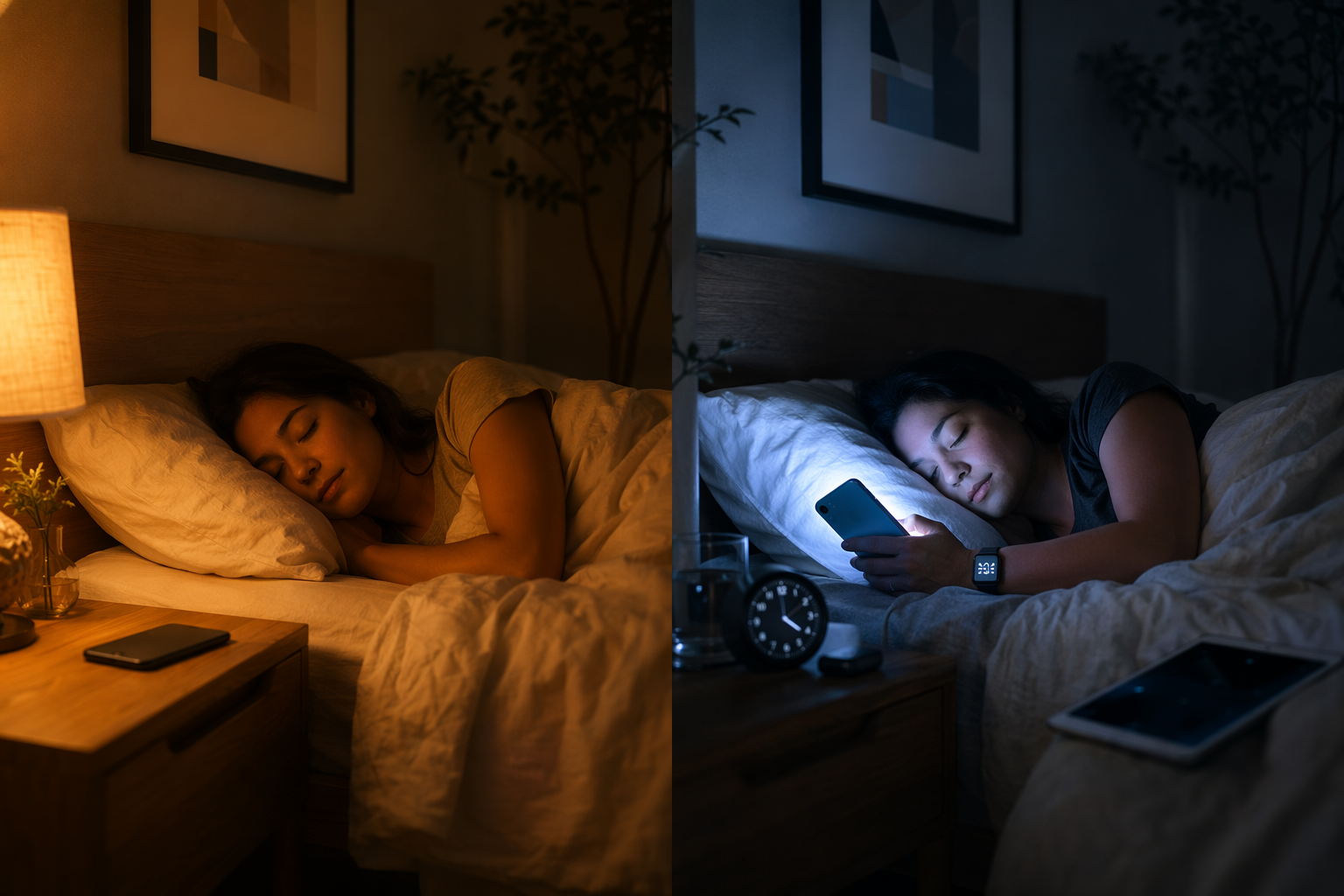
For years, the dominant narrative was simple: blue light from screens suppresses melatonin, delays sleep onset, and wrecks your circadian rhythm. The reality, as of 2026, is more nuanced — and less alarming.
A 2026 review of 11 studies, reported by the BBC, found that screen light delays sleep by approximately 9 minutes on average. That is a real, measurable effect — but it is far smaller than the dramatic claims that circulated in the mid-2010s. Dr. Jamie Zeitzer, a Stanford sleep researcher quoted in the review, put it plainly: "The amount of light emitted from our screens is really inconsequential" for sleep disruption when compared to natural light. A full 24 hours of blue light from a digital device equals less than one minute spent outdoors on a sunny day (100,000 lux outdoors versus roughly 50–80 lux from a phone screen).
That does not mean screen light has no effect — it means the effect is dose-dependent and cumulative. According to the Sleep Health Foundation, the natural evening rise in melatonin is not affected by one hour of bright screen light, but it is after 90 minutes. After 1.5 hours of bright screen use before bed, people report feeling less sleepy and show increased alertness on brainwave and mental performance tests. More strikingly, repeated use of a bright screen over five consecutive nights can delay the body clock by 1.5 hours.
What does this mean for the average adult? If you use your phone for 10 minutes to check the weather or set an alarm, the circadian impact is negligible. If you watch a 90-minute movie on a bright tablet in a dark room every night for a week, you are measurably shifting your internal clock later. The dose matters.
The BBC article also notes that blue-light filter features on phones — often marketed as a physiological solution — may actually work better as behavioral cues. When your screen shifts to warm tones at 10 p.m., it is a Pavlovian reminder that bedtime is approaching. The behavioral signal may be more valuable than the marginal reduction in blue light. And the most powerful countermeasure is not a filter at all: morning outdoor light exposure, even a 30-minute walk, significantly reduces evening light sensitivity and anchors the circadian clock.
Mechanism 2: Sleep Displacement — The "One More Episode" Problem
While blue light gets most of the media attention, sleep displacement — the simple act of using a device instead of sleeping — is often the strongest disruptor for most adults. The mechanism is not physiological; it is behavioral. You stay up later because the content is engaging, the episode is short, or the conversation is unresolved.
The scale of this problem is documented in a large cross-sectional study of 10,106 Saudi Arabian adults published in 2022. The findings are striking: 95.1% had a smartphone in their bedroom, and 80.7% used it frequently (a few nights a week or every night) when they should have been sleeping. Regular smartphone use was associated with a near two-fold risk of taking more than 30 minutes to fall asleep (odds ratio 1.98, 95% CI: 1.51–2.60, p<0.0001) and conferred the same odds ratio for reporting "very bad" sleep quality. Regular tablet use also increased the risk of prolonged sleep latency (OR 1.44). The mean sleep duration in the sample was just 6.64 hours (SD 2.1).
The Sleep Health Foundation makes an important distinction here: passive devices (e.g., listening to music, reading on an e-reader, watching television) are less harmful for sleep preparation than interactive devices (e.g., video games, social media, messaging). Interactive technologies boost alertness and create a pull that makes it harder to disengage. The "one more episode" problem is fundamentally a displacement problem — the content is designed to keep you engaged, and your sleep schedule pays the price.
| Device Type | Typical Use Pattern | Displacement Risk | Key Finding from AlShareef (2022) |
|---|---|---|---|
| Smartphone | Interactive (social media, messaging, games) | High | 80.7% used frequently at bedtime; OR 1.98 for >30 min sleep latency |
| Tablet | Mixed (streaming, reading, games) | Moderate-High | OR 1.44 for sleep latency >30 min |
| Laptop | Mixed (work, streaming, browsing) | Moderate | Less studied in bedtime context |
| E-reader (passive) | Reading only | Low | Not associated with significant displacement in most studies |
| TV | Passive viewing | Low-Moderate | Less disruptive than interactive screens |
Mechanism 3: Cognitive and Emotional Arousal
The third mechanism is the least visible but often the most potent: the content itself keeps your brain alert. This is distinct from light exposure (which is physiological) and displacement (which is behavioral). Cognitive arousal is neurochemical — the content triggers emotional responses, problem-solving, social evaluation, or anticipation that directly counteracts the natural wind-down process.
The Sleep Health Foundation explicitly distinguishes between passive and interactive device use on this basis. Interactive technologies — video games, social media feeds, messaging apps, work emails — boost alertness because they demand active cognitive engagement. A heated discussion on social media or a tense game level activates the sympathetic nervous system, raising heart rate and cortisol. Even seemingly benign activities like scrolling through Instagram involve constant micro-decisions (like, scroll, comment) that keep the brain in an evaluative mode rather than a restful one.
Passive content — listening to a calm playlist, reading a physical book or e-reader with warm light, watching a familiar show — does not produce the same arousal response. The key variable is not the screen itself but the interactivity and emotional valence of the content.
Orthosomnia: When Tracking Becomes the Problem
For a subset of sleep tracker users, cognitive arousal takes a specific form: anxiety about sleep data itself. The American Academy of Sleep Medicine (AASM) introduced the term orthosomnia to describe an unhealthy obsession with perfecting sleep data that paradoxically worsens sleep. The AP reported in January 2026 that orthosomnia is a recognized concern among sleep physicians, where tracking data creates anxiety that drives the very insomnia the user is trying to solve.
This is not a reason to abandon sleep tracking — it is a reason to use it wisely. If you find yourself waking up anxious about your sleep score, or making drastic changes based on a single night's data, you may be experiencing orthosomnia. Our guide on sleep trackers for people with insomnia provides deeper guidance on managing this risk.
The Upside: How Technology Can Help You Sleep Better
The same devices that disrupt sleep through the three mechanisms above can also be leveraged to improve it. The key is intentional use — deploying technology for its strengths (data collection, sound generation, timing cues) while minimizing its weaknesses (displacement, arousal, light exposure).
Validated Sleep Trackers: Useful for Trends, Not Diagnosis
Consumer sleep trackers have improved significantly. A 2023 prospective multicenter validation study (n=75, 3,890 hours of sleep data) compared 11 consumer devices against polysomnography (PSG), the gold standard. The results give a realistic picture of what these devices can and cannot do.
| Device Class | Examples Tested | Best Macro F1 Score | Key Limitation |
|---|---|---|---|
| Wearables | Google Pixel Watch, Galaxy Watch 5, Fitbit Sense 2, Apple Watch 8, Oura Ring 3 | 0.6863 (SleepRoutine, airable) | Generally overestimate sleep by misclassifying wake as sleep |
| Nearables | Withings Sleep Tracking Mat, Google Nest Hub 2, Amazon Halo Rise | Lower than wearables for stage classification | Overestimate sleep latency by ~29 minutes on average |
| Airables (non-contact) | SleepRoutine, SleepScore, Pillow | 0.6863 (SleepRoutine) — highest overall | Variable performance; Pillow scored only 0.2588 |
The highest macro F1 score for sleep stage classification was 0.6863 (SleepRoutine, an airable device), while the lowest was 0.2588 (Pillow). Wearables showed the highest deep-stage F1 scores (0.5564–0.5933). Nearables, which do not require body contact, overestimated sleep latency with a mean bias of 29.02 minutes — meaning they thought you fell asleep much later than you actually did.
Dr. Chantale Branson of Morehouse School of Medicine, quoted in an AP News article from January 2026, advises that devices help highlight trends over time but should not be viewed as a definitive measure of sleep health. Single-night data should not drive behavior change. Dr. Daniel Forger of the University of Michigan notes that algorithms used by major brands have become highly accurate for determining when someone is asleep — but sleep stage classification (light vs. deep vs. REM) remains less reliable.
For a deeper dive into the accuracy data for specific wearable brands, see our smart watch sleep tracker accuracy review, which covers the 2024–2026 validation studies in detail.
Soundscapes, Smart Alarms, and CBT-I Apps
Beyond tracking, technology offers several evidence-supported sleep aids:
- Soundscapes and white noise machines: Ambient sound can mask disruptive noises and create a consistent auditory environment that signals sleep. Apps like myNoise, Endel, and various sleep-focused playlists on streaming services offer this without the cognitive engagement of interactive content.
- Smart alarms: Devices that wake you during light sleep (rather than at a fixed time) can reduce sleep inertia. Many trackers now include this feature, though the evidence base is still developing.
- CBT-I apps: Digital cognitive behavioral therapy for insomnia (CBT-I) programs — such as Sleepio, CBT-i Coach, and others — deliver the first-line treatment for chronic insomnia through a smartphone or computer. These are not generic sleep tips; they are structured, evidence-based protocols. For a complete overview of the in-person protocol, see our CBT-I protocol guide.
Practical Decision Framework: What to Remove, What to Keep, How to Use Tech Intentionally
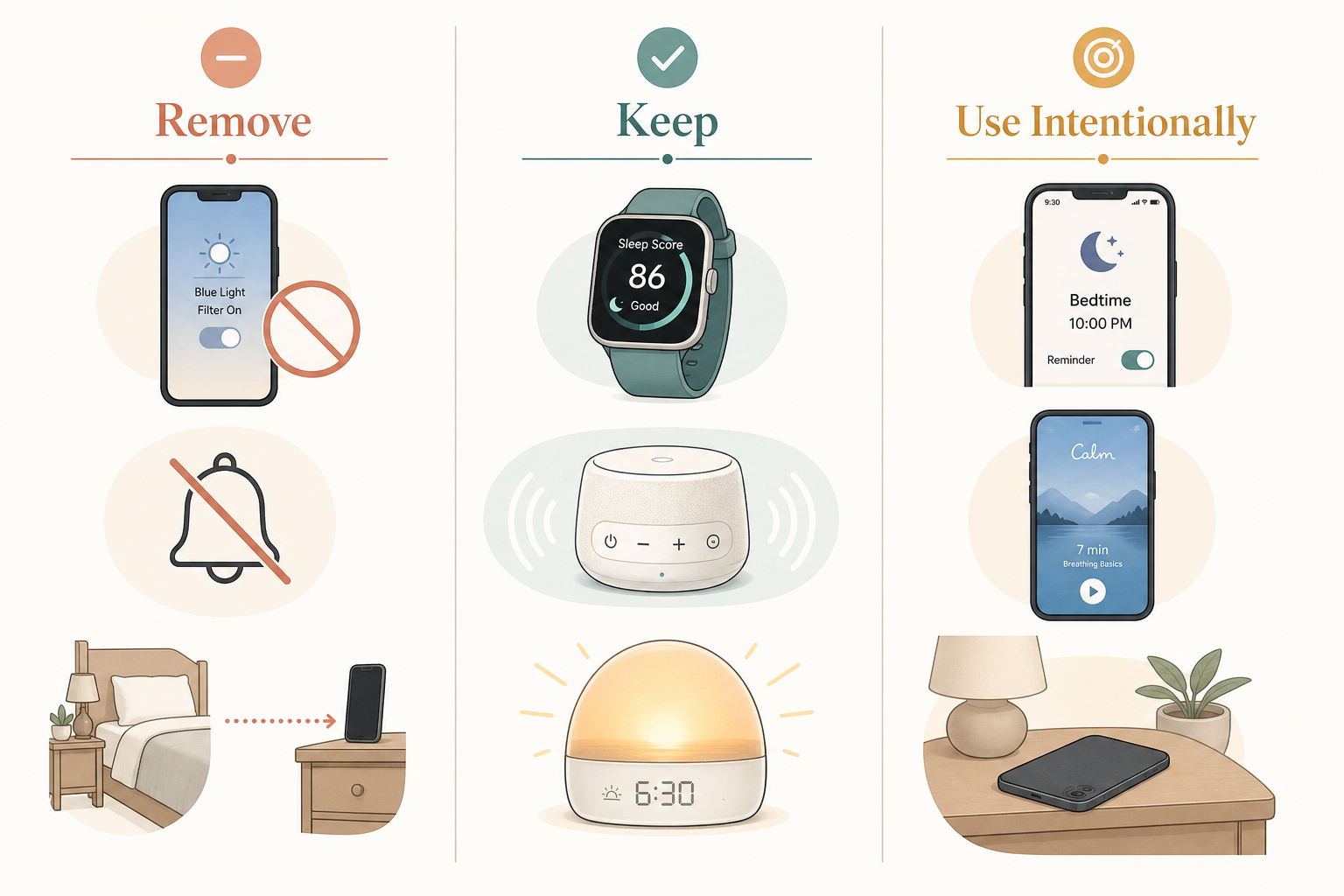
Rather than a blanket "no screens before bed" rule — which most adults find unrealistic — this framework helps you triage your own technology use into three categories: remove, keep, and use intentionally.
| Category | What Goes Here | Why | Example Actions |
|---|---|---|---|
| Remove | Notifications, bright screens 30–60 min before bed, interactive content late at night | These are the highest-risk behaviors for all three mechanisms: they emit light, displace sleep, and cause cognitive arousal. | Turn off all non-essential notifications after 9 p.m. Set phone to grayscale or warm mode automatically. No social media, gaming, or work email in the last hour before bed. |
| Keep | Validated sleep trackers (for trend data), soundscapes, smart alarms, e-readers with warm light | These tools provide useful data or passive relaxation without the high arousal risk of interactive content. | Use a tracker to monitor weekly trends, not nightly scores. Listen to a calm playlist or white noise. Use a smart alarm that wakes you during light sleep. |
| Use Intentionally | Blue-light filters (as bedtime cues), morning light exposure, phone face-down on nightstand, bedtime reminders | These are behavioral tools that leverage the device's features to support sleep rather than undermine it. | Set a blue-light filter to activate at a fixed bedtime — treat it as a cue, not a cure. Get 30 minutes of outdoor light in the morning. Place phone face-down to avoid visual distraction. |
For readers who want to compare specific tracker brands before purchasing, our Apple Watch vs. Oura Ring vs. Fitbit comparison provides side-by-side accuracy data and subscription cost analysis to support an informed choice.
Summary Table: Three Disruption Mechanisms and Their Countermeasures
The table below consolidates the three mechanisms, their evidence-backed effects, and the corresponding countermeasures discussed throughout this guide. Use it as a quick reference when evaluating your own evening technology habits.
| Mechanism | What Happens | Key Evidence | Countermeasure |
|---|---|---|---|
| Blue light / circadian disruption | Screen light delays melatonin onset and can shift the body clock later with repeated exposure. | ~9 min average sleep delay per 11-study review (2026). Melatonin unaffected at 1 hour but suppressed after 1.5 hours of bright screen use. 5 nights of bright screen use can delay body clock by 1.5 hours (Sleep Health Foundation, 2024). | Use warm/amber screen modes as behavioral bedtime cues. Prioritize morning outdoor light exposure (30-min walk) to anchor the circadian clock. Avoid bright screens for >90 minutes before bed. |
| Sleep displacement | Device use directly replaces sleep time — the "one more episode" problem. | 80.7% of adults use smartphones frequently at bedtime (AlShareef, 2022, n=10,106). OR 1.98 for >30 min sleep latency. Mean sleep duration in sample: 6.64 hours. | Set a device curfew 30–60 min before bed. Use passive content (music, e-reader) instead of interactive content (social media, gaming, messaging) in the pre-bed window. |
| Cognitive / emotional arousal | Interactive content keeps the brain in an alert, evaluative state, counteracting wind-down. | Interactive technologies boost alertness more than passive ones (Sleep Health Foundation). Orthosomnia describes tracker-induced anxiety that worsens sleep (AASM). | Switch to passive content at least 30 min before bed. If using a sleep tracker, focus on weekly trends, not nightly scores. If orthosomnia is a concern, see our insomnia-focused tracker guide. |
Supports these guides
Spot an error or have clinical feedback?
Because this article covers clinical, medication, or safety information, we use a moderated correction channel instead of open public comments. Let us know if something about “How Technology Affects Sleep: Three Mechanisms of Disruption and Three Ways to Use Tech Better” needs a closer look.
Send feedback on this article