Mechanism explainer
Why emotional rejection ruins your sleep
Social rejection activates the same brain pathways as physical pain, triggering a stress response that directly disrupts sleep. This article explains the neurobiological cascade from rejection to hyperarousal and why some people are more vulnerable to sleeplessness after rejection.
Rejection can leave no bruise, no fever, no visible injury, and still make the body refuse sleep as if something has gone physically wrong. That contradiction is the center of how emotional stress from rejection ruins sleep: the event is social, but the brain does not process social disconnection as a harmless abstraction.
A breakup text, a friend quietly withdrawing, being ignored at work, or realizing a group has moved on without you can start as a thought and become a full-body alarm. The bed is dark. The room is safe. Yet the chest is tight, the stomach is active, the mind keeps scanning, and sleep feels biologically unavailable. That is not melodrama. It is the nervous system treating exclusion as information that matters.
Social pain is not just a metaphor
The cleanest early evidence came from a strangely simple experiment. In Eisenberger and colleagues’ 2003 fMRI study, participants played a virtual ball-tossing game called Cyberball and were gradually excluded by the other “players.” During that exclusion, the dorsal anterior cingulate cortex and anterior insula became more active — regions involved in the affective distress component of physical pain.[1]
A virtual ball game is not a marriage ending, a humiliating office freeze-out, or months of friendship drift. The lab task matters because it isolates exclusion with unusual clarity, not because it captures the whole emotional weight of real rejection. Still, the finding was not trivial: the brain regions responding to social exclusion were not random “sadness areas.” They were part of the same system that helps make physical pain feel aversive and urgent.
Kross and colleagues later extended the overlap with a more personally loaded version of rejection. In a 2011 PNAS study of people who had recently experienced unwanted romantic rejection, looking at an ex-partner and thinking about the rejection activated not only distress-related areas but also somatosensory representations shared with physical pain.[2]
That does not mean every rejection is identical to tissue damage. It means the brain has overlapping machinery for bodily pain and social pain, especially where pain becomes distressing, attention-grabbing, and hard to dismiss. The phrase “rejection hurts” is therefore not merely poetic. It is an imperfect everyday description of a measurable neural overlap.
The path from rejection to wakefulness
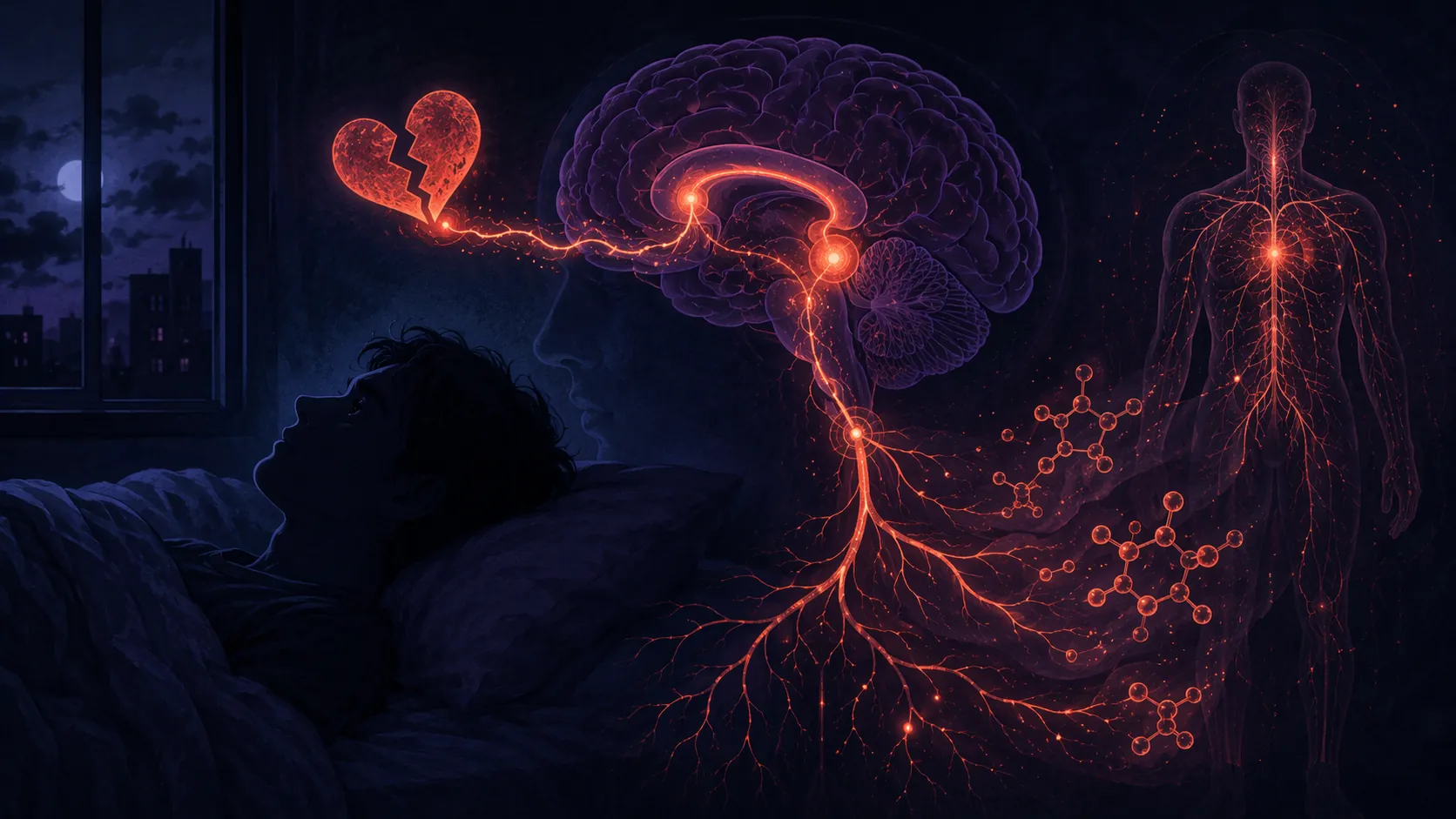
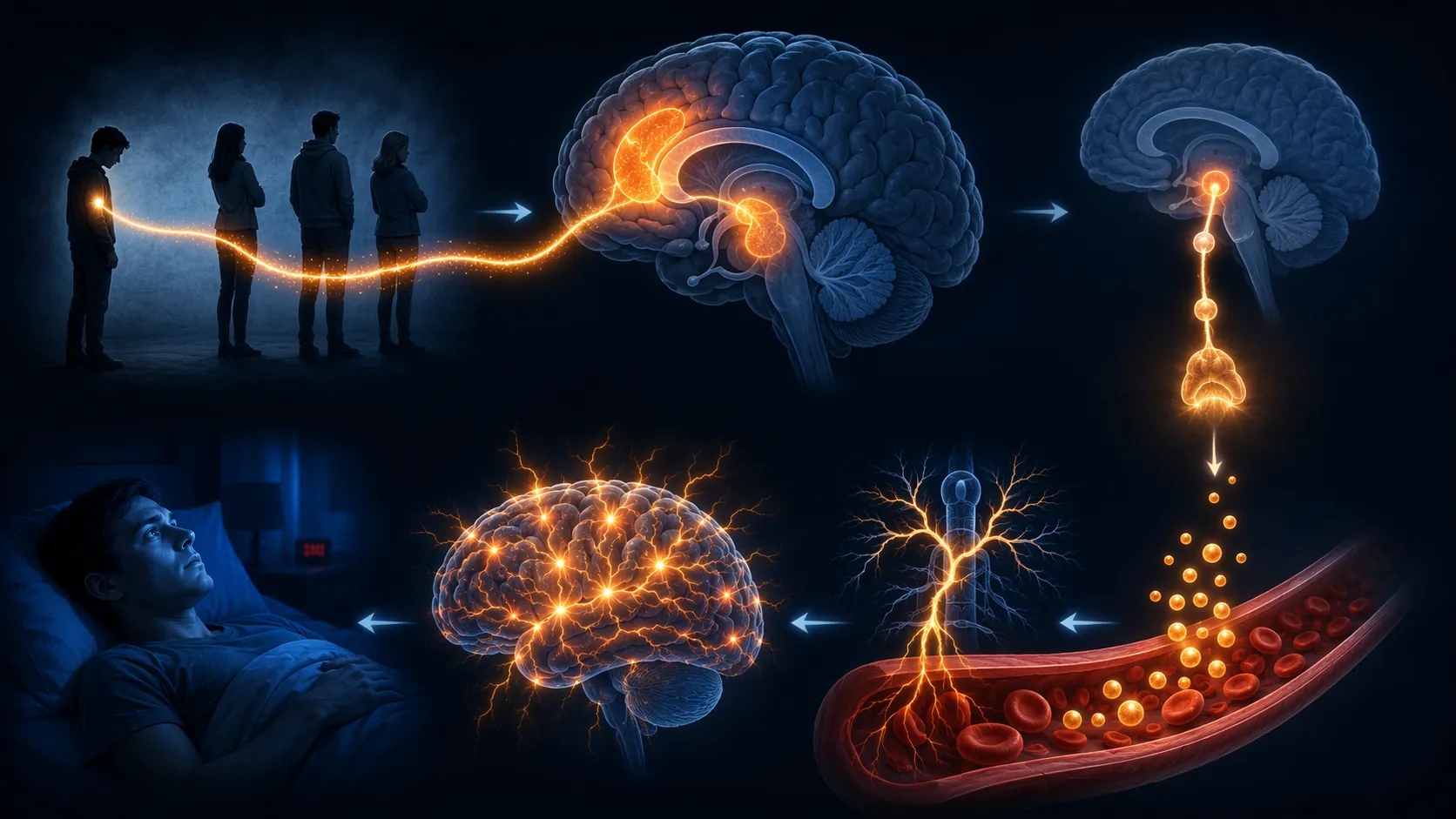
The missing step is often treated as a character flaw: you were rejected, then you “couldn’t stop thinking,” so sleep disappeared. Rumination may be part of the night, but it is not the whole engine. A rejection event can recruit pain and threat systems, and those systems push the body toward hyperarousal — the physiological state most hostile to sleep.
| Stage | What changes | Why sleep suffers |
|---|---|---|
| Social rejection | The brain registers exclusion as a salient social threat | Attention narrows around the rejected bond or group |
| dACC and anterior insula activation | Distress and bodily salience systems become engaged | The experience feels urgent rather than abstract |
| Stress-response activation | HPA-axis and sympathetic systems become more active | The body shifts toward mobilization |
| Cortisol and sympathetic dominance | Arousal chemistry rises instead of quieting | Sleep initiation becomes harder |
| Cortical hyperarousal | The brain remains metabolically and cognitively alert | Sleep becomes lighter, delayed, or repeatedly interrupted |
The hyperarousal model of insomnia describes this hostile sleep state in physiological terms: stress can be associated with elevated cortisol, sympathetic nervous system dominance, and cortical hyperarousal, all of which interfere with falling asleep and staying asleep.[3] Rejection is not the only possible trigger. But because social exclusion can activate pain-related distress circuitry, it has a plausible route into the same stress systems that make the body feel guarded at night.[1][2][3]
The dorsal anterior cingulate cortex helps track distress and conflict: something is wrong, something needs attention. The anterior insula helps map the internal state of the body: the sinking stomach, the heat in the face, the chest pressure, the feeling that the emotional event has become physical. Together, they can make rejection feel less like an opinion someone had about you and more like a bodily alarm.
Once the brain treats the event as threatening, the stress response does what it is built to do. The HPA axis — the hypothalamic-pituitary-adrenal system — helps regulate cortisol. The sympathetic nervous system shifts the body toward readiness. Heart rate, muscle tension, vigilance, and scanning can all belong to this mobilized state. None of these changes are designed for sleep.
Sleep onset requires a different biological posture: reduced vigilance, less threat monitoring, lower arousal, and enough safety for consciousness to loosen. Rejection pulls in the opposite direction. The rejected brain keeps asking for updated information — Why did this happen? What did I miss? What happens tomorrow? — while the body supplies the chemistry of alertness.
This is why the phrase “just stop thinking about it” lands so badly. Thought is visible to the person suffering, so it gets blamed. But under the thought is a body state. If the stress system is still behaving as if social safety has been damaged, the mind may not be able to simply declare the night over.
The same broad hyperarousal machinery shows up in other forms of emotional distress, which is why rejection insomnia can resemble the sleeplessness that follows panic, grief, or shock. For a wider version of that pathway, Restful Ground’s explainer on how emotional breakdowns disrupt sleep follows the amygdala, prefrontal cortex, HPA-axis, and hyperarousal loop more broadly.
Why the same rejection does not cost everyone the same night
One person gets rejected, cries, sleeps badly once, and slowly stabilizes. Another has the same kind of loss and enters weeks of light, broken, anxious sleep. The difference is not proof that one person cared more. Sleep has its own vulnerability system.
Drake and colleagues’ stress-diathesis model of insomnia focuses on sleep reactivity: the tendency for stress to disturb sleep. In their prospective work, people with high sleep reactivity, measured by a Ford Insomnia Response to Stress Test score of 16 or higher, had a 2- to 3-fold greater risk of developing insomnia after stressful life events.[4]
That finding is useful because it moves the explanation away from moral language. High sleep reactivity does not mean someone is weak, dramatic, or doomed. It means their sleep system is more easily recruited by stress. The same rejection can be emotionally painful for two people while only one person’s sleep system escalates into sustained hyperarousal.
There is a measurement caveat here. The FIRST is a validated self-report measure, not a direct physiological assay. It tells researchers how people report their sleep responding to stress-prone situations; it does not look into the nervous system and produce an objective “reactivity level.” Even so, the prospective pattern matters: sleep reactivity helps explain why stress exposure alone is not the whole story.[4]
Kalmbach and colleagues’ work on sleep-system sensitization adds a more uncomfortable possibility: insomnia itself may leave the sleep system more reactive later. In a 2016 Sleep Medicine study, 68% of people with insomnia who had low baseline sleep reactivity were reclassified as high-reactivity after insomnia onset, and reactivity did not return to pre-insomnia baseline even after remission.[5]
That does not prove that every painful rejection permanently rewires sleep. It does suggest that major or repeated stress-linked insomnia may change the future threshold. After enough nights where rejection and wakefulness become paired, the bed can start to feel less like a recovery place and more like the place where the alarm returns.
This distinction is also why social pain can resemble physical pain without being the same problem. After an injury, sleep can be disrupted by nociceptive pain signals, inflammation, restricted position, and fear. After rejection, the injury is social, but the resulting threat physiology can still block sleep. Restful Ground’s article on why sleep suffers after an accident injury is a useful contrast because it separates the physical-pain pathway from the psychological-trauma pathway.
The next day is not neutral after a bad night
The first sleepless night after rejection is already punishing. The more dangerous part is what poor sleep can do to the next day’s social brain. Sleep loss does not merely make a person tired while they recover from rejection. It can make the world look more rejecting.
Ben Simon and Walker’s 2018 work, reported by UC Berkeley, found that poor sleep amplified social withdrawal and rejection sensitivity the next day, creating conditions in which sleep-deprived people were more likely to pull away socially and be perceived as lonelier.[6]
That matters after rejection because the next morning often demands interpretation. A neutral message, a delayed reply, a coworker’s flat tone, or a friend’s distracted expression can arrive in a brain that has not slept. The underslept brain is less buffered. It has fewer resources for ambiguity. It may treat uncertain social signals as further evidence that the original rejection is still expanding.
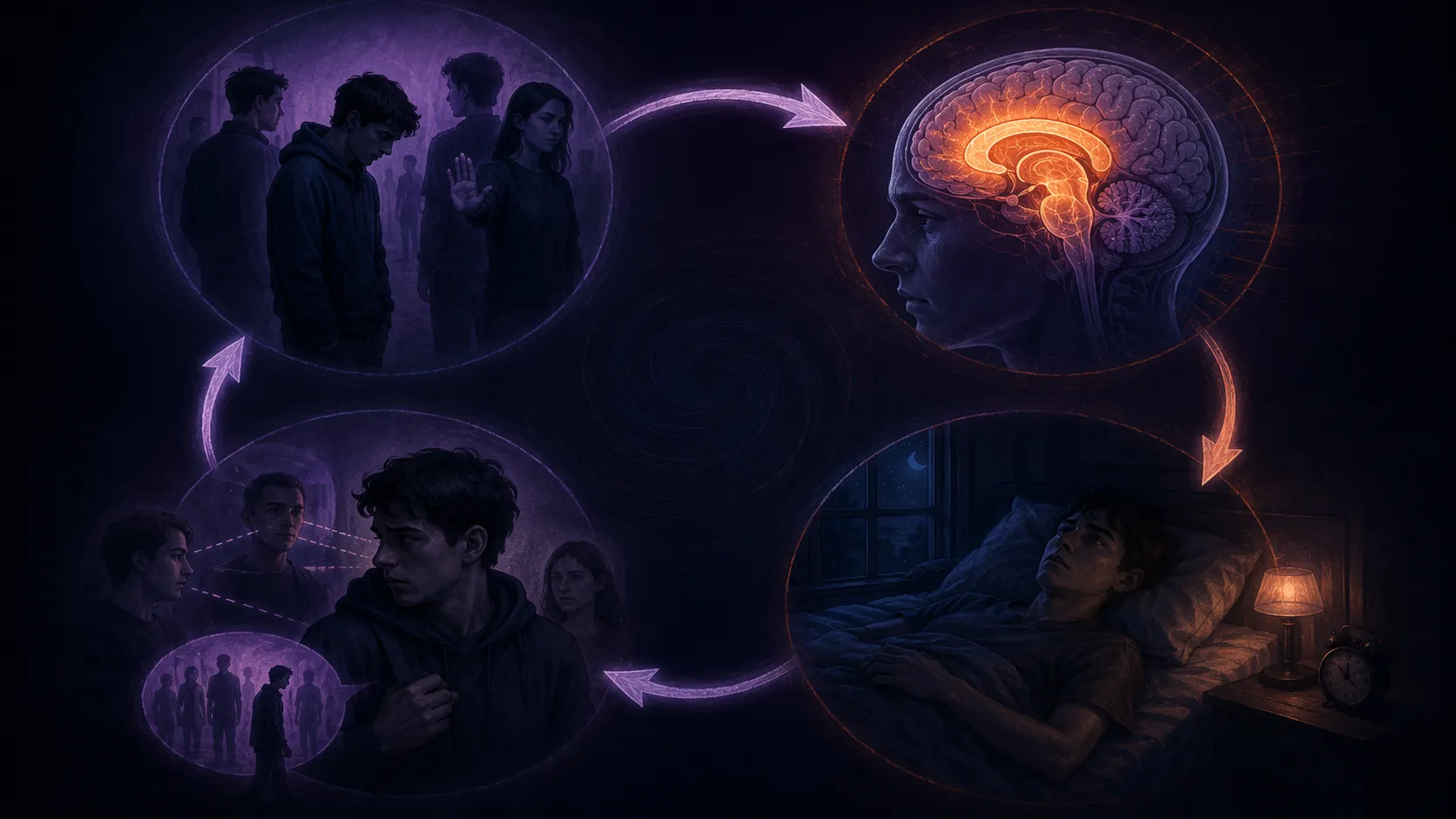
This is the bidirectional trap: rejection worsens sleep; poor sleep heightens social threat perception and withdrawal; withdrawal can reduce the very social contact that might have helped the nervous system relearn safety. The loop does not require anyone to be irrational. It requires a tired brain trying to solve social danger with fewer regulatory resources than usual.
A similar loop appears in anxiety, where poor sleep amplifies the next day’s threat sensitivity and anxiety then steals more sleep. If that pattern feels familiar beyond rejection, the related Restful Ground piece on why anxiety steals sleep and sleep makes anxiety worse covers the broader sleep-anxiety feedback cycle.
The painkiller study is evidence, not advice
The most provocative evidence for the social-physical pain overlap is also the easiest to misuse. DeWall and colleagues found that acetaminophen reduced social pain-related distress and dACC activity, offering behavioral and neural evidence that social pain and physical pain overlap biologically.[7]
That finding should not be turned into “take a painkiller for rejection insomnia.” The study is useful here because it makes the overlap harder to dismiss as language or sentiment. It is not a treatment protocol for heartbreak, workplace ostracism, loneliness, or sleeplessness. Acetaminophen has its own risks and is not a sleep medication.
The better conclusion is narrower and stronger: if a drug known for physical pain can alter some measures of social pain in a study context, then the boundary between “real pain” and “just emotional pain” is not where casual advice often puts it.
When rejection insomnia is a normal stress response, and when it starts to harden
A bad night after rejection can be a normal acute stress response. So can several rough nights while the brain keeps replaying the rupture and the body gradually stops treating it as immediate danger. Painful does not automatically mean pathological.
The pattern becomes more concerning when nights of hyperarousal repeat, when the bed itself starts to predict alertness, when daytime functioning deteriorates, or when the person begins organizing life around fear of another sleepless night. That is where high sleep reactivity matters: it can turn a socially painful event into a more durable insomnia pattern, especially if poor sleep then increases rejection sensitivity and withdrawal.
It also helps to separate explanation from resignation. Sleep reactivity is a vulnerability, not destiny. A sensitized sleep system can be worked with. But pretending the problem is merely “overthinking” misses the biology that made sleep feel impossible in the first place.
For readers trying to decide whether a stress-related sleep problem is still in the acute zone or becoming more entrenched, Restful Ground’s guide to normal versus concerning stress insomnia may help set that boundary without turning every hard night into a diagnosis.
Rejection ruins sleep because the brain treats social disconnection as biologically salient pain, the body mobilizes against threat, and sleep requires the opposite state. No wound has to be visible for the nervous system to behave as if something important has been hurt.
References
- Does rejection hurt? An fMRI study of social exclusion. Science, 2003.
- Social rejection shares somatosensory representations with physical pain. PNAS, 2011.
- Hyperarousal and sleep reactivity in insomnia: current insights. Nature and Science of Sleep, 2018.
- Stress and sleep reactivity: a prospective investigation of the stress-diathesis model of insomnia. Sleep, 2014.
- Sleep system sensitization: evidence for changing roles of etiological factors in insomnia. Sleep Medicine, 2016.
- Poor sleep triggers viral loneliness and social rejection. Berkeley News, 2018.
- Acetaminophen reduces social pain: Behavioral and neural evidence. Psychological Science, 2010.
Supports these guides
Spot an error or have clinical feedback?
Because this article covers clinical, medication, or safety information, we use a moderated correction channel instead of open public comments. Let us know if something about “Why emotional rejection ruins your sleep” needs a closer look.
Send feedback on this article