
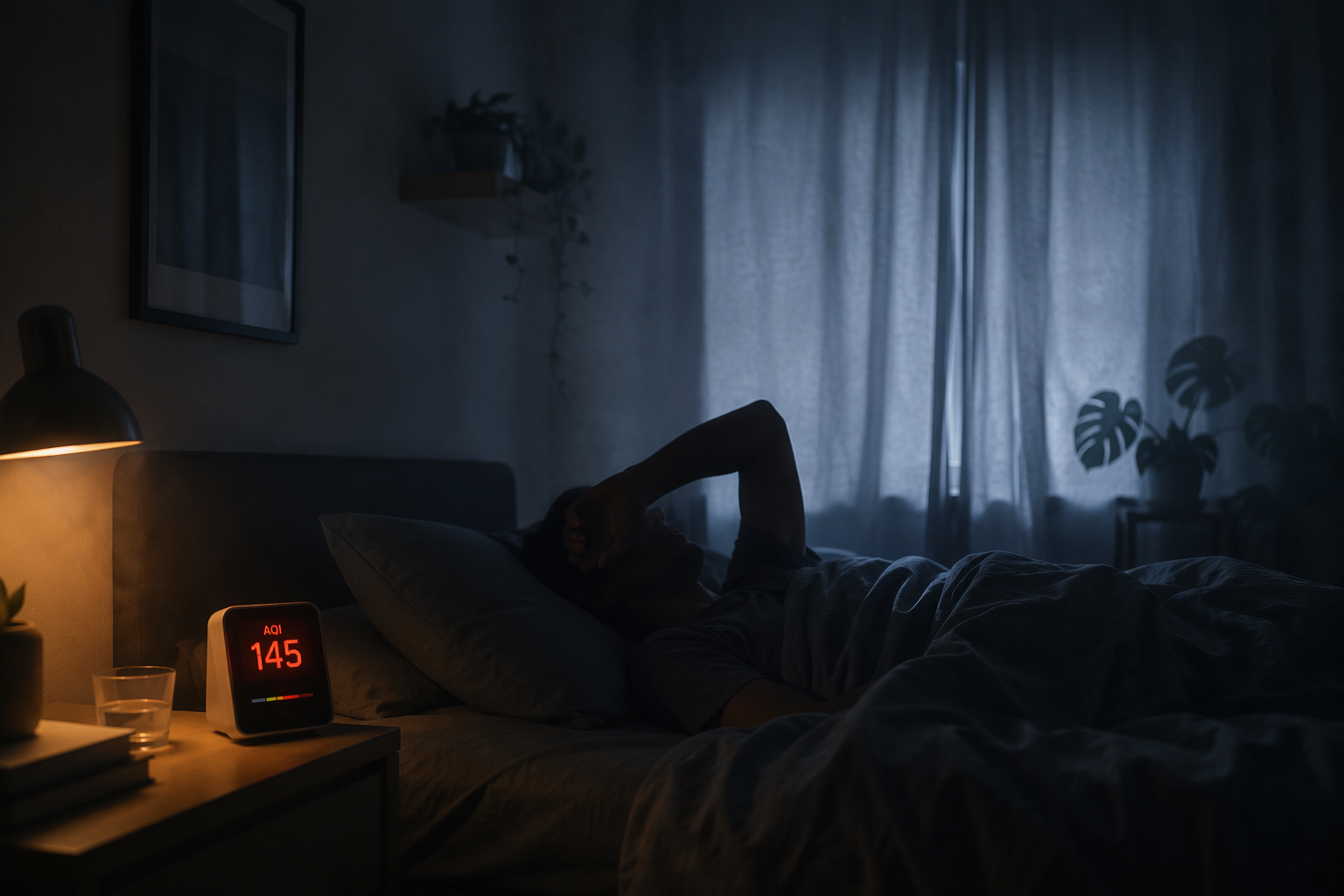
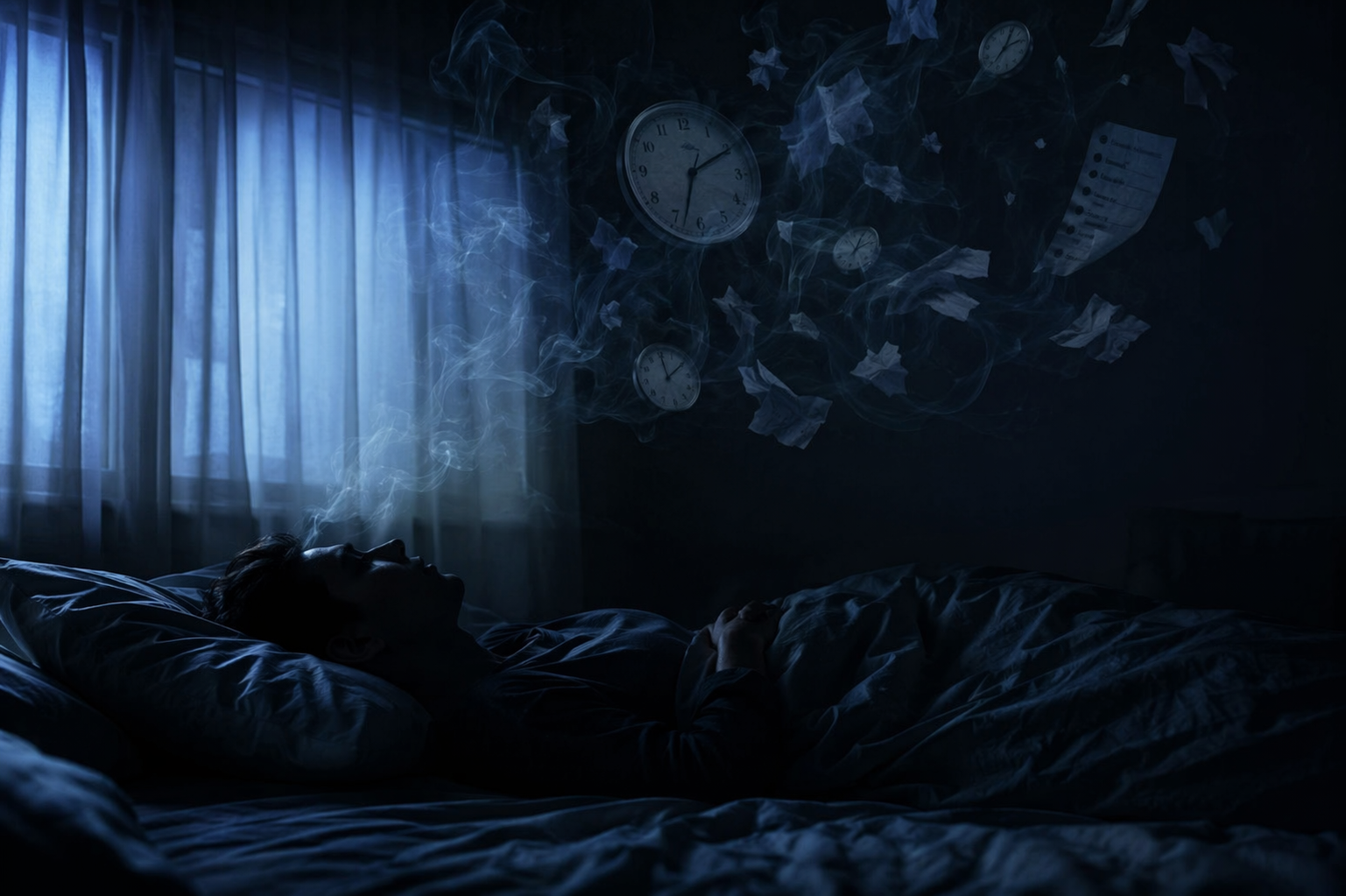
The hard part often starts after the house is quiet. You are tired enough to sleep, but the moment the lights go out your body begins taking inventory: the ceiling, the windows, the bookshelf, the hallway, the distance to your shoes. A pipe knocks. A truck passes. The mattress seems to shift for half a second, and your chest answers before your mind can check whether anything actually moved.
That is earthquake anxiety sleep disruption in its most specific form. It is not simply “worrying too much.” The feared event is tied to a place, a posture, and a state of consciousness. Bed becomes the place where you might be caught unprepared. Sleep itself starts to feel like the risky act.
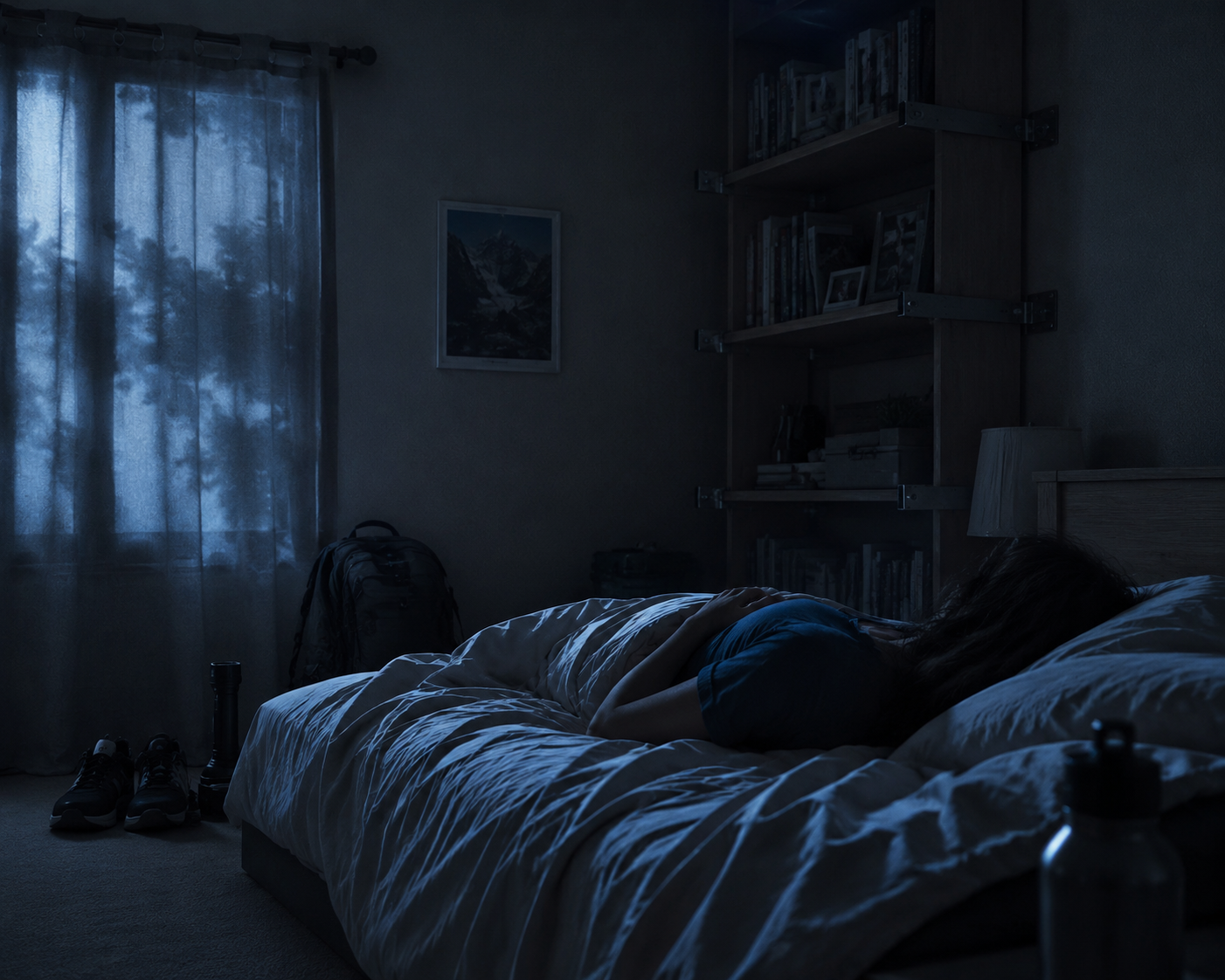
This is why ordinary sleep hygiene can feel strangely thin after an earthquake. A dark room, a cool temperature, and fewer screens may help general insomnia, but they do not answer the question your nervous system is asking at 2 a.m.: “If shaking starts while I am unconscious, what happens next?”
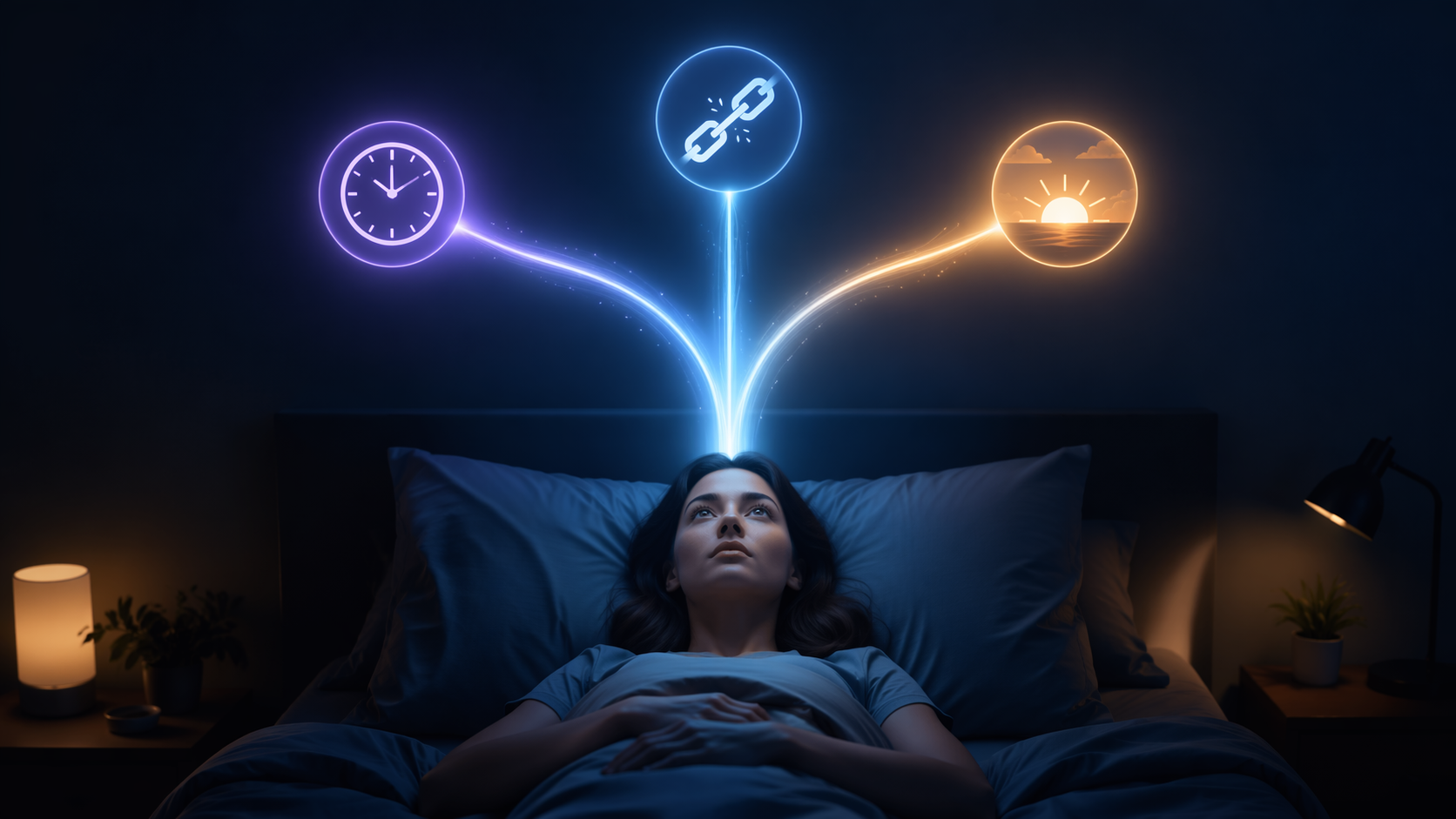
The answer is not to argue yourself out of fear. The answer is to retrain the loop that now connects bed with danger. That means changing the room, calming the body, and moving preparation into daylight so the night does not become a rehearsal space for disaster.
Why the Fear Feels So Physical
Earthquake-related sleep problems have a recognizable pattern: hypervigilance, body scanning, repeated checking, difficulty surrendering control, and fear of being asleep during another tremor or aftershock. Studies of severe earthquake exposure cannot be used to predict what every person will experience after a moderate tremor, but they do show that the anxiety-sleep link is real and can be strong.
In a 2025 study of 402 adolescent survivors assessed 9 to 12 months after the major earthquakes in Türkiye, high earthquake anxiety was associated with 5.72 times higher odds of sleep-quality impairment than mild anxiety in logistic regression analysis. That finding came from an extreme survivor population, so it should not be treated as a universal multiplier for anyone who felt shaking. Its value is more precise: stronger earthquake anxiety tracked with worse sleep, rather than sleep trouble appearing as a vague, unrelated complaint [1].
Severity context matters too. In one study of 165 Haiti earthquake survivors in an urban area, 94% reported insomnia symptoms after the disaster, and 42% met clinical PTSD criteria two years later. Those numbers come from a specific, highly exposed sample, not from the general public after every quake. Still, they underline why post-earthquake sleep disruption deserves attention instead of dismissal [2].
Poor sleep can also feed the fear that caused it. Research among older survivors of the 2011 Great East Japan Earthquake and Tsunami found bidirectional associations between PTSD symptoms and sleep quality: worse trauma symptoms and poorer sleep appeared to reinforce each other over time [3]. In ordinary bedroom terms, one bad night leaves the nervous system more reactive the next evening, and the next evening then becomes harder to trust.
First Make the Bedroom Less Like a Trap
The room does not need to become a bunker. It needs to stop sending the message that sleep equals helplessness. Environmental safety measures work best when they are specific enough to answer the fear and limited enough that they do not turn into a nightly inspection ritual.
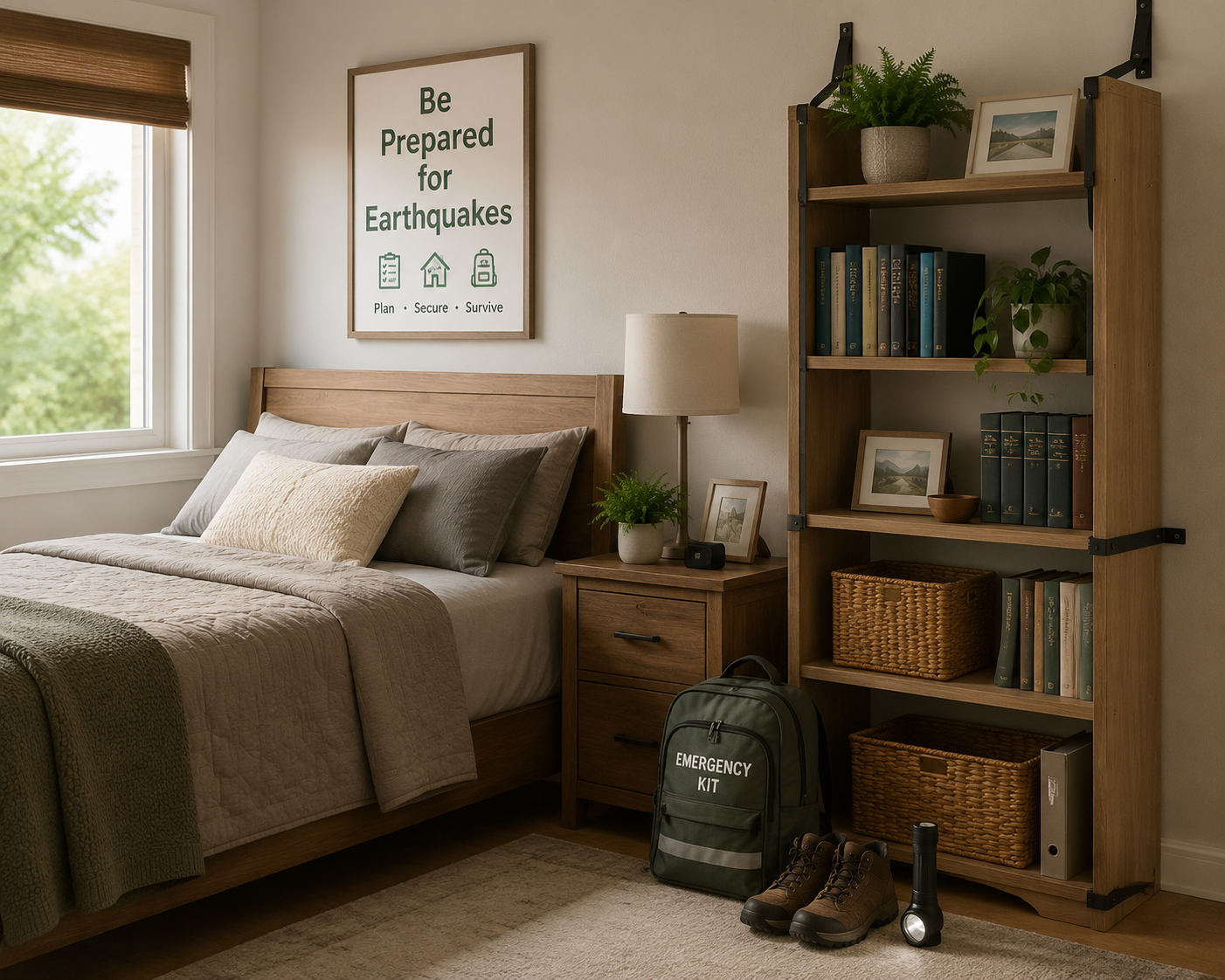
Start with the objects your mind keeps returning to. If you keep imagining a shelf falling, anchor the shelf. If you keep picturing broken glass on the floor, place sturdy shoes within reach. If you keep worrying that you will not find your way out, keep a flashlight where your hand can reach it without searching. If you live with others, decide before bed who checks on whom and where you meet if you need to move.
| Night fear | Prepared answer |
|---|---|
| “Something will fall on me.” | Anchor tall furniture; move heavy objects away from the bed. |
| “I will step on glass or debris.” | Place closed-toe shoes and a flashlight beside the bed. |
| “I will freeze and not know what to do.” | Choose the safest nearby spot and rehearse the first action once during the day. |
| “I will be responsible for everyone and miss something.” | Agree on a household check-in plan before bedtime. |
| “I need to keep checking all night.” | Use one brief, scheduled room check, then stop. |
This kind of preparation is not just practical safety work. It changes the meaning of the bedroom. A room with unsecured furniture, unknown exits, and no supplies can feel like a place where you must stay alert. A room with a simple plan becomes a place where alertness has already done its job.
Clinical neuropsychologist Judy Ho has described concrete preparedness steps, such as securing furniture and keeping emergency supplies, as a way to reduce the helplessness that can drive post-earthquake anxiety [4]. The important word is concrete. Reading more fault-line maps at midnight usually gives anxiety more material. Moving a heavy object away from the bed gives the body a completed action.
Keep the Check Brief
A safety check can help when it is planned. It can also become the thing that keeps the fear alive. The difference is whether the check has an endpoint.
- Do the room check before you get into bed, not after every sound.
- Check only what is on your list: shoes, flashlight, phone, water, exit path, heavy objects.
- Say the endpoint plainly: “The plan is set for tonight.”
- If the urge to recheck appears, treat it as an anxiety signal, not as new evidence.
The goal is not perfect certainty. Earthquakes do not offer that. The goal is enough preparedness that your nervous system can stop treating sleep as negligence.
Then Give the Body Something to Do Besides Monitor
Once the room is prepared, the next problem is physiological. Your mind may understand that you have taken reasonable steps, while your body is still running a threat scan. Heart rate, muscle tension, shallow breathing, and startle responses can remain active after the danger has passed.
Psychiatrist Gail Saltz has recommended deep breathing with a longer exhale for earthquake anxiety, including a 5-count inhale followed by a 7-count exhale, describing it as a way to activate the parasympathetic nervous system and counter hypervigilance [5]. This is expert guidance consistent with common clinical relaxation practice, not a quake-specific cure proven by one definitive trial. Used well, it gives your body a repeated signal that the immediate emergency response can stand down.
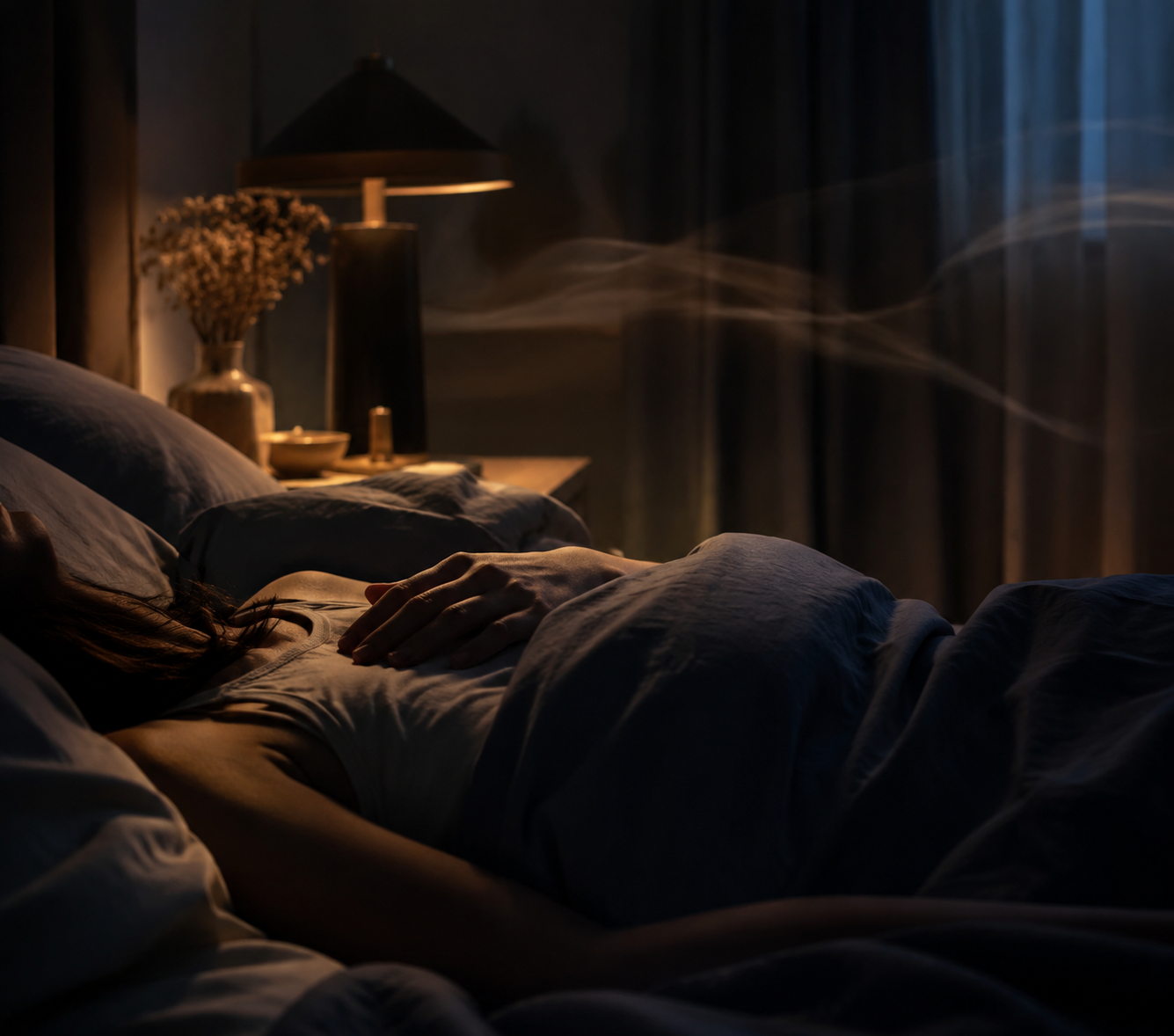
A Breathing Pattern for the First Ten Minutes in Bed
- Place one hand on your abdomen or ribs so the breath has a physical target.
- Inhale gently through the nose for a count of 5.
- Exhale slowly for a count of 7, without forcing the breath out.
- Repeat for several minutes, letting the exhale stay longer than the inhale.
- When your attention jumps to a sound or sensation, return to the next exhale rather than checking immediately.
The last step is often the real practice. A creak in the house does not need to become a full investigation. It can become the cue to lengthen the next exhale. That is how the bedroom starts collecting new evidence: sound, body response, return to rest.
Progressive muscle relaxation can help when the fear is held more in the jaw, shoulders, stomach, or legs than in clear thoughts. Saltz has also recommended progressive muscle relaxation for reducing the physiological tension associated with earthquake anxiety [5]. The method is simple: tense one muscle group briefly, release it, and move through the body in order.
A Short Progressive Muscle Relaxation Sequence
- Feet and calves: gently tense, hold briefly, release.
- Thighs and hips: tense enough to notice effort, then let the bed take the weight.
- Hands and arms: make loose fists, hold, release the fingers.
- Shoulders: lift toward the ears, hold, drop.
- Face and jaw: squeeze lightly, then unclench the teeth and soften the tongue.
Do not use relaxation as a test you must pass. If you finish the sequence and still feel awake, that does not mean it failed. It may have reduced the body’s alarm enough for you to stay in bed without escalating into checking, searching, or replaying footage of the quake.
Move Earthquake Thinking Out of the Night
Daytime preparedness is different from nighttime rumination. One gives anxiety a job and an endpoint. The other gives it an audience.
Set aside a short daytime window for earthquake-related tasks. Use it for actions that make the next night easier: confirm your household plan, charge devices, replace missing supplies, move heavy items, or look up one credible local preparedness source. Do not let that window become open-ended earthquake research. The purpose is to reduce helplessness, not to become the night-shift seismologist in your own home.
| Do during the day | Do not save for bed |
|---|---|
| Anchor or move one risky item. | Scan the room repeatedly in the dark. |
| Pack or check a small emergency kit. | Mentally rebuild the kit while trying to sleep. |
| Agree on a family contact or meeting plan. | Wake yourself to review everyone’s location. |
| Choose a reliable alert or local information source. | Refresh news and social feeds from bed. |
| Write down tomorrow’s preparedness task. | Try to solve every possible scenario tonight. |
This is cognitive restructuring by action. Instead of telling yourself “I am safe” in a way your body may not believe, you give the body a record of completed preparation: the shelf is secured, the shoes are there, the flashlight works, the plan is known. At night, you are not asked to deny uncertainty. You are asked to stop doing daytime work from under the covers.
If You Wake After a Sound or Sensation
A post-quake body can wake fast. The question is what happens in the next minute. If there is actual shaking, follow your safety plan. If there is no shaking and the trigger is a sound, a body sensation, or uncertainty, keep the response small enough that the bed does not become an emergency command center.
- Pause and orient: notice the room, the bed, the current time, and whether shaking is actually occurring.
- Use one planned check only if needed, such as looking at your shoes and flashlight or listening for a few seconds.
- Return to the 5-in, 7-out breathing pattern.
- If your mind starts demanding more certainty, postpone the problem to the daytime preparedness window.
- If you are wide awake for a long stretch, leave the bed briefly for a quiet, low-light activity, then return when sleepiness comes back.
The brief departure from bed is not avoidance of sleep. It is a way to protect the bed from becoming the place where you spend hours rehearsing danger. Keep it boring. No disaster videos, no shaking maps, no group chats that restart the alarm.
When Self-Management Is No Longer Enough
Some sleep disruption after an earthquake is an acute stress response. It can improve as the body relearns ordinary nights. But there is a point where adding more rituals is not care; it is the anxiety system expanding its territory.
Consider professional help if you are avoiding sleep for many nights, if you need longer and more elaborate checks to get into bed, if panic symptoms keep jolting you awake, or if earthquake memories intrude during the day. Also seek help if nightmares, numbness, irritability, avoidance, or a persistent sense of threat are interfering with work, relationships, caregiving, or basic routines.
Long-term sleep disruption after earthquakes is not just theoretical. A Wenchuan earthquake cohort study reported sleep disturbances persisting at a 10-year follow-up, with psychiatric comorbidity predicting sleep problems [6]. That does not mean your current insomnia will last for years. It means persistent symptoms deserve treatment rather than endless private endurance.
For a chronic insomnia pattern, cognitive behavioral therapy for insomnia, or CBT-I, is often the relevant next step. When the fear remains intrusive, trauma-focused care may be needed as well. Sleep usually returns not because you convince yourself the earthquake did not matter, but because your body learns that rest and preparedness can exist in the same room.
References
- Earthquake anxiety and sleep quality among adolescent survivors 9–12 months after the great earthquakes in Türkiye, Nature, 2025.
- Disturbed sleep linked to mental health problems in natural disaster survivors, American Academy of Sleep Medicine, 2019.
- Bidirectional Associations of Posttraumatic Stress Disorder Symptoms and Sleep Quality Among Older Survivors of the 2011 Great East Japan Earthquake and Tsunami, Sleep, 2023.
- Post-Earthquake Anxiety? It's Normal. And Treatable., Crisis Text Line, 2019.
- What to do if you have earthquake anxiety, according to an expert, CNN, 2024.
- Psychiatric comorbidity predicts sleep disturbances among earthquake survivors 10 years after the Wenchuan earthquake, Sleep Medicine, 2021.

Comments
Join the discussion with an anonymous comment.