
If you are comparing perimenopause insomnia treatment options, the first useful fact is this: they do not sit on the same evidence shelf. In the best pooled comparison available, cognitive behavioral therapy for insomnia, or CBT-I, reduced Insomnia Severity Index scores by 5.2 points more than control in perimenopausal and menopausal women with frequent hot flashes and insomnia symptoms. Exercise and venlafaxine helped, but by about 2 points more than control. Low-dose estradiol was closer to 1 point. Yoga, escitalopram, omega-3, and sleep hygiene education alone were weaker for insomnia symptoms in that analysis.[1]
That does not mean every woman should be handed the same plan. It means the plan should start with the treatment most likely to reduce insomnia itself, then move to symptom-targeted choices when hot flashes, mood symptoms, access, cost, or medical risks change the equation.
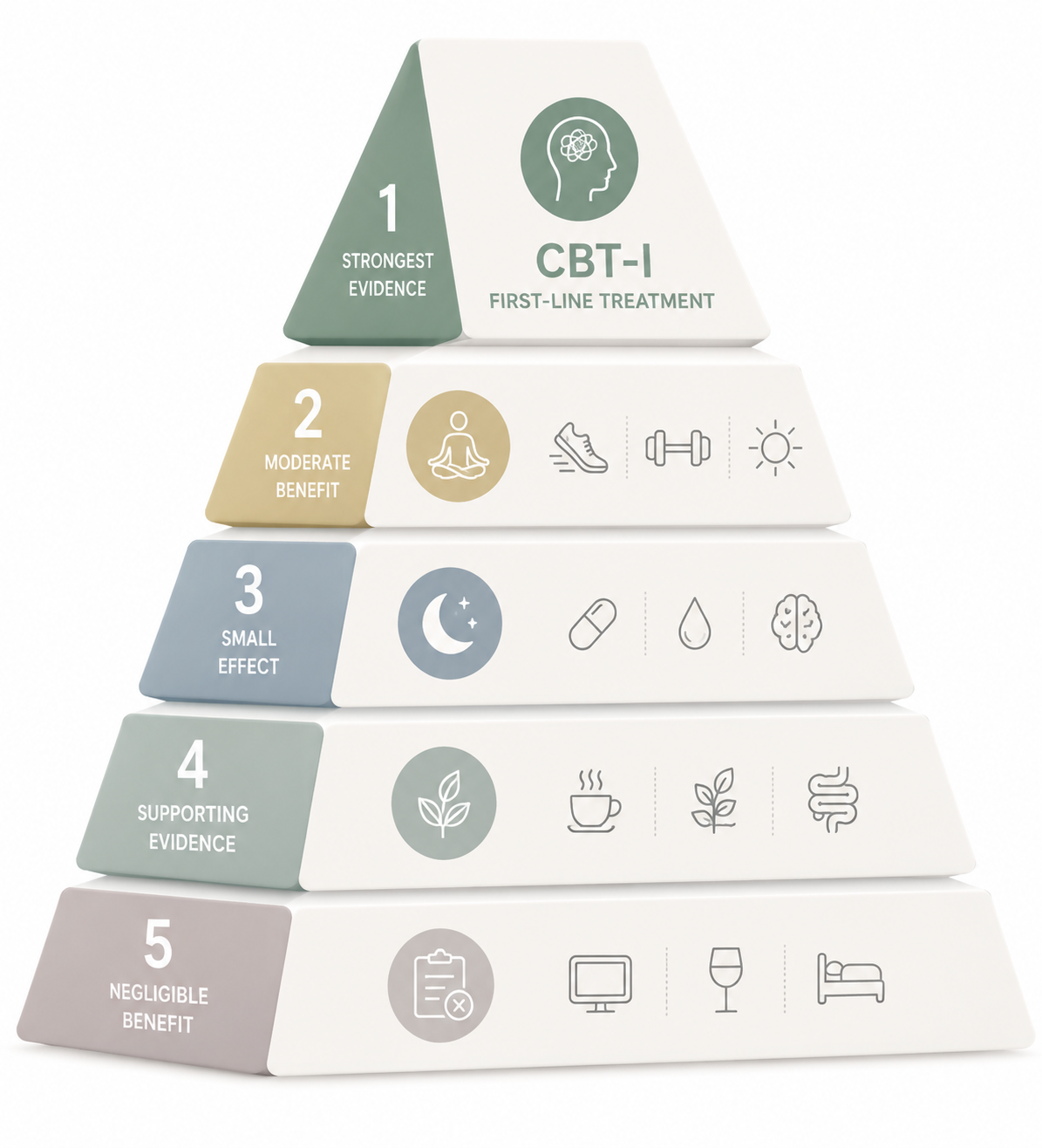
| Evidence tier | Options | What the evidence supports |
|---|---|---|
| First-line for insomnia | CBT-I | Largest direct improvement in insomnia severity; remission rates were high in perimenopausal and postmenopausal women studied. |
| Moderate benefit | Exercise; venlafaxine | Meaningful but smaller insomnia improvements than CBT-I in MsFLASH comparisons. |
| Symptom-adjacent or small sleep benefit | Low-dose estradiol; yoga; escitalopram | May help broader menopause symptoms or mood, but weaker as standalone insomnia treatments. |
| Possible medication options with narrower evidence | Suvorexant; other DORAs; gabapentin; melatonin | May be reasonable in selected patients, but evidence is less perimenopause-specific or less consistent for routine first-line use. |
| Adjuncts, not the core plan | Sleep hygiene education alone; omega-3 | Low or negligible insomnia benefit in the available comparative evidence. |
Before Ranking Treatments, Confirm the Sleep Problem
Perimenopause can make sleep fragile through hot flashes, hormone fluctuation, circadian disruption, mood symptoms, and changing medical risks. It is also a time when obstructive sleep apnea and restless legs syndrome become easier to miss if every 3 a.m. awakening gets labeled “hormonal.” A 2025 narrative review describes sleep disturbance as affecting about 35% to 60% of women during the menopausal transition and highlights vasomotor symptoms, circadian change, obstructive sleep apnea, and restless legs syndrome as relevant pathways or comorbid problems.[2]
So the first fork is not “natural or prescription.” It is whether the main problem is insomnia: difficulty falling asleep, staying asleep, or waking too early despite a reasonable chance to sleep. Loud snoring, witnessed pauses in breathing, morning headaches, marked daytime sleepiness, or an urge to move the legs at night deserve a different workup. If that part is still unclear, start with Is It Perimenopause Insomnia or Sleep Apnea? before choosing a treatment ladder.
Why CBT-I Belongs at the Top
CBT-I earns the first tier because it has the strongest direct evidence for insomnia severity, not because it sounds virtuous or nonmedical. In the MsFLASH pooled analysis of 546 women, CBT-I produced the largest reduction in Insomnia Severity Index score compared with control: 5.2 points better than control, roughly double the improvement seen with any other intervention in that comparison.[1]
The population fit is not perfect. The MsFLASH analysis included perimenopausal and menopausal women with frequent hot flashes and ISI scores of at least 12, not necessarily women formally diagnosed with insomnia disorder. Still, it is the rare comparison that puts behavioral therapy, exercise, antidepressant treatment, estradiol, yoga, omega-3, and sleep education into the same broad clinical neighborhood. That is more useful than comparing claims from unrelated supplement pages, menopause clinics, and sleep apps.
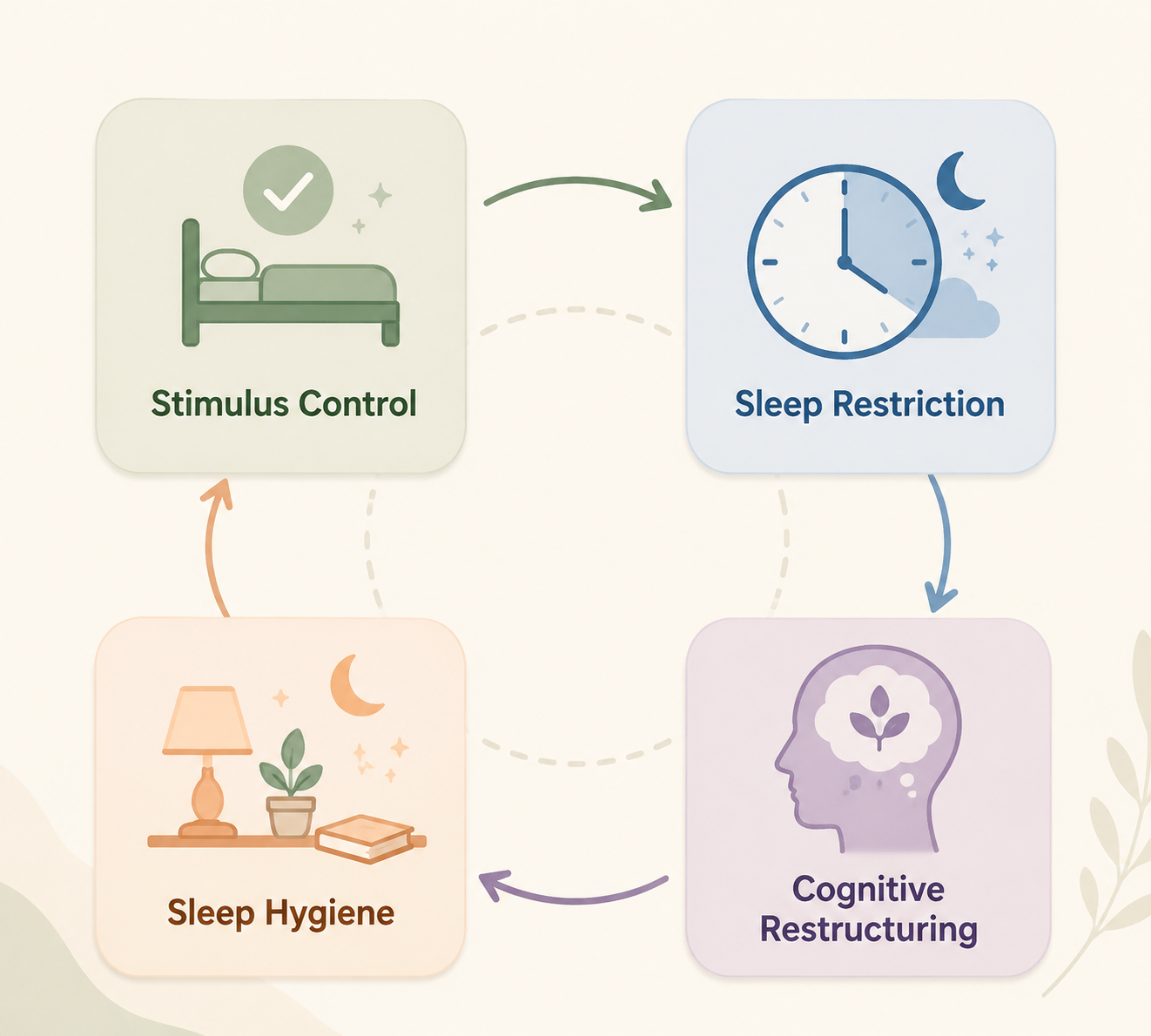
CBT-I is not sleep hygiene with better branding. A typical program uses stimulus control, sleep restriction or sleep compression, cognitive work around sleep threat and effort, relapse planning, and targeted sleep education. The uncomfortable part is often the useful part: it changes the learned pattern in which the bed becomes a place for monitoring, bargaining, clock-watching, and failing.
For a deeper explanation of why this treatment is considered first-line, see Why CBT-I Is the First-Line Treatment for Perimenopause Insomnia. The short version for treatment ranking is simpler: CBT-I has the largest measured effect on insomnia symptoms in the comparative evidence.
Telephone CBT-I matters because access is part of effectiveness
A treatment cannot be a real first choice if the only version available is an in-person specialist with a six-month wait and a cash-pay fee. That is why the telephone CBT-I trial deserves more attention than it usually gets. In a randomized clinical trial, six 20- to 30-minute telephone CBT-I sessions delivered over 8 weeks produced remission rates of 70% to 84% in perimenopausal and postmenopausal women with moderate-to-severe insomnia and vasomotor symptoms.[3]
Those numbers should not be read as a promise that every exhausted woman will be sleeping normally after six calls. Trial participants were selected, supported, and followed. The study population, like many CBT-I trials in this area, was not as diverse as the population that actually lives with perimenopause insomnia. But the delivery model matters: it shows that CBT-I does not have to mean weekly visits at an academic sleep center.
There is still an access problem. Many clinicians recommend CBT-I without knowing where a patient can get it. If that is the barrier, look for a licensed clinician trained in behavioral sleep medicine, a validated digital CBT-I program, group CBT-I, telehealth CBT-I, or referral through a sleep clinic. The access issue is real enough to deserve its own discussion in Why cognitive behavioral therapy for insomnia is so hard to get.
CBT-I also beats sleep hygiene education
The comparison with sleep hygiene is important because many women are told they have already “tried CBT-I” when what they actually received was a handout about caffeine, screens, room temperature, and bedtime routines. In a randomized trial of postmenopausal women with chronic insomnia, CBT-I reduced ISI scores by 7.70 points and outperformed sleep hygiene education.[4]
Sleep hygiene can clean up obvious obstacles. It usually does not dismantle chronic insomnia once the pattern is established. If you have already cooled the room, stopped late caffeine, and bought the sunrise lamp, the next evidence-based step is not a longer list of bedtime rules.
Moderate-Benefit Options: Exercise and Venlafaxine
Exercise and venlafaxine sit in the middle tier because they improved insomnia symptoms more than control in the MsFLASH pooled analysis, but not by CBT-I-sized margins. Exercise reduced ISI by 2.1 points more than control, and venlafaxine reduced ISI by 2.3 points more than control.[1]
Exercise is still worth taking seriously. It can improve health, mood, cardiometabolic risk, pain tolerance, and daytime energy, and those gains may make sleep less brittle. But when the question is “What treats insomnia most directly?” exercise is not the top answer. It is a good supporting treatment and, for some women, part of the main plan because it improves more than sleep.
Venlafaxine is different. It may be considered when vasomotor symptoms, depression, or anxiety symptoms are part of the clinical picture, but it is not a general sleeping pill. It can have side effects and discontinuation issues, and the sleep benefit in the pooled analysis was moderate rather than dominant.[1]
Hormone Therapy May Help the Right Problem, but That Problem May Not Be Insomnia Alone
Hormone therapy is where the conversation often gets muddy. If night sweats are waking you repeatedly, treating vasomotor symptoms may improve sleep because fewer heat surges break the night. That is a legitimate clinical goal. It is not the same as saying estradiol is the strongest standalone insomnia treatment.
In the MsFLASH pooled analysis, low-dose estradiol improved ISI by about 1 point more than control, clearly below CBT-I, exercise, and venlafaxine for insomnia symptoms.[1] A meta-analysis of menopausal hormone therapy and sleep also found that subjective sleep improvements are reported more consistently than objective polysomnography improvements, while differences in hormone type, dose, route, duration, and study design make broad conclusions uncertain.[5]
This is the practical distinction: if your main complaint is drenching night sweats, hormone therapy may belong near the center of the medical discussion, assuming your personal risk profile allows it. If your hot flashes are mild but you lie awake for hours with conditioned arousal, clock-checking, and fear of another ruined day, hormone therapy is unlikely to substitute for insomnia treatment.
Yoga and Escitalopram: Useful for Some Symptoms, Weak as Insomnia Treatments
Yoga and escitalopram are not useless; they are just easy to overstate. In the comparative MsFLASH evidence, they did not land near CBT-I for insomnia severity improvement.[1] Yoga may help stress, mobility, body awareness, and general well-being. Escitalopram may be appropriate when anxiety or depression symptoms warrant treatment. Neither should be sold as the most evidence-based primary treatment for perimenopause insomnia.
That distinction matters because many women are offered lifestyle calming strategies when they are actually describing a persistent insomnia disorder. Calming practices can be part of the evening, but they do not automatically correct the sleep-wake conditioning that keeps insomnia going.
Prescription Sleep Medications: Sometimes Reasonable, Not the Evidence Leader Here
Medication is not a moral failure. Short-term pharmacologic treatment can be appropriate when insomnia is severe, safety is deteriorating, a patient is waiting for CBT-I, or another condition is being treated at the same time. The problem is not using medication; the problem is pretending every medication has perimenopause-specific evidence equal to CBT-I.
Dual orexin receptor antagonists, or DORAs, are one of the more interesting medication categories because they target wake signaling rather than broadly sedating the brain. A 2022 randomized controlled trial reported suvorexant as well tolerated and efficacious for insomnia associated with vasomotor symptoms in midlife women.[6] That is relevant evidence, but it is still not the same as multiple large, diverse, perimenopause-only trials showing superiority over behavioral treatment.
Lemborexant also has supportive evidence in midlife women from a phase 3 post-hoc analysis described in the research literature, but post-hoc subgroup findings should be handled differently from trials designed specifically around perimenopause insomnia. They can inform a conversation with a clinician; they should not rewrite the first-line ranking by themselves.
Gabapentin may enter the discussion when hot flashes, pain, or restless legs-type symptoms are part of the picture, but the treatment target should be named honestly. If it is being used mainly for vasomotor symptoms or another nighttime driver, say that. If the diagnosis is chronic insomnia disorder, do not let an indirect rationale replace a direct insomnia treatment plan.
Melatonin, Omega-3, and Sleep Hygiene Alone Belong Near the Bottom
Melatonin is often treated as the harmless middle ground between doing nothing and taking a prescription medication. The evidence is less tidy. Prolonged-release melatonin at 2 mg is approved for insomnia in adults 55 and older in some countries, but U.S. sleep-medicine guidance has noted insufficient evidence for routine use in sleep-onset or sleep-maintenance insomnia. For a perimenopausal woman in her 40s or early 50s with chronic awakenings, that is not a strong first-line case.
Omega-3 is easier to place. In the MsFLASH pooled analysis, omega-3 did not show meaningful insomnia benefit compared with control.[1] It may have other health reasons for use in some people, but it should not be the core treatment for waking at 3 a.m.
Sleep hygiene education alone also belongs in the adjunct category. Keep the bedroom cool, reduce alcohol if it fragments your sleep, protect a consistent wake time, and stop using the bed as a second office. Then do not mistake those basics for a complete treatment when insomnia has become chronic.
For a broader supplement evidence map, use Natural Sleep Remedies Graded by Scientific Evidence rather than building a treatment plan from product labels.
A Practical Order to Try Treatments
The most useful order is stepped, not purist. It leaves room for medication and hormone therapy without pretending they outrank the best insomnia evidence.
- Confirm the sleep complaint. If symptoms suggest sleep apnea, restless legs syndrome, medication effects, pain, mood disorder, or another hidden driver, investigate that instead of assuming perimenopause is the whole explanation.
- Use CBT-I as the first-line insomnia treatment when it is available. In-person, telehealth, group, telephone-based, or validated digital delivery may all be more realistic than waiting for the perfect specialist.
- Add or choose moderate-benefit options based on the actual symptom mix. Exercise may support sleep and overall health; venlafaxine may fit when vasomotor symptoms or mood symptoms are also being treated.
- Consider hormone therapy when vasomotor symptoms are the major sleep disruptor and the medical risk-benefit profile is appropriate. Do not use it as a substitute for insomnia treatment when hot flashes are not the main driver.
- Use prescription sleep medications selectively, especially for severe symptoms, short-term stabilization, or when CBT-I access is delayed. Discuss next-day impairment, interactions, falls risk, complex sleep behaviors, and duration of use with a clinician.
- Treat melatonin, supplements, yoga, and sleep hygiene as adjuncts unless there is a specific reason they match your problem. They may support a plan; they should not quietly become the whole plan.
If you want a broader non-pill ladder, Help Me Sleep Without Pills can sit alongside this condition-specific ranking. Just keep the hierarchy clear: for perimenopause insomnia itself, CBT-I has the strongest direct evidence; the rest of the plan should be chosen for the symptoms, risks, and access barriers in front of you.
References
- Effects of Pharmacologic and Nonpharmacologic Interventions on Insomnia Symptoms and Self-reported Sleep Quality in Women With Hot Flashes: A Pooled Analysis of Individual Participant Data From Four MsFLASH Trials. Menopause. 2018.
- Sleep Disturbance and Perimenopause: A Narrative Review. 2025.
- Telephone-Based Cognitive Behavioral Therapy for Insomnia in Perimenopausal and Postmenopausal Women With Vasomotor Symptoms: A MsFLASH Randomized Clinical Trial. JAMA Internal Medicine. 2016.
- Treating Chronic Insomnia in Postmenopausal Women: A Randomized Clinical Trial Comparing Cognitive-Behavioral Therapy for Insomnia, Sleep Restriction Therapy, and Sleep Hygiene Education. Sleep. 2019.
- Effects of Menopausal Hormone Therapy on Sleep Quality: Systematic Review and Meta-Analysis. 2017.
- Suvorexant for the Treatment of Insomnia Associated With Vasomotor Symptoms in Midlife Women. 2022.


Comments
Join the discussion with an anonymous comment.