
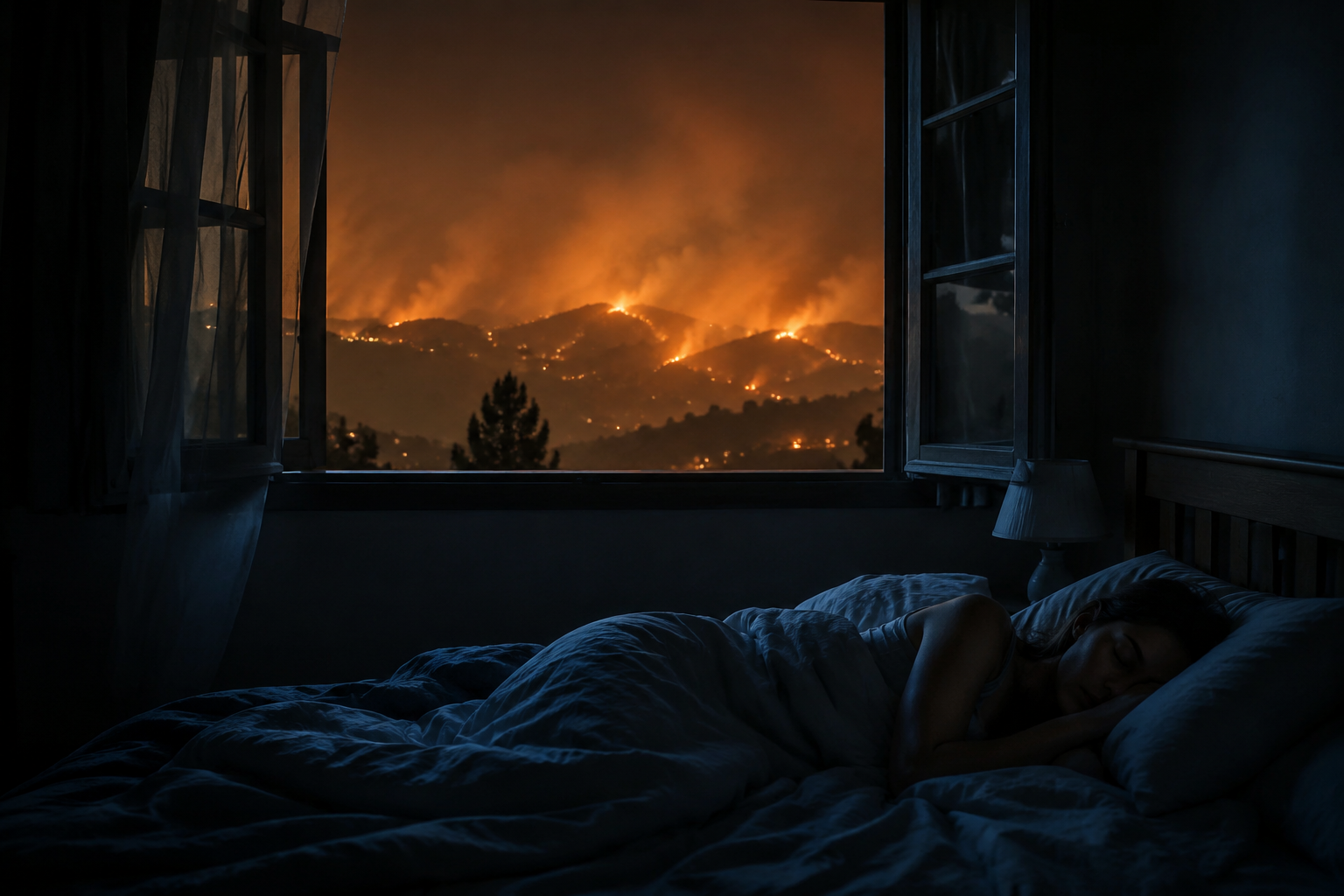
During a smoke event, sleep can fail in a way that feels disproportionate. You did the obvious things: closed the windows, stayed inside, skipped the evening run, maybe watched the air-quality number more than you wanted to. Then the night arrives and the body behaves as if the emergency is still happening. The throat catches. The nose blocks. A cough interrupts the first stretch of sleep. At 3 a.m., even if the room is quiet, the nervous system is not.
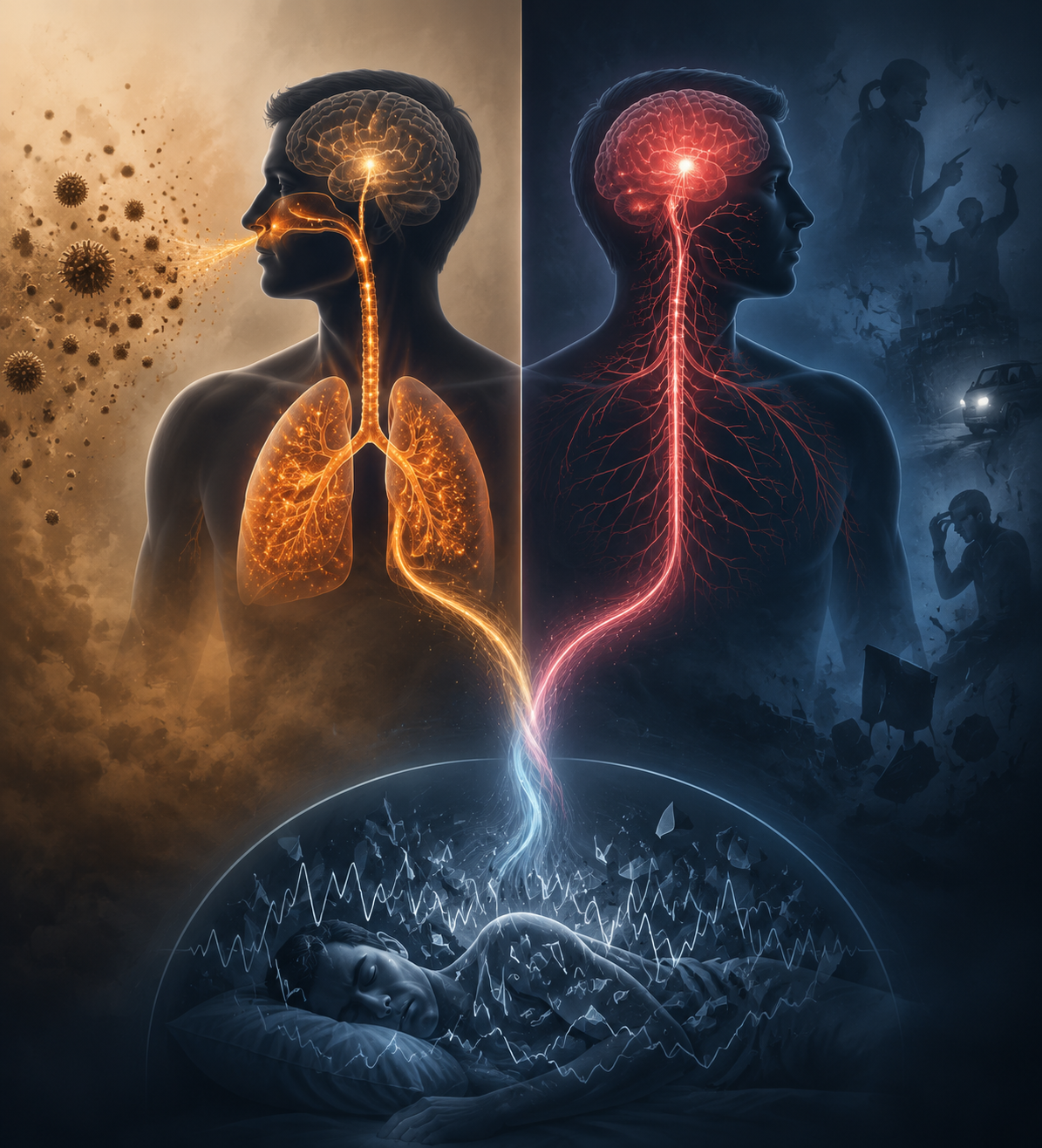
Wildfire smoke's impact on sleep quality is not just a breathing problem. It is better understood as two pathways arriving together: fine-particle exposure irritating the airway and possibly affecting sleep-regulating brain systems, while the event itself keeps threat circuits and autonomic arousal switched on. Either pathway can disturb sleep. Together, they can make an exhausted person feel strangely unable to settle.
That pattern showed up at population scale during the 2019–20 bushfire season in the Australian Capital Territory. In a study of adults exposed to bushfire smoke, 37% reported disrupted or poor sleep, and 45.3% reported anxiety due to smoke.[1] Those numbers matter because they put two common complaints side by side: sleep disruption and anxiety were not separate footnotes to the smoke season. They were part of the same lived event.
The first pathway is mechanical before it is dramatic
Wildfire smoke carries a mixture of gases and particles, but the sleep-relevant starting point is often fine particulate matter. PM2.5 is small enough to reach deep into the respiratory tract. At night, that exposure does not have to cause a medical crisis to matter. A mildly inflamed airway can narrow. Nasal tissue can swell. Mucus can increase. A dry cough can become more noticeable when the house is quiet and the person is lying flat.
Sleep is not a sealed-off state. It depends on stable breathing, stable temperature, and a nervous system willing to reduce its vigilance. Smoke works against that stability in small, repeated ways. Congestion changes airflow. Coughing produces brief awakenings. Throat irritation can pull a sleeper into lighter stages before they are fully conscious. Even if each interruption is short, the night loses continuity.
This is why “I could breathe, technically” does not rule out smoke-related sleep disruption. People often judge breathing trouble by daytime standards: wheezing, chest tightness, shortness of breath on stairs. Sleep is less forgiving. The threshold for disturbance is lower because the brain has to keep checking whether the airway is safe enough to stay asleep.
Fine particles may also reach systems that help regulate sleep
The respiratory pathway is the most immediate and easiest to feel. The neurological pathway is more cautious territory. Broader air-pollution research supports the idea that fine particles can reach the central nervous system through routes including the olfactory nerve, with potential effects on brain regions and signaling systems involved in sleep-wake regulation and circadian timing.[2] That does not mean human wildfire-smoke nights have been mapped cleanly from nose to brain to insomnia. They have not.
The distinction matters. It is reasonable to say that PM2.5 exposure has plausible routes into neural systems relevant to sleep. It is too strong to say that wildfire smoke has been proven, in exposed humans during real fire events, to disrupt sleep mainly by direct central nervous system penetration. The better reading is layered: airway irritation is visible at the surface, while particle-related inflammation and neural signaling may add another route by which polluted air interferes with sleep architecture.
Sleep architecture is the important phrase here. A person does not only need enough hours in bed. The night has to move through deeper non-REM sleep and REM sleep in a reasonably organized way. Anything that increases inflammatory signaling, respiratory effort, autonomic activation, or circadian instability can make sleep more fragmented even when total time in bed looks adequate.
The second pathway is threat, not ordinary worry
The psychological pathway is often flattened into “stress,” which is accurate but too bland. A smoke event changes the meaning of the night. The air outside is unsafe. The smell may enter the house. The sky may have been orange for hours. Alerts may still be active. Someone in the household may have asthma, pregnancy, heart disease, or a job that cannot move indoors. The body does not treat that as a normal bad day.
Among 126 wildfire survivors in one study, 49.2% met criteria for clinical insomnia, and smoke severity was a significant predictor of insomnia severity beyond other trauma factors.[3] That finding is striking, but it should be held carefully. The sample was small and non-random, and wildfire survivors may also be dealing with evacuation, property loss, direct fire threat, and trauma symptoms. The study does not turn every smoke-exposed sleeper into a trauma patient. It does show that smoke severity can remain relevant even in a psychologically complicated setting.
A scoping review of wildfire smoke and mental health found that chronic or persistent smoke exposure has been associated with anxiety, depression, and sleep disruption, while also noting that the evidence is limited and that smoke-specific effects are difficult to separate from evacuation, property loss, and proximity to fire.[4] That uncertainty is not a reason to dismiss the sleep complaint. It is a reason to stop looking for one clean cause when the exposure arrives bundled with fear, confinement, disrupted routines, and health monitoring.
Hyperarousal is the bridge between the outside event and the bedroom. In insomnia, hyperarousal means the systems that should soften at night—attention, heart rate, muscle tone, threat detection—stay too active. After earthquakes, for example, people may find that the bed itself becomes associated with vigilance rather than safety. A similar process can happen during smoke events, except the cue may be the smell of smoke, the air purifier sound, the blocked window, or the habit of checking conditions before lying down.
Why awakenings multiply
The two pathways do not wait politely in separate lanes. A cough wakes the sleeper. Once awake, the person notices the smell, the dryness in the throat, or the pressure in the chest. That noticing can trigger monitoring: Is the air worse? Did the seal around the window fail? Is the child coughing? Should the filter be turned higher? The body shifts from repair to surveillance.
Surveillance changes the physiology of sleep. Heart rate may stay higher. Blood pressure may not dip as smoothly. Breathing feels more deliberate. The person may still be lying still in the dark, but the nervous system is solving a safety problem, not entering deep sleep.
This compounding is what makes smoke-event insomnia feel different from a routine poor night. A routine insomnia night may be driven mainly by conditioned arousal, schedule disruption, pain, medication, or rumination. A smoke-event night adds an external exposure that can keep generating physical signals. The airway keeps reporting irritation. The environment keeps carrying risk. The brain keeps receiving reasons to check.
| Layer of disruption | What changes at night | How it can show up |
|---|---|---|
| Airway irritation | Inflammation, congestion, coughing, throat dryness | Brief awakenings, lighter sleep, waking with cough or blocked nose |
| Possible particle-related neural effects | Inflammatory and sleep-wake signaling may be affected, based mainly on broader PM2.5 research | Less stable sleep architecture; direct human wildfire evidence remains limited |
| Threat and confinement | Anxiety, health monitoring, loss of outdoor routines, uncertainty | Difficulty falling asleep, early-morning waking, feeling wired despite fatigue |
| Autonomic arousal | Higher vigilance, heart-rate activation, reduced downshifting | Restless sleep, repeated awakenings, poor recovery |
Animal sleep data make the physiology easier to see
Human smoke seasons are hard to study cleanly because the exposure is never just smoke. People are changing homes, routines, stress levels, activity, and sometimes medications at the same time. That is where controlled animal work can be useful, as long as it is not mistaken for a human outcome study.
In a 2025 EPA animal study, rats exposed to controlled eucalyptus smoke for 1 hour showed disrupted slow-wave sleep and REM sleep, along with elevated heart rate and blood pressure; the cardiovascular effects correlated with the magnitude of sleep disruption.[5] This does not prove that a person sleeping through several smoky nights will experience the same sleep-stage changes. It does support a biologically coherent picture: smoke exposure can coincide with both disturbed sleep architecture and cardiovascular activation.
That pairing is important because deeper sleep is not simply a mood state. Slow-wave sleep is part of the body’s overnight recovery. REM sleep is part of emotional and cognitive processing. If smoke exposure and autonomic activation make those states harder to enter or maintain, the next day’s fatigue can reflect more than lost minutes. It can reflect a night that never fully settled into its usual pattern.
Why sleep hygiene only reaches part of the problem
Basic sleep habits still matter during smoke season. A regular wake time, reduced alcohol, a dark room, and less late-night alert checking can lower avoidable arousal. For some people, tracking sleep with a wearable may help distinguish one bad night from a multi-night pattern. None of that changes the central issue: smoke-event insomnia is exposure-driven.
That is why the usual advice can feel insulting when it is offered as the whole answer. A person may have a reasonable bedtime routine and still wake repeatedly because the airway is inflamed, the house smells faintly smoky, and the nervous system is treating the environment as unstable. Better sleep hygiene can reduce friction around the edges. It cannot make unsafe air feel safe to the body.
The most honest model is compounded disruption. PM2.5 and smoke gases irritate the respiratory system and may affect sleep-regulating pathways. Coughing and congestion fragment the night. Stress, confinement, and uncertainty raise hyperarousal. Each awakening gives the brain another chance to scan for danger, and each scan makes deeper sleep harder to regain.
The evidence is strongest for the lived association between smoke seasons and poor sleep, and for the plausibility of respiratory and stress pathways. It is more limited for direct human proof that wildfire PM2.5 reaches the brain and disrupts sleep architecture during real smoke events. That gap should stay visible. It does not weaken the main point; it keeps the explanation properly sized. Wildfire smoke can ruin sleep because the body is responding to an exposure and an alarm at the same time.
References
- Physical and mental health effects of bushfire and smoke in the Australian Capital Territory 2019–20, PMC, 2021
- The association between air pollution and sleep: A systematic review, PMC, 2020
- Prevalence and Predictors of Sleep and Trauma Symptoms in Wildfire Survivors, ScienceDirect, 2023
- The mental health and well-being effects of wildfire smoke, PMC, 2022
- EPA animal sleep study, PubMed, 2025
Comments
Join the discussion with an anonymous comment.