
The hard part of fight-week sleep is not that an athlete suddenly forgets how to sleep. It is that the body is being asked to do incompatible jobs at the same time: stay alert enough to tolerate hunger, thirst, soreness, heat exposure, and scale anxiety, then shut down cleanly for recovery. That is where the weight cutting effects on sleep become more than a comfort issue.
The direct sleep evidence is still thin. In the most relevant recent synthesis, Kużdżał et al. identify sleep as a critical gap in rapid weight-loss research, not as a settled field with precise sleep-loss estimates for every athlete. The one study in that review that directly measured sleep quality during weight cutting used the Pittsburgh Sleep Quality Index and found only a mild worsening, from 5.15 to 5.52. That number matters because it is rare direct measurement, but it should not be inflated into a dramatic collapse in sleep quality. The stronger case comes from convergence: caloric restriction, dehydration, and low energy availability all push against the physiology that normal sleep and recovery require.[1]
The Scale Can Be Passed While Sleep Is Still Losing
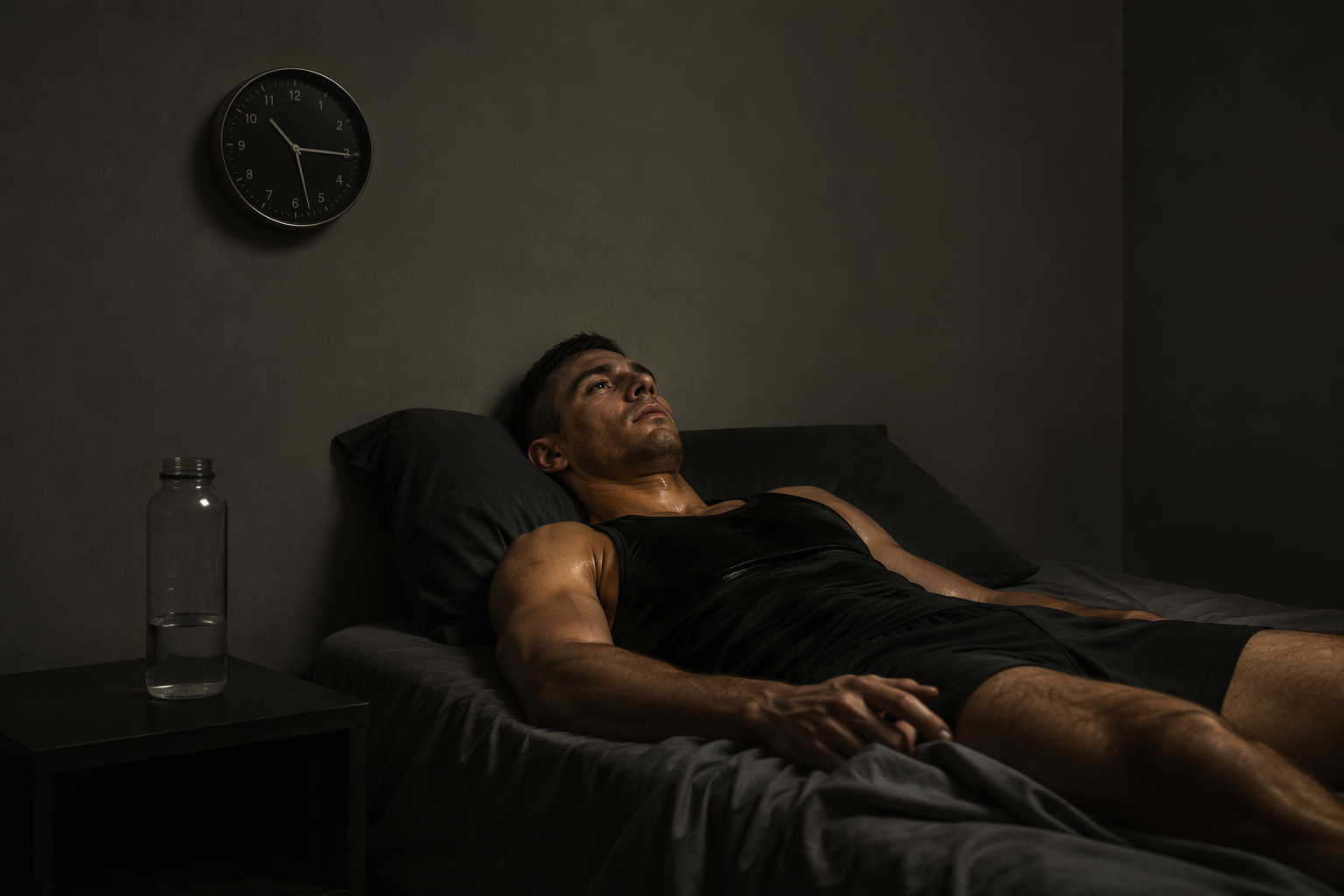
A passed weigh-in tells you that body mass reached a target. It does not tell you whether the athlete slept, whether slow-wave sleep held up, whether soreness eased overnight, or whether the nervous system came down from the stress of the cut. In a weigh-in room, that distinction is easy to miss because the result is visible and immediate. Sleep damage is quieter. It shows up later as flat warm-ups, delayed reactions, irritable decision-making, and an athlete who needs more time than the schedule gives.
Rapid weight loss in the reviewed literature generally involved losing about 2–10% of body mass over 1–7 days. Across that window, the body is not only smaller on the scale; it is also under endocrine, hydration, and tissue-repair stress. Creatine kinase, a marker commonly used around muscle damage, peaked at 713.4 ± 194.6 U/L, while perceived fatigue rose from 41.8 to 51.3 A.U. Those are not sleep measures, but they describe a body state that is not friendly to sleep initiation or sleep maintenance.[1]
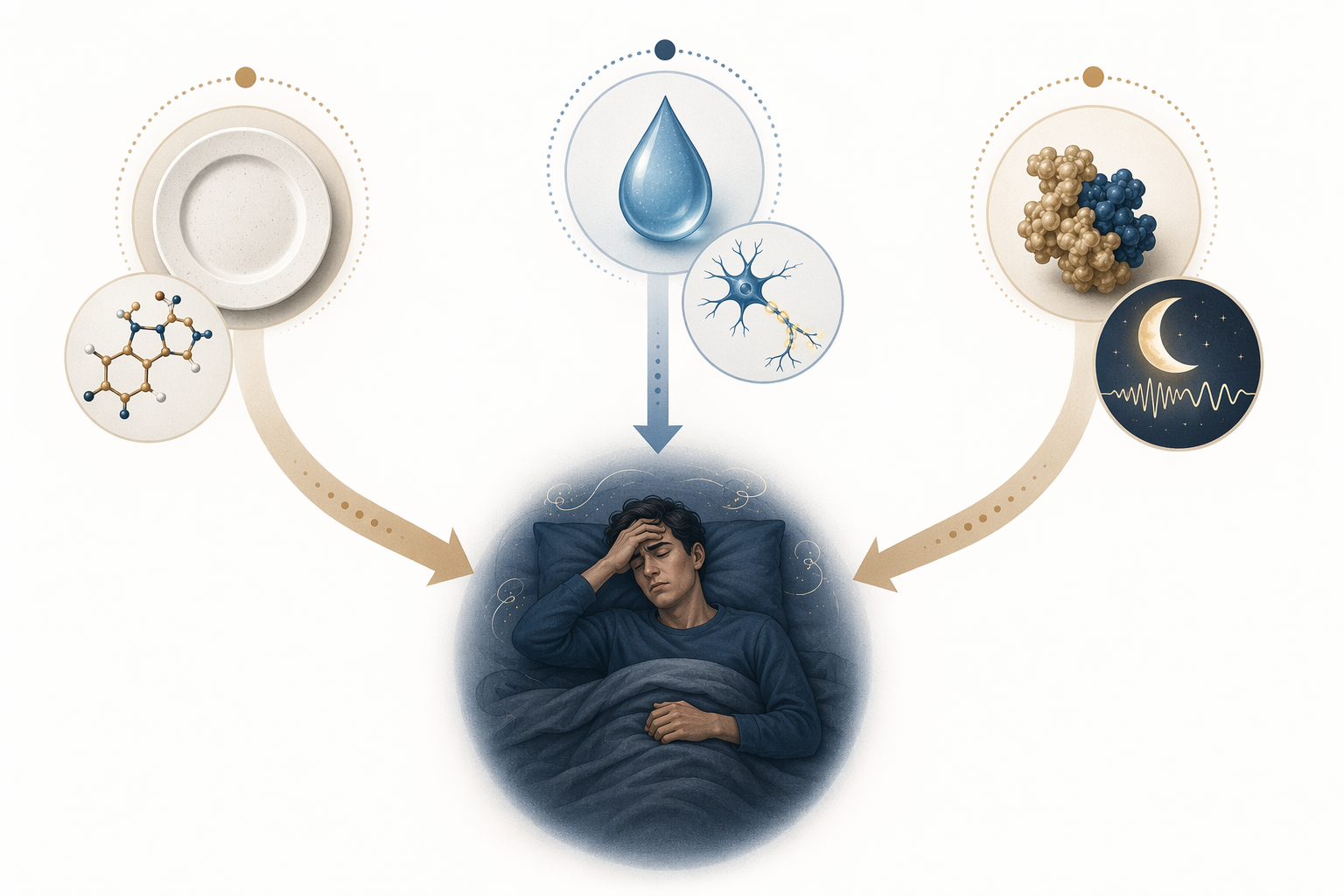
Pathway 1: Caloric Restriction Keeps the Stress System Online
The first pathway is caloric restriction. During a cut, food is not merely reduced in a tidy nutrition-tracking sense. It is often reduced while training continues, social routines narrow, and the athlete’s attention keeps returning to the number on the scale. That combination can pull the hypothalamic-pituitary-adrenal axis into the middle of the sleep problem.
In the weight-cutting evidence gathered by Kużdżał et al., cortisol rose from about 499.9 to 731.6 nmol/L. Cortisol is not a villain; athletes need it for normal arousal, metabolism, and stress response. The sleep issue is timing and load. When the stress signal stays elevated late in the day or through the night, the body has a harder time moving from vigilance into stable sleep.[1]
That is one reason a hungry athlete may feel exhausted without feeling sleepy in the useful sense. The legs are heavy, the mood is short, and the room is dark, but the system is still monitoring threat: food, fluids, weigh-in timing, opponent, travel, and the possibility of missing. Sleep can become lighter and more fragmented even when total time in bed looks acceptable.
This is also where it is easy to overstate certainty. The sleep-quality data do not prove exactly how many minutes of sleep an athlete loses from caloric restriction. What they do is sit beside the cortisol pattern and make the mechanism harder to dismiss.[1]
Pathway 2: Dehydration Raises the Body’s Nighttime Alarm
The second pathway is dehydration. Fluid restriction, sweat sessions, and sauna use are common enough in rapid weight cuts that people around combat sports can become numb to them. The body is not numb to them. When plasma volume, thermal strain, and thirst signals move in the wrong direction, the sympathetic nervous system has reasons to stay active.
That matters because sleep is not just unconsciousness. Slow-wave sleep depends on the body being able to reduce arousal and move into a deeper restorative state. Dehydration plausibly works against that state by increasing sympathetic activation, raising the likelihood of awakenings and reducing the depth or continuity of sleep. The scoping review frames this as a likely mechanism rather than a fully quantified sleep outcome, which is the right level of caution.[1]
Anyone who has watched an athlete try to sleep dry has seen the practical version: dry mouth, repeated position changes, heat discomfort, and shallow dozing that breaks too easily. None of that requires melodrama. It is just a bad environment for deep sleep, created at the exact point when the athlete is hoping the night will repair the day.
Pathway 3: Low Energy Availability Cuts Into Repair
The third pathway is low energy availability: the gap between what the athlete’s body has available and what training, basic physiology, and recovery require. This is not identical to being hungry for a few hours. During aggressive cuts, the body may be short on usable energy while still being asked to train, make weight, travel, warm up, and compete.
Sleep is one of the main windows when repair work is supposed to happen. NREM sleep, especially deeper NREM sleep, is tied to growth hormone secretion and tissue recovery. The review’s mechanistic concern is that low energy availability can suppress growth hormone-supported repair during NREM sleep, leaving muscle recovery less complete after sessions that are already being performed under restriction.[1]
This is where the athlete can get caught in a loop that feels unfair but is physiologically coherent. Training creates muscle damage and fatigue. The cut limits energy and fluids. Sleep becomes lighter or shorter. Then the next session starts with more soreness, more perceived effort, and less margin for clean technical decisions.
The Feedback Loop Reaches the Mat, Cage, and Stage
The most important downstream effect is not that the athlete feels bad. Athletes often feel bad and still compete well. The concern is that rapid weight loss can stack several small disadvantages into the same narrow window: elevated fatigue, muscle damage, impaired sleep continuity, slower cognition, and less reliable recovery.
Reaction time and decision-making are especially exposed because they depend on sleep-sensitive systems. A wrestler who hesitates on a re-attack, a fighter who reads a feint late, or a grappler who makes a poor scramble choice is not simply showing weak will. Sleep loss can make the brain slower at selecting and executing the right option under pressure. That is why poor sleep belongs in the same conversation as technical readiness, not off to the side as a wellness preference.
The injury signal makes the same point in harder terms. In males, injury odds increased by OR 1.19 per 1% of body mass lost. In female athletes, the contrast was 45.62 injuries per 1000 athletic exposures during weight loss versus 17.64 during normal training. Those numbers do not prove that sleep loss alone caused the injuries. They do show that the weight-loss window is not just a weigh-in problem; it is a higher-risk performance environment.[1]
That connection is the reason sleep deserves attention when injury risk is being discussed. The broader relationship is covered in How Poor Sleep Increases Your Risk of Sports Injury, but the weight-cutting version has its own pressure points: athletes are often depleted, dehydrated, and sore before the contest even starts.
What the Evidence Still Cannot Prove
The conservative reading is not that every athlete loses the same amount of sleep during every cut. The field is not there. Only one study in the review directly measured sleep quality with PSQI during weight cutting, and that finding was mild. Four of the five randomized studies in the review were rated at high risk of bias. Female athletes were also badly underrepresented: only 1 of 17 studies was female-only.[1]
There is another boundary worth keeping. General sleep-deprivation studies often used to explain metabolic and recovery effects were conducted in overweight general populations, not elite combat-sport athletes. That does not make them useless; physiology does not reset because someone has a singlet or gloves on. But it does mean effect sizes, tolerance, and recovery speed may differ from the populations those studies actually tested.[1]
Those caveats sharpen the point rather than erase it. The direct sleep-measurement base is thin, but the mechanisms converge in the same direction. Caloric restriction can keep the stress system elevated. Dehydration can raise sympathetic activation and interrupt deeper sleep. Low energy availability can interfere with growth hormone-supported repair during NREM sleep. Meanwhile, fatigue, muscle damage markers, and injury risk worsen in the same rapid weight-loss window.[1]
The More Useful Way to Read a Weight Cut
Rapid weight cutting is usually judged by whether the athlete makes weight and whether performance survives. Sleep adds a third lens. A cut can succeed on the scale while still acting as a recovery stressor, especially when food restriction, fluid loss, and low energy availability converge before competition.
The most credible warning is not that weight cutting causes a predictable, exact sleep-loss dose in every athlete. It is that the physiology points in the wrong direction during the very window when athletes need restoration most. Rapid weight cutting is not only a body-mass manipulation strategy. It is also a sleep and recovery stressor that can compound cognitive decline and injury vulnerability when the margin for error is already small.
References
- Kużdżał et al. 2025 scoping review. PMC. 2025. https://pmc.ncbi.nlm.nih.gov/articles/PMC12371904/
Comments
Join the discussion with an anonymous comment.