If your sleep score drops after a strong geomagnetic storm, the timing is not automatically meaningless. It is also not a diagnosis from the sky. The best reading of the evidence is narrower and more useful: geomagnetic activity may reduce sleep quality in a physiologically sensitive minority, while most people probably do not experience a noticeable effect. A 2023 review estimated that roughly 10–15% of people react measurably to solar or geomagnetic disturbances, with higher rates reported in older adults and people with cardiovascular disease.[1]
That distinction matters for anyone using a wearable. A bad night on a tracker can be real without proving why it happened. Consumer sleep devices are better at showing patterns than assigning causes, which is why it helps to understand how sleep trackers compare with lab validation data before treating a single low recovery score as evidence of a geomagnetic effect.
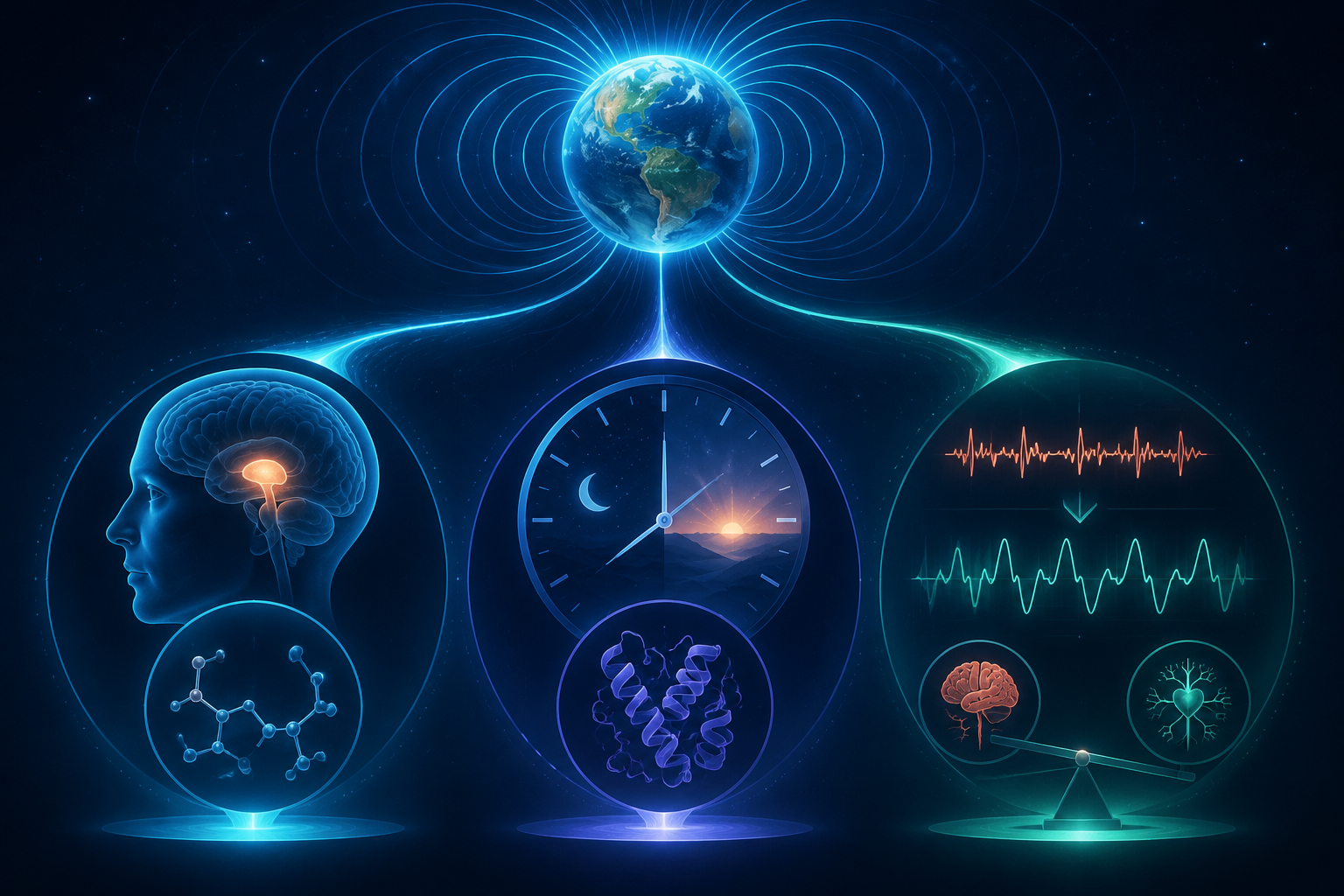
The most credible discussion does not start with a vague “energy” effect. It starts with three body systems that already sit close to sleep: melatonin signaling, circadian timing, and autonomic nervous system balance. Each has some evidence connecting it to geomagnetic conditions. None turns a forecasted Kp spike into a personal sleep prediction.
Melatonin Is The Most Direct Sleep-Specific Clue
Melatonin is not a sedative in the way many people imagine. It is closer to a darkness signal: it tells the body that biological night has arrived, helps organize circadian timing, and supports the conditions under which sleep becomes easier. If geomagnetic disturbance is associated with lower nighttime melatonin output, that is immediately relevant to sleep quality.
One of the key human studies came from a high-latitude setting. Weydahl and colleagues reported that at 70°N latitude, geomagnetic disturbances above 80 nT were associated with decreased melatonin synthesis.[2] The latitude is not a footnote. Geomagnetic field variations are larger at high latitudes than near the equator; the Martel review notes that variations can reach 5 µT at high latitudes compared with about 1 µT at the equator.[1]
Burch and colleagues added a related finding: elevated geomagnetic activity was associated with reduced nocturnal excretion of 6-sulfatoxymelatonin, a urinary metabolite used as an indirect marker of melatonin production.[3] This is not the same as showing that every participant slept worse, but it does show that a sleep-relevant biological signal changed in association with geomagnetic conditions.
The limitation is the part that keeps this from becoming a universal explanation for insomnia. The direct melatonin studies cited in this area are small, generally involving tens to low hundreds of participants, and many come from northern latitudes where geomagnetic variation is stronger.[1] A person living far from polar regions should not assume the same size effect. A person who repeatedly sees the pattern, however, is not being irrational for wondering whether melatonin timing is part of it.
This is also where supplement questions usually appear. If geomagnetic activity can coincide with lower melatonin output, would taking melatonin fix the problem? The evidence does not support that leap. Melatonin can help some circadian-timing problems, but dose, timing, age, light exposure, and medications matter. Readers thinking about supplementation are better served by a broader look at which alternative insomnia treatments have evidence than by treating a geomagnetic storm as an automatic reason to add a pill.
Circadian Timing May Be Sensitive, But The Human Sleep Link Is Still Unsettled
The more intriguing pathway runs through cryptochromes, light-sensitive proteins involved in circadian biology. In animal magnetoreception research, cryptochromes are often discussed as part of a biological compass system. The human version is not merely a decorative evolutionary leftover: Foley, Gegear, and Reppert found that the human CRY2 gene was functionally magnetosensitive when it rescued magnetic navigation behavior in cryptochrome-knockout Drosophila.[4]
That is a strange and elegant result. It does not prove that a human lying in bed feels a geomagnetic storm through CRY2. It does show that a human circadian-related molecule can participate in a magnetic response under experimental conditions. For sleep, the responsible conclusion is “biologically plausible,” not “clinically proven.”
Older human timing work points in the same general direction. Wever reported that human circadian rhythms free-ran at 24.87 hours under natural geomagnetic conditions and 25.26 hours under magnetically shielded conditions.[5] The difference suggests that the geomagnetic environment can influence circadian timing, though it does not tell us how often modern sleepers lose sleep during natural storms.
Close later proposed a mechanism in which geomagnetic storms introduce “incorrect yet coherent” directional signals into a cryptochrome compass system, potentially disturbing hormonal systems along the HPA axis.[6] That idea is useful because it connects magnetoreception to stress physiology rather than treating sleep loss as a mysterious direct hit. It remains a proposal, not a confirmed explanation for common poor sleep.
For someone already prone to circadian drift, the practical overlap is easier to imagine. If the body’s night signal is delayed, weakened, or made noisier, sleep can become lighter, later, or more fragmented. That resembles the logic behind circadian rhythm disorders such as delayed sleep phase syndrome in adults, though geomagnetic activity should be treated as a possible small influence rather than the main driver.
The Nervous System Pathway Is The One Tracker Users Usually Notice
Many people do not notice melatonin or circadian phase directly. They notice a wearable saying their recovery is poor, their heart rate stayed elevated, or their HRV dropped overnight. That is where the autonomic nervous system pathway becomes relevant.
Heart rate variability, or HRV, is often used as a rough window into autonomic balance. Higher nighttime parasympathetic activity generally reflects more “rest-and-digest” tone, while lower HRV can show that the body is carrying more physiological load. McCraty and colleagues reported real-time synchronization between geomagnetic activity and human autonomic rhythms, with Kp 5+ events correlating with reduced parasympathetic tone during sleep.[7]
Alabdulgader and colleagues later reported long-term HRV responses to changes in the solar and geomagnetic environment.[8] Again, this is not a personal forecast. It is a population-level physiological association, and HRV is influenced by many ordinary variables: alcohol, late meals, fever, emotional stress, training load, sleep debt, medications, and menstrual-cycle phase.
The tracker problem is that a plausible mechanism can make a weak pattern feel more certain than it is. If your HRV falls on a night with a geomagnetic storm, the storm becomes memorable. If HRV falls on a night after wine, work stress, or a late bedtime, the cause may feel too ordinary to register. Pattern recognition is useful, but it is not immune to preference.
There is a psychological parallel here as well. Environmental events can disturb sleep through hyperarousal even when the body is not physically injured. The mechanism is obvious after earthquakes, where the nervous system may remain on alert long after immediate danger has passed; the same sleep-maintenance problem is discussed in CBT-I approaches to earthquake-related sleep anxiety. With geomagnetic storms, the environmental signal is less consciously dramatic, but anxious monitoring can still become its own sleep disruptor.
Who Is Most Likely To Notice Geomagnetic Storm Sleep Quality Effects?
The evidence points toward sensitivity, not universality. Martel and colleagues’ 10–15% estimate is useful because it sets a boundary: geomagnetic effects may be real for a minority, while absent or too small to notice for most people.[1] That minority may not be random. The same review describes higher reactivity in elderly people and cardiovascular patients.[1]
| More reason to consider geomagnetic activity | Less reason to prioritize it |
|---|---|
| Repeated sleep disruption during Kp 5+ periods across many months | One bad night after seeing a solar-storm headline |
| Lower HRV, lighter sleep, or more awakenings without obvious lifestyle changes | Alcohol, illness, travel, late light exposure, or schedule disruption on the same night |
| Living at higher latitude where geomagnetic variation is larger | Living at lower latitude with no repeated personal pattern |
| Known cardiovascular vulnerability or older age | Young, healthy sleeper with inconsistent tracker data |
This table is not a screening tool. It is a way to keep the claim the right size. A repeated pattern deserves curiosity. A single coincidence deserves less weight.
It is also worth remembering what the research cannot do. Geomagnetic storms cannot be randomly assigned in a double-blind sleep trial, so the available evidence is mostly correlational or based on artificial field simulation.[1] That does not make the findings worthless. It does mean they should not be interpreted like a medication trial where exposure and placebo can be controlled.
How To Read Your Own Pattern Without Turning It Into A New Worry
If you want to test the pattern in your own data, the cleanest approach is boring: look backward over weeks or months instead of checking space weather every night. Mark nights with unusually poor sleep, then compare them with Kp 5+ periods afterward. This reduces the chance that expectation itself changes your sleep.
- Use repeated patterns, not single nights, as the minimum threshold for interest.
- Compare similar nights: same bedtime range, no alcohol, no illness, no travel, and similar stress load.
- Treat HRV and sleep score changes as clues, not proof of a cause.
- Give stronger weight to known sleep disruptors before considering geomagnetic activity.
- Avoid nightly monitoring if it makes bedtime feel like a threat assessment.
So if your sleep repeatedly worsens during Kp 5+ periods, you can treat geomagnetic activity as one possible environmental stressor. It should sit below light exposure, anxiety, alcohol, illness, medications, pain, sleep debt, and irregular schedules on the list of likely causes. That ranking is not dismissive. It is how a real signal stays useful without becoming another invisible thing to fear at night.
References
- Potential health effects of geomagnetic storms, Biomedical Journal, 2023, PMC10740910
- Geomagnetic activity influences the melatonin secretion at 70 degrees N, Biomedicine & Pharmacotherapy, 2001, PubMed ID 11774869
- Geomagnetic disturbances are associated with reduced nocturnal excretion of a melatonin metabolite in humans, PubMed, PubMed ID 10465710
- Human cryptochrome exhibits light-dependent magnetosensitivity, Nature Communications, 2011, PubMed ID 21694704
- The circadian system of man: results of experiments under temporal isolation, Wever, 1974
- Are stress responses to geomagnetic storms mediated by the cryptochrome compass system?, Proceedings of the Royal Society B, 2012, PMC3321722
- Synchronization of Human Autonomic Nervous System Rhythms with Geomagnetic Activity in Human Subjects, International Journal of Environmental Research and Public Health, 2017, PMC5551208
- Long-Term Study of Heart Rate Variability Responses to Changes in the Solar and Geomagnetic Environment, 2018, PMC5805718
Comments
Join the discussion with an anonymous comment.