
Mechanism explainer
Apple Watch vs. Oura Ring vs. Fitbit: Which Sleep Tracker Is Most Accurate?
A head-to-head comparison of the Apple Watch, Oura Ring Gen3, and Fitbit Sense 2 for sleep tracking, based on peer-reviewed PSG validation studies. We break down the accuracy data, practical tradeoffs, and which device is best for your needs.
Introduction: Why the Right Sleep Tracker Matters
If you own an iPhone and are shopping for a sleep tracker, you are likely weighing three primary options: the Apple Watch, the Oura Ring, or a Fitbit. Each device promises to reveal how much deep sleep you got, how long it took you to fall asleep, and how restorative your night was. But the data they deliver can differ substantially — and those differences matter when you are using the information to make decisions about your health.
The core question is not which device has the most features or the best battery life. It is which one produces sleep data you can actually trust. A growing body of peer-reviewed research has put these three wearables head-to-head against the gold standard for sleep measurement: polysomnography (PSG). The results reveal a clear hierarchy in accuracy, but also important tradeoffs that depend on what you value most.
This article synthesizes the most rigorous comparative data available — primarily the 2024 Brigham & Women's Hospital study and a large 2023 multicenter trial — to help you decide which device is right for your specific sleep tracking needs.
The Gold Standard: How the Brigham & Women's 2024 Study Was Designed
The most direct comparison of the Apple Watch Series 8, Oura Ring Gen3, and Fitbit Sense 2 comes from a 2024 study conducted by researchers at Brigham & Women's Hospital and published in Sensors (PMC11511193). The study enrolled 35 healthy adults and had them wear all three devices simultaneously during a single night of in-lab PSG — the same setup used to diagnose sleep disorders clinically.
Each device's sleep stage classifications (wake, light, deep, REM) were compared epoch-by-epoch against the PSG scoring performed by trained sleep technicians. The researchers calculated Cohen's Kappa for 4-stage classification, intraclass correlation coefficients (ICC) for sleep-wake detection, and per-stage bias (the average difference between the device's estimate and the PSG truth).
A second important data source is a 2023 multicenter study (PMC10654909) that tested 11 devices in 75 participants across multiple sleep labs in Korea. That study provides a broader benchmark, including macro F1 scores for 4-stage classification, and helps validate whether the Brigham & Women's findings hold up in a different population and setting.
Oura Ring Gen3: The Accuracy Leader for Sleep Stage Classification
In the Brigham & Women's study, the Oura Ring Gen3 achieved the highest 4-stage Cohen's Kappa of 0.65. This was 5% higher than the Apple Watch (0.60) and 10% higher than the Fitbit Sense 2 (0.55). More importantly, Oura was the only device that did not significantly misestimate any individual sleep stage. Its average wake, light, deep, and REM estimates were statistically indistinguishable from PSG.
Oura also recorded a 100% data collection rate — every participant produced a full night of usable data. This is a meaningful advantage: a tracker that fails to collect data on some nights is a tracker you cannot rely on for longitudinal trends.
| Metric | Oura Ring Gen3 | Apple Watch Series 8 | Fitbit Sense 2 |
|---|---|---|---|
| 4-Stage Cohen's Kappa | 0.65 | 0.60 | 0.55 |
| Sleep-Wake ICC | 0.74 (good) | 0.85 (excellent) | 0.56 (fair) |
| Wake Sensitivity | 68.6% | Not reported | Not reported |
| Deep Sleep Sensitivity | 79.5% | ~62% (Apple Oct 2025) | Not reported |
| Data Collection Rate | 100% | 83% (6/35 failed) | 94% (2/35 failed) |
| Significant Stage Bias | None | Yes (deep, light, wake) | Yes (deep, light) |
For readers who prioritize sleep stage accuracy above all else — for example, those tracking deep sleep to manage recovery from illness or optimize athletic performance — the Oura Ring is the strongest choice based on the available head-to-head evidence. For a deeper dive into Oura's validation data, see our full Oura Ring accuracy analysis.
Apple Watch Series 8: Best Sleep-Wake Detection, but a Deep Sleep Problem
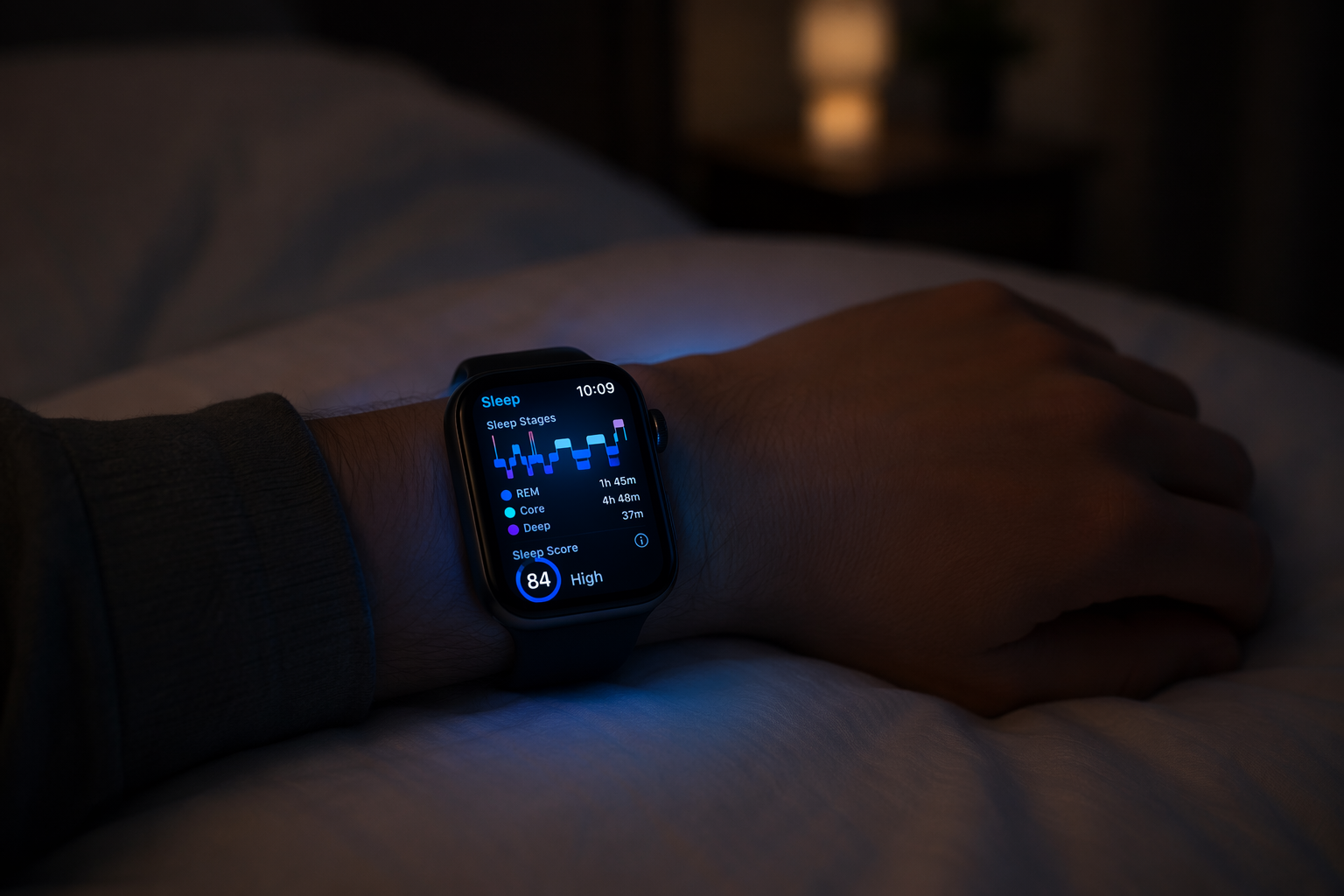
The Apple Watch Series 8 posted the highest sleep-wake ICC of the three devices — 0.85, which is classified as excellent. This means if your primary question is "was I awake or asleep at a given moment?" the Apple Watch is the most reliable of the three. Its sensitivity for detecting sleep was above 95%, matching the other devices.
However, the Apple Watch's stage-level accuracy tells a different story. The device significantly underestimated deep sleep by an average of 43 minutes per night and overestimated light sleep by 45 minutes (both p < 0.01). It also underestimated wake time by 7 minutes. These biases are large enough to meaningfully distort your sleep profile. If your Apple Watch tells you that you got 45 minutes of deep sleep, the PSG truth may be closer to 88 minutes.
Apple's own October 2025 validation paper, which incorporated foundation models from the Apple Heart and Movement Study (data from iOS 26 and watchOS 26), reported that the Apple Watch is about 62% accurate in detecting deep sleep, confusing it for core sleep 38% of the time. This internal data confirms the deep sleep problem identified in the independent Brigham & Women's study.
The Apple Watch also had the highest data failure rate: 6 of 35 participants (approximately 17%) had no usable data despite proper setup. This is a practical concern — if you occasionally wake up to a blank sleep graph, you are not alone.
Fitbit Sense 2: The Middle Ground with Moderate Accuracy
The Fitbit Sense 2 occupied the middle position in the Brigham & Women's study on most metrics. Its 4-stage Kappa of 0.55 was lower than both Oura and Apple, and its sleep-wake ICC of 0.56 was only fair. Like the Apple Watch, the Fitbit showed statistically significant stage biases: it overestimated light sleep by 18 minutes and underestimated deep sleep by 15 minutes (p < 0.001).
However, the 2023 multicenter study (PMC10654909) painted a more nuanced picture. In that 75-participant trial, the Fitbit Sense 2 achieved a macro F1 score of 0.581 for 4-stage classification — higher than the Apple Watch 8 (0.491), the Oura Ring 3 (0.519), and even the Google Pixel Watch (0.567). This suggests that in some populations and settings, Fitbit's algorithm may perform competitively, particularly for deep stage detection.
Why the discrepancy? The two studies used different populations (U.S. vs. Korean), different PSG scoring protocols, and different statistical metrics (Kappa vs. F1). The Brigham & Women's study also tested all three devices simultaneously on the same participants, which controls for individual differences in sleep architecture. The multicenter study tested devices across different nights and labs, which introduces more variability but also better reflects real-world conditions.
For a detailed look at Fitbit's performance across multiple validation studies, see our Fitbit sleep tracking review.
Beyond Accuracy: Practical Tradeoffs That Affect Your Decision
Accuracy is the most important criterion for a sleep tracker, but it is not the only one. The device you choose must also fit your lifestyle, budget, and tolerance for daily maintenance. Here is how the three devices compare on the practical dimensions that matter most.
| Factor | Apple Watch Series 8 | Oura Ring Gen3 | Fitbit Sense 2 |
|---|---|---|---|
| Form Factor | Wristwatch | Finger ring | Wristwatch / fitness band |
| Battery Life | ~18 hours (daily charge) | ~7 days | ~6 days |
| Subscription Cost | $0 | $5.99/month | $0 (basic) / $9.99/month (Premium) |
| Upfront Cost | $249–$799 | $349–$499 | $299–$349 |
| Activity Tracking | Full (GPS, ECG, workouts) | Basic (steps, activity score) | Full (GPS, workouts) |
| Comfort for Sleep | Moderate (wrist band) | High (ring, no strap) | Moderate (wrist band) |
| Charging Routine | Charge while awake | Charge while awake (30 min) | Charge while awake |
The Apple Watch's daily charging requirement is the most significant practical drawback for sleep tracking. If you forget to charge before bed, you either sleep without tracking or wear it with low battery. The Oura Ring's 7-day battery and quick charging (about 30 minutes to full) make it much easier to maintain consistent nightly tracking. The Fitbit's multi-day battery falls between the two.
Comfort is another differentiator. Many users find a ring more comfortable for sleep than a wrist band, especially side sleepers who press their wrist into the pillow. The Oura Ring is also smaller and less obtrusive than either smartwatch.
Cost of ownership over two years tells a different story. An Apple Watch SE at $249 with no subscription costs $249 total. An Oura Ring Gen3 at $349 plus $5.99/month for 24 months costs $492.68. A Fitbit Sense 2 at $299 with Premium at $9.99/month costs $538.76. If you skip the Fitbit Premium subscription, the cost drops to $299, but you lose advanced sleep metrics and trends.
Which Device Should You Choose? A Recommendations Table by Use Case
The right device depends on what you value most. The table below matches common reader profiles to the best device based on the available evidence.
| Your Priority | Best Device | Why |
|---|---|---|
| Maximum sleep stage accuracy | Oura Ring Gen3 | Highest 4-stage Kappa (0.65), no significant stage bias, 100% data collection rate |
| Best sleep-wake detection | Apple Watch Series 8 | Excellent sleep-wake ICC (0.85), most reliable for knowing when you were asleep vs. awake |
| Best value (no subscription) | Apple Watch SE | $249 upfront, $0/month, good sleep-wake detection, full smartwatch features |
| Best for side sleepers / comfort | Oura Ring Gen3 | Ring form factor, no wrist band, 7-day battery, no charging before bed |
| Best all-in-one (fitness + sleep) | Fitbit Sense 2 | Good activity tracking, moderate sleep accuracy, large user community |
| Best for deep sleep tracking | Oura Ring Gen3 | 79.5% deep sleep sensitivity, no significant deep sleep bias vs. PSG |
| Best for iPhone integration | Apple Watch Series 8 | Seamless integration with Health app, no subscription, FDA-approved ECG |
If you are still unsure, consider your primary use case. If you are a data-driven person who wants the most accurate sleep staging available in a consumer device, the Oura Ring is the clear winner based on the Brigham & Women's study. If you want a smartwatch that also tracks sleep reasonably well and integrates seamlessly with your iPhone, the Apple Watch is a strong choice — just be aware of its deep sleep bias. If you want a balance of sleep tracking and fitness features at a moderate price, the Fitbit Sense 2 is a solid middle option.
The Bottom Line: Accuracy Data Is Clear, but Your Choice Depends on Priorities
The head-to-head PSG data from the Brigham & Women's 2024 study establishes a clear accuracy hierarchy: Oura Ring Gen3 leads in sleep stage classification with no significant bias, Apple Watch Series 8 leads in sleep-wake detection but has a substantial deep sleep underestimation problem, and Fitbit Sense 2 sits in the middle with moderate performance and some stage bias.
However, accuracy is not the only variable. The Apple Watch's daily charging requirement, the Oura Ring's subscription cost, and the Fitbit's mixed performance across different studies all factor into the decision. The best device for you is the one that you will actually wear every night and whose data you can trust for your specific needs.
For deeper dives into each device's individual performance, visit our detailed reviews: Apple Watch sleep tracking review, Oura Ring accuracy analysis, and Fitbit sleep tracking review.
Supports these guides
Spot an error or have clinical feedback?
Because this article covers clinical, medication, or safety information, we use a moderated correction channel instead of open public comments. Let us know if something about “Apple Watch vs. Oura Ring vs. Fitbit: Which Sleep Tracker Is Most Accurate?” needs a closer look.
Send feedback on this article