
Mechanism explainer
Apple Watch Sleep Tracking Review: How Accurate Is It Compared to Polysomnography?
A data-driven review of Apple Watch sleep staging accuracy, comparing it to gold-standard polysomnography (PSG). Learn where the Apple Watch excels (sleep/wake detection) and where it falls short (deep sleep estimation), based on the 2024 Brigham & Women's Hospital study and Apple's own validation data.
Introduction: Can You Trust Your Apple Watch for Sleep Data?
If you own an Apple Watch, you have likely glanced at the sleep stage graph in the Health app and wondered: is this real? Does the watch actually know when I am in deep sleep, or is it guessing? These are fair questions, and the answers matter more than most users realize. Sleep data influences how people feel about their rest, and for some, it can even drive health decisions.
This review is built on peer-reviewed validation data, not marketing materials. The core finding is straightforward: the Apple Watch is excellent at detecting whether you are asleep or awake, but it systematically underestimates deep sleep by a significant margin. Understanding this gap is essential for anyone who wants to use the watch for sleep improvement rather than accidental anxiety.
How the Apple Watch Tracks Sleep: Sensor Fusion Explained
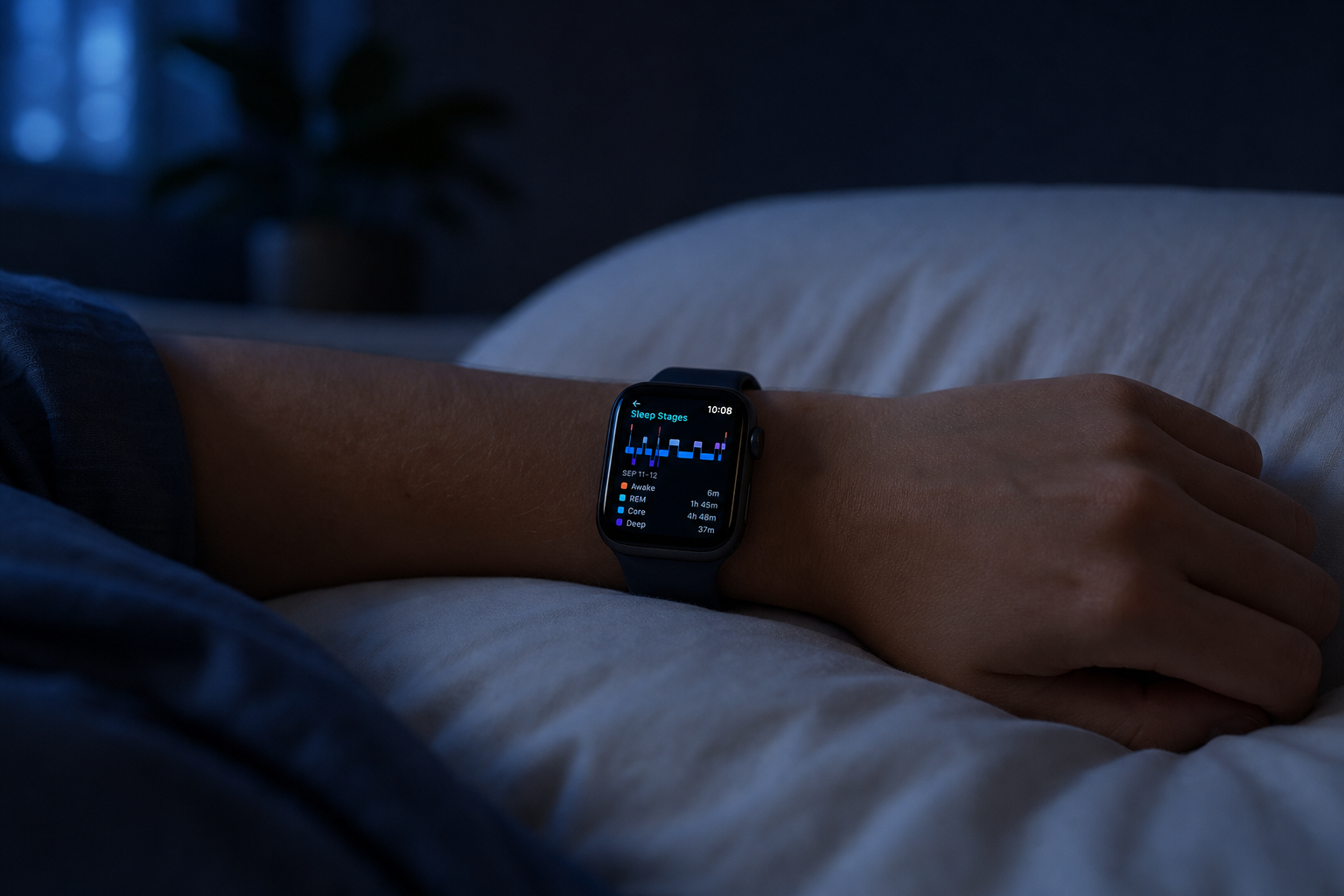
The Apple Watch does not measure brain waves. Instead, it relies on a combination of sensors to infer sleep stages through a process called sensor fusion. The primary inputs are:
- An accelerometer that detects gross body movement and micro-movements associated with breathing
- An optical heart rate sensor that captures heart rate variability (HRV) and resting pulse patterns
- A respiratory rate sensor derived from the accelerometer's detection of chest wall oscillations
These signals are fed into a machine learning model trained on large datasets, including Apple's Heart and Movement Study. The model classifies each 30-second epoch into one of four categories: wake, REM, core (light), or deep sleep. The algorithm is proprietary, but Apple has published validation data that allows independent evaluation of its performance.
For readers who want a primer on what these sleep stages actually represent and why accurate detection matters, the site's Sleep Architecture: NREM and REM Stages Explained guide provides the necessary background.
The Gold Standard: What the Brigham & Women's Hospital 2024 Study Found
The most rigorous independent evaluation of Apple Watch sleep tracking to date was published in 2024 by researchers at Brigham & Women's Hospital and Harvard Medical School. The study compared the Apple Watch Series 8 against gold-standard polysomnography (PSG) in a controlled laboratory setting with 35 healthy adults aged 20 to 50.
The headline results are impressive for sleep/wake detection but reveal a sharp drop-off when the watch attempts to classify individual sleep stages.
| Metric | Apple Watch Performance | Interpretation |
|---|---|---|
| Sleep/wake sensitivity | 97% | Excellent — the watch almost never misses when you are asleep |
| Epoch agreement (sleep/wake) | 93% | Strong agreement with PSG for binary sleep detection |
| Four-stage agreement | 75% | Moderate — performance drops when classifying specific stages |
| Light sleep sensitivity | 86.1% | Good — the watch detects most light sleep epochs |
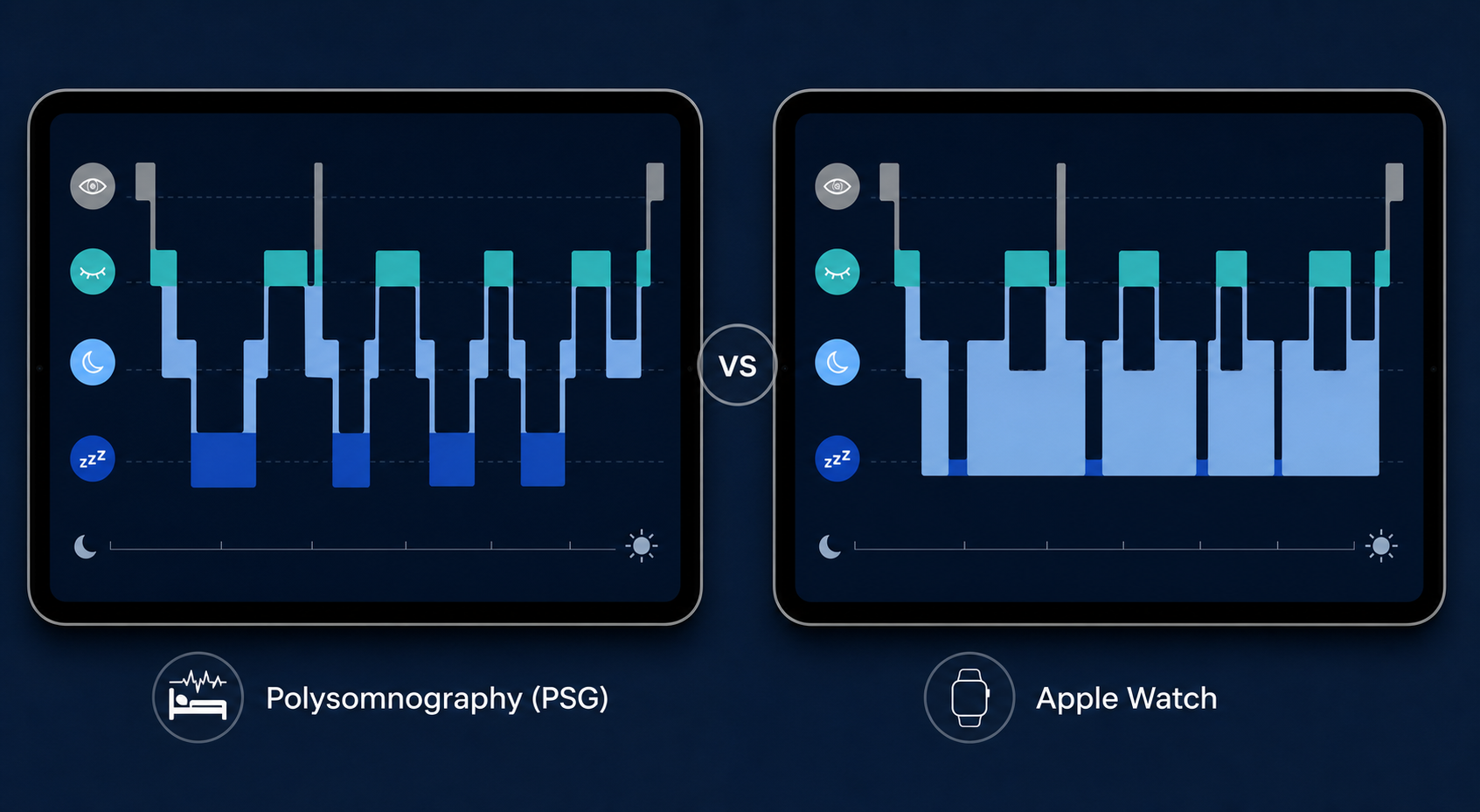
| Deep sleep sensitivity | 50.5% | Poor — the watch misses roughly half of actual deep sleep |
| REM sleep sensitivity | 82.6% | Good — REM detection is reasonably reliable |
| Deep sleep precision | 87.8% | When the watch says deep sleep, it is usually correct |
| REM sleep precision | 77.7% | Moderate — some epochs labeled REM are actually other stages |
The study also reported that the Apple Watch failed to record any data for 6 out of 35 participants (a 17% data loss rate) despite proper initialization. This is a non-trivial failure rate that users should be aware of when relying on the device for nightly tracking.
The Deep Sleep Problem: Why Your Apple Watch Underestimates Your Most Restorative Sleep
The most significant accuracy limitation is the Apple Watch's poor deep sleep detection. The Brigham & Women's Hospital study found that the watch underestimated deep sleep by an average of 43 minutes per night (p < 0.001) and overestimated light sleep by 45 minutes. The intraclass correlation coefficient (ICC) for deep sleep was 0.13, which indicates poor concordance — individual nightly estimates can vary wildly from the true value.
Apple's own validation data, published in an October 2025 white paper and reported by Empirical Health, confirms this pattern. The company's internal testing showed the Apple Watch was approximately 62% accurate in detecting deep sleep, confusing it for core (light) sleep 38% of the time. This means that even Apple acknowledges the limitation.
The population-level data from Empirical Health shows that the average Apple Watch user sees about 12% deep sleep per night, with the 1st percentile at 3% and the 99th percentile at 31%. A reasonable target based on PSG norms is 14% or higher. But because the watch systematically undercounts deep sleep, many users who are actually in the normal range may see numbers that look concerning.
Apple Watch vs. Oura Ring vs. Fitbit: How the Accuracy Numbers Stack Up
The Brigham & Women's Hospital study tested three devices simultaneously against the same PSG reference, making it possible to compare accuracy directly. The results show a clear hierarchy for sleep stage classification.
| Metric | Apple Watch Series 8 | Oura Ring Gen3 | Fitbit Sense 2 |
|---|---|---|---|
| Four-stage agreement (Cohen's kappa) | 0.60 | 0.65 | 0.55 |
| Deep sleep sensitivity | 50.5% | 79.5% | Not reported (lower overall) |
| Wake detection sensitivity | 52.4% | 68.6% | Not reported |
| Light sleep overestimation | 45 min | No significant misestimation | 18 min overestimation |
| Deep sleep underestimation | 43 min | No significant misestimation | Not reported |
Oura Ring was approximately 5% more accurate than Apple Watch and 10% more accurate than Fitbit in four-stage sleep classification. Critically, Oura did not significantly misestimate any sleep stage, while Apple Watch overestimated light sleep by 45 minutes and underestimated deep sleep by 43 minutes. For readers who prioritize stage accuracy, the Oura Ring Sleep Tracking Accuracy and Features: What the Research Actually Shows review provides a deeper dive into why the ring outperforms wrist-based wearables.
For a head-to-head comparison of the two top performers in sleep tracking, see Oura Ring vs. WHOOP for Sleep Tracking: What the PSG Validation Evidence Actually Shows.
What This Means for You: When to Trust Apple Watch Data and When to Be Skeptical
The accuracy data translates into clear practical guidance. The Apple Watch is not equally reliable across all metrics, and knowing which numbers to trust and which to treat as rough estimates is essential for making good use of the device.
- Sleep/wake timing: Highly reliable. The 97% sensitivity means the watch accurately detects when you fall asleep and when you wake up. Use this data to track sleep duration and bedtime consistency.
- Total sleep time: Reliable. Because sleep/wake detection is strong, the total minutes of sleep reported each night is a trustworthy figure.
- REM sleep: Moderately reliable. With 82.6% sensitivity and 77.7% precision, REM estimates are useful for tracking trends over weeks but should not be taken as precise nightly values.
- Deep sleep: Unreliable. The 50.5% sensitivity and ICC of 0.13 mean that individual nightly deep sleep numbers are essentially untrustworthy. Do not use this metric to evaluate your sleep quality.
- Light sleep: Unreliable as a precise value. The systematic 45-minute overestimation means the watch consistently inflates light sleep at the expense of deep sleep.
Beyond Sleep Staging: Apple's Sleep Apnea Screening and Other Features
While sleep stage accuracy has clear limitations, the Apple Watch offers additional sleep-related features that add value beyond basic staging. The most significant is the FDA-authorized sleep apnea screening feature, available on Series 9 and later models, including the Ultra 2.
This feature analyzes accelerometer data over a 30-day period to detect Breathing Disturbances — episodes where breathing is interrupted during sleep. If the algorithm identifies consistent patterns suggestive of moderate-to-severe obstructive sleep apnea, the watch issues an alert. The American Academy of Sleep Medicine (AASM) notes that this is a screening tool, not a diagnostic device. A positive alert warrants a follow-up with a sleep specialist and a formal PSG study, but a negative result does not rule out mild sleep apnea.
The latest watchOS 26 update on the Series 11 also introduced a native Sleep Score and the Vitals app, which provides a consolidated view of overnight health metrics including heart rate, respiratory rate, wrist temperature, and sleep duration. These features make the Apple Watch a more comprehensive sleep tool than earlier models, but they do not change the underlying stage detection limitations. For a detailed explanation of how sleep scores are calculated across different devices, see Sleep Score Explained: What the Number Actually Means and How Trackers Calculate It.
Battery Life and Comfort: The Practical Tradeoffs of Sleeping with an Apple Watch
Accuracy is only one part of the equation. A sleep tracker that you do not wear consistently cannot collect data, and the Apple Watch has practical limitations that affect real-world use.
- Battery life: The Series 11 lasts approximately 24 hours on a full charge. This means you need to charge the watch daily, and the charging window typically falls during the evening or morning — both of which can interfere with sleep tracking if you forget to charge before bed.
- Charging routine: Unlike the Oura Ring (approximately 7 days of battery) or Whoop (approximately 5 days), the Apple Watch requires a deliberate charging schedule. Many users charge while showering or during a brief evening window, but missing this window means sleeping without tracking.
- Comfort: The Apple Watch is bulkier than a ring or a slim fitness band. Some users find it uncomfortable for sleep, particularly side sleepers who feel the watch pressing into their wrist. Tightening the band by one notch at night can improve sensor contact but may reduce comfort.
- Data loss: The Brigham & Women's Hospital study reported a 17% data loss rate even under controlled conditions. In real-world use, data loss from poor sensor contact, battery depletion, or software glitches may be higher.
For readers who prioritize battery life and comfort for sleep tracking, the Garmin Sleep Tracking: Accuracy, Metrics, and How It Compares review covers devices that offer multi-day battery life without sacrificing sleep data collection.
Final Verdict: A Summary of What to Trust and What to Ignore
The Apple Watch is a capable sleep tracker for specific use cases, but its limitations are real and well-documented. The following table summarizes what you can rely on and what you should treat with skepticism.
| Metric | Reliability | Best Use |
|---|---|---|
| Sleep/wake timing | High | Track bedtime consistency and total sleep duration |
| Total sleep time | High | Monitor nightly sleep duration trends |
| REM sleep percentage | Moderate | Observe weekly trends, ignore nightly values |
| Deep sleep percentage | Low | Do not use for evaluating sleep quality |
| Light sleep percentage | Low | Do not use — systematically inflated |
| Sleep apnea screening | Moderate (screening only) | Follow up with a sleep specialist if alerted |
| Sleep score (watchOS 26) | Moderate | Use as a general trend indicator, not a diagnostic |
The bottom line: the Apple Watch is an excellent tool for tracking when you sleep and how long you sleep. It is not a reliable tool for measuring how well you sleep in terms of stage distribution. If your goal is to improve sleep timing and consistency, the Apple Watch is a strong choice. If your goal is to optimize deep sleep or diagnose a sleep disorder, you need a clinical sleep study — not a wrist-worn consumer device.
For a detailed comparison of how the Apple Watch stacks up against Fitbit on the same PSG validation metrics, see Fitbit Sleep Tracking Review: How It Works and How Accurate It Really Is.
Supports these guides
Spot an error or have clinical feedback?
Because this article covers clinical, medication, or safety information, we use a moderated correction channel instead of open public comments. Let us know if something about “Apple Watch Sleep Tracking Review: How Accurate Is It Compared to Polysomnography?” needs a closer look.
Send feedback on this article