How Poor Sleep Fuels Athletic Injuries and Injuries Disrupt Sleep
Explore the two-way relationship between sleep and athletic injury—how poor sleep raises injury risk and how injuries disrupt sleep, creating a cycle that slows recovery. This article explains the mechanisms and provides evidence-based insights for athletes and coaches.
The useful answer to "are tired athletes getting hurt, or are hurt athletes sleeping badly?" is both. Sustained short sleep can raise injury risk before anything looks wrong in warmups, and an injury can then make sleep worse through pain, inflammation, and a disrupted daily rhythm. That is the sleep-injury impact that matters most in a real season: not one bad night, and not sleep as a magic shield, but a feedback loop that can keep feeding the next problem.
One of the clearest starting points comes from adolescent athletes. In a 2014 study, athletes who slept less than 8 hours per night had 1.7 times greater risk of musculoskeletal injury than those who slept at least 8 hours.[1] That does not mean every athlete under 8 hours is one practice away from getting hurt. It does mean short sleep is not just a soft wellness note. For a high school or college athlete training hard, traveling, lifting, studying, and trying to stay available, it is a risk signal worth treating like a real part of the load.
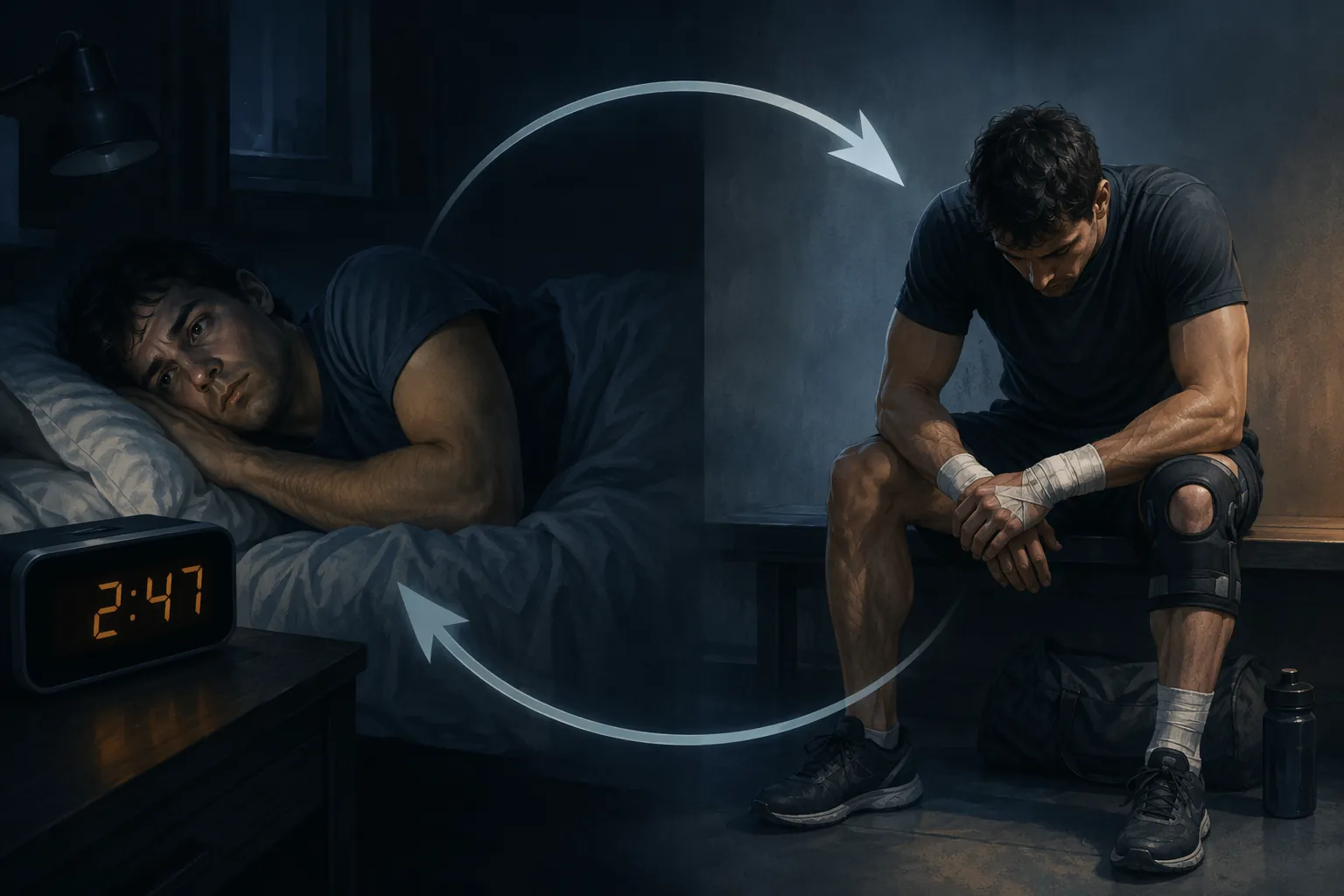
The Loop Starts Before the Limp
Injury risk rarely announces itself as neatly as "I slept six hours, therefore I strained a hamstring." More often, short sleep changes the quality of movement and recovery in ways that are easy to miss until the athlete is already compensating. A landing gets a little less organized. A cut is a fraction late. The athlete feels flat but pushes through because the session is important. Nobody wants to pull a player for being tired, and that is reasonable; competitive sport cannot be run like a nap-preservation project.
The problem is when short sleep becomes the background condition. Milewski's finding matters because it looked at adolescent athletes across a season-level reality, not a lab fantasy. The athletes sleeping under 8 hours were not simply less optimized; they were more likely to sustain musculoskeletal injuries.[1] That is the kind of evidence a coach or parent can actually use: if an athlete is chronically short on sleep, their injury risk profile has changed even if effort and toughness have not.
There are more dramatic estimates, but they deserve careful handling. A review reports that in a small study of male NCAA Division I basketball players, each additional hour of sleep was associated with a 43% lower risk of next-day injury.[2] That is a striking signal, not a universal exchange rate. It came from a small sample, and it should not be turned into a promise that one extra hour tonight cuts every athlete's risk by the same amount tomorrow. Still, it points in the same practical direction: sleep duration is connected to what happens in the next training and competition window.
How a Short Night Becomes a Riskier Practice
The mechanism is not mystical. Poor sleep can make the same drill more expensive because the athlete brings a less prepared nervous system and a less favorable repair environment into the session. That matters most in the moments athletes do not get to slow down: landing after contact, reacting to a screen, decelerating from a sprint, or changing direction when the planned movement suddenly becomes the wrong movement.
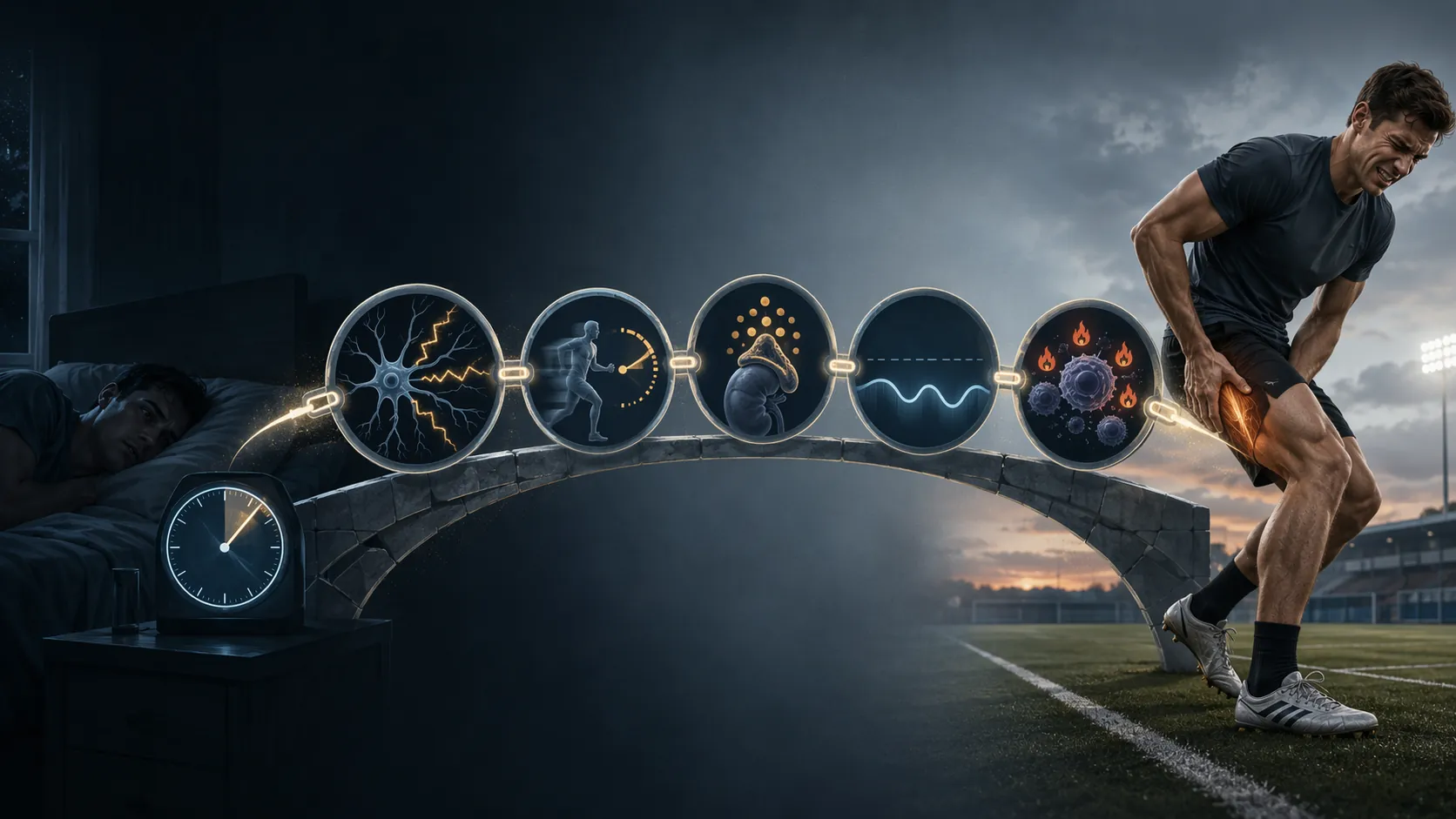
Start with neuromuscular control. Good movement is not just strength; it is timing, coordination, joint position sense, and the ability to correct quickly when the body is slightly out of line. When sleep is restricted, reaction time and coordination can suffer. For an athlete, that can show up as a late brace, a sloppy plant foot, or a landing that the hip and trunk fail to control. The athlete may still look tough and engaged. The risk is that the margin for error has narrowed.
Then there is the hormonal side. Sleep deprivation is associated with elevated cortisol and reduced growth hormone secretion, changes that work against muscle repair and tissue regeneration.[2] Cortisol is not a villain; athletes need stress hormones to train and compete. But if the recovery side of the equation is repeatedly shortened, the athlete may spend more time in a physiology that favors strain over rebuilding. Growth hormone release during deep non-REM sleep is one reason sleep is often discussed in tissue repair, including in related recovery questions such as sleep and bone healing.
Inflammation also belongs in the chain. Sleep deprivation has been linked with increases in inflammatory markers including IL-6 and CRP.[2] That does not mean inflammation is always bad; training creates stress, and repair involves an inflammatory response. The concern is poor timing and poor resolution. If the athlete keeps layering load onto a body that is sleeping too little, the recovery environment may be noisier and less efficient when tissues need repair.
| Sleep-related change | What it can mean in sport |
|---|---|
| Slower reaction time | Later response to contact, a loose ball, an opponent's cut, or an unexpected landing |
| Impaired neuromuscular control | Less precise joint positioning, poorer deceleration, or reduced coordination under fatigue |
| Elevated cortisol | More physiological stress during a period when the athlete also needs repair |
| Reduced growth hormone secretion | Less favorable conditions for muscle and tissue regeneration |
| Higher IL-6 and CRP | A more inflammatory recovery environment after training or injury |
This is why sleep belongs next to training load, soreness, pain, and mood when coaches are deciding how aggressively to push. It is not a reason to bubble-wrap athletes. It is a reason to notice when an athlete is stacking hard sessions on top of repeated short nights and then asking the same joints, tendons, and muscles to solve high-speed problems.
Injury Pushes Back Into Sleep
The other half of the loop is just as important: injury itself can disturb sleep. The athlete with a wrapped ankle or irritated tendon is not only managing pain at practice. They are trying to find a position that does not throb at night, waking when medication wears off, losing the normal fatigue pattern that came from training, or lying awake worried about losing their spot.
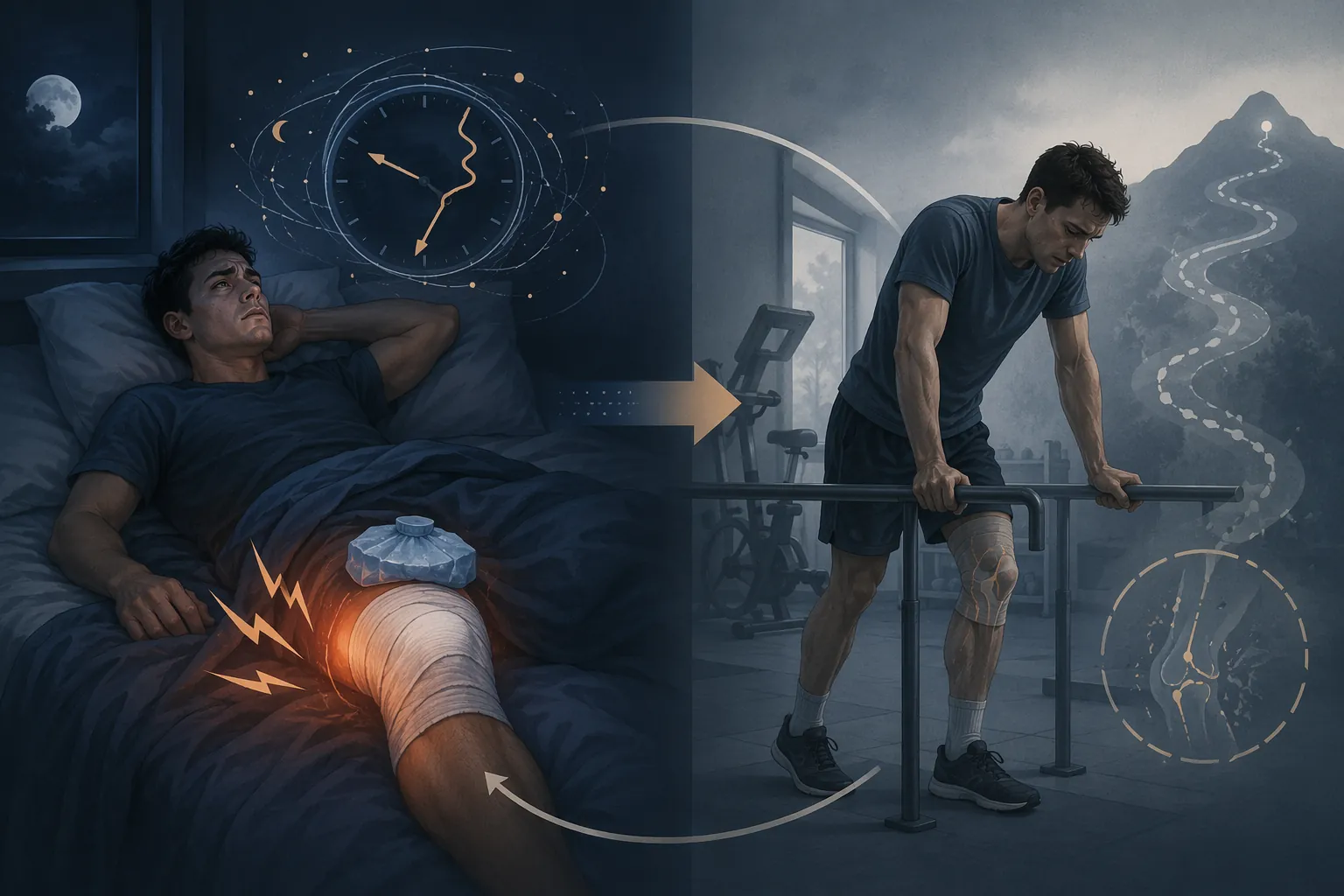
Pain is not a side note here. In a 2021 study of 338 athletes, 50% reported pain, and the authors describe a bidirectional relationship between pain and sleep.[3] That matches what many injured athletes experience: pain makes it harder to fall asleep or stay asleep, and poor sleep can make pain feel louder the next day. By morning, the athlete may not just be tired. They may be more pain-sensitive, less patient with rehab, and less ready to absorb the work that is supposed to bring them back.
Inflammation helps explain why this can feel bigger than the injured structure itself. Injury triggers inflammatory activity as part of the repair process, while sleep disruption is also associated with inflammatory changes such as IL-6 and CRP.[2] When pain keeps waking the athlete and poor sleep worsens the body's recovery conditions, rehab begins from a disadvantage. The plan may be appropriate, the athlete may be compliant, and the tissue may still be trying to heal in a system that is under-recovered.
Forced inactivity can add another layer. A healthy training routine gives the day structure: morning lift, afternoon practice, evening fatigue, predictable meals, predictable sleep pressure. After injury, that rhythm can collapse. The athlete may train less, spend more time sitting, nap irregularly, or lose exposure to the normal cues that helped anchor sleep. That circadian disruption does not need to be dramatic to matter; it only has to make nights less consolidated while the body is trying to repair.
What Coaches and Athletes Should Not Overclaim
The evidence is strong enough to treat sustained poor sleep as meaningful, but not clean enough to pretend sleep alone explains injury. Athletes get hurt because of contact, workload spikes, previous injury, strength deficits, technique, equipment, surfaces, growth, stress, and luck. Sleep threads through that list by changing readiness and repair. It does not replace the list.
Measurement also matters. Many sports sleep studies rely on self-reported sleep, including questionnaires and diaries. Those tools can be useful, but they can overestimate total sleep time compared with actigraphy or polysomnography. So an 8-hour threshold should not be treated as a perfect biological border. It is better used as a practical flag: if an athlete is regularly under that range, or says they are in bed for 8 hours but wakes repeatedly, ask more questions.
Context can also limit how far a finding travels. Hamlin and colleagues reported that athletes sleeping at least 8 hours had 20% lower odds of injury or illness, while higher sleep quality was associated with 40% lower odds.[4] That supports the broader pattern, but the study occurred during COVID-19 lockdown conditions in New Zealand, which the authors noted as a possible confound.[4] Lockdown sleep, training, stress, exposure, and illness patterns were not normal sport life.
Concussion deserves its own lane. Sleep after concussion can be crucial, and it can also be complicated in ways that do not map neatly onto hamstring strains, tendon pain, or general musculoskeletal recovery. For that specific question, see the concussion-focused guides on sleep and concussion recovery, when more sleep is not always better after concussion, and the concussion recovery sleep guide. This article is staying with the broader injury-sleep loop.
The Practical Risk Signal
The most useful question is not whether sleep or injury always comes first. In a season, the order can change. A tired athlete may get hurt; a hurt athlete may sleep badly; a rehabbing athlete may return to practice with pain, poor sleep, and a nervous system that is still not sharp. The better question is whether the current sleep pattern is feeding the next problem.
For coaches, that means repeated short sleep belongs in the same conversation as soreness, workload spikes, and previous injury. For athletes, it means bad sleep during rehab is not a character flaw or a minor inconvenience. Pain, inflammation, inactivity, and anxiety can all make sleep harder, and that sleep disruption can make the next day of recovery less efficient.
Sleep is not a guarantee against injury, and it is not a standalone treatment after injury. But sustained short sleep is a meaningful risk signal before injury and a meaningful recovery signal after injury. If an athlete is sleeping poorly for more than a brief stretch, especially while training hard or rehabbing, the sleep pattern is part of the injury picture.
References
- Chronic lack of sleep is associated with increased sports injuries in adolescent athletes, PubMed, 2014.
- Sleep and Athletic Performance: Impacts on Physical Performance, Mental Performance, Injury Risk and Recovery, and Mental Health, PMC.
- Sleep and pain in athletes, PMC, 2021.
- The Effect of Sleep Quality and Quantity on Athlete's Health and Perceived Training Quality, Frontiers in Sports and Active Living, 2021.
Explore the mechanism
Next step
Spot an error or have clinical feedback?
Because this article covers clinical, medication, or safety information, we use a moderated correction channel instead of open public comments. Let us know if something about “How Poor Sleep Fuels Athletic Injuries and Injuries Disrupt Sleep” needs a closer look.
Send feedback on this article