
If you are awake at 3 a.m. with a cast propped on pillows, the phrase “get plenty of rest” can start to sound suspiciously vague. Rest could mean keeping weight off the limb. It could mean taking pain medicine before the pain spikes. It could mean sleeping more, or sleeping at the same time each night, or simply not pushing activity too soon.
The narrow answer is this: sleep helps broken bone recovery in biologically plausible, measurable ways, especially through growth hormone release during deep non-REM sleep, circadian regulation inside bone cells, and lower exposure to catabolic stress signals such as cortisol. The stronger claim—that improving sleep in a person with a fracture has been proven in a human randomized trial to shorten healing time—is not yet supported. The evidence is mechanistic, not a stopwatch on human fracture union.
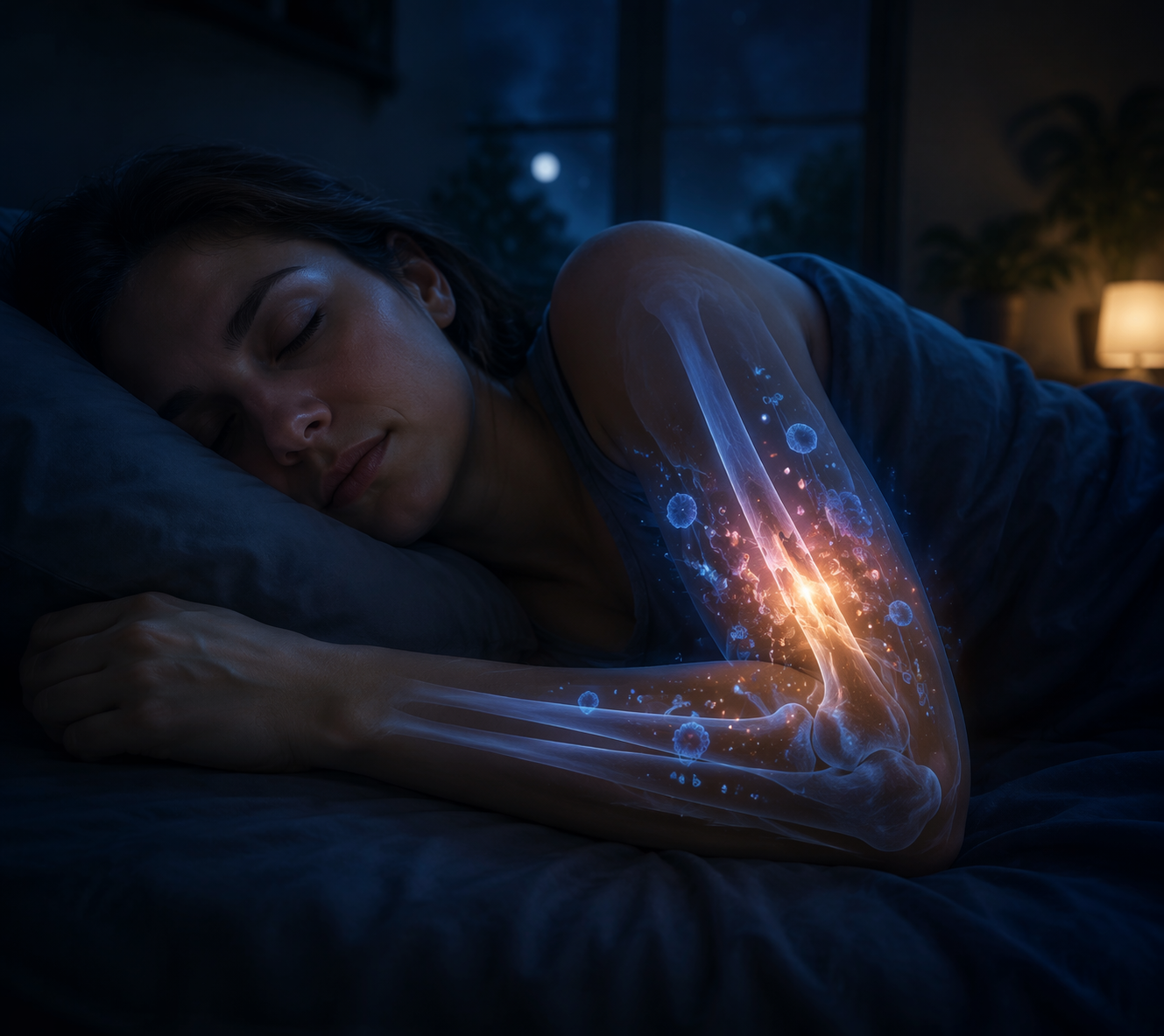
Bone repair does not go idle at night
A healing fracture is busy tissue. Cells have to clear damage, build cartilage and collagen scaffolding, mineralize new bone, and remodel that early repair into stronger structure. Sleep matters because several signals that govern those tasks are rhythmic rather than constant.
The most useful human evidence comes from bone turnover markers, not from fracture X-rays. These markers do not show a broken radius knitting closed, but they do show whether the body is leaning toward bone formation or bone breakdown under controlled sleep and circadian conditions.
In a forced-desynchrony protocol reported by Swanson and colleagues, cumulative sleep restriction combined with circadian disruption reduced P1NP, a marker of bone formation, by 21.4 mcg/L in young men and 9.5 mcg/L in young women. In young women, the same protocol also increased CTX, a marker of bone resorption, by 0.182 ng/mL—a pattern the authors described as a “double hit” of lower formation and higher resorption.[1]
P1NP and CTX are not household terms, but they are clinically meaningful. P1NP reflects type I collagen formation, which matters because collagen is a major scaffold for bone. CTX reflects collagen breakdown during resorption. A fracture needs both cleanup and rebuilding, but a recovery environment tilted away from formation is not what anyone wants when new bone has to be laid down.
That study does not prove that a person’s tibia heals a specific number of days faster after better sleep. It does something more modest and, in some ways, cleaner: it shows in humans that sleep and circadian disruption can move measurable bone metabolism in the wrong direction.
The first pathway: deep sleep and growth hormone
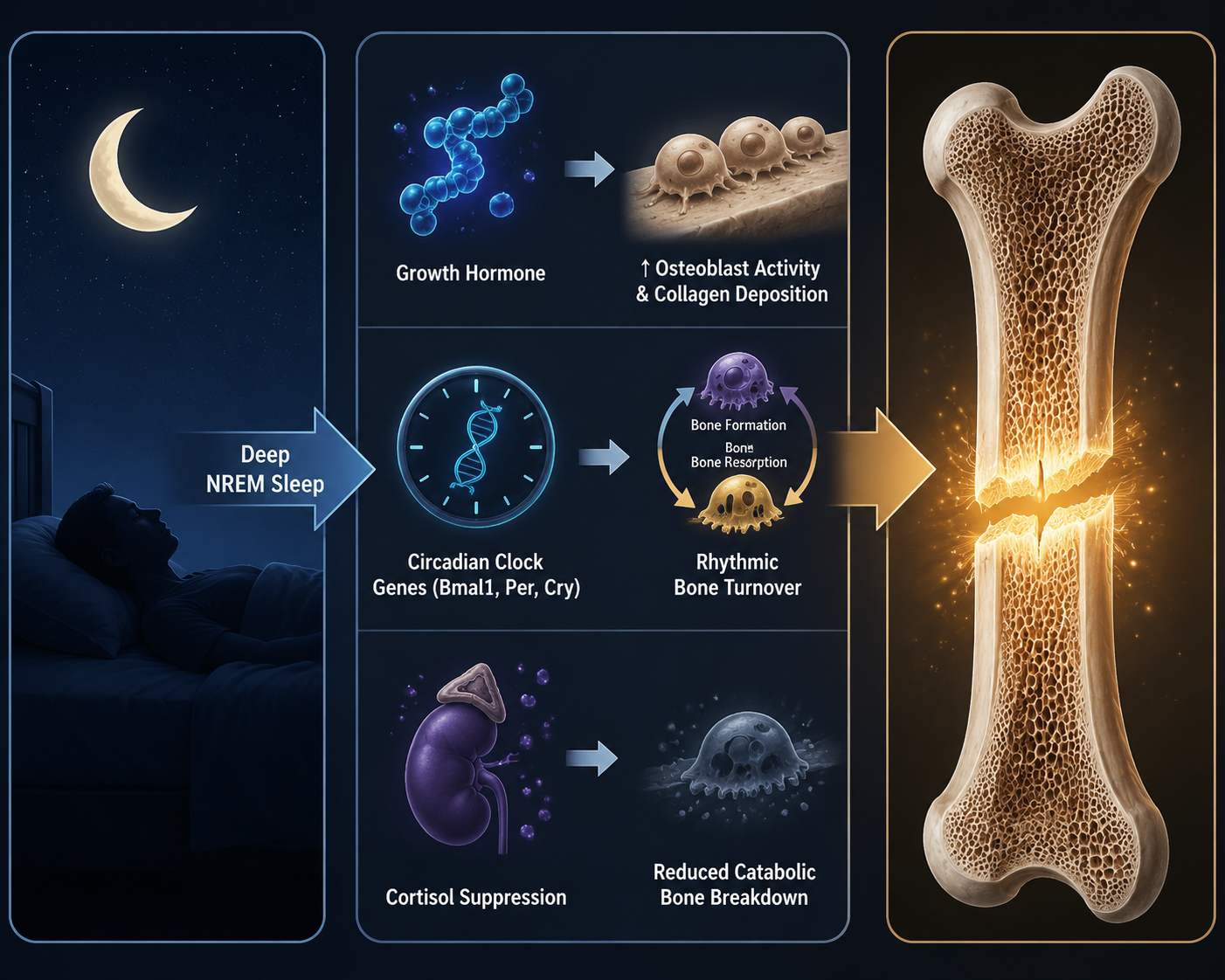
Growth hormone is one reason sleep is not just passive downtime. Pulses of growth hormone are closely tied to deep non-REM sleep, the stage often called slow-wave sleep. In bone repair, growth hormone helps stimulate osteoblast activity and supports collagen synthesis, both central to building the matrix that later mineralizes.
A 2025 UC Berkeley mouse study gave this pathway a more detailed starting point. Researchers identified a neural circuit involving growth-hormone-releasing hormone neurons in the hypothalamus, somatostatin neurons, and the locus coeruleus that links deep non-REM sleep to growth hormone release.[2]
The restraint matters. This was mouse work, not a human fracture-healing trial. It does not show that a person who sleeps better this week will close a fracture gap faster on imaging. What it does show is a plausible neural route from deep sleep to a hormone already known to participate in tissue growth and bone-building biology.
That also explains why “sleep more” is an imprecise instruction. A long night fragmented by pain, alarms, itching under a cast, or poorly timed medication may not deliver the same deep-sleep continuity as a shorter but more consolidated night. For readers interested in the immune side of slow-wave sleep and related hormones, the site’s guide to how sleep boosts the immune system covers a neighboring repair pathway.
The second pathway: bone cells keep time
Circadian rhythm is not just a brain clock telling you when to feel sleepy. Bone cells themselves express clock genes, including Bmal1, Per, and Cry, in osteoblasts, osteoclasts, and osteocytes. In mouse models, Bmal1 knockout is associated with low bone mass and increased osteoclast formation.[3]
That matters because fracture healing depends on coordination. Osteoblasts build bone. Osteoclasts resorb bone. Osteocytes help sense and regulate the tissue environment. A timing system inside those cells gives bone turnover a daily pattern rather than a flat, uniform pace.
Constant-routine studies, which reduce the confounding effects of ordinary behavior, have found that bone turnover markers retain endogenous circadian rhythms. CTX and P1NP continue to vary by biological time, with CTX peaking around 4–5 a.m.[4]
This is the reason regular timing deserves more respect than it usually gets in fracture recovery advice. It is not only that late nights make people tired. Misalignment between sleep timing, light exposure, meals, and internal clocks may disturb the timing of bone formation and resorption signals.
Population data point in the same direction, though they cannot prove causation. In the Nurses’ Health Study, postmenopausal women with 20 or more years of rotating night shift work had a 37% higher risk of hip and wrist fractures, with a 95% confidence interval from 4% to 80%.[5]
That finding is about fracture risk, not fracture healing. It also involves long-term occupational exposure in a specific population. It should not be used to frighten someone who had several bad nights after surgery. Its value here is narrower: it supports the broader idea that chronic circadian disruption and bone health are connected.
The third pathway: sleep lowers catabolic pressure
Cortisol is useful in the right amount and the right timing. It helps mobilize energy and respond to stress. But chronically elevated or poorly timed catabolic signaling is not friendly to tissue building. During healthy sleep, cortisol is normally restrained for part of the night before rising toward morning.
For a person recovering from a fracture, this pathway is easy to overlook because the stressor is obvious: pain, dependence on others, interrupted routines, and fear of delayed healing. The injury itself can disturb sleep, and disturbed sleep can plausibly worsen the internal environment needed for repair. That loop is not a character flaw. It is physiology colliding with a cast, a surgical incision, or a throbbing limb.
This is also where generic wellness advice can become careless. Telling someone in acute pain to “just sleep” ignores the fact that pain control, medication timing, safe positioning, and anxiety all affect sleep architecture. The biological case for sleep is strong enough that clinicians should be specific about how to protect it, not vague enough that patients should blame themselves for every broken night.
Animal fracture studies show what severe sleep loss can do
Animal fracture models add a more visual kind of evidence. In work discussed by the Medical College of Wisconsin, sleep-restricted rats showed a nearly complete absence of active intramembranous ossification sites, and their bone density averaged nearly three standard deviations below controls.[6]
Intramembranous ossification is one way new bone forms directly, without first making a cartilage template. Seeing those active sites nearly absent in sleep-restricted animals is not a subtle wellness signal; it suggests that severe sleep disruption can change the repair landscape itself.
Still, rats are not adult humans managing a wrist fracture, a repaired ankle, or a pinned hip. Animal models can reveal mechanisms with clarity that human trials often cannot, but they do not provide a recovery calendar for patients. The right conclusion is not “one bad night ruins your callus.” It is that sleep loss can interfere with bone-building biology strongly enough to deserve attention during recovery.
What the evidence can—and cannot—say
| Evidence level | What it shows | What it cannot prove |
|---|---|---|
| Human bone turnover marker studies | Sleep and circadian disruption can suppress bone formation markers and, in some groups, increase resorption markers. | They do not directly measure fracture union time. |
| Growth hormone sleep circuitry | Deep non-REM sleep can trigger hormonal pathways relevant to tissue growth and bone formation. | The 2025 circuit evidence is from mice, not a human fracture intervention. |
| Bone-cell clock research | Osteoblasts, osteoclasts, and osteocytes have clock-gene machinery that regulates turnover rhythms. | It does not show exactly how much regular sleep changes healing speed in a specific patient. |
| Animal fracture models | Severe sleep restriction can visibly impair bone repair processes. | Rat fracture repair cannot be converted into a human recovery timeline. |
| Shift-work epidemiology | Long-term circadian disruption is associated with higher fracture risk in some populations. | It does not prove that short-term sleep disruption after a fracture delays union. |
The most defensible judgment is that sleep likely supports, and may accelerate, fracture repair through converging biological pathways. Deep sleep helps coordinate growth hormone release. Circadian timing shapes bone turnover. Better sleep may reduce catabolic stress exposure. Human marker data, animal fracture work, and circadian biology all point in the same direction.
The missing piece is a direct human randomized controlled trial that improves sleep during fracture recovery and measures healing time as the primary endpoint. Without that, any claim that sleep will make a fracture heal a set number of days or weeks faster is more precise than the evidence allows.
What to do with that answer while you are healing
The practical conclusion is calibrated, not dramatic. Prioritizing sleep during broken bone recovery is biologically sensible. It is especially reasonable to protect deep sleep and regular sleep timing when pain, immobilization, and stress are already pulling in the other direction.
That does not mean a bad night has undone the work of healing. Bone repair is resilient and distributed across days, weeks, cells, hormones, loading conditions, nutrition, and medical stabilization. Sleep is one repair environment, not a magic cast.
If you want practical steps after the science, use an evidence-ranked sleep guide rather than chasing fracture-specific sleep hacks; the site’s tiered sleep tips guide is the better place for that. During fracture recovery, the useful mindset is simple: protect sleep where you can, get help when pain is repeatedly breaking it apart, and do not turn every restless night into evidence that your bone has stopped healing.
References
- Bone Turnover Markers After Sleep Restriction and Circadian Disruption: A Mechanism for Sleep-Related Bone Loss in Humans, Journal of Clinical Endocrinology & Metabolism, 2017
- Sleep strengthens muscle and bone by boosting growth hormone levels; UC Berkeley researchers discover how, UC Berkeley News, 2025-09-08
- Does our internal clock influence bone healing?, Charité 3R
- The Circadian Timing System Contributes to the Sex Difference in Serum Bone Turnover Markers, Journal of Bone and Mineral Research, 2019
- Nightshift work and fracture risk: the Nurses’ Health Study, Osteoporosis International, 2009
- Insights into Sleep Deprivation: Exploring its Effects on Cells and Bone Health, Medical College of Wisconsin
Comments
Join the discussion with an anonymous comment.