
Why caffeine disrupts sleep more in perimenopause
Caffeine and estrogen are cleared by the same liver enzyme, and perimenopause combines shifting hormones, slower clearance, and lighter, hot-flash-fragile sleep. That combination is why the same coffee that felt harmless at 35 can now linger and disrupt sleep — and why timing and dose, not willpower, are the levers that matter.
The unnerving part of caffeine and sleep in perimenopause is often how ordinary the dose looks. Same morning coffee. Same green tea. Same “small” afternoon cup that used to disappear from your body by bedtime. Then suddenly it has a tail: a wired feeling at 10 p.m., a 3 a.m. wake-up, a night sweat that turns into an hour of staring at the ceiling.
That does not mean you became fragile, dramatic, or bad at moderation. It means the body handling the caffeine may no longer be the same body that handled it at 35.

The question is not whether caffeine changed
Caffeine is still caffeine. It blocks adenosine, one of the chemical signals that helps sleep pressure build across the day. The more useful question is what changed around it: liver clearance, hormone patterns, age, sleep depth, temperature regulation, and the threshold at which a small arousal becomes a full wake-up.
Most caffeine is metabolized through the liver enzyme CYP1A2. The Sleep Foundation describes CYP1A2 as responsible for more than 90% of caffeine metabolism, and places caffeine’s half-life roughly between 2 and 12 hours depending on individual factors; UCLA Health also notes that caffeine sensitivity can grow with age as metabolism changes.[1][2]
That range matters. A half-life is not the time it takes caffeine to vanish. It is the time it takes your body to clear about half of it. If your half-life is closer to the short end, a noon coffee may feel like ancient history by bedtime. If it is closer to the long end, the same drink may still be biologically relevant when you are trying to fall asleep.
Perimenopause is exactly the kind of life stage where “same dose, different effect” deserves a real explanation. Not a scolding. Not a cartoon rule about becoming caffeine-free overnight. A mechanism.
Caffeine and estrogen share liver traffic
The most interesting clue is that caffeine metabolism and estrogen are not separate stories. They overlap at CYP1A2. That does not prove every perimenopausal woman clears caffeine more slowly every day, but it gives us a concrete pathway for why caffeine can start behaving less predictably when reproductive hormones are changing.
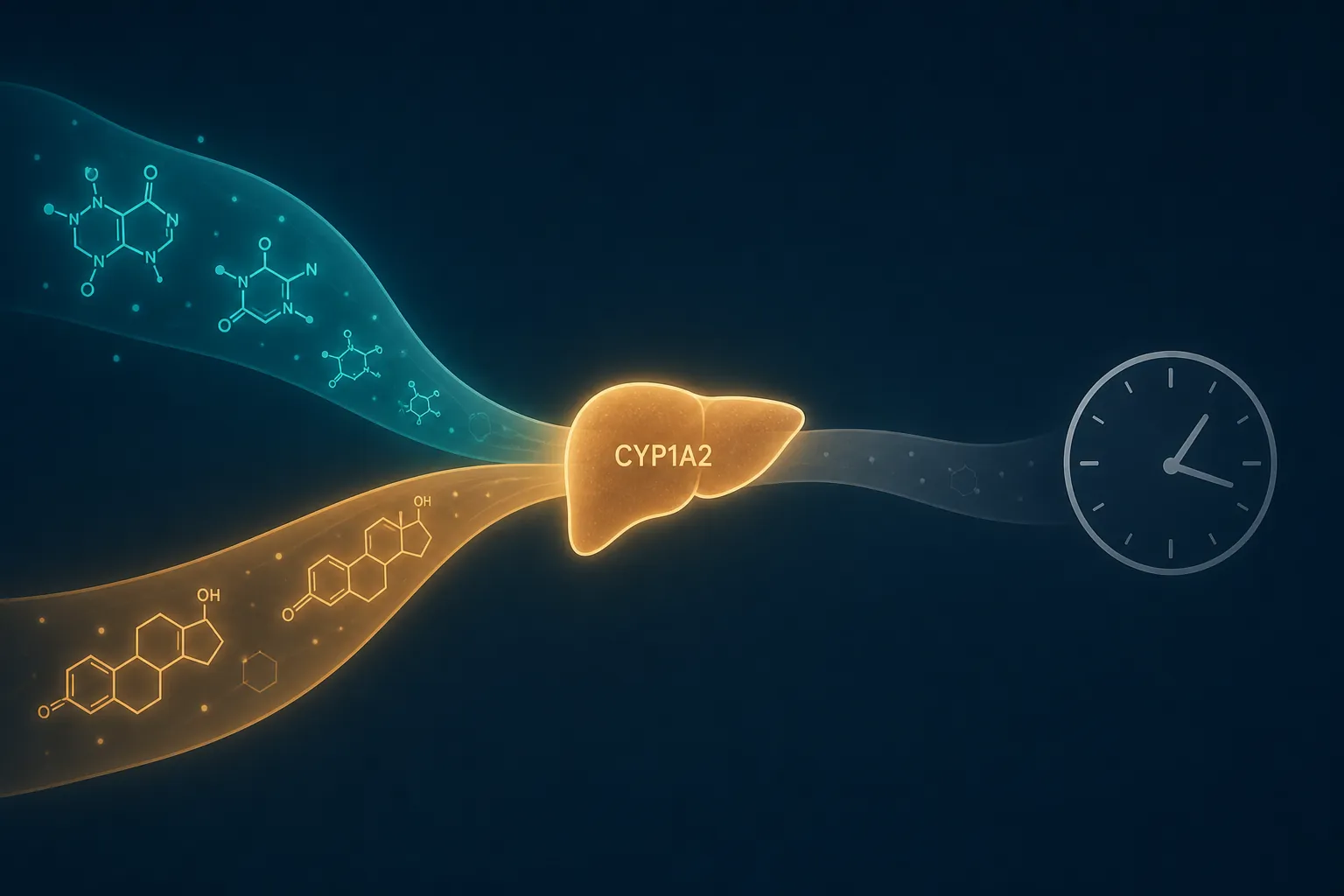
The strongest evidence here does not come from perimenopause itself. It comes from studies where estrogen exposure was changed more clearly: oral contraceptives and estrogen replacement therapy.
In a 1980 pharmacokinetic study, women taking oral contraceptive steroids had impaired caffeine elimination: the reported caffeine half-life was about 10.7 hours in oral contraceptive users versus 6.2 hours in non-users.[3] In a 1999 study of postmenopausal women, estrogen replacement therapy measurably inhibited CYP1A2-mediated caffeine metabolism.[4]
Those are not vague wellness observations. They are metabolism studies. They show that estrogen exposure can slow caffeine clearance through the same enzyme system. That is why the “I used to drink this and be fine” story is worth taking seriously.
Now the necessary caution: these studies do not directly test caffeine pharmacokinetics in perimenopause, with its messy endogenous hormone swings. Perimenopause is not the same as taking oral contraceptives, and it is not the same as postmenopausal estrogen therapy. The honest conclusion is narrower: estrogen can inhibit caffeine metabolism, caffeine clearance varies widely and may slow with age, and perimenopause puts estrogen patterns into flux. That combination makes a changed caffeine response plausible, not proven in every person.
| What the evidence directly shows | What it can support | What it does not prove |
|---|---|---|
| CYP1A2 handles most caffeine metabolism, and caffeine half-life varies widely.[1] | The same dose can linger very differently from one person to another. | A single universal caffeine cutoff time. |
| Oral contraceptive steroid users had a longer caffeine half-life than non-users.[3] | Estrogen exposure can slow caffeine elimination. | That all perimenopausal women always clear caffeine more slowly. |
| Estrogen replacement therapy inhibited CYP1A2-mediated caffeine metabolism in postmenopausal women.[4] | Hormone state can affect caffeine metabolism. | A direct perimenopause caffeine-clearance result. |
| Caffeine sensitivity may increase with age.[2] | Midlife can change the body’s caffeine response. | That age alone explains every new symptom. |
Perimenopause makes the same leftover caffeine more consequential
A little caffeine remaining at bedtime may not have bothered you in a sturdier sleep system. Perimenopause often changes the background conditions.
Progesterone, which has sleep-promoting effects, declines. Estrogen changes can destabilize temperature regulation. Midlife sleep difficulties are common: Stanford Lifestyle Medicine describes perimenopause sleep disruption in the context of declining progesterone, estrogen-related thermoregulation changes, and lighter, more fragmented sleep; SWAN reports that about 40% to 60% of women experience sleep problems during the menopausal transition.[5][6]
This is where caffeine stops being just a beverage and becomes a timing problem. Caffeine blocks adenosine’s sleep-pressure signal. If more caffeine is still active near bedtime, it can make it harder for the brain to slide into sleep and easier for small disturbances to register. Add a warmer sleep environment, a narrowed comfort zone, or a night sweat, and the wake-up has more ways to stick.
That does not require caffeine to be the original cause of every bad night. It only has to lower the margin for error. A bedroom that is a bit too warm, a stressful evening, alcohol, late exercise, or a hot flash may be easier to sleep through on one night and impossible on another. Lingering caffeine can be the difference between briefly surfacing and being fully awake.
If heat and night sweats are part of your pattern, the thermoregulation side is worth separating from the caffeine side. The site’s guide to sleep during a heat wave in perimenopause and the broader heat wave and hot flashes sleep guide go deeper into cooling strategies. For this question, the key point is simpler: caffeine may not need to create the hot flash to make the recovery from it harder.
The sleep loss can be hard to notice
One of the more irritating facts about caffeine is that you may not notice the full sleep cost accurately. In a 2013 study in the Journal of Clinical Sleep Medicine, caffeine taken 6 hours before bedtime reduced objectively measured total sleep time by more than an hour, even though participants did not reliably perceive that loss.[7]
That finding lands differently in perimenopause. If your sleep is already lighter, warmer, or more fragmented, you may not experience caffeine as obvious insomnia. You may experience it as “I slept, but it didn’t count,” or “I woke up at 3 and never got fully back,” or “my hot flashes were worse on the nights I had afternoon coffee.”
Objective sleep loss also helps explain why a person can insist, truthfully, that caffeine does not keep her awake — while still seeing better sleep when she moves the last cup earlier. Falling asleep is only one outcome. Total sleep time, awakenings, sleep depth, and next-day fatigue matter too.
What about hot flashes and night sweats?
The caffeine–hot flash evidence is not clean enough to declare caffeine a universal vasomotor trigger. It is useful enough to justify testing it in your own body.
A 2025 meta-analysis reported that hot flashes were associated with higher odds of sleep disorders in perimenopausal women, with an odds ratio of 2.70 and a 95% confidence interval of 1.81 to 4.02.[8] That does not make caffeine the cause. It shows why anything that increases arousal, heat sensitivity, or wakefulness can matter more when hot flashes are in the picture.
The Mayo Clinic study is similarly worth reading with care. In that observational study, caffeine users reported slightly more bothersome hot flashes and night sweats than non-users, with symptom scores of 2.30 versus 2.15, and the association remained statistically significant after adjustment. The same study also found that perimenopausal caffeine users reported fewer mood, memory, and concentration problems.[9]
So the reasonable conclusion is not “caffeine causes hot flashes in everyone.” It is this: if night sweats or hot flashes are already fragmenting sleep, caffeine is a legitimate personal trigger to test, especially timing and dose. For more on the temperature side of the pattern, the piece on whether cooler weather improves perimenopause sleep explains why small thermal changes can loom large at this stage.
The pattern to look for is a longer caffeine footprint
A longer caffeine footprint does not always announce itself as classic jitters. In perimenopause, it can look like several smaller changes adding up:
- A cup that used to feel calming now feels edgy or anxiety-like.
- Morning caffeine is still fine, but caffeine after lunch changes the night.
- You fall asleep, then wake in the early morning with a busy brain.
- Hot flashes or night sweats are easier to trigger, or harder to recover from.
- You technically slept, but the sleep feels thin, shallow, or unrefreshing.
None of those signs proves caffeine is the culprit. They are clues that caffeine’s timing may have drifted too close to your current sleep biology. That distinction matters because it gives you something practical to test without turning coffee into a character judgment.
Timing and dose are the useful levers
The mechanism points to a modest experiment, not an identity crisis. If caffeine has started disrupting sleep in perimenopause, the first levers are when the last caffeine lands and how much total caffeine your body has to clear.
A useful experiment is usually boring: move the last caffeinated drink earlier, reduce the afternoon dose, or swap the later drink for a lower-caffeine option. Hold the change long enough to see a pattern across several nights, because perimenopause sleep varies for reasons that have nothing to do with caffeine. If you are prone to caffeine withdrawal headaches, taper instead of quitting abruptly.
The point is not to find the morally correct caffeine rule. It is to find the dose and cutoff your current body can clear before bedtime. For some women, that may mean coffee remains a morning pleasure. For others, it may mean tea is fine but an afternoon espresso is not. For someone in a high-symptom stretch — night sweats, stress, short sleep, warmer weather — even the usual amount may temporarily become too much.
If you want the broader life-stage context, the perimenopause sleep hub collects related guides. The caffeine-specific takeaway is already clear enough: the same cup can hit differently because the system receiving it has changed. The direct perimenopause caffeine-clearance study still needs to be done, but the CYP1A2 estrogen evidence, age-related sensitivity, and fragile midlife sleep backdrop are enough to make timing and dose worth testing.
References
- Caffeine and Sleep Problems — Sleep Foundation
- Caffeine sensitivity grows as people age — UCLA Health
- Impaired elimination of caffeine by oral contraceptive steroids — PubMed, 1980
- Inhibition of caffeine metabolism by estrogen replacement therapy in postmenopausal women — PubMed, 1999
- How Perimenopause Affects Sleep — Stanford Lifestyle Medicine
- Effects of Sleep Problems During Menopause — SWAN
- Caffeine effects on sleep taken 0, 3, or 6 hours before going to bed — PubMed, 2013
- Association of vasomotor symptoms with sleep disorders in perimenopausal women: a systematic review and meta-analysis — Frontiers in Neurology, 2025
- The association between caffeine and menopausal symptoms — PubMed, 2014
Safety & eligibility read
Cross-check against other interventionsExplore the mechanism
Next step
Spot an error or have clinical feedback?
Because this article covers clinical, medication, or safety information, we use a moderated correction channel instead of open public comments. Let us know if something about “Why caffeine disrupts sleep more in perimenopause” needs a closer look.
Send feedback on this article