
Why scary movies keep you up at night during perimenopause
If you used to enjoy horror movies but now find them keeping you wired and awake, perimenopause is the likely reason. This article explains the hormonal and neurological changes that make your brain more reactive to fear, why your nervous system takes longer to recover, and what you can do about the resulting insomnia.
The strange part is usually not the movie itself. It is what happens after: the credits are over, the house is quiet, and your body is still acting as if something needs to be watched for. Your heart is a little too present. The hallway feels more noticeable than it should. You get into bed and discover that your mind has kept the soundtrack, the jump scare, the image you thought you had shrugged off. Maybe you used to love this. Maybe you still want to love it.
If scary movies are keeping you up at night in perimenopause, the most useful answer is not that you have become dramatic, weak, or mysteriously “more anxious.” A better explanation is that the same fear stimulus may now be landing in a different hormonal and neurological environment. Perimenopause can make the fear system more reactive and the recovery system slower, so a movie that once felt thrilling can now leave you wired long after the screen goes dark.
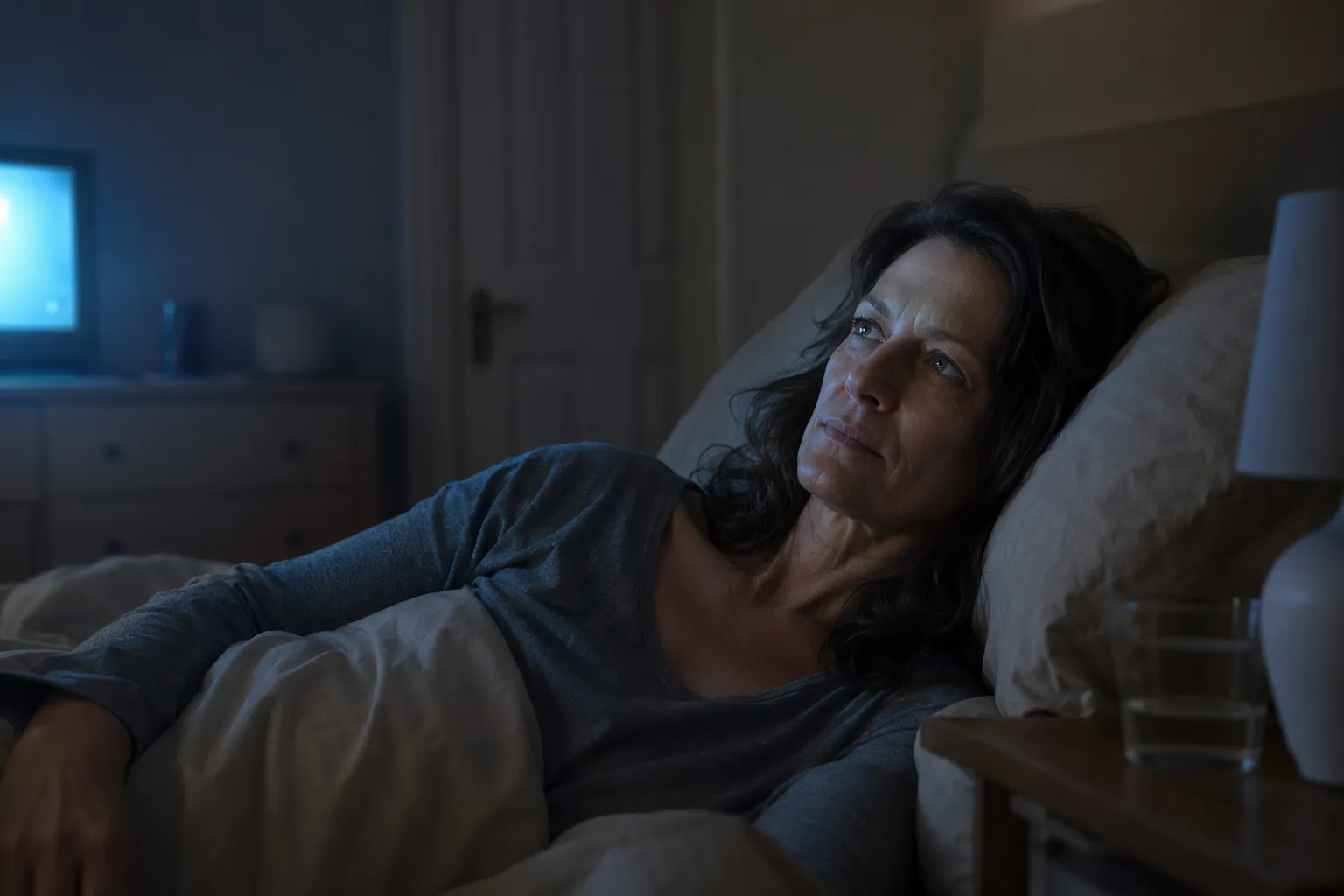
There is an important honesty line here: there does not appear to be a direct formal study of horror-movie tolerance during perimenopause. What we do have are two better-supported bodies of evidence. One shows that frightening media can activate real fear and stress physiology. The other shows that perimenopause changes the systems that regulate fear, cortisol, arousal, and sleep. Put together carefully, they explain why your reaction can feel new even when your taste has not changed.
A fictional threat can still produce a real body response
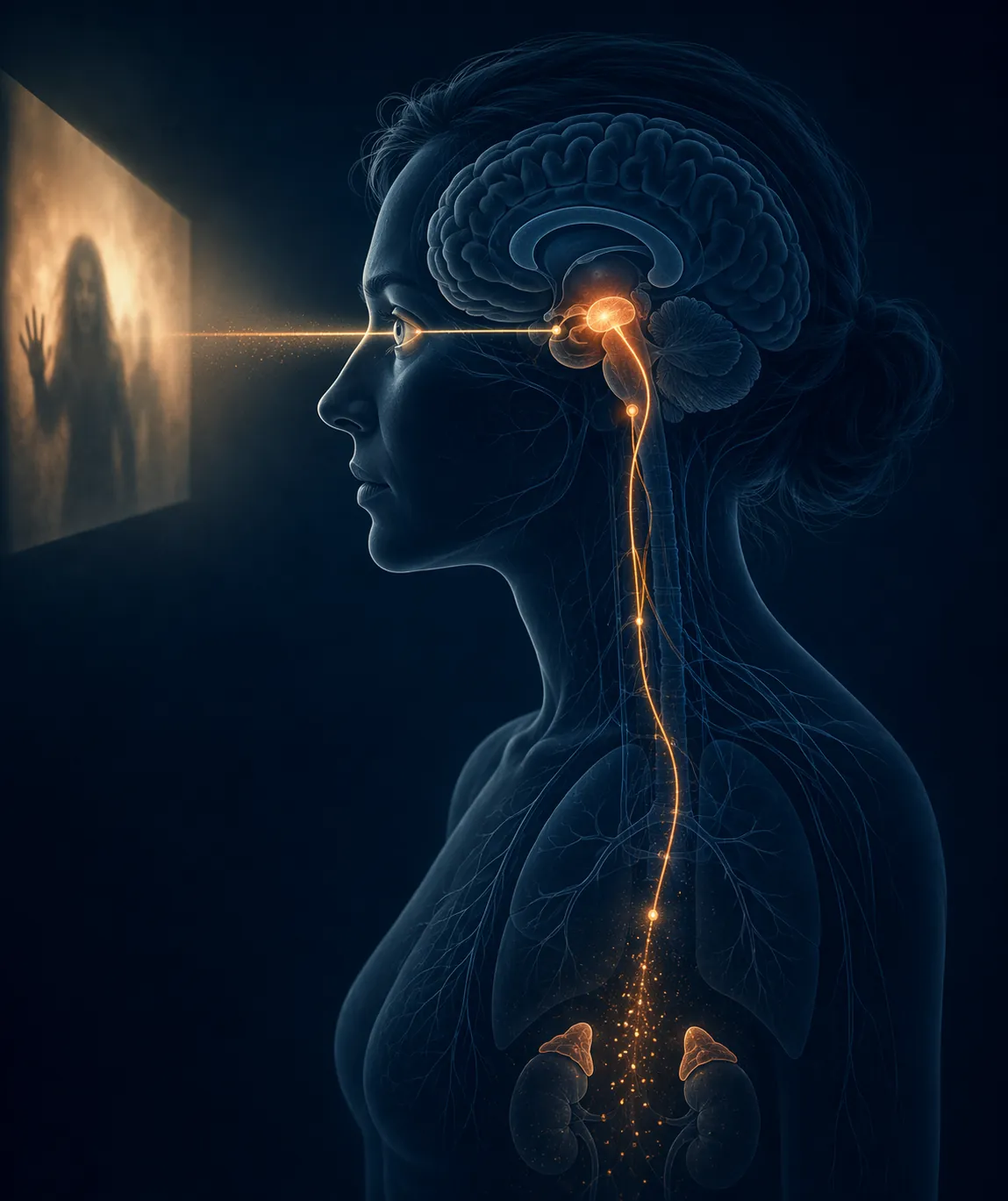
Horror works because the brain does not wait for a courtroom-level review of whether the danger is real. During frightening scenes, the amygdala helps detect threat, while the hippocampus contributes context and memory; together, they help the brain process fear even when the threat is coming from a screen rather than the room you are sitting in [1].
That is why a scary movie can feel silly to your thinking brain and still register in your body. Stress hormones rise. Adrenaline and cortisol are part of the response. Heart rate can spike during frightening content, and one source describing the general physiology of horror viewing notes a typical recovery window of about 20 to 30 minutes after the scare response is triggered [2].
For many people, that recovery window is enough. The nervous system gets the message: false alarm, story over, go back to baseline. The problem in perimenopause is not necessarily that the initial scare is abnormal. It is that baseline may be easier to disturb and harder to return to.
Why the same movie may hit harder now
Perimenopause is not just a reproductive transition. It is also a nervous-system transition. Estrogen and progesterone do not simply manage periods; they interact with brain regions and chemical systems involved in mood, fear, sleep, temperature regulation, and stress recovery.
The first mechanism is estrogen fluctuation. Johns Hopkins Medicine describes estrogen changes during perimenopause as one reason the amygdala, the brain region involved in fear and threat detection, can become more reactive; the same source notes that 40% to 60% of women experience sleep disruption during this transition [3]. That combination matters. A more reactive threat detector plus already-fragile sleep is not a small inconvenience when you add a fear stimulus at night.
This is the part many women recognize before they have language for it. The old version of you watched the tense scene, flinched, laughed, maybe slept fine. The current version watches the same kind of scene and feels as if the volume on threat detection has been turned up. The movie has not necessarily become scarier. The threshold for your body calling something “threat” may have shifted.
Progesterone adds a second layer. Stanford Lifestyle Medicine describes progesterone as having sedative effects and discusses its role in perimenopause-related sleep disruption [4]. When progesterone declines or becomes erratic, one of the brain’s familiar calming influences may be less available. That does not mean progesterone is the whole story, and it does not mean every woman will have the same symptoms. It does mean that the chemical background against which you process fear may be different than it was a few years ago.
Anxiety symptoms are also common enough in this phase that they should not be treated as a character flaw. Inflexxion Health cites research in which 58% of perimenopausal women reported anxiety symptoms, a figure best read as indicative rather than universal because it comes from a narrower study sample [5]. The point is not that every post-horror wake-up is an anxiety disorder. The point is that perimenopause can make anxiety-like body states more available: alertness, vigilance, racing thoughts, a sense that the system cannot quite power down.
The real sleep problem is often the recovery phase
The most frustrating part of post-movie insomnia is that the fear is often over before the arousal is. You may know the plot was fictional. You may even feel embarrassed that your body has not gotten the update. But sleep does not begin just because the rational mind has closed the case. Sleep requires a shift away from vigilance.
This is where the HPA axis becomes important. The hypothalamic-pituitary-adrenal axis helps coordinate the stress response, including cortisol rhythms. Denver Holistic Medicine describes perimenopause as a time when HPA-axis regulation can become destabilized, with a shift toward sympathetic dominance, elevated evening cortisol, and blunted morning cortisol patterns [6]. In plain terms: the body may be more likely to stay in “on” mode at exactly the time you need it to stand down.
Now add a horror movie. The movie supplies the trigger: threat imagery, suspense, sound spikes, anticipation, adrenaline, cortisol. A perimenopausal HPA axis may supply the longer tail: the stress response does not resolve as neatly, or it reappears later in the night when sleep is already lighter.
Progesterone’s decline can make that harder still. Truvaga describes the drop in progesterone as a loss of allopregnanolone’s GABAergic calming effect — in other words, less support for the brain’s braking system — and also notes that blood sugar dips may contribute to nocturnal cortisol release [7]. This does not prove that last night’s movie caused your 3 a.m. wake-up. It does explain why a nervous system already vulnerable to nighttime arousal may not treat an evening fear stimulus as a cleanly finished event.
General sleep commentary on scary movies often says that post-viewing stress and arousal can feed on themselves and that cortisol may remain elevated after watching frightening content [8]. That advice is not wrong, but it is incomplete for a perimenopausal reader. The issue is not merely “don’t watch scary things before bed.” It is that your evening cortisol rhythm, calming neurotransmitter support, temperature regulation, and startle threshold may all be less forgiving than they used to be.
Hot flashes can compound the same pattern. Inflexxion Health cites data indicating that 69% of hot flash events coincided with recorded awakenings [5]. If a horror movie leaves you physiologically activated, and then a hot flash wakes you during the night, your brain may re-enter wakefulness already primed for threat scanning. This is where women often describe being awake but not fully rationally afraid: the body is alert first, and the mind starts looking for reasons afterward.
That 3 a.m. feeling has cousins in other kinds of perimenopausal hyperarousal. The same nervous system that cannot settle after horror may also struggle after loss, health worry, smoke events, or other threat cues. If this is your pattern, it may help to read post-movie wakefulness alongside other threat-detection sleep problems, such as grief-related insomnia during perimenopause or sleep disrupted by wildfire anxiety and smoke. The triggers differ, but the sleep problem is often the same: the brain has decided the night is a time for monitoring.
Sound, suspense, and sensory load can matter more than gore
Some women find that they can still handle dark themes but not jump scares. Others can read a frightening plot but cannot tolerate the sound design of a horror film. That distinction makes sense. A movie is not just a story; it is light, sound, anticipation, facial expressions, silence, sudden movement, and the body’s prediction that something is about to happen.
ScienceWorks Health frames perimenopause as a neurological transition state and discusses lowered sensory-gating thresholds during this period [9]. That is a useful way to think about horror. If your sensory filter is less efficient, the creaking door, low-frequency score, flickering image, and sudden scream may not remain neatly categorized as entertainment. They become input your nervous system has to process and then recover from.
This is also why the issue can resemble other startle-based sleep problems. If storms suddenly feel harder to sleep through, the shared mechanism may be heightened sensory reactivity rather than a new lifelong fear of thunder. The same idea is explored in perimenopause thunderstorm sleep tips: the sound is real, but the disproportionate after-alertness often belongs to the nervous system state.
What helps without turning this into a lecture about bedtime discipline
You do not have to treat yourself like a fragile object. You do need to stop pretending the timing and format are neutral. If the biology is arousal plus slower recovery, the practical levers are when you watch, how much sensory load you take in, and what you do when wakefulness has already started.
- Move intense content earlier. If you want to keep horror in your life, try watching it in the afternoon or early evening rather than close to bed. The goal is not avoidance; it is giving your cortisol, adrenaline, and startle systems more time to come down.
- Separate “scary” from “high-arousal.” A quiet gothic story, a familiar rewatch, or a supernatural drama may land differently than a jump-scare-heavy film with aggressive sound design. Your nervous system may be reacting less to genre and more to intensity.
- Build a real decompression buffer. Ten minutes of scrolling may not be a buffer if it keeps your brain visually and emotionally activated. A better buffer is boring, predictable, and low-stakes: dim light, a warm shower, folding laundry, slow breathing, or a familiar audiobook.
- Do not test yourself with the worst option. If you already know that true crime, home-invasion plots, or body horror keep replaying at night, that is useful data. You are allowed to adjust based on the pattern instead of proving you can endure it.
- Treat a 3 a.m. wake-up as a vulnerable window, not a verdict. If you wake hot, alert, or uneasy, the task is to reduce stimulation and stop feeding the monitoring loop. This is not the hour to analyze your personality.
If you are awake long enough that the bed starts to feel like a place where you practice being alert, use a CBT-I-informed response. Let’s Talk Menopause cites Dr. Sara Nowakowski on CBT-I and the 15-to-20-minute rule for wake bouts: if you cannot sleep after roughly that window, get out of bed and do something quiet and low-light until sleepiness returns [10]. The point is not to punish yourself for being awake. It is to keep your brain from pairing bed with threat rehearsal.
For a broader menu of options, including which perimenopause insomnia treatments have stronger evidence behind them, see perimenopause insomnia treatments ranked by evidence. If insomnia becomes persistent enough that you are considering medication or supplements, the comparison of suvorexant and melatonin for insomnia can help you frame that conversation more clearly.
When to take the symptom beyond the movie
Occasional post-movie insomnia is different from a sleep problem that is taking over your week. It is reasonable to change the timing or intensity of what you watch and see whether your sleep settles. It is also reasonable to feel some grief about losing an easy pleasure, especially one that used to be harmless fun.
But if you are having persistent anxiety, frequent panic symptoms, severe insomnia, worsening depression, traumatic intrusive images, or sleep disruption that continues even when you avoid obvious triggers, it is worth bringing the pattern to a clinician. The same is true if you snore heavily, wake choking or gasping, have significant daytime sleepiness, or suspect sleep apnea. Perimenopause can explain a lot, but it should not become a container where every symptom gets quietly stored.
If scary movies now keep you up, the most accurate interpretation may be simple: the stimulus did not change, but the system receiving it did. A more reactive amygdala, a less stable stress axis, and less progesterone-linked calming support can turn entertainment into prolonged hyperarousal. That is not irrationality. It is a nervous system asking for different conditions than it used to need.
References
- Why Horror Movies Feel So Real to Your Brain — Houston Methodist.
- Scary Movies: How Fear Hits Your Gut and Heart — Nuvance Health.
- Perimenopause and Anxiety — Johns Hopkins Medicine.
- How Perimenopause Affects Sleep — Stanford Lifestyle Medicine.
- Perimenopause Anxiety — Inflexxion Health.
- Why Perimenopause Affects Your Nervous System — Denver Holistic Medicine.
- Why Menopause Makes Your Mind Race at Night — Truvaga.
- Why You Can't Sleep After Watching Scary Movies — Saatva.
- Perimenopause Sensory Overload — ScienceWorks Health.
- Insomnia — Let's Talk Menopause.
Explore the mechanism
Next step
Spot an error or have clinical feedback?
Because this article covers clinical, medication, or safety information, we use a moderated correction channel instead of open public comments. Let us know if something about “Why scary movies keep you up at night during perimenopause” needs a closer look.
Send feedback on this article