
It is the quiet nights that can feel unreasonable. No rain on the roof. No feeder bands on radar. Maybe not even a named storm in the Atlantic. Still, the phone gets checked one more time before sleep, then again after the 11 p.m. advisory, then again because a model run appeared in a social feed and somebody in the comments used the word “trend.”
That is the particular shape of hurricane season forecast sleep anxiety: the body starts preparing for impact before the weather has arrived. The mind may know the difference between an outlook, a tropical wave, a cone, a watch, and a warning. The nervous system may not treat those distinctions so politely, especially if it has learned from past seasons that a forecast can be the first step in several days of decisions, noise, waiting, evacuation math, or cleanup.
This does not mean every forecast check is a problem. In hurricane country, paying attention is part of being a responsible adult. The problem begins when monitoring stops being a preparedness behavior and becomes a bedtime threat rehearsal: checking to feel safer, getting a jolt of uncertainty, delaying sleep, waking more easily, and returning the next day to the same maps with a more sensitive brain.
Why a Forecast Can Feel Like a Threat
Weather anxiety is often treated as if it were ordinary overthinking with a coastal accent. That misses something important. A hurricane forecast is not just a thought. It is a sensory and civic cue: alert tones, color-coded maps, county briefings, school closure rumors, gas lines remembered from another year, the sound of wind in the attic, the knowledge that decisions may soon have consequences.
UAB Medicine describes storm anxiety through the brain systems that decide what deserves attention. Psychiatrist Dr. Merida Grant explains that the salience network, including the insula and frontal cortex, helps detect and prioritize potential threats; the amygdala and hippocampus can become persistently sensitive when someone has lived through a frightening weather event; and warning sounds can become conditioned fear triggers rather than neutral information [1].
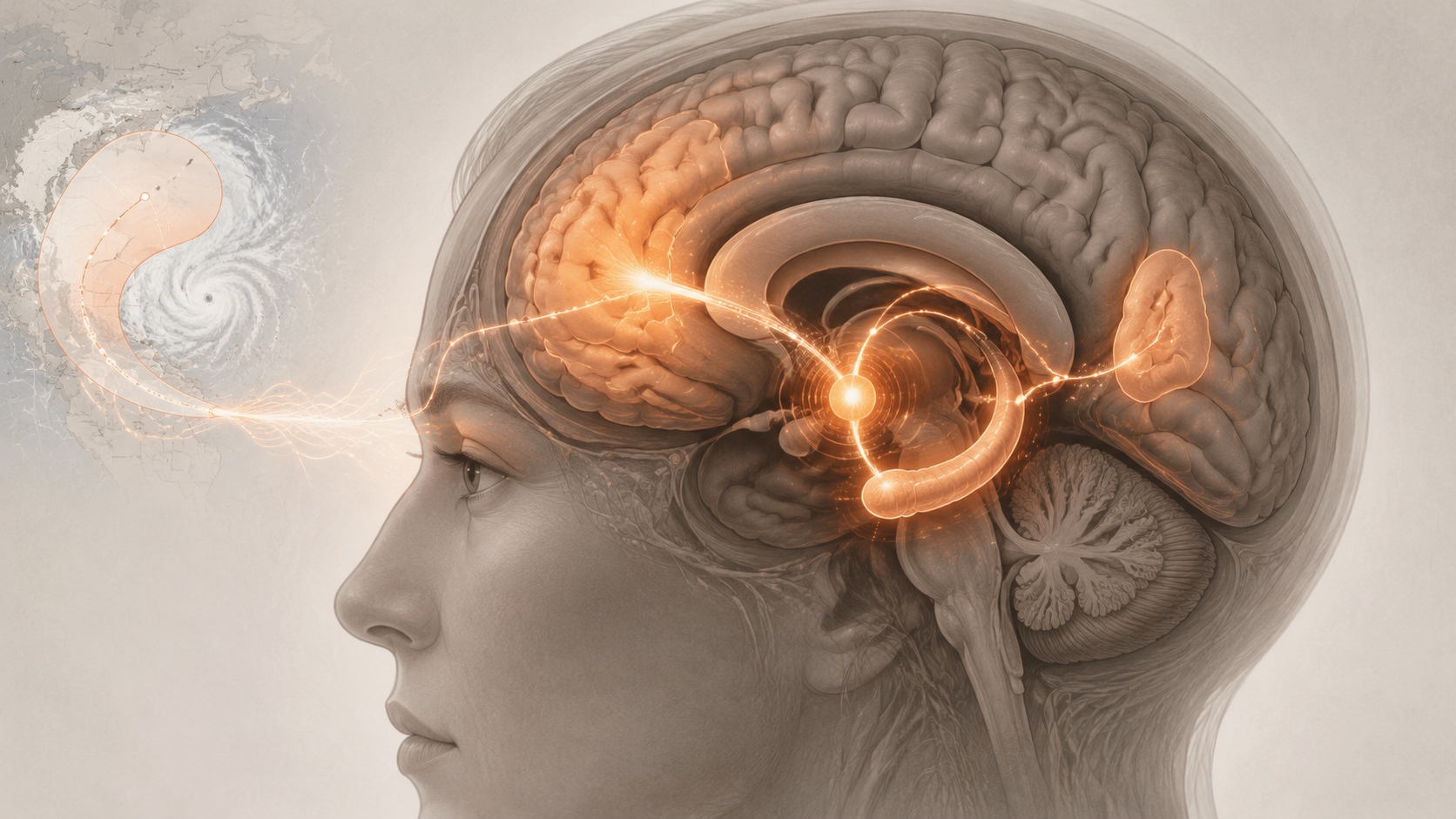
That mechanism matters because sleep onset asks the brain to do almost the opposite. To fall asleep, the body has to downshift: temperature, muscle tone, alertness, and threat scanning all need room to drop. A forecast cue can move the system in the other direction. The chest tightens a little. The jaw sets. The next check feels necessary. The bed becomes a place where the brain tries to solve an unsolved weather problem.
The cue does not have to be dramatic. A familiar alert tone can be enough. So can a spaghetti model image, a local meteorologist's “worth watching,” or the first seasonal outlook that makes June feel like the start of a long watch. For people with prior evacuation, property damage, insurance disputes, roof leaks, flooding, or long power outages in memory, the forecast is not abstract. It is a signal with history attached.
There is a useful parallel in other weather-related sleep disruptions: thunder, lightning, barometric change, and acoustic startle can all push the body toward hyperarousal. But hurricane forecasts add a planning burden. The brain is not only reacting to sound or light; it is trying to anticipate groceries, medications, pets, generators, evacuation routes, work, school, older relatives, and whether the thing on the map will still be there tomorrow. For more on the broader weather-sleep mechanism, see why thunderstorms disrupt sleep quality.
The Loop: Forecast, Hypervigilance, Bad Sleep, More Threat
The nightly loop usually starts before the person calls it insomnia. It starts as “just monitoring.” A forecast cue appears. The salience network flags it. The body shifts into vigilance. Sleep is delayed or broken. The next day, because sleep was poor, the brain has less capacity to regulate uncertainty. The forecast feels more urgent. More checking follows.
| Part of the loop | What it can look like at home | Why it keeps going |
|---|---|---|
| Forecast cue | An outlook, advisory, model image, alert tone, or local update appears near bedtime | The brain treats the cue as information that may require action |
| Threat activation | The body feels keyed up even when the house is quiet | Past storm experience can make weather cues emotionally loaded |
| Sleep disruption | Sleep onset is delayed, or the person wakes and checks the phone | The bed becomes associated with monitoring and decision-making |
| Next-day sensitivity | Uncertainty feels harder to tolerate after a short night | Poor sleep reduces emotional regulation and increases threat sensitivity |
The strongest hurricane-specific evidence does not prove every piece of a season-long forecast cycle, but it does show why sleep quality deserves more respect than it usually gets in disaster stress. A study of 296 low-income young women in southeast Texas after Hurricane Ike found that participants who were good sleepers before the hurricane, defined as a Pittsburgh Sleep Quality Index score below 5, showed declining perceived stress afterward. Poor sleepers remained at elevated stress levels, with no recovery pattern over the same follow-up period [2].
That finding should be handled carefully. The sample was specific: young, low-income women in one region after one hurricane. It was not a study of every adult on the Gulf Coast watching every preseason outlook. It also did not directly test whether seasonal forecast tracking causes insomnia. What it does show is still important: sleep quality was not merely a reflection of stress after hurricane exposure. It predicted the stress recovery curve [2].
That is why “get some rest” is not a throwaway line. If poor sleep makes the next day's threat processing more brittle, then bedtime forecast habits are not a small lifestyle issue. They are part of the preparedness system. A tired brain is more likely to refresh compulsively, misread uncertainty as immediacy, argue with itself at 2 a.m., and mistake vigilance for control. The same bidirectional stress-sleep pattern shows up outside hurricane season too; the mechanism is explored further in breaking the cycle of stress and poor sleep.
Why the 2026 Outlook Should Not Be Used as a Sedative
NOAA's May 21, 2026 Atlantic hurricane season outlook calls for a 55% chance of a below-normal season, with 8 to 14 named storms; the 1991-2020 seasonal average is 14 named storms [3]. That is useful context. It is not a bedtime medication.
A below-normal outlook can reduce one kind of uncertainty, but it cannot tell a specific household whether it will spend a night listening to roof noise, lose power, evacuate, or watch water rise at the curb. It also cannot erase a nervous system that has been conditioned by previous seasons. If anything, a quieter outlook creates a practical opening: fewer immediate threats mean more time to build habits before peak season, rather than trying to learn them once a cone is already pointed close to home.
The outlook may also change. NOAA typically issues an updated Atlantic seasonal outlook in early August, and the 2026 ranges could be revised as oceanic and atmospheric conditions evolve [3]. Use the outlook for preparation, not as permission to let forecast information run the entire night.
Use CBT-I Principles Before the Season Gets Loud
Cognitive behavioral therapy for insomnia, or CBT-I, is a drug-free insomnia treatment usually delivered over 6 to 8 weeks. Sleep specialists often use it to change the behaviors and thought patterns that keep insomnia active, including sleep-related anxiety and the habit of fighting with wakefulness in bed [4]. For hurricane season, the same principles need a local translation. The goal is not to become less prepared. It is to stop using the bed as a forecast operations center.
Keep the Wake Time Fixed, Even After a Bad Night
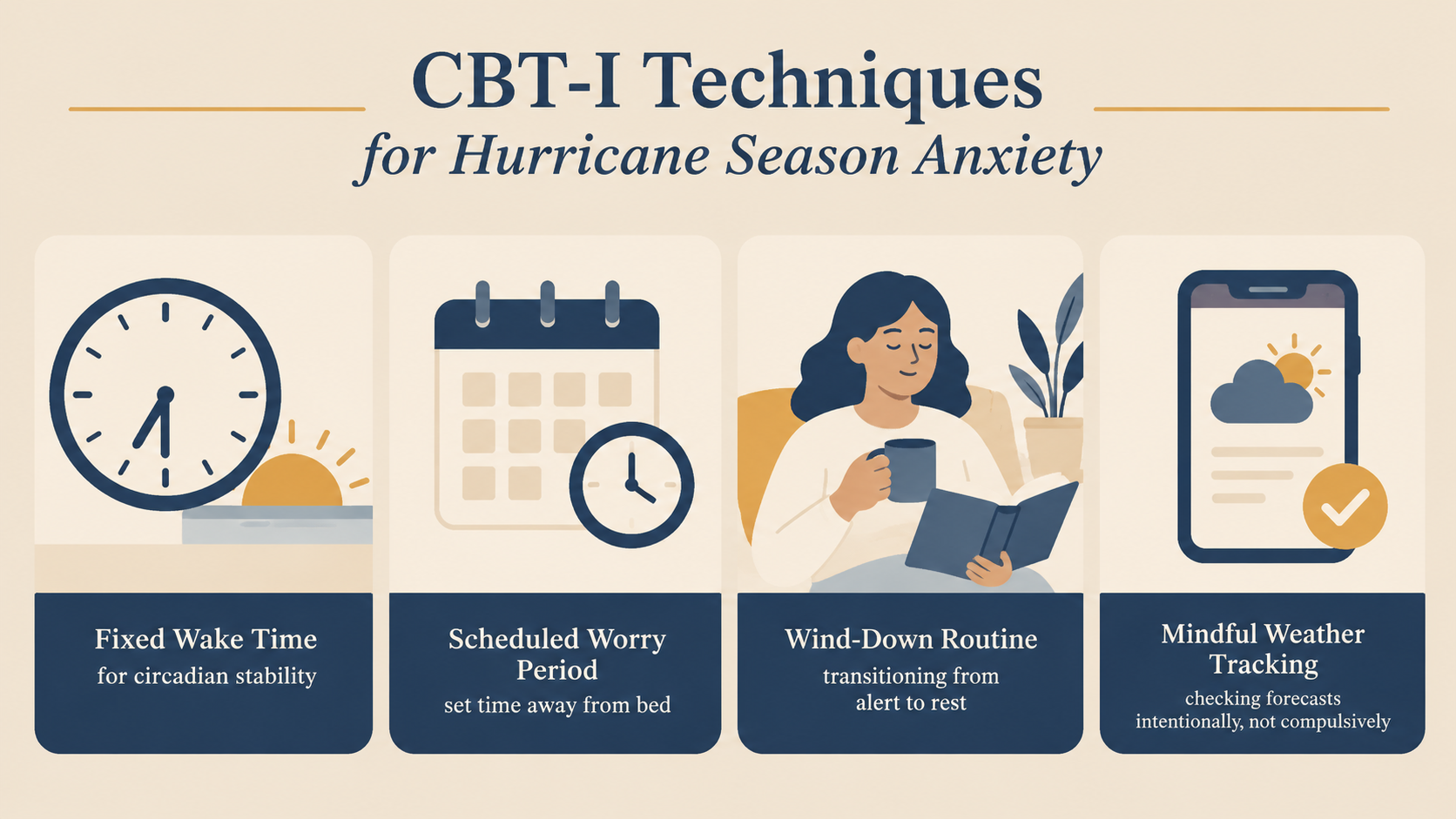
The wake time is the anchor. During hurricane season, people often focus on the bedtime they want and then feel defeated when anxiety pushes it later. A fixed wake time works differently. It gives the circadian system a steady morning signal even when the night before was uneven.
This is uncomfortable after a poor night, which is why it matters. Sleeping late to compensate may feel merciful in the moment, but it can weaken sleep pressure the next night and make bedtime more fragile. A consistent wake time does not punish the body; it helps the body predict when sleep should build again. If you need help separating anxiety-driven wakefulness from a shifted sleep schedule, the distinction is covered in can't fall asleep: mind or clock.
There are exceptions. If an active warning, evacuation, caregiving duty, or overnight safety task interrupts sleep, safety comes first. The fixed wake time is a stabilizing practice for ordinary forecast-season nights, not a rule that outranks emergency judgment.
Move Hurricane Worry Out of the Bedtime Slot
Scheduled worry time sounds too tidy until it is used for a problem that actually needs thinking. The point is not to tell yourself to stop worrying. It is to give the brain a reliable appointment for hurricane-related planning before the bedroom becomes the only available conference room.
Use 10 to 15 minutes earlier in the day for the questions that usually arrive after lights out: What would make us evacuate? Are prescriptions refilled? Which neighbor needs a check-in? Where are the batteries? What is the threshold for bringing in patio furniture? NPR's Life Kit describes scheduled worry as a way to externalize anxious thoughts and reduce their pull at bedtime [4].
- Write the worry as a task if it has an action: “Refill medication,” “download county alert app,” “photograph insurance documents.”
- Write it as an uncertainty if it has no action yet: “Track tropical wave only at scheduled check times.”
- End the session by naming the next forecast check, not by opening another radar loop.
- If the same thought returns in bed, remind yourself where it is written and when it will be reviewed.
This is one place where preparedness and anxiety need different treatment. Preparedness improves when decisions are written down, shared, and tied to triggers. Anxiety grows when the same decision is reopened in the dark without new information. For a broader insomnia toolkit, including what to do when anxiety keeps you awake after you are already in bed, see what to do when anxiety keeps you up at night.
Use a Wind-Down Routine, Not a Perfect Bedtime
A rigid bedtime can become another performance test: “If I fall asleep by 10:30, I will be fine tomorrow; if not, I am in trouble.” That pressure raises arousal, especially for people already measuring the night against the next advisory cycle. A wind-down routine is more forgiving. It tells the body what phase it is entering without demanding immediate sleep.
The routine should be boring enough to survive hurricane season. Charge the phone outside arm's reach if another responsible adult or alert device covers overnight safety. Put the go bag in its place before the routine starts, not after. Do the same low-light sequence each night: wash up, set tomorrow's first forecast check, read something non-weather, stretch lightly, or listen to familiar audio. The repetition is the intervention.
The routine also creates a boundary for legitimate monitoring. If there is no watch, warning, evacuation order, or agreed household trigger, the wind-down period is not the time to keep negotiating with the radar. If there is an active threat, the plan changes; otherwise, the routine protects the part of preparedness that depends on a functioning brain tomorrow.
Make Weather Tracking Mindful Enough to Be Useful
Mindful weather tracking is not ignoring the weather. It is deciding in advance when, where, and how forecast information will be checked. The opposite is letting every uneasy sensation become permission to reopen the app.
| Instead of | Try |
|---|---|
| Checking every time anxiety spikes | Checking at preset times unless an official alert arrives |
| Following multiple model accounts in bed | Using one or two trusted sources and reading the official advisory |
| Asking “Could this get worse?” all evening | Asking “Is there a decision I need to make before the next check?” |
| Keeping the phone in hand after lights out | Placing the phone where alerts can be heard but scrolling is inconvenient |
This matters because compulsive tracking can wear the costume of safety. A person may say they are staying informed while actually training the brain to treat uncertainty itself as an emergency. Good tracking produces a decision or confirms that no decision is needed yet. Bad tracking produces only more arousal.
Do not reduce your warning system to willpower. Keep official alerts enabled, use trusted local emergency channels, and make sure someone in the household knows the overnight plan. At the same time, do not rely on a single alert method as your whole safety net. Sirens, phones, radios, household members, and local instructions all have limits. Redundancy is preparedness; repeated scrolling is usually not.
What to Expect When a Storm Is Actually Close
Forecast-season insomnia and storm-night sleep are related, but they are not the same problem. During active storm conditions, expectations need to be calibrated. Amerisleep's hurricane sleep guidance notes that many people get only 3 to 5 hours of broken sleep during active storm conditions, and storm noise can reach 100 or more decibels, roughly comparable to a motorcycle [5].
That kind of night is not a personal failure. If wind is hitting the house, alerts are sounding, power is flickering, or family members are moving between rooms, consolidated sleep may not be realistic. Amerisleep also describes sleep patterns beginning to improve 3 to 7 days after the threat passes, with full recovery taking 2 to 4 weeks depending on damage and disruption [5]. For practical storm-night barriers like noise, light, and anxiety, see sleep during a tropical storm.
Medication deserves caution in this window. Strong sedatives can impair emergency responsiveness if conditions change overnight. Melatonin at low doses is often treated as a gentler option, but anyone considering sleep medication during hurricane season should discuss it with a clinician, especially if they may need to drive, evacuate, care for children, use medical equipment, or respond to official warnings.
When the Forecast Is Tied to Trauma
Some people are not merely anxious about a possible storm. They are remembering one. The body may react to a forecast because it has already lived through the sound of a roof failing, the smell of wet drywall, the logistics of displacement, the fear of being unreachable, or the exhaustion of rebuilding while still working and parenting.
CBT-I tools can still help with the sleep loop, but they may not be enough on their own when nightmares, panic, intrusive memories, avoidance, or persistent hypervigilance continue outside forecast checks. In that case, the sleep problem is not just a habit problem. It is a trauma-and-sleep problem, and clinical support is appropriate. A comparison point is disaster-related conditioned fear after earthquakes, discussed in how earthquake anxiety keeps you awake.
A Realistic Plan for the Rest of the Season
The practical plan is not dramatic. Keep the household prepared. Decide which forecast sources matter. Choose check times before bedtime arrives. Use a fixed wake time most days. Put hurricane worries into a short scheduled window. Build a wind-down routine that can hold even when the tropics are active but not yet threatening your area.
Then watch what changes. Not whether you feel perfectly calm; that is too high a bar for hurricane season. Watch whether the last hour of the evening has fewer negotiations with the phone. Watch whether one bad night no longer turns into three. Watch whether forecast information leads to decisions instead of loops. If insomnia persists for weeks, daytime functioning worsens, or storm memories keep intruding, bring a sleep clinician or mental health professional into the plan.
References
- Understanding and managing storm anxiety during tornado season — UAB Heersink School of Medicine, 2026.
- Sleep Quality Among Low-Income Young Women in Southeast Texas Predicts Changes in Perceived Stress Through Hurricane Ike — SLEEP, 2015.
- NOAA 2026 Atlantic Hurricane Season Outlook — Climate Prediction Center, May 21, 2026.
- 4 ways to calm your sleep anxiety — NPR Life Kit, January 2026.
- Hurricane Preparedness and Sleep — Amerisleep.
Comments
Join the discussion with an anonymous comment.