
How Parkinson's Disease Disrupts Your Sleep
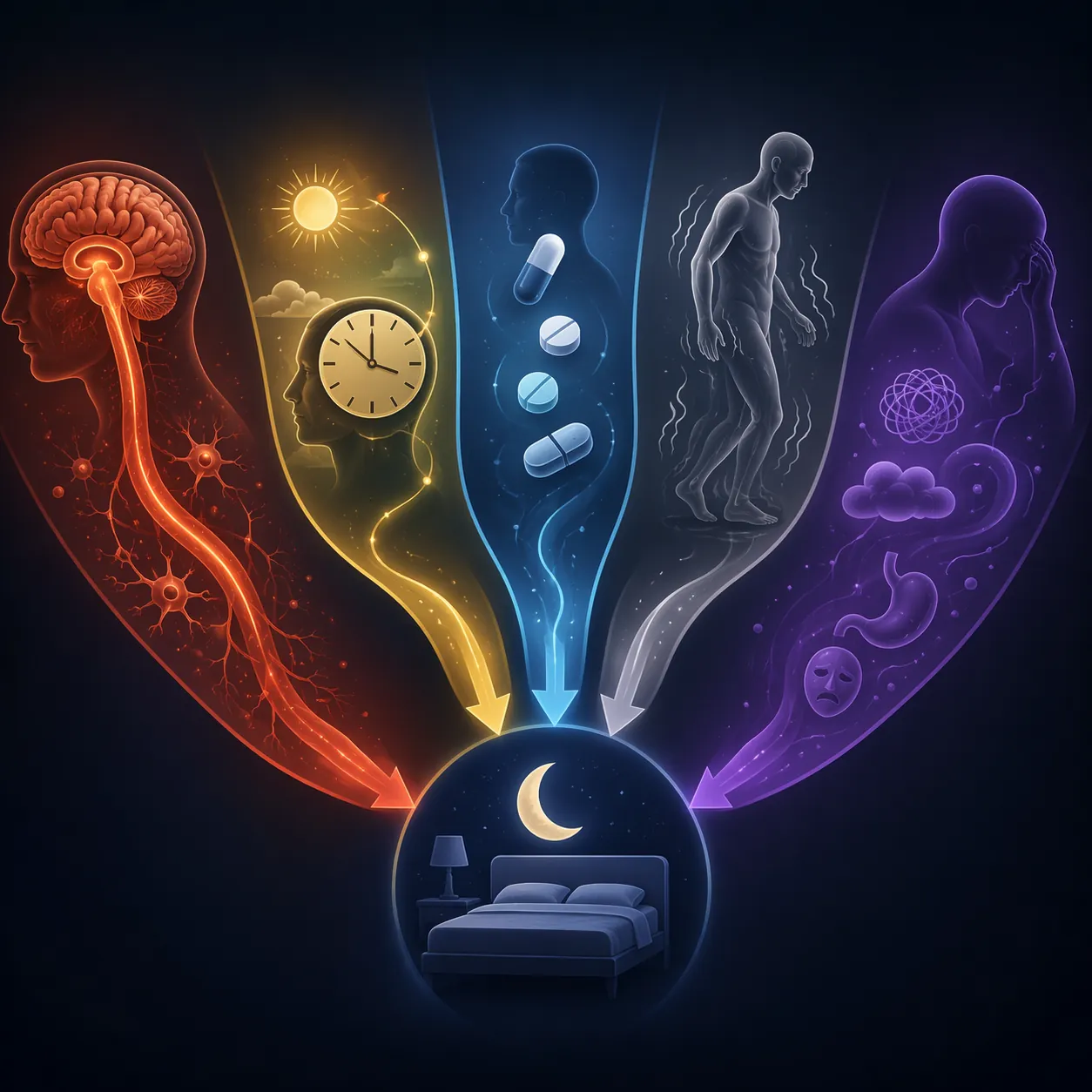
This article explains how Parkinson's disease disrupts sleep through multiple biological pathways—including brainstem neurodegeneration, circadian rhythm disruption, and medication effects—and why the right approach depends on identifying the specific driver.
The maddening thing about Parkinson's disease and sleep problems is that the night often does not begin as the problem. You may get into bed tired. You may even fall asleep. Then the night starts breaking into pieces: awake at 1 a.m., awake again at 3 a.m., stiff when you try to turn over, needing the bathroom, too alert for no obvious reason, or exhausted the next day despite having spent enough hours in bed.
That pattern is easy to misread as ordinary insomnia, poor sleep habits, or aging. It is also easy to blame yourself for not relaxing correctly. But sleep disruption is one of the common non-motor burdens of Parkinson's. The Parkinson's Foundation says more than 75% of people with Parkinson's have sleep-related symptoms, and the APDA describes people with Parkinson's averaging just over 5 hours of sleep a night and waking about twice as often as age-matched controls.[1][2]
Those numbers matter because they change the interpretation. This is not simply “bad sleep hygiene” wearing a neurological costume. In many people with Parkinson's, the machinery that keeps sleep stable is being disturbed from several directions at once.
The clue is not just insomnia. It is where the insomnia happens.
A useful hinge comes from the ICEBERG cohort, a study of early-stage Parkinson's published in 2024. The group was relatively early in the disease course, with a mean Parkinson's duration of 18 months and a mean age of 61, so its findings should not be treated as a perfect map for every older adult with more advanced disease. But the pattern is hard to ignore: insomnia in Parkinson's showed up mainly as sleep maintenance difficulty, not sleep initiation difficulty.[3]
In that cohort, 35% of people with Parkinson's had sleep maintenance insomnia, compared with 16% of controls.[3] In plain terms, the Parkinson's group was not mainly saying, “I lie there for hours and cannot fall asleep.” More often, the problem was, “I cannot stay asleep.”
That distinction is not cosmetic. Much generic insomnia advice is built around sleep onset: dim the lights, avoid screens, keep a regular bedtime, reduce arousal. Those steps may still help some people. But if the central problem is repeated waking caused by dopamine timing, stiffness, nocturia, pain, anxiety, circadian weakening, or degeneration in sleep-wake circuits, then a cleaner bedtime routine will not reach the whole problem.
Parkinson's can disturb the sleep-wake system itself
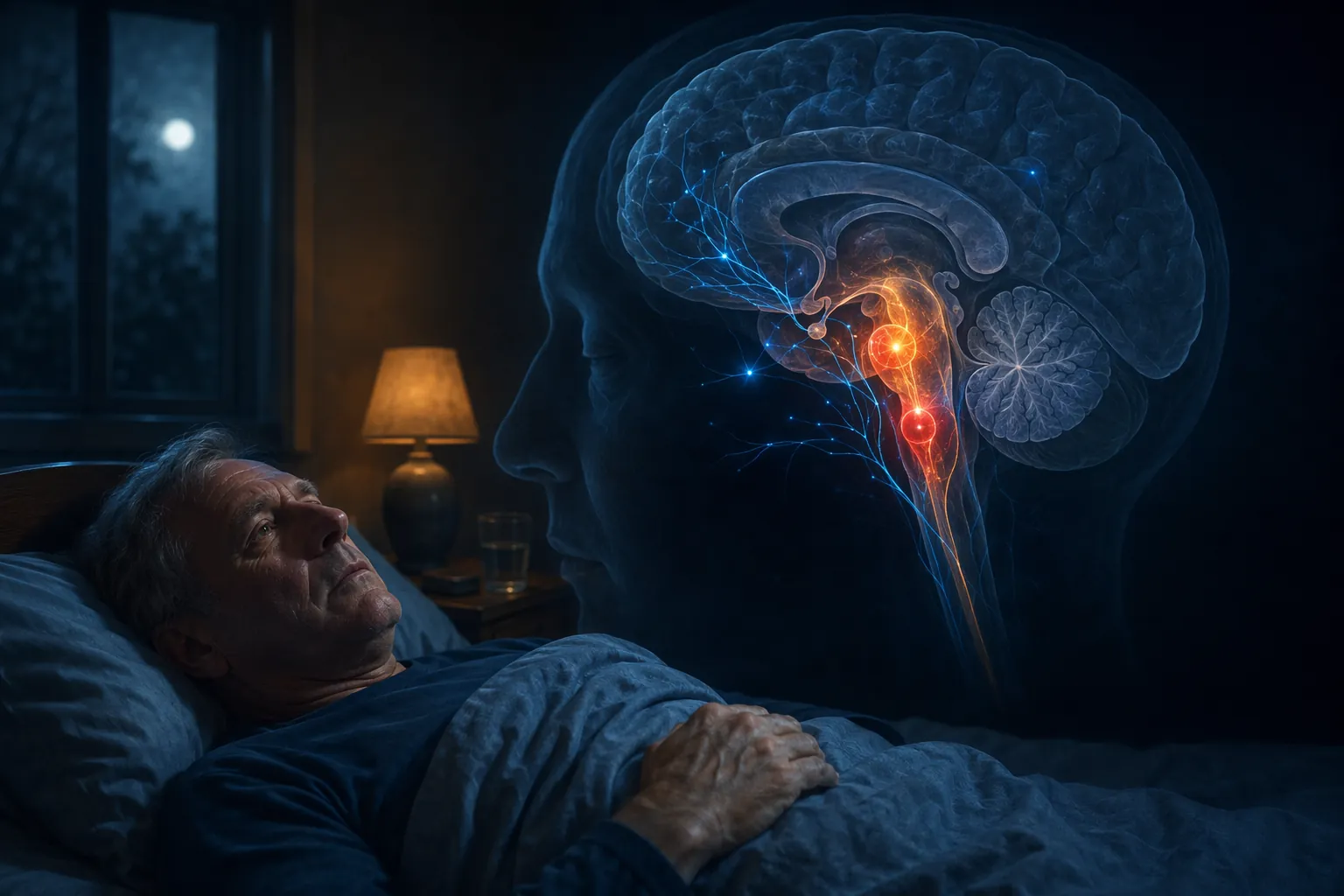
The most Parkinson's-specific explanation starts in the brainstem. Parkinson's is usually recognized by movement symptoms, but the disease process does not politely wait for tremor or slowness before touching systems that regulate sleep and wakefulness. A 2022 review describes neurodegeneration in brainstem sleep-wake regulatory regions, including the raphe nuclei and locus coeruleus, along with orexin system involvement, in ways consistent with early Braak stages 1 and 2.[4]
That matters because these regions help coordinate arousal, REM sleep, wake stability, and transitions between sleep stages. If those circuits are affected early, sleep can become lighter, more fragmented, or stranger before a person has a clear explanation for why. The night may start to feel unreliable years before a formal Parkinson's diagnosis, not because the person has suddenly forgotten how to sleep, but because the regulation system is changing.[4]
REM sleep behavior disorder belongs in this conversation, though not as the center of this article. Acting out dreams can be a clue in synuclein-related diseases, including Parkinson's and Lewy body dementia. If that is the main concern, Restful Ground's guide to sleep disorders linked to Lewy body dementia goes deeper into that specific pattern.
The body clock may be giving a weaker signal
Another layer is circadian disruption. The circadian system is the body's timing network: it helps decide when alertness should rise, when sleep pressure should be reinforced, and how hormones such as melatonin follow the light-dark cycle. In Parkinson's, studies reviewed in the sleep-management literature describe diminished melatonin rhythm amplitude, altered clock gene expression, and reduced light exposure related to impaired mobility.[4]
This is a credible explanation, but it should not be inflated into a universal answer. A weaker circadian signal may help explain why sleep becomes shallow, fragmented, or poorly timed. It does not automatically explain every 2 a.m. awakening. A person who wakes because medication has worn off and rigidity has returned is not having the same night as someone whose sleep-wake rhythm has drifted and whose days include little bright light exposure.
Still, circadian weakening helps explain why Parkinson's sleep can feel different from ordinary older-adult sleep change. Aging can lighten sleep and shift timing. Parkinson's may add a disease-related disturbance to the timing system itself, then compound it with less daytime movement, less outdoor light, fatigue, and naps that may be hard to avoid.
Medication timing is often the practical middle of the night
Medication is where the discussion has to become specific. Dopaminergic treatment can improve the night for some people by reducing stiffness, tremor, dystonia, and difficulty turning in bed. It can also complicate sleep through daytime sleepiness, vivid dreams, hallucinations in vulnerable patients, or sleep-maintenance problems depending on the medication, dose, timing, and individual response.[4]
The RECOVER trial is useful because it is one of the clearer Parkinson's-specific randomized trial signals in this area. In that study, the rotigotine transdermal patch improved subjective sleep quality and nighttime motor function.[4] That does not make rotigotine the answer for every person with Parkinson's who wakes at night. It does show why a Parkinson's-specific sleep conversation should ask whether the night is being broken by motor wearing-off, not only whether the patient has practiced relaxation breathing.
Levodopa timing can be just as important. If medication wears off overnight, a person may wake stiff, slow, tremulous, painful, or unable to reposition comfortably. If dosing or formulation contributes to alertness, dreams, or other side effects, the same drug plan that helps the day may be costing the night. This is why the useful question is not simply “Which sleep aid works?” It is “What is happening in the body when the waking occurs?”
Motor symptoms can turn normal awakenings into long awakenings
Everyone wakes briefly during the night. Most people do not remember it. Parkinson's can make those normal awakenings harder to pass through because the body is less able to settle, turn, or get comfortable again.
Tremor, rigidity, dystonia, painful cramping, and impaired bed mobility can each become sleep-maintenance problems. A person may wake because a symptom breaks through, or wake for another reason and then discover that turning over is now a project. Once movement becomes effortful, the brain is no longer drifting quietly between sleep stages. It is solving a physical problem in the dark.
This is also where the household feels the disease, even when only one person has the diagnosis. Repositioning, getting to the bathroom, bed exits, and repeated awakenings can disturb a partner's sleep as well. That partner burden deserves its own focus, and Restful Ground covers it separately in Why your sleep suffers when your partner has Parkinson's. Here, the central point is narrower: nighttime movement symptoms should be treated as evidence, not background noise.
Non-motor symptoms can be the actual alarm clock
Some Parkinson's nights are not primarily broken by tremor or medication wearing off. They are broken by non-motor symptoms: nocturia, pain, anxiety, depression, vivid dreams, restless legs symptoms, constipation discomfort, temperature discomfort, or daytime sleepiness that has shifted sleep pressure away from the night. Parkinson's organizations consistently include these non-motor contributors when describing sleep problems in the disease.[1][2][5]
Nocturia is a common example of how a symptom that also occurs in older adults can become more consequential in Parkinson's. Getting up once to urinate is one thing. Getting up when mobility is slow, balance is uncertain, medication has worn off, and returning to sleep is difficult is a different clinical problem. The same is true of pain or anxiety: the symptom may not be unique to Parkinson's, but the way it interacts with motor impairment and sleep-wake instability can make it more disruptive.
This is why long lists of possible sleep disorders are less helpful than a careful description of the night. A label such as “insomnia” may be accurate, but it is not complete enough to guide treatment if it does not say what keeps waking the person or what prevents sleep from returning.
What to bring to the clinician conversation
Most drug evidence for treating sleep in Parkinson's is still thinner than patients deserve. The 2022 management review notes that much pharmacologic guidance is extrapolated from primary insomnia populations rather than built from Parkinson's-specific randomized trials.[4] That gap makes pattern-finding more important, not less.
Before trying another generic sleep fix, it helps to track a few nights with enough detail to identify the likely driver. This does not require a perfect sleep diary. It requires the details that change the next clinical question.
| Night pattern | Possible driver to discuss | Why it matters |
|---|---|---|
| Falls asleep, then wakes repeatedly without a clear trigger | Sleep-maintenance insomnia, circadian disruption, medication effect, or sleep-wake circuit disruption | The problem may not be bedtime behavior. |
| Wakes stiff, tremulous, cramped, or unable to turn over | Overnight motor wearing-off or undertreated nighttime motor symptoms | Medication timing or formulation may need review. |
| Wakes mainly to urinate, then cannot fall back asleep | Nocturia plus Parkinson's-related mobility and sleep-maintenance difficulty | The bathroom trip may be only the first part of the problem. |
| Sleeps during the day, then has a fragmented night | Daytime sleepiness, medication effect, reduced light exposure, or weakened circadian rhythm | The 24-hour pattern matters more than bedtime alone. |
| Acts out dreams or has violent dream enactment | REM sleep behavior disorder | This deserves specific medical attention and is not ordinary insomnia. |
Basic sleep habits are still worth cleaning up: consistent wake time, light exposure during the day when safe and feasible, a safer path to the bathroom, and avoiding alcohol or late caffeine if they worsen sleep. If you want a broader evidence framework for non-drug approaches, Restful Ground's evidence-rated home remedies for sleeplessness can help separate reasonable experiments from wishful thinking. But in Parkinson's, those steps should sit underneath a more specific question: which pathway is breaking this person's sleep?
If the main driver is brainstem sleep-wake disruption, the plan will look different from a plan for overnight rigidity. If the issue is circadian weakening, the day matters as much as the night. If medication timing is involved, the answer may require adjusting Parkinson's treatment rather than adding a generic sedative. If pain, nocturia, anxiety, or depression is the alarm clock, naming that symptom is the first useful move.
Parkinson's sleep problems are common, biologically specific, and often too complicated for advice that assumes ordinary insomnia. The better starting point is the actual pattern of waking: when it happens, what the body is doing, what medication is doing, and what makes sleep fail to return.
References
- Understanding Sleep Problems in Parkinson's — Parkinson's Foundation
- Sleep Problems in Parkinson's — APDA
- Sleep disorders in Parkinson's disease, an early and multiple problem — npj Parkinson's Disease, 2024
- Management of Sleep Disturbances in Parkinson's Disease — PMC, 2022
- Fatigue and Sleep Problems in Parkinson's Disease — Michael J. Fox Foundation
Explore the mechanism
Next step
Spot an error or have clinical feedback?
Because this article covers clinical, medication, or safety information, we use a moderated correction channel instead of open public comments. Let us know if something about “How Parkinson's Disease Disrupts Your Sleep” needs a closer look.
Send feedback on this article