
Pregnancy insomnia remedies that actually work and are safe
A trimester-structured safety guide to pregnancy insomnia medications and supplements, organized by evidence tier so you can discuss risks and benefits with your OB-GYN — including when untreated insomnia may be more dangerous than the remedy.
If you are reading this at 3 a.m. with Unisom, Benadryl, melatonin, magnesium, or a prescription bottle in front of you, the useful question is not “Is anything perfectly safe?” Pregnancy rarely gives that kind of answer. The better question is: which pregnancy insomnia remedies that actually work have the best-characterized safety record for your trimester, your symptoms, and your medical history?
That distinction matters because blanket avoidance can be as unhelpful as casual reassurance. Pregnancy insomnia is common — Cleveland Clinic notes that it affects up to 80% of people by the third trimester, while a 2024 global meta-analysis estimated overall pregnancy insomnia prevalence at 43.9% — but “common” does not mean harmless or something you should simply endure indefinitely.[1][2]

Use this as a discussion guide for your OB-GYN or maternal-fetal medicine clinician, not as permission to self-treat. The safest choice can change with trimester, dose, other medications, depression or anxiety history, blood pressure, gestational diabetes risk, restless legs symptoms, and whether the problem is occasional sleeplessness or sustained insomnia.
A trimester-aware evidence tier for sleep remedies
Older FDA Pregnancy Category letters still show up in searches and on health forums, but current medication labeling relies on narrative risk information rather than the old A/B/C/D/X shorthand. The old categories can be a clue to historical use; they are not a complete safety decision.
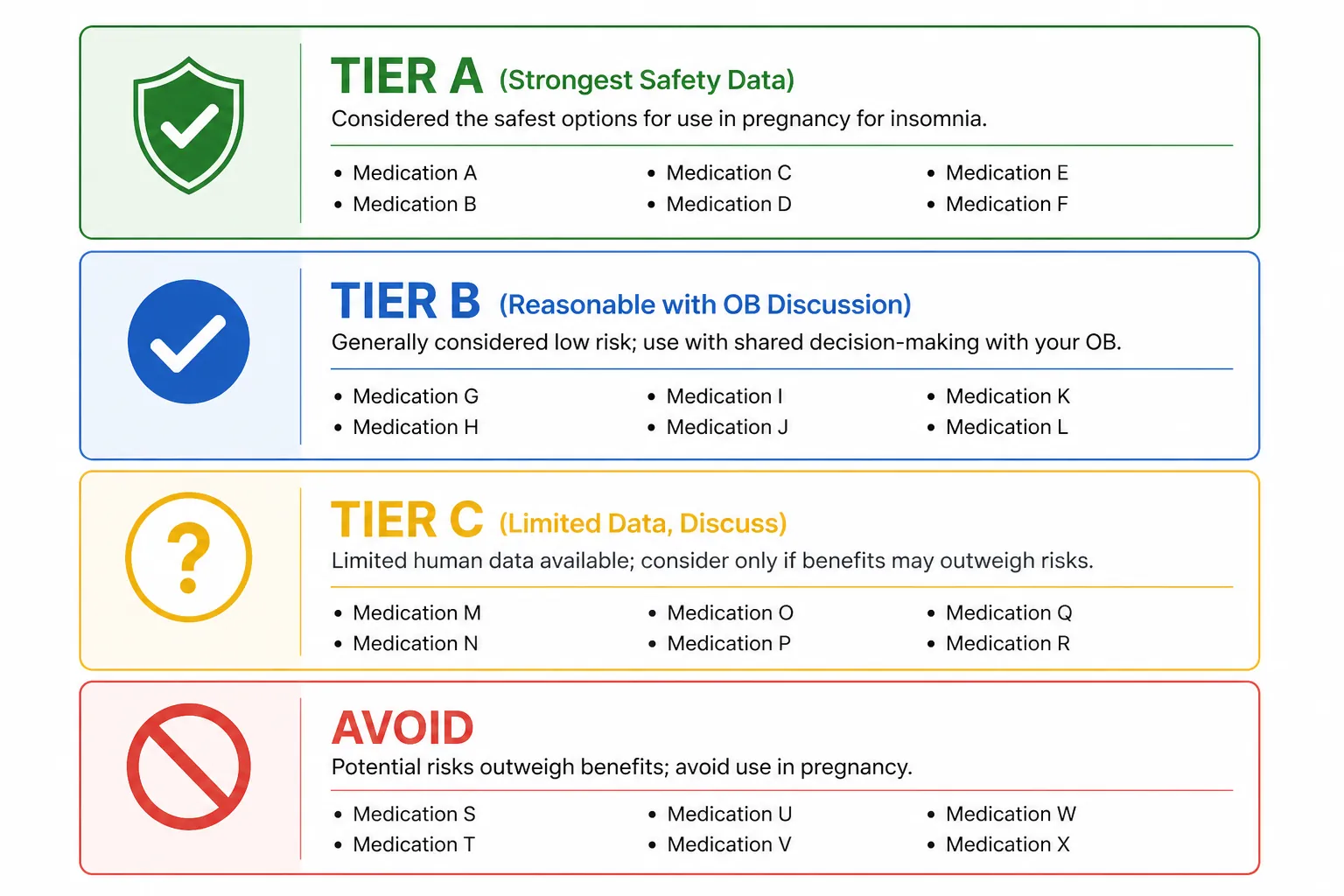
| Evidence tier | Options | How to think about trimester use | What the evidence can and cannot say |
|---|---|---|---|
| Tier A: strongest safety data to discuss | Doxylamine, including Unisom SleepTabs; magnesium glycinate when appropriate | Often the first OTC medication conversation, especially when occasional medication is needed. Magnesium is more relevant when restless legs, cramps, or low intake are part of the picture. | Doxylamine has decades of pregnancy use, mostly for nausea and vomiting rather than insomnia; magnesium supplementation is commonly discussed in pregnancy, but it is not a sedative cure-all.[3] |
| Tier B: reasonable, but more individualized | Diphenhydramine, including Benadryl and many PM products; trazodone by prescription | Diphenhydramine may be considered for short-term use, but first-trimester use deserves extra caution and product labels matter. Trazodone belongs in a clinician-led discussion. | Large human data have not shown a major malformation signal for diphenhydramine, but it is less preferred than doxylamine. Trazodone has smaller human pregnancy datasets.[3] |
| Tier C: limited or mixed data | Melatonin; zolpidem by prescription | These are not automatically off the table, but they need a clearer reason, trimester context, and clinician supervision. | Melatonin crosses the placenta and fetal circadian effects remain unsettled. Zolpidem crosses the placenta; one Taiwan study included 2,497 exposed pregnancies and found associations with low birth weight and preterm delivery, but not congenital anomalies.[3][4] |
| Avoid unless a specialist is managing a separate indication | Benzodiazepines; alcohol; cannabis; valerian, kava, and other sedating herbal supplements | Do not use these as routine sleep remedies in pregnancy. | The problem is not only fetal safety uncertainty. Sedation, dependence, impaired judgment, inconsistent supplement composition, and pregnancy-specific risks make these poor insomnia choices. |
The table deliberately separates “used by many pregnant people” from “well characterized for pregnancy safety.” A pharmacotherapy review reported that more than 90% of pregnant people use over-the-counter sleep aids at least occasionally, and that 10% to 15% use antihistamines.[3] Those numbers normalize the conversation. They do not, by themselves, prove that every OTC product is a good choice.
Untreated insomnia is also an exposure
A medication decision in pregnancy often gets framed as exposure versus no exposure. With persistent insomnia, that framing is too neat. Severe or sustained sleep loss can affect mood, functioning, prenatal care, driving, work, blood pressure routines, food choices, and the ability to recognize when something is wrong.
The mood data are hard to dismiss. The MGH Center for Women’s Mental Health summarizes research linking insomnia during pregnancy with a 3.72-fold higher risk of antenatal depression and a 2.7-fold higher risk of postpartum depression.[5] Those figures do not mean insomnia always causes depression, and they do not mean a sleep aid prevents depression. They do mean that “take nothing” is not always the lower-risk path.
MGH also notes associations between sleep disturbance and adverse pregnancy outcomes including gestational diabetes, preeclampsia, and preterm birth.[5] Associations are not the same as proof that treating insomnia with medication will prevent those outcomes. Still, they are enough to justify a real risk-benefit conversation rather than another lecture about putting the phone away.
If you have not tried evidence-based behavioral treatment, especially CBT-I adapted for pregnancy, that remains the right first-line discussion for many people. For a behavioral-first treatment path, see the companion guide on CBT-I as a pregnancy sleep aid. But if you have already tried the reasonable non-medication steps and are still not sleeping, the next conversation should become more precise, not more moralizing.
Doxylamine: the best-characterized OTC medication option
Doxylamine is the ingredient in Unisom SleepTabs and in the prescription nausea-vomiting combination doxylamine-pyridoxine. Its strongest reassurance comes from long pregnancy use, especially for nausea and vomiting, rather than from insomnia-specific trials. That caveat matters, but it does not erase the value of the safety record.[3]
For a pregnant person who needs an occasional OTC medication to sleep, doxylamine is often the most sensible first medication to ask about because the pregnancy exposure history is comparatively old and boring. In medication safety, old and boring is a virtue. A plausible supplement with thin pregnancy data is not safer simply because it sounds gentler.
The practical questions for your OB-GYN are straightforward: whether doxylamine is appropriate in your trimester, whether it interacts with anything else you take, whether next-day grogginess would create risk, and whether your insomnia pattern suggests a different diagnosis such as anxiety, depression, reflux, sleep apnea, or restless legs syndrome.
Diphenhydramine: familiar, useful for some, not automatically first choice
Diphenhydramine is the sedating antihistamine in Benadryl and many “PM” pain-relief products. Large-scale human studies have not shown a major congenital malformation pattern, but the pregnancy sleep-aid review still treats antihistamines as medications that require caution, especially around first-trimester use and repeated dosing.[3]
The product label matters. Tylenol PM, for example, combines diphenhydramine with acetaminophen. That is a different decision from taking diphenhydramine alone, because you may be adding a pain reliever you do not need. For a deeper ingredient-level review, see Tylenol PM’s two ingredients.
Diphenhydramine can also leave some people foggy, dry-mouthed, constipated, or paradoxically restless. Those side effects are not trivial in pregnancy if you already have constipation, dizziness, fall risk, or a morning commute. “OTC” does not mean consequence-free.
Melatonin is where intuition often misfires
Melatonin feels like the gentle answer: a hormone the body already makes, sold as a supplement, easy to find, usually shelved far away from prescription medications. That packaging does a lot of persuasive work. It should not do the safety work.
Sleep Foundation estimates that about 4% of pregnant people use melatonin, but it also notes that melatonin crosses the placenta and that routine use during pregnancy is not advised because safety data remain limited.[4] MGH takes a similarly conservative position, advising that when medication is needed, clinicians generally prefer options with better-characterized reproductive safety profiles than melatonin.[6]
The concern is not that melatonin has been proven dangerous as a routine sleep aid in pregnancy. The concern is that the fetal circadian system is developing, melatonin crosses from parent to fetus, supplement dosing and purity can vary, and the human data are not mature enough to treat it as the default safer option.[4][6]
The picture is made more complicated by research interest in melatonin for specific pregnancy conditions, including potential neuroprotection in fetal growth restriction. That does not translate into “take melatonin for insomnia.” A substance being studied under specialist supervision for a particular obstetric problem is not the same as an over-the-counter nightly sleep remedy.
If melatonin is the option you are considering, the question for your clinician should be narrow: why this instead of a better-characterized alternative, at what dose, for how long, and with what trimester-specific concern? For a fuller evidence review, see Is melatonin safe for pregnancy.
Magnesium: useful when the problem is partly legs, cramps, or deficiency
Magnesium glycinate is often discussed in pregnancy because it is generally better tolerated than some other magnesium forms and may help when sleep is being disrupted by restless legs symptoms or leg cramps. That is different from saying magnesium is a reliable insomnia medication.
The upper supplemental amount commonly used as a safety boundary is 350 mg per day, unless a clinician gives different instructions. More is not automatically better. Too much magnesium can cause diarrhea, dehydration, and medication interactions, which is not a helpful trade when you are pregnant and already uncomfortable.
Magnesium is most worth asking about when your insomnia has a body-based trigger: twitchy legs, calf cramps, poor dietary intake, or a known deficiency concern. If your main pattern is racing thoughts at 3 a.m., magnesium may not touch the actual driver.
Prescription options: not casual, not forbidden
Prescription sleep medication during pregnancy should be reserved for situations where the severity of insomnia justifies a more individualized risk-benefit decision. That may include sustained insomnia with mood deterioration, inability to function, high-risk medical context, or failure of safer and better-characterized options.
Trazodone
Trazodone is sometimes used when insomnia overlaps with depression or anxiety symptoms, but the pregnancy data are smaller than for older antihistamines. The available human studies have not shown a major malformation signal, yet that is not the same as having a large, definitive pregnancy insomnia safety database.[3]
This is the kind of medication where the reason matters. “I need something stronger” is too vague. “I have persistent insomnia plus worsening depressive symptoms despite behavioral treatment” is a different clinical conversation.
Zolpidem
Zolpidem is not a simple yes or no. It crosses the placenta, and the pharmacotherapy review describes a Taiwan population study involving 2,497 exposed pregnancies. That study found increased risks of low birth weight and preterm delivery among exposed pregnancies, but it did not find an increased risk of congenital anomalies.[3]
That mixed pattern is exactly why zolpidem belongs in clinician judgment rather than internet reassurance. A congenital anomaly finding is not the only outcome that matters. Preterm birth and low birth weight matter too, and insomnia severity, underlying illness, and other factors can complicate interpretation.
If zolpidem is being considered, the conversation should include dose, frequency, duration, trimester, fall risk, next-day impairment, other sedating medications, and whether a short rescue plan is being used while a longer-term treatment is put in place.
What to avoid as pregnancy insomnia remedies
Some substances do not belong in the “maybe” pile for routine pregnancy insomnia. Alcohol and cannabis should not be used as sleep treatments in pregnancy. Their sedating effect is not a safety argument, and the fact that they may make someone feel sleepy does not make them medically appropriate.
Benzodiazepines are also not routine pregnancy sleep aids. There may be rare circumstances where a specialist continues or adjusts them for a separate condition, but that is different from starting one for ordinary insomnia.
Sedating herbal supplements such as valerian and kava deserve particular skepticism. “Herbal” does not guarantee consistent dosing, pregnancy safety data, manufacturing quality, or freedom from interactions. If a supplement label promises deep sleep without acknowledging pregnancy uncertainty, that is a reason to slow down, not a reason to trust it.
How to make the OB-GYN conversation sharper
A useful appointment does not start with “What is safe?” It starts with enough detail for your clinician to judge the tradeoff in front of you.
- Name the pattern: trouble falling asleep, waking after a few hours, early-morning waking, restless legs, reflux, pain, anxiety, or fetal-movement-related waking.
- State the duration: how many nights per week and how many weeks this has been happening.
- Bring the exact product: active ingredient, dose per pill or gummy, other ingredients, and how often you have taken it.
- Ask by tier: “Is doxylamine appropriate for me before diphenhydramine, melatonin, or a prescription option?”
- Ask by trimester: “Does your answer change because I am in the first, second, or third trimester?”
- Ask by consequence: “At what point does my insomnia itself become a bigger risk to mood, functioning, or pregnancy management?”
The modest conclusion is the most useful one: doxylamine is usually the best-characterized OTC medication option to discuss; diphenhydramine can be reasonable but is less preferred and more context-dependent; magnesium may help when leg symptoms or deficiency are part of the problem; trazodone and zolpidem require individualized prescription judgment; melatonin should not be treated as automatically safer because it is a supplement; and alcohol, cannabis, benzodiazepines for routine sleep, and sedating herbal products should stay out of your self-treatment plan.
For a broader medication ladder, see Pregnancy Sleep Aid Safety: A Clinically Grounded Treatment Ladder. If you want a narrower side-by-side comparison, use Comparing Safe Sleep Aids for Pregnancy Insomnia.
References
- Pregnancy Insomnia, Cleveland Clinic.
- Global prevalence and associated factors of insomnia during pregnancy: a systematic review and meta-analysis, Frontiers in Psychiatry, 2024.
- Insomnia during pregnancy: diagnosis and rational interventions, PMC.
- Pregnancy and Sleep Aids: What You Need to Know, Sleep Foundation.
- Treatment of Insomnia During Pregnancy, MGH Center for Women’s Mental Health.
- You Asked: Is It Safe to Take Melatonin During Pregnancy?, MGH Center for Women’s Mental Health.
Safety & eligibility read
Cross-check against other interventionsExplore the mechanism
Next step
Spot an error or have clinical feedback?
Because this article covers clinical, medication, or safety information, we use a moderated correction channel instead of open public comments. Let us know if something about “Pregnancy insomnia remedies that actually work and are safe” needs a closer look.
Send feedback on this article