
Sleep Anxiety and Insomnia: The Bidirectional Link, Causes, and Evidence-Based Treatment
Anxiety and insomnia are not simply co-occurring problems — they form a self-reinforcing neurobiological loop through hyperarousal, HPA axis dysregulation, and conditioned arousal. This article explains the mechanisms driving that cycle, how different anxiety disorders produce distinct sleep disruption profiles, and why CBT-I is the evidence-based first-line treatment that addresses both conditions simultaneously.
Why Treating One Without the Other Often Fails
Most people who struggle with both anxiety and poor sleep have tried at least one of the standard fixes: wind-down routines, limiting screens before bed, or talking to a therapist about their worries. Some find partial relief. Many do not. The reason is not a lack of effort — it is that anxiety and insomnia share a common neurobiological substrate, and treating only one side of that substrate leaves the other side intact and capable of sustaining the whole cycle on its own.
Anxiety activates physiological arousal systems that directly prevent sleep. Sleep loss, in turn, amplifies the brain's threat-detection circuitry, making anxiety worse the following day. Each condition becomes both a cause and a consequence of the other. This is not a metaphor or a loose correlation — it is a mechanistic loop with identifiable biological components.
This article covers that mechanism in detail, explains how different anxiety disorders produce meaningfully different sleep disruption profiles, and lays out the full treatment hierarchy — from the evidence-based first-line approach through adjunct strategies and medication considerations. If you have been told to "just relax before bed" and it has not worked, what follows is the explanation for why, and what actually does.
Defining the Terms: Sleep Anxiety, Anxiety-Driven Insomnia, and General Insomnia
These three presentations overlap in everyday experience but are clinically distinct, and the distinction matters for how treatment is targeted.
Sleep anxiety refers specifically to anticipatory fear directed at sleep itself — dread of not being able to fall asleep, fear of what will happen if you do not get enough sleep, or apprehension about lying in bed with your thoughts. The bed and the act of trying to sleep become the trigger for anxiety, not just a context in which anxiety happens to appear. This is a conditioned response, and it can develop even in people who do not have a diagnosable anxiety disorder.
Anxiety-driven insomnia describes sleep disruption that is caused or maintained by an underlying anxiety disorder — generalized anxiety disorder (GAD), panic disorder, post-traumatic stress disorder (PTSD), or related conditions. Here, the anxiety is the primary driver; the sleep problem is a downstream consequence, though it quickly develops its own maintaining mechanisms.
General insomnia without a primary anxiety driver is sleep disruption arising from other causes — behavioral patterns, circadian misalignment, medical conditions, or medications — where anxiety is not the initiating factor, even if it develops secondarily.
| Presentation | Core Feature | Primary Treatment Target |
|---|---|---|
| Sleep anxiety | Anticipatory fear of sleep itself or of not sleeping; bed becomes a conditioned anxiety trigger | Conditioned arousal (stimulus control, cognitive restructuring) |
| Anxiety-driven insomnia | Insomnia caused or maintained by GAD, panic disorder, PTSD, or related anxiety conditions | Underlying anxiety disorder plus insomnia-specific perpetuating factors |
| General insomnia | Sleep disruption from behavioral, circadian, medical, or medication-related causes without a primary anxiety driver | Condition-specific cause; CBT-I addresses behavioral perpetuating factors |
Biological Causes: How Anxiety Activates the HPA Axis and Prevents Sleep
The hypothalamic-pituitary-adrenal (HPA) axis is the body's primary stress-response system, and its relationship with sleep is deeply reciprocal. Under normal conditions, sleep — particularly slow-wave sleep (SWS) — exerts an inhibitory influence on the HPA axis, suppressing cortisol secretion during the first half of the night. Anxiety disrupts this relationship at its foundation.
Chronic anxiety chronically activates the corticotropin-releasing hormone (CRH) system and the locus ceruleus–autonomic nervous system (LC-ANS). CRH drives the release of adrenocorticotropic hormone (ACTH), which in turn stimulates cortisol production. Elevated sympathetic tone from LC-ANS activation keeps the body in a state of physiological readiness. The net result is elevated cortisol, elevated ACTH, and sustained sympathetic arousal — precisely the conditions that prevent sleep initiation and maintenance.
Research on the HPA axis and sleep confirms that exogenous administration of CRH, ACTH, or cortisol produces prolonged sleep onset, reduced slow-wave sleep, and increased sleep fragmentation. Critically, chronic insomnia is associated with 24-hour increases in ACTH and cortisol secretion — with the greatest elevations occurring in the evening and the first half of the night, exactly when sleep onset should be occurring. This is not simply a nighttime problem. It is a disorder of CNS hyperarousal across the full 24-hour period.
The therapeutic implication follows directly: interventions that target only nighttime symptoms — a sleep aid taken at bedtime, a relaxation exercise done at 10 pm — cannot fully address a hyperarousal state that is operating around the clock. Effective treatment must reduce overall physiological and emotional arousal across the sleep-wake cycle, not just manage symptoms at the moment of trying to sleep.
For readers who want a deeper look at how hyperarousal and other disruptors alter the architecture of sleep itself — including how SWS suppression affects overall sleep quality — the explainer on how common disruptors alter sleep architecture provides the mechanistic background.
Cognitive and Behavioral Causes: Worry, Racing Thoughts, and Conditioned Arousal
Biological hyperarousal does not operate in isolation. Cognitive and behavioral factors layer on top of the physiological state, creating additional maintaining mechanisms that can sustain insomnia long after the original anxiety trigger has resolved.
Presleep worry and rumination are the most commonly cited cognitive drivers of insomnia — the mind replaying problems, rehearsing future scenarios, or dwelling on what went wrong during the day. But research published in Comprehensive Psychiatry suggests that racing thoughts at bedtime are a meaningfully distinct phenomenon from worry and rumination — and a more specific predictor of sleep-onset difficulties. Racing thoughts show a marked circadian increase in the evening and at bedtime, and they are specifically associated with difficulty initiating sleep, while general rumination and worry do not carry the same predictive weight for onset insomnia. This distinction matters for treatment: targeting worry alone may leave the racing-thoughts component unaddressed.
Behavioral perpetuating factors are equally important, and they are the primary reason insomnia persists even when acute anxiety has reduced. The most significant is conditioned arousal: through repeated experiences of lying in bed awake, worrying, and failing to sleep, the bed itself becomes a learned trigger for wakefulness and anxiety. The nervous system has been trained to associate the sleep environment with arousal rather than rest. This conditioning is powerful and does not resolve on its own simply because the underlying anxiety improves.
- Conditioned arousal: the bed and bedroom become associated with wakefulness, worry, and frustration through repeated unsuccessful sleep attempts.
- Time-in-bed extension: spending more hours in bed to compensate for lost sleep fragments the sleep drive and weakens the homeostatic pressure that promotes consolidated sleep.
- Clock-watching: repeatedly checking the time while awake amplifies performance anxiety about sleep and reinforces the association between the bedroom environment and wakefulness.
- Anticipatory anxiety about the next night: worrying during the day about whether tonight will be another bad night elevates arousal before bedtime even begins.
How Insomnia Worsens Anxiety: The Feedback Loop Explained
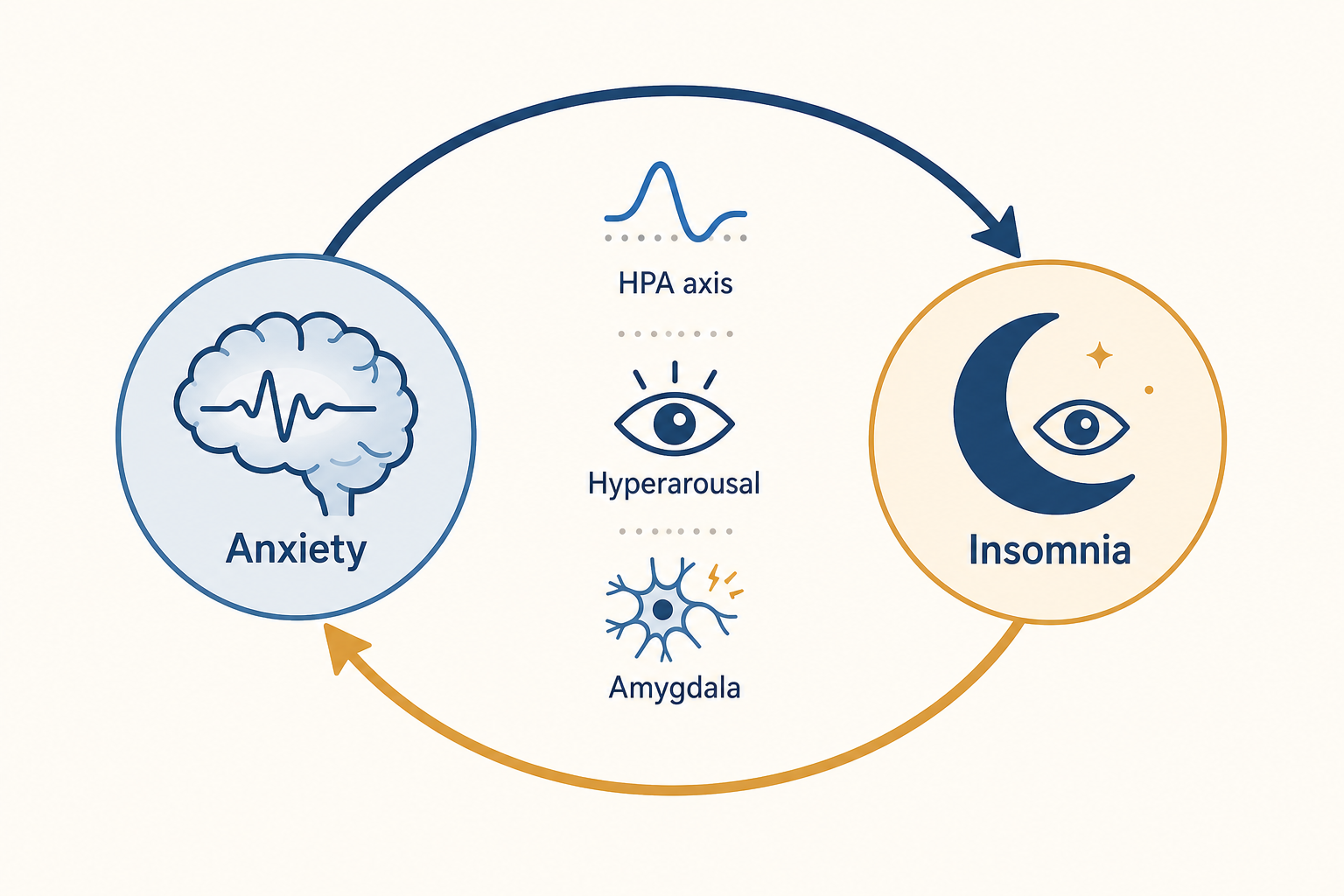
The relationship between anxiety and insomnia is not one-directional. Insomnia does not merely result from anxiety — it actively worsens it. Understanding this reverse pathway is essential for understanding why the cycle is so self-sustaining.
Sleep deprivation impairs the prefrontal cortex's regulatory control over the amygdala — the brain's primary threat-detection center. When that regulatory control is reduced, the amygdala becomes hyperreactive to threat cues, interpreting neutral or ambiguous stimuli as more dangerous than they are. Anxiety sensitivity increases. Emotional reactivity rises. The threshold for triggering the stress response drops.
Research on generalized anxiety disorder and sleep confirms this mechanism: heightened HPA axis activity, increased amygdala reactivity, and reduced prefrontal cortical control form a common pathophysiological substrate that reinforces both conditions simultaneously. Insomnia is not merely a symptom of GAD — it is also a risk factor and a maintaining mechanism for it.
The epidemiological data reflects this bidirectionality. In population studies, anxiety appeared before insomnia in approximately 43.5% of comorbid cases — but insomnia preceded anxiety in roughly 18% of cases, and both appeared simultaneously in 38.6%. This means that for a substantial proportion of people, the insomnia is not simply downstream of the anxiety; it is part of the initiating or co-initiating process.
The practical implication is significant. A person who develops anxiety following a period of poor sleep is not experiencing a simple reaction to feeling tired. They are experiencing the neurobiological consequence of a sleep-deprived brain with impaired threat regulation. And once that anxiety is established, it feeds back into the hyperarousal state that prevents sleep — completing the loop.
Anxiety Subtypes and Their Distinct Sleep Disruption Profiles
Not all anxiety-related sleep disruption looks the same. GAD, panic disorder, and PTSD each produce meaningfully different polysomnographic and subjective sleep signatures. Treating them as interchangeable leads to poorly targeted interventions.
Generalized anxiety disorder primarily disrupts sleep maintenance — the ability to stay asleep through the night — rather than sleep onset. Between 60% and 70% of people with GAD report insomnia symptoms, with some surveys placing the figure as high as 90%. The shared mechanisms include elevated nighttime cortisol, increased amygdala reactivity, reduced prefrontal regulatory control, and GABAergic deficits. Because the hyperarousal state is chronic and diffuse rather than episodic, the sleep disruption in GAD tends to be persistent and pervasive across the night.
Panic disorder disrupts both sleep onset and sleep maintenance. Approximately 68% of people with panic disorder report difficulty falling asleep, and 77% report disturbed sleep overall. A particularly significant feature is nocturnal panic attacks — abrupt awakenings from sleep accompanied by the full physiological signature of a panic attack. These occur in an estimated 20% to 45% of people with panic disorder and are distinct from nightmares or sleep terrors. They arise from NREM sleep rather than REM, suggesting a different neurobiological trigger than dream-related awakenings.
PTSD produces the most severe sleep disruption profile of the three. Nightmares, hypervigilance, and sustained hyperarousal characterize the condition's sleep presentation. Sleep latency — the time it takes to fall asleep — is often severely prolonged. Research on combat-related PTSD consistently finds that over 90% of affected individuals report insomnia symptoms. The nightmare component is not merely distressing; it fragments REM sleep, prevents sleep consolidation, and maintains the hyperarousal state through the night.
| Anxiety Condition | Primary Sleep Disruption | Distinctive Feature | Reported Prevalence of Insomnia |
|---|---|---|---|
| Generalized Anxiety Disorder (GAD) | Sleep maintenance (staying asleep) | Chronic, diffuse hyperarousal; elevated nighttime cortisol | 60–90% of GAD patients |
| Panic Disorder | Sleep onset and maintenance | Nocturnal panic attacks (NREM-based) in 20–45% of patients | 68% difficulty falling asleep; 77% disturbed sleep |
| PTSD | Severely prolonged sleep latency; sleep fragmentation | Nightmares, hypervigilance, REM disruption; hyperarousal maintained through the night | >90% in combat-related PTSD |
Recognizing the Pattern: Symptoms, Differential Diagnosis, and When Polysomnography Is Warranted
Identifying which presentation you are dealing with — sleep anxiety, anxiety-driven insomnia, or general insomnia — begins with a careful symptom history. The following patterns offer a practical starting framework.
- Sleep anxiety is suggested when the anxiety is specifically triggered by the approach of bedtime or the act of trying to sleep — not present throughout the day at the same intensity. The bedroom itself may feel anxiety-provoking.
- Anxiety-driven insomnia is suggested when a diagnosable or subclinical anxiety condition (persistent worry, panic episodes, trauma history) is clearly present and preceded or coincided with the onset of sleep problems.
- Nocturnal panic attacks are suggested by abrupt awakenings from sleep with racing heart, shortness of breath, and acute fear — without a preceding nightmare or identifiable environmental trigger.
- PTSD-related sleep disruption is suggested by recurrent trauma-related nightmares, hypervigilance at bedtime, and difficulty feeling safe enough to sleep.
- General insomnia without a primary anxiety driver is suggested when sleep difficulties began independently of anxiety symptoms, or when anxiety appears to be a secondary response to the sleep problem rather than its cause.
Two validated tools are commonly used in clinical and self-assessment contexts: the Insomnia Severity Index (ISI) for quantifying insomnia severity, and the GAD-7 for screening for generalized anxiety. A sleep diary — tracking sleep times, awakenings, and daytime function over two weeks — provides the behavioral data that neither questionnaire captures on its own.
| Diagnostic Tool | What It Measures | Clinical Context |
|---|---|---|
| Insomnia Severity Index (ISI) | Subjective insomnia severity across seven domains (sleep onset, maintenance, early awakening, satisfaction, impairment, noticeability, distress) | Self-administered; widely used in clinical trials and primary care screening |
| GAD-7 | Generalized anxiety disorder symptom severity over the past two weeks | Self-administered; validated screening tool; scores ≥10 suggest moderate-to-severe GAD warranting clinical follow-up |
| Two-week sleep diary | Nightly sleep timing, estimated sleep latency, number of awakenings, total sleep time, daytime function | Provides behavioral baseline for CBT-I and helps distinguish sleep patterns across nights |
Polysomnography — overnight sleep study — is not routinely indicated for insomnia with a clear anxiety-related presentation. It becomes warranted when sleep-disordered breathing (such as obstructive sleep apnea) is suspected as a comorbid or confounding condition, when the clinical picture remains unclear after behavioral assessment, or when nocturnal events (such as possible nocturnal panic attacks or parasomnias) need to be distinguished from one another through objective measurement.
First-Line Treatment: Why CBT-I Addresses Both Conditions Simultaneously
Cognitive behavioral therapy for insomnia (CBT-I) is the first-line treatment for chronic insomnia, including insomnia comorbid with anxiety disorders. This designation is endorsed by the American Academy of Sleep Medicine (AASM) and reflects a substantial evidence base that distinguishes CBT-I from every other available intervention.
The most directly relevant evidence for the anxiety-insomnia comorbidity comes from a randomized study of 120 participants with comorbid insomnia and anxiety. CBT-I was more effective than CBT for anxiety at reducing insomnia severity at both post-treatment and three-month follow-up — while being equally effective at reducing anxiety symptoms. The implication is direct: when both conditions are present, starting with CBT-I is the more efficient treatment strategy.
CBT-I works on the anxiety-insomnia cycle through several mechanisms operating simultaneously:
- Stimulus control directly targets conditioned arousal. By restricting bed use to sleep and sex only, getting out of bed when unable to sleep, and maintaining a consistent wake time regardless of sleep quality, the bed-wakefulness association is gradually extinguished and replaced with a bed-sleep association.
- Sleep restriction consolidates fragmented sleep by temporarily limiting time in bed to match actual sleep time, building homeostatic sleep pressure and improving sleep continuity. This is often the most difficult component but produces the most rapid improvement in sleep efficiency.
- Cognitive restructuring targets insomnia-specific catastrophic beliefs — the conviction that a bad night will ruin tomorrow, that you are permanently broken as a sleeper, or that you must control your sleep through effort. These beliefs maintain hyperarousal and are distinct from general anxiety cognitions, requiring targeted intervention.
- Relaxation training and sleep hygiene education address somatic hyperarousal and environmental factors as supporting components, not the primary intervention.
For readers who want a broader view of how CBT-I performs across multiple comorbid conditions — including depression, chronic pain, and perimenopause — the article on CBT-I for comorbid insomnia covers the multi-condition evidence base.
Digital CBT-I (dCBT-I) programs — fully automated or therapist-supported — are a clinically meaningful alternative when in-person CBT-I is unavailable or inaccessible. A 2023 meta-analysis of 22 randomized controlled trials involving over 10,000 participants, published in npj Digital Medicine, found that dCBT-I produced a large effect on insomnia severity (standardized mean difference of −0.76) and a small-to-moderate effect on anxiety symptoms (SMD −0.29) at post-treatment. Higher-adherence groups showed larger effects for both outcomes. Fully automated programs without therapist support were also effective.
Medication Options: Role, Limitations, and the 2026 AASM Combination Guideline
Medication plays a role in the treatment of anxiety-related insomnia, but the evidence hierarchy places it as an adjunct to CBT-I rather than a standalone first-line approach. The 2026 AASM guideline on combination therapy for chronic insomnia, published April 13, 2026 in the Journal of Clinical Sleep Medicine and led by Dr. Daniel Buysse at the University of Pittsburgh, makes this position explicit through two conditional recommendations.
The guideline recommends using combination therapy (CBT-I plus medication) over medication alone. But it also recommends against combination therapy rather than CBT-I alone — because CBT-I by itself produces meaningful and durable improvements without the added risks that pharmacotherapy introduces. These recommendations carry conditional strength with low certainty of evidence, meaning they reflect the best available data while acknowledging the evidence base is not yet definitive.
| Medication Class | Primary Role | Key Considerations |
|---|---|---|
| SSRIs / SNRIs | Treating the underlying anxiety disorder (GAD, panic disorder, PTSD) | First-line for the anxiety condition itself; some may initially worsen sleep or increase anxiety when first started; effects on insomnia are indirect |
| Benzodiazepine receptor agonists (BZRAs) | Short-term management of acute insomnia | Tolerance and dependence risk with extended use; rebound insomnia on discontinuation; not appropriate as a long-term standalone approach |
| Sedating antidepressants (e.g., trazodone, mirtazapine) | Off-label sleep aid, often used when anxiety and depression are both present | Lower dependence risk than BZRAs; evidence base for insomnia is more limited; mirtazapine may increase appetite and weight |
| Benzodiazepines | Short-term anxiolytic and hypnotic | Significant tolerance, dependence, and rebound insomnia risk; Beers Criteria flags for elderly; not appropriate for long-term insomnia management |
| OTC sleep aids (e.g., diphenhydramine) | Occasional short-term sleep initiation | Not appropriate as a standalone approach for anxiety-driven insomnia; tolerance develops rapidly; does not address underlying hyperarousal |
OTC antihistamine-based sleep aids such as diphenhydramine are sometimes used by people with anxiety-related insomnia who are seeking an accessible short-term option. These products do not address the hyperarousal mechanisms driving anxiety-driven insomnia, and tolerance to their sedating effects develops within days of regular use. For a detailed look at the mechanism, limitations, and population-specific risks of diphenhydramine, the article on diphenhydramine as a sleep aid covers the evidence.
Behavioral and Relaxation Adjuncts: What Helps and What Doesn't Replace CBT-I
Several behavioral and relaxation-based strategies have meaningful evidence as adjuncts to CBT-I for anxiety-related insomnia. None of them replaces CBT-I's core components, but each addresses a specific aspect of the hyperarousal state that CBT-I alone may not fully resolve.
- Progressive muscle relaxation (PMR): Systematically tensing and releasing muscle groups reduces somatic hyperarousal — the physical tension component of the anxiety response. PMR is particularly useful when bodily tension is a prominent presleep symptom. It can be practiced independently and combined with stimulus control.
- Mindfulness-based approaches: Mindfulness reduces cognitive reactivity to presleep thoughts — not by stopping thoughts, but by changing the relationship to them. For people whose insomnia is maintained by the distress caused by noticing their own thoughts, mindfulness can reduce the secondary anxiety that amplifies the primary arousal.
- Worry scheduling: Setting a specific, bounded time earlier in the day to engage with worries — and consciously deferring worry that arises at bedtime to the scheduled window — externalizes rumination to a time when it does not interfere with sleep. This is a cognitive technique that complements, rather than replaces, the behavioral components of CBT-I.
When to Seek Professional Help and What to Ask For
Self-managed behavioral approaches are a reasonable starting point for mild-to-moderate anxiety-related insomnia. There are clear signals, however, that indicate when professional evaluation is warranted rather than optional.
- Symptoms have persisted for three months or longer despite consistent behavioral effort.
- Daytime impairment is significant — affecting work performance, relationships, or ability to carry out daily responsibilities.
- You are experiencing nocturnal panic attacks — abrupt awakenings from sleep with acute physiological fear responses.
- You have recurrent trauma-related nightmares or hypervigilance at bedtime that is not responding to self-directed strategies.
- You suspect sleep-disordered breathing (snoring, witnessed apneas, excessive daytime sleepiness) as a comorbid condition.
- You are taking medications that may be contributing to sleep disruption or anxiety, and you are unsure how to adjust them safely.
- Anxiety symptoms are severe enough to be impairing daily functioning independently of the sleep problem.
When seeking professional help, specificity in what you ask for will improve the likelihood of receiving appropriate care:
- Ask for a referral to a therapist trained in CBT-I, or ask about validated digital CBT-I programs if in-person access is limited.
- Ask to be screened for a comorbid anxiety disorder — GAD, panic disorder, or PTSD — if you have not already been evaluated.
- Ask whether short-term pharmacotherapy is appropriate as an adjunct to CBT-I in your specific situation, and what the plan is for tapering if medication is initiated.
- If you are already taking an SSRI or SNRI for anxiety, ask whether the medication's effect on sleep has been considered and whether the timing or dose should be adjusted.
Explore the mechanism
Next step
Spot an error or have clinical feedback?
Because this article covers clinical, medication, or safety information, we use a moderated correction channel instead of open public comments. Let us know if something about “Sleep Anxiety and Insomnia: The Bidirectional Link, Causes, and Evidence-Based Treatment” needs a closer look.
Send feedback on this article