How to sleep when Typhoon Chanmi makes you anxious
You may be safe enough to sleep, but your nervous system may still be acting like you are on duty. That is a miserable place to be: the phone is charged, the bag is near the door, the alerts are on, and every gust still sounds like a new assignment.
Before trying to calm down, set the safety boundary. If your municipality has issued a Level 4 evacuation instruction for your area and you can still move safely, evacuating takes priority over sleep. If conditions have reached Level 5, the question is no longer whether you can get comfortable; survival action comes first, usually by moving to the safest available place immediately rather than attempting late travel through dangerous conditions. Chanmi coverage from Kagoshima used this Level 4 and Level 5 distinction because it is meant to separate “leave now if you safely can” from “protect your life where you are.” [1]
If your official local alerts do not tell you to evacuate, the job changes. You are not ignoring the typhoon by sleeping. You are putting real monitoring into a system sturdy enough that your body can stand down for a while.
First, confirm what actually needs monitoring
Typhoon Chanmi is also referred to internationally as Tropical Storm Jangmi, so you may see both names in reports and archives. The disruption was not imaginary. Reports from Kagoshima described more than 200,000 people ordered to evacuate, 35 injuries, and more than 48,000 power outages during the event. [1] The international storm record also identifies the system as Tropical Storm Jangmi in 2026. [2]
That matters because the goal is not to convince yourself nothing is happening. A typhoon can be loud, wet, destructive, and still leave you in a situation where the safest next move is to rest in a prepared room while official alerts remain enabled.
Use one official source as your lead source tonight: your municipal disaster information, Japan Meteorological Agency information, local emergency alerts, or the channel your city tells residents to use. Pick it once. The more sources you open after that, the easier it is to confuse anxiety with additional safety.
- If your area is under Level 4 and travel is still safe, do not try to sleep through the decision. Leave for the designated safe place.
- If your area is under Level 5, do not spend time packing for comfort. Move to the strongest, safest available indoor location and follow emergency instructions.
- If no evacuation instruction applies to your location, keep alerts audible and prepare the sleep area as if the power may fail.
- If you are in a flood-prone, landslide-prone, coastal, or low-lying area and feel uncertain about the alert boundary, resolve that uncertainty before bed by checking the official hazard map or municipal notice, not by watching radar loops for another hour.
Choose the sleep zone before you are exhausted
The safest sleep zone is not always your usual bed. During a typhoon night, choose the place that still works if rain gets louder, the power goes out, or glass becomes a concern. That often means away from large windows, away from exterior doors that rattle, and out of rooms where you would have to cross clutter in the dark.
For an apartment, that may be an interior bedroom, a hallway futon, or a room on the side of the building less exposed to wind. For a house, it may be a lower interior room if flooding is not a risk, or a higher safe room if local flooding is the main hazard. The deciding factor is the hazard where you are, not the room that feels most familiar.
Once you pick the zone, stop renegotiating it every time the wind changes pitch. Write the decision in one sentence if that helps: “No evacuation order applies; alerts are on; I am sleeping in the interior room away from windows.” A tired brain benefits from a record it does not have to keep re-litigating.
Stage a small sleep kit, not a second emergency headquarters
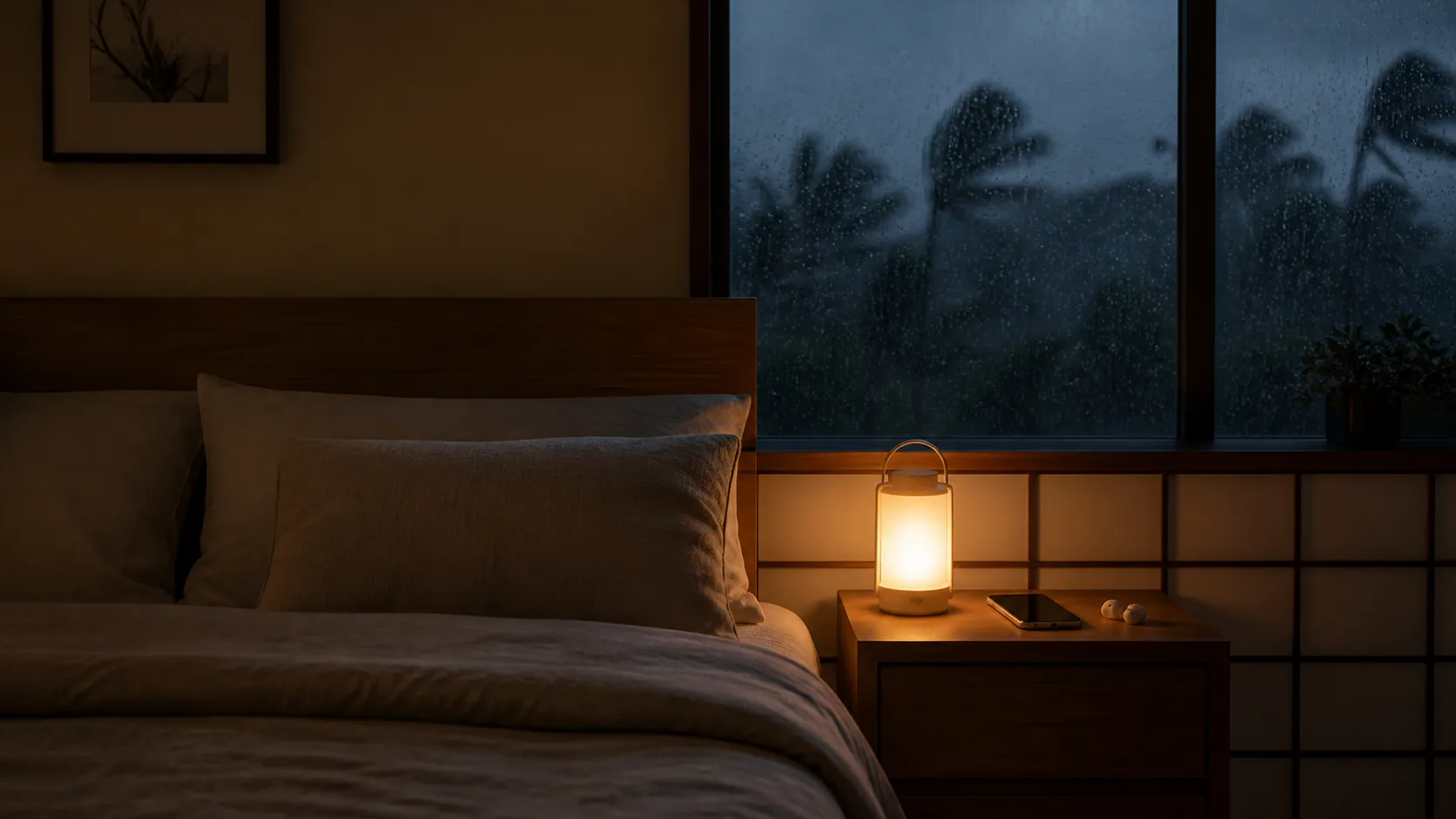
A good typhoon sleep setup does two jobs. It keeps you reachable by alerts, and it keeps ordinary discomfort from dragging you back into full alarm. It does not need to look impressive. It needs to work in a dark room at 3 a.m.
| Put within reach | Why it matters tonight |
|---|---|
| Phone, charged power bank, charging cable | Keeps official alerts available if the power drops |
| Battery-powered lantern or flashlight | Lets you move without using candles or stumbling in the dark |
| Water and any needed medication | Prevents unnecessary trips through the house |
| Earplugs or one earplug | Reduces non-informational noise while preserving alert awareness |
| Eye mask or cloth | Blocks lightning flashes, emergency lights, or hallway light |
| Light breathable layers | Helps if air conditioning or fans stop during an outage |
| Shoes or sandals | Protects your feet if you must get up quickly |
Use battery light instead of candles if possible. If you use white noise, use a battery-powered device or a phone at low volume, and keep emergency alerts allowed through. White noise should cover the drip-and-rattle layer of the storm, not bury the signal that tells you to act.
If the power is out or unstable, sleep cooler than you think you need to. Heavy bedding can become a problem in humid air without a fan. Choose breathable layers you can remove quickly, and keep water near the bed. For a fuller outage setup, this site’s guide to sleeping during a power outage in a thunderstorm goes deeper on heat, darkness, and noise control.
One rule is not negotiable: do not run generators, grills, camp stoves, charcoal burners, or other fuel-burning devices indoors, on balconies, or near windows and doors. Carbon monoxide has no useful warning smell, and a sleeping person cannot count on waking up to symptoms. Keep fuel-burning equipment well away from living spaces, and make sure carbon monoxide alarms are placed where they can wake you.
Set an alert-checking plan with an end point
The dangerous habit is not checking alerts. The dangerous habit is checking in a way that never produces a decision. Radar, social feeds, neighborhood chats, wind maps, and video clips can keep proving that the storm exists without telling you what to do next.
Weather and anxiety guidance generally favors having a plan and a kit over continuous monitoring. The National Weather Service storm anxiety page advises people to prepare, know where to go, and use reliable warning sources rather than feeding fear with nonstop storm content. [3] The Anxiety and Depression Association of America gives similar hurricane-season guidance: prepare in advance, limit media exposure, and return attention to what is controllable. [4]
A safe nighttime checking plan can be very plain:
- Check the official evacuation level and local alerts once before bed.
- Confirm your phone can sound emergency alerts and is not silenced in a way that blocks them.
- Set one planned check-in time if conditions are expected to worsen overnight.
- Do not open extra radar, social media, or live video unless an official alert or a real household change gives you a reason.
- If a new official instruction arrives, act on it; if no new instruction arrives, return to rest.
This is the line between monitoring and hypervigilance. Monitoring has a source, a trigger, and an action. Hypervigilance keeps asking for one more look even after the action is already complete.
When the room is prepared, give the body something specific to do
Storm anxiety can make sleep feel physically unavailable. That is not a character flaw. In a Korean observational study of 1,358 disaster victims exposed to typhoons, heavy rain, fire, or earthquake between 2012 and 2018, typhoon survivors had 2.75 times higher odds of poor sleep quality than earthquake survivors. [5] That study does not prove every person in Japan after Chanmi will sleep badly, and it does not make a direct claim about your bedroom tonight. It does show that typhoon-related sleep disruption is measurable enough to deserve practical planning.
Once the evacuation check, sleep zone, kit, and alert plan are handled, calming techniques are no longer pretending the danger is fake. They are a way to tell the body that the watch has been assigned to systems that can wake you if needed.
Use 4-7-8 breathing if your chest is tight
Breathe in through the nose for four counts, hold for seven, and exhale slowly for eight. Do four rounds, then breathe normally. Baylor College of Medicine, UAB, and Cleveland Clinic all point readers toward breathing or grounding techniques for storm-related anxiety and phobia symptoms, although their materials are written largely around severe storms, hurricanes, tornadoes, or astraphobia rather than this specific typhoon. [6][7][8]
Use 5-4-3-2-1 grounding if your mind keeps scanning
Name five things you can see, four things you can feel, three things you can hear, two things you can smell, and one thing you can taste. During a typhoon, do not choose the window for all five sights. Use the prepared room: lantern, wall, blanket, phone, shoes. The point is to relocate attention from imagined next events to the actual safe-enough space you have set up.
Use muscle release if the wind keeps making you brace
Starting at your feet, tighten one muscle group for a few seconds, then release it. Move upward: calves, thighs, hands, shoulders, jaw. Keep it gentle. You are not trying to win a relaxation contest; you are teaching clenched muscles that they do not have to answer every gust.
If anxiety at night is a familiar pattern for you even outside storms, it may help to understand how worry and arousal interfere with sleep. Sleep Foundation’s overview of nighttime anxiety explains the broader sleep-anxiety loop. [9] For a storm-specific version that is not tied to Chanmi, use this site’s general tropical-storm anxiety sleep protocol.
Make the storm less intrusive without blocking real warnings
Noise control during a typhoon is a balancing act. You want fewer startles, not total isolation. If you use earplugs, consider using one earplug on the side not facing your phone, or keep the alert device close enough and loud enough that official warnings cut through. If you use an eye mask, keep the battery light in the same place all night so you can reach it without searching.
Move the bed, futon, or pillow position away from windows if you can do it safely before lying down. Close curtains or blinds if they help reduce lightning flashes and visual motion. Do not keep getting up to inspect the glass unless something has actually changed, such as water coming in, a broken seal, or an official instruction to move.
For more detailed tactics on thunder, lightning, pressure changes, and startle responses, see the guide to sleeping through severe storms. If you are pregnant, older, using CPAP, or caring for someone whose medical equipment depends on electricity, use the more specific power-outage sleep guide for pregnancy, seniors, and CPAP users rather than relying on generic storm advice.
If you wake up during Chanmi, do the same check every time
Waking during a typhoon does not mean the plan failed. It means your brain heard something worth evaluating. Keep the evaluation short and repeatable.
- Look for an official alert first, not a social feed.
- Check the room for immediate changes: water, broken glass, smoke, heat, blocked exit, or a device alarm.
- If there is a real change, act on the prepared plan.
- If there is no real change and no new instruction, take a sip of water, restart one grounding technique, and lie back down.
Try not to punish yourself for partial sleep. During a typhoon night, two or three broken stretches of rest may be the realistic target. That is still better than keeping your whole body on watch when your alerts, room, and evacuation decision are already doing the work.
Rest is not neglect when evacuation guidance is followed and the environment is prepared. Constant checking is not the same as protection.
References
- Typhoon Chanmi Forces 200,000 to Evacuate in Kagoshima, Japan, Eastern Herald, June 2, 2026
- Tropical Storm Jangmi (2026), Wikipedia
- Storm Anxiety, National Weather Service
- Hurricane Season is Here: How to Reduce Your Anxiety, Anxiety and Depression Association of America
- Association between disaster experience and quality of life: the mediating role of sleep quality, Kim & Lee, 2021
- Navigating pre-storm anxiety, Baylor College of Medicine
- Understanding and managing storm anxiety during tornado season, UAB News
- Astraphobia, Cleveland Clinic
- Anxiety at Night, Sleep Foundation
Read the full guide: How to Sleep When Flight Anxiety Strikes