A Buck Moon Sleep Ritual for Perimenopause Insomnia
This article presents a timed moon breathing (Chandra Bhedana Pranayama) ritual for the 2026 Buck Moon to help perimenopausal women counter the 'tired but wired' insomnia that peaks around the full moon. Learn the simple 6-minute technique backed by quantitative evidence and understand why it directly addresses the hormonal and nervous system changes of perimenopause.
The 2026 Buck Moon peaks on July 29 at 10:36 a.m. EDT, which is inconveniently not when most people are trying to sleep.[1] For a Buck Moon sleep ritual for perimenopause insomnia, the more useful date is earlier: July 24 to 26. That is when the nervous system gets its warning window, because one lunar sleep study found that sleep disruption tended to peak 3 to 5 nights before the full moon, not only on the dramatic-looking night itself.[2]
That timing matters if your full-moon insomnia feels less like ordinary restlessness and more like being exhausted with the lights still on inside your body. Perimenopause can already make sleep shallower, hotter, and easier to fracture. Add a few bright, restless nights around the full moon, and the problem is not that you failed to relax hard enough. The problem is that your sleep system may need a cue before bedtime, repeated early enough to matter.
Use the Buck Moon window, not just the Buck Moon night
A sensible 2026 plan starts before the calendar says “full moon.” If the Buck Moon peaks the morning of Wednesday, July 29, the bedtime practice belongs on the nights leading into it, then continues through the peak night if you want the ritual anchor.
| Date | Why it matters | What to do |
|---|---|---|
| Friday, July 24 | Five nights before the Buck Moon peak; inside the disruption window reported by Casiraghi et al.[2] | Begin the 6-minute moon breathing practice before bed. |
| Saturday, July 25 | Four nights before peak; often the kind of night people dismiss until the pattern repeats | Keep the routine identical. Do not add complexity. |
| Sunday, July 26 | Three nights before peak; still inside the evidence-supported timing window[2] | Practice before bed even if you feel only mildly wired. |
| Monday, July 27 to Thursday, July 30 | Builds continuity across the visible full-moon period | Continue nightly if it feels calming and stop if it feels uncomfortable. |
This is the first place moon language can become either useful or sloppy. The moon can be a calendar cue. It should not become a guarantee. The Sleep Foundation’s review of lunar sleep research notes that studies have found associations between moon phases and sleep, including shorter sleep and later bedtimes in some settings, but the evidence is not uniform across every person or every study.[3] One frequently cited laboratory study reported that around the full moon, participants took 5 minutes longer to fall asleep and had a 30% reduction in deep sleep.[3]
For a woman in perimenopause, that does not prove the Buck Moon is causing her 2 a.m. wake-up. It does make the timing worth respecting, especially if she has already noticed a pattern in her own sleep diary.
Why this particular breathing practice fits “tired but wired” sleep
Chandra Bhedana Pranayama is often called moon breathing or left-nostril breathing. In practical bedtime terms, it is a short pattern: inhale through the left nostril, exhale through the right, and make the exhale longer than the inhale. The useful part is not the poetry of the name. The useful part is that the pattern gives an over-alert body a slow, repeatable parasympathetic cue.
That matters in perimenopause because the insomnia often has a wired quality. Stanford Lifestyle Medicine describes perimenopause sleep disruption as tied to hormonal shifts, including estrogen changes that can affect circadian regulation.[4] Allara Health similarly explains that declining progesterone can reduce GABA-related calming effects, removing some of the sedating influence that helped the nervous system downshift in earlier years.[5]
Put less clinically: the body may be tired, but the brake pedal is not as reliable. Progesterone decline can leave some women with less of the GABAergic inhibition that usually helps quiet neural activity. Estrogen fluctuation can make temperature regulation, mood, and circadian stability less predictable. If the evening also includes bright screens, alcohol, stress, night sweats, or a moonlit room that nudges wakefulness later, sleep onset can turn into a standoff.
A longer exhale is not a hormone replacement. It is a small nervous-system intervention. Slow exhalation is commonly used to increase vagal tone and tilt the body away from sympathetic activation. A breathing teacher interviewed by Saatva describes moon breathing as a calming practice and advises that the exhale be longer than the inhale for that reason.[6] That is the part worth carrying to the bedside.
There is one important boundary: the tempting “double hit” story, in which perimenopause and the full moon both suppress melatonin in the same woman at the same time, is a synthesis of separate research streams. It is not a single study result in perimenopausal women. The honest version is narrower: perimenopause can increase vulnerability to insomnia, lunar phase may affect sleep in some studies, and a short calming breath practice is plausible enough to test during the risk window.
The 6-minute moon breathing ritual
Do this before bed, ideally after the lights are already low and before you get into a fight with the clock. Keep it plain. The point is to give your body one reliable sequence, not to build an elaborate ceremony when you are already depleted.
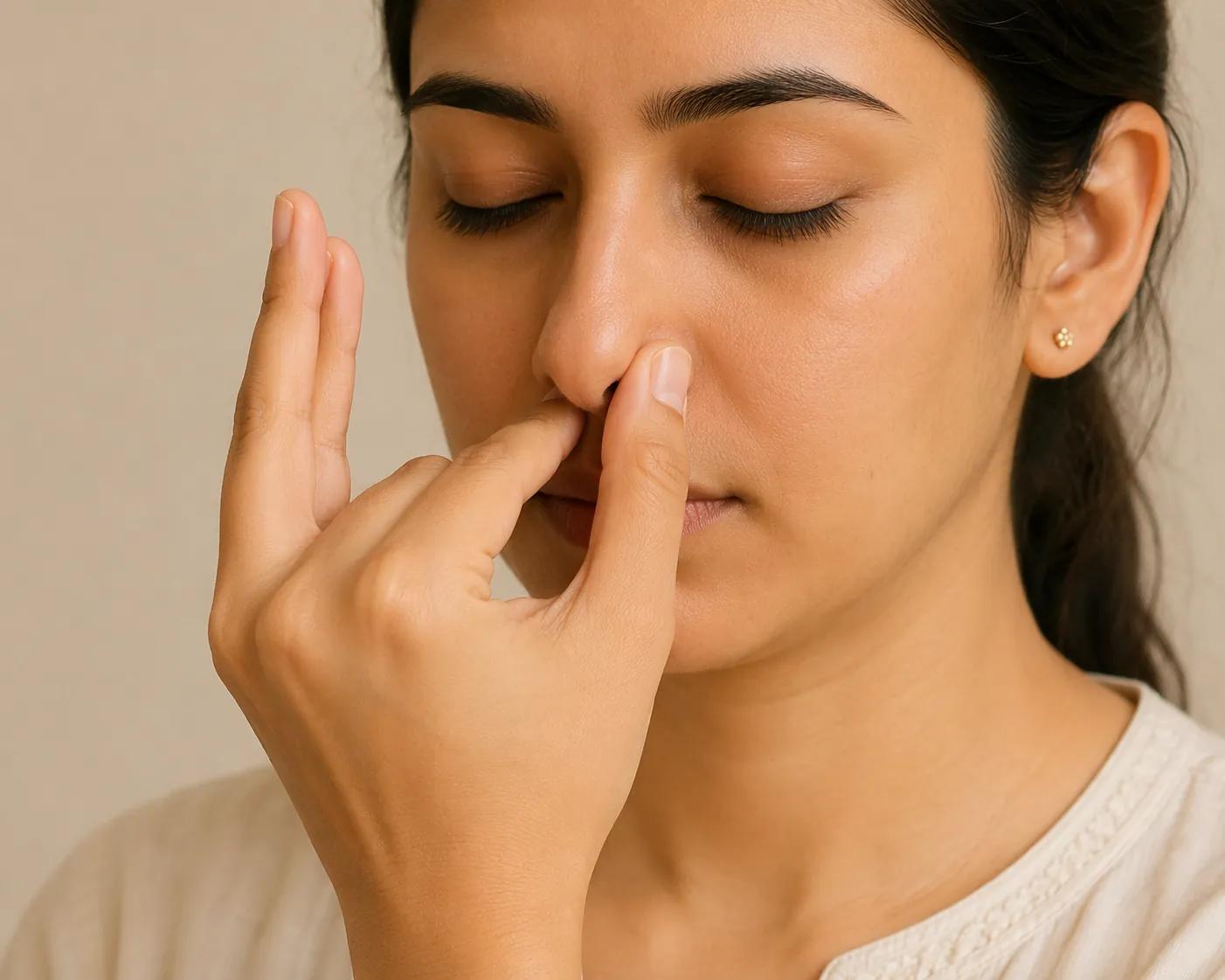
- Sit comfortably on the edge of the bed, in a chair, or supported against pillows. Keep the spine upright but not rigid.
- Close the right nostril gently with your right thumb.
- Inhale through the left nostril for a count of 4.
- Close the left nostril gently with your ring finger.
- Release the thumb and exhale through the right nostril for a count of 6 to 8.
- Repeat for 4 to 6 rounds, or about 6 minutes.
If a count of 8 makes you strain, use 6. If counting makes you anxious, silently think “in” on the left-side inhale and “out, out” on the longer right-side exhale. The exhale should feel like a soft lengthening, not a breath-holding contest.
Stop if you feel dizzy, short of breath, panicky, chest discomfort, or air hunger. Avoid this practice, or ask a clinician first, if you have uncontrolled hypertension, an acute asthma exacerbation, or pregnancy; those cautions are specifically raised in guidance on moon breathing.[6]
What the evidence can and cannot promise
The strongest breathing-specific evidence here comes from a 2022 study in the International Journal of Preventive Medicine. Forty-eight medical students practiced left-nostril breathing nightly before bed for 4 weeks. Their mean Pittsburgh Sleep Quality Index score dropped from 6.63 ± 3.6 before the intervention to 3.46 ± 2.1 afterward, with p < 0.0001.[7]
That is unusually concrete for a low-burden breathing practice. The study also reported significant improvement across all seven PSQI components: subjective sleep quality, sleep latency, sleep duration, habitual sleep efficiency, sleep disturbances, use of sleep medication, and daytime dysfunction.[7] Those categories are not decorative. They are the difference between “I slept a little better” and measurable changes across the main ways a person experiences sleep quality.
But the sample matters. The participants were medical students with a mean age of about 19.8 years, not women in their 40s or 50s navigating hormonal transition.[7] So the fair conclusion is not that Chandra Bhedana has been proven to treat perimenopause insomnia. The fair conclusion is that nightly left-nostril breathing has quantitative sleep-quality evidence in a young adult group, and its calming mechanism is relevant enough to test cautiously in perimenopause.
The need is not small. A 2023 meta-analysis reported a 50.3% prevalence of sleep disorders in perimenopause.[8] That figure does not mean every perimenopausal woman has the same sleep problem. It does mean sleep disruption is common enough that vague reassurance is not adequate care.
How to keep the ritual from becoming another thing to fail at
Use the Buck Moon as the reminder, not the judge. If you miss July 24, start July 25. If you forget one night, do not “make up” rounds the next night. A nervous system that is already monitoring itself too closely does not need a performance metric at bedtime.
The best setup is boring: dim lights, phone away, bedroom cool, one hand position, one count. If environmental cues are part of your sleep pattern, pair the breathing with simple bedroom changes rather than adding more ceremony; Restful Ground’s guide to feng shui bedroom placement for better perimenopause sleep is a gentler place to look than another supplement shelf.
If your full-moon nights are tangled with revenge bedtime procrastination, streaming, or the wired feeling that arrives after “just one more episode,” the breathwork may help only after the trigger moves earlier. The hyperarousal pattern is covered more directly in why perimenopause turns a Netflix binge into a sleepless night.
And if the moon itself is the part you track, it is fine to keep tracking it. A sleep diary that notes cycle phase, hot flashes, alcohol, late meals, screen exposure, moon phase, and wake time is more useful than a vague memory that “the full moon always ruins me.” For broader lunar sleep context, see Restful Ground’s Blood Moon sleep disruption guide.
When breathwork is not enough
A 6-minute practice is reasonable when the burden is low and the risk is bounded. It is not a substitute for care when insomnia is persistent, when night sweats are severe, when anxiety is escalating, or when you are using alcohol, antihistamines, or supplements more often because sleep feels out of reach.
For that level of disruption, route the problem into structured treatment rather than a more elaborate moon ritual. Restful Ground’s CBT-I pathway for perimenopause sleep is a better next step, especially when wakefulness has become conditioned to the bed itself. Breathwork can still be part of the wind-down, but it should not carry the whole burden of a chronic sleep disorder.
For the July 24 to 30, 2026 Buck Moon window, Chandra Bhedana is a small, evidence-adjacent ritual worth trying for perimenopausal “tired but wired” insomnia: timed early, practiced gently, and kept honest about what the evidence actually shows.
References
- Full Moon July 2026: The Buck Moon, The Old Farmer’s Almanac.
- Moonstruck sleep: Synchronization of human sleep with the moon cycle under field conditions, Science Advances, 2021.
- Do Moon Phases Affect Sleep?, Sleep Foundation.
- Sleep and Perimenopause, Stanford Lifestyle Medicine.
- Perimenopause Insomnia: How Hormones Disrupt Your Sleep, Allara Health.
- Moon Breathing: What Is It and How Does It Help You Sleep?, Saatva.
- Effect of Chandra Nadi Pranayama on Sleep Quality in Medical Students, International Journal of Preventive Medicine, 2022.
- Global prevalence of sleep disorders during menopause: a meta-analysis, 2023.
Safety & eligibility read
Cross-check against other interventionsExplore the mechanism
Next step
Spot an error or have clinical feedback?
Because this article covers clinical, medication, or safety information, we use a moderated correction channel instead of open public comments. Let us know if something about “A Buck Moon Sleep Ritual for Perimenopause Insomnia” needs a closer look.
Send feedback on this article