
Tornado Warning Ended — Now How Do I Sleep?
If the tornado warning has ended but your heart is still racing, start by downshifting your body before you try to force sleep. The official all-clear can arrive faster than your nervous system can stand down. That lag is not weakness, and it is not a sign that you “failed” to calm yourself. A tornado warning is a real threat cue; your brain and body treated it that way.
For the next few minutes, the job is not to convince yourself nothing happened. The job is to give your brain several clear safety signals in order: ground before leaving shelter, reset your senses, re-enter the bedroom deliberately, borrow calm from another living body if you can, and only then work with the thoughts that keep replaying.
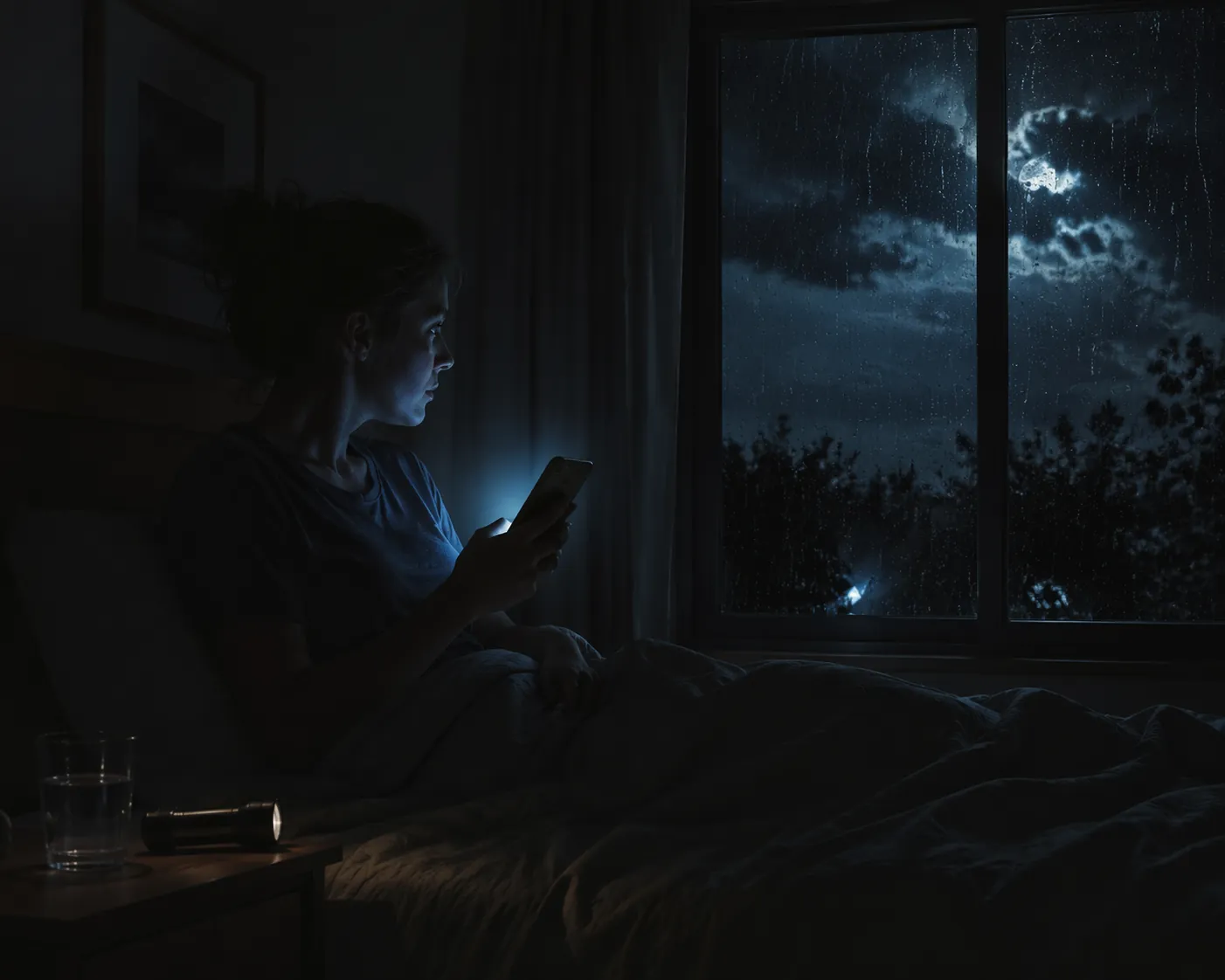
The Post-Warning Wind-Down Protocol
This sequence is not a clinically tested tornado-warning sleep treatment as a complete package. It is a practical protocol drawn from storm-anxiety guidance, grounding techniques, co-regulation concepts, and sleep-anxiety strategies used in adjacent clinical work. That distinction matters: use it as a structured way to help your body stand down, not as a promise that one exact script works for everyone.
| Moment | What to do | Why it helps |
|---|---|---|
| Before leaving shelter | Use 5-4-3-2-1 grounding while still seated or standing safely. | It gives the threat-monitoring brain present-time sensory evidence. |
| First few minutes after all-clear | Lower the sensory intensity: dim phone, reduce alert sounds, sip water, unclench your body. | It stops adding fresh alarm signals after the warning has ended. |
| Bedroom re-entry | Enter the room as a safety check, not as a demand to sleep immediately. | It prevents the bed from becoming a place where you perform calmness. |
| If someone calm is nearby | Let a steady person or pet help your body match a slower rhythm. | Calm social cues can support down-regulation. |
| If your mind keeps replaying | Use a short worry plan, then return to a low-effort rest position. | It gives the brain a place to put the next-warning question without solving it all night. |
1. Ground before you leave the shelter
Do this while you are still in the safest place you used during the warning: hallway, bathroom, basement, closet, interior room. Do not make the first post-warning act a jump back into scanning windows, radar loops, outdoor sounds, or damage checks unless there is an immediate safety reason. Your body just spent the warning looking for danger. Give it one minute of ordinary reality before asking it to move.
Use the 5-4-3-2-1 grounding technique in a literal way. Name five things you can see. Name four things you can feel. Name three things you can hear. Name two things you can smell. Name one thing you can taste. UAB includes this technique in storm-anxiety guidance, and similar severe-weather anxiety resources from Riverside Healthcare, Nashville Psych, and Baylor College of Medicine also point readers toward sensory grounding as a way to come back into the present moment after alarm activation.[1][2][3][4]
- Five things you can see: the door hinge, a towel, the edge of the bathtub, your shoes, the phone charger.
- Four things you can feel: your feet on the floor, your shirt against your shoulder, the wall behind you, your tongue resting in your mouth.
- Three things you can hear: the air conditioner, rain easing off, your own breathing.
- Two things you can smell: soap, laundry, damp air, or even nothing obvious.
- One thing you can taste: water, toothpaste, mint, or just the neutral taste in your mouth.
The point is not to make the fear disappear on command. The point is to interrupt the brain’s rapid-fire threat search with specific, current, non-tornado information. “The towel is blue” is not profound. At 1:17 a.m., after a warning siren, it may be exactly the kind of plain fact your body can use.
2. Turn the warning environment back into a room
After grounding, change only a few things. This is not the time to deep-clean, reorganize the closet, or review every radar frame from the last hour. Make the room less like a command center.
- Set your phone brightness low and silence nonessential alerts, while keeping whatever weather alert access you actually need.
- Take a few sips of water, especially if your mouth is dry from adrenaline.
- Drop your shoulders, open your hands, and let your jaw loosen once rather than trying to breathe perfectly.
- If you used a blanket, shoes, flashlight, or bike helmet during sheltering, place them where you can find them without keeping them in your lap.
Works Counseling Center describes “storm aftercare” and suggests comfort items such as aromatherapy, fidget toys, a blanket, and soothing music in or near the shelter area so sheltering feels less punishing.[5] That idea is useful after the warning, too. A comfort kit is not childish; it lowers the cost of doing the safe thing during the next warning, and it gives your senses something predictable when the weather has been anything but.
Keep this reset brief. The longer you remain in full monitoring mode, the more your body learns that the end of the warning is still a time to stand guard. If you need to check one official source, check one official source. Then close the loop: “The warning has expired. I know where my shelter is. My alerts are on.”

3. Re-enter the bedroom as a safety signal, not a test
The bedroom can feel strange after a tornado warning. A few minutes earlier, you may have left it quickly because it was not the safest place to be. Now you are supposed to lie down in it and become unconscious again. If your body hesitates at that doorway, it is making a crude but understandable association: bed equals vulnerable.
So do not march back in and demand sleep. Re-enter the bedroom as if you are reintroducing it to your nervous system.
- Stand in the doorway and name one sign that the room is intact: the lamp is still there, the window is closed, the floor is clear enough to walk.
- Turn on only enough light to orient yourself, then reduce it again.
- Put your phone somewhere reachable but not in your hand.
- Sit on the edge of the bed for 30 to 60 seconds before lying down.
- Let your feet feel the floor, then let your body feel the mattress.
That small pause matters. It separates “I escaped here because the warning ended” from “I am forcing myself to sleep because I should be over it.” The second one often keeps the body braced. The first gives it a sequence it can follow.
4. Borrow calm if it is available
If another person in the house is calm, or if a pet is nearby and settled, use that. Nashville Psych and Riverside Healthcare both describe co-regulation in weather anxiety: the nervous system can take safety cues from a calm person, grounding voice, or steady animal presence.[2][3]
This does not require a long conversation. In fact, a long post-storm debrief may wake you further. Try a short exchange: “The warning is over. I’m still keyed up. Can you sit with me for two minutes?” If you are with a pet, put one hand on the animal’s side and feel the rhythm of breathing or warmth. You are not asking someone else to remove the fear. You are letting your body register that another nervous system is no longer acting as if the threat is immediate.
If you are alone, use a recorded calm voice, a familiar low-volume podcast, or a soft sound you already associate with ordinary nights. Keep it boring. The goal is companionship for your alert system, not entertainment for your waking brain.
5. Give the “what if another warning comes?” thought a job
This is usually the thought that keeps the night open. It is not irrational. Severe weather can come in rounds. Phones can fail. Sirens may be hard to hear indoors. Your mind is trying to prevent you from being caught off guard.
Answer it with a plan, not an argument. A plan has an endpoint; an argument can run until morning.
- “My alerts are on.”
- “My shelter spot is the interior bathroom.”
- “My shoes and phone are beside the bed.”
- “If another warning comes, I will go there again.”
Then stop improving the plan. The anxious brain often disguises reassurance-seeking as preparedness: one more radar check, one more social media search, one more local report. If the action would change what you do next, it may be useful. If it only restarts the alarm loop, postpone it until morning.
A short phrase can help close the loop: “I have a warning plan. I do not have to stay awake to make the plan work.” It may not feel fully true yet. It only needs to be clear enough that you can return to resting.
Why Your Body Does Not Stand Down on Schedule
UAB’s Merida Grant explains storm anxiety through the brain’s salience network, which helps decide what deserves attention. In that account, the amygdala detects threat, the insula tracks internal body sensations, and the frontal cortex helps evaluate and regulate the response.[1] During a warning, those systems have good reason to prioritize danger: sound, darkness, urgency, family logistics, and uncertainty all arrive at once.
The problem after the warning is timing. The weather alert can expire in an instant. Your amygdala, chest, stomach, muscles, and listening ears may not update that quickly. The insula may still be reporting a pounding heart or tight throat; the amygdala may treat those sensations as more evidence that something is wrong; the frontal cortex may try to reason with both while half-asleep. That is how a person can know the warning ended and still feel as if they are waiting for impact.
This stress-sleep link is broader than tornado warnings. In a 2024 American Academy of Sleep Medicine survey, 74% of Americans said stress disrupted their sleep, and 68% said anxiety disrupted it.[6] That does not prove anything specific about post-tornado sleep, but it does put the experience in the right category: a threat-activated body often has trouble turning sleep back on.
That is why the order of the protocol matters. Grounding gives the salience network new input. Sensory reset reduces fresh alarm cues. Bedroom re-entry changes the meaning of the room. Co-regulation adds a social safety signal. The cognitive step keeps your planning system from working all night.
If Sleep Still Will Not Come
After a real warning, “sleep” may be too big a target. Aim first for rest without monitoring. Lie down in a position that feels protected enough: side-lying, one hand under the pillow, blanket pulled up, feet able to find the floor. Keep the room dim. Let your breathing be ordinary before you try to slow it.
If you are still wide awake after a while, get out of bed briefly but do not restart storm patrol. Sit somewhere low-lit and uninteresting. Read something familiar, fold a blanket, hold a warm mug, or listen to a quiet track. Return to bed when sleepiness begins to show up again. This protects the bed from becoming the place where you lie still and rehearse disaster.
If your mind keeps showing the same scene, try writing three lines on paper: what happened, what you did, and what you will do if another warning comes. Keep it plain. “Warning at night. Sheltered in bathroom. Alerts on; shoes by bed.” A complete account is for daylight. At night, the note is just a container.
Do not punish yourself for checking once. Also do not let checking become the only way your body feels allowed to rest. There is a middle place: one official update, one clear plan, then back to low stimulation.
When This Is More Than One Bad Night
Most people do not need to pathologize one hard night after a warning. The threshold changes when the fear starts traveling beyond the storm. If post-warning sleep disruption lasts more than a month, starts happening on clear nights, leads you to avoid ordinary activities, or makes you feel constantly on guard, it is time to talk with a clinician.
Cleveland Clinic describes lilapsophobia as an intense fear of tornadoes or hurricanes, and storm-related distress can also overlap with post-traumatic stress symptoms after a frightening or destructive event.[7][8][9] Those labels are not something to pin on yourself at 2 a.m. They are signposts for when support should become more formal.
If severe-weather anxiety is part of a wider pattern, you may also find it useful to read about sleeping with hurricane anxiety, earthquake-related sleep anxiety, flight anxiety at bedtime, or nighttime panic during perimenopause. Different triggers can share the same late-night problem: a body that has not yet received enough safety signals to let sleep return.
Tonight, the goal is modest. You do not have to feel calm on command. You have to give your body a few deliberate signals that the threat window has closed: present-time senses, lower stimulation, a safe re-entry to bed, a simple next-warning plan, and enough quiet for the sleep drive to come back online.
References
- Understanding and managing storm anxiety during tornado season, UAB School of Medicine.
- Coping with Anxiety Around Severe Weather, Riverside Healthcare.
- Finding Calm in the Storm, Nashville Psych.
- Navigating pre-storm anxiety, Baylor College of Medicine.
- A therapist's experience with storm anxiety and tips to overcome it, Works Counseling Center.
- Stress, anxiety and depression survey shows mental health conditions disrupt a majority of Americans' sleep, American Academy of Sleep Medicine, 2024.
- Lilapsophobia, Cleveland Clinic.
- Hurricane Season is Here: How to Reduce Your Anxiety, Anxiety and Depression Association of America.
- Coping with Stress After a Tornado, Mississippi State University Extension.