
Why You Wake Up Panicking During Perimenopause
Learn why nocturnal panic attacks spike during perimenopause due to a triple convergence of hormonal changes, nighttime cortisol surges, and a high rate of undiagnosed sleep-disordered breathing — and why effective management must address all three drivers, not just the anxiety symptom.
It is one thing to wake at 3:17 a.m. because the room is too hot. It is another to come upright with your heart pounding, sweat on your chest, a hard wave of dread, and the immediate question: Is this a panic attack, a hot flash, a heart problem, or something wrong with my breathing?
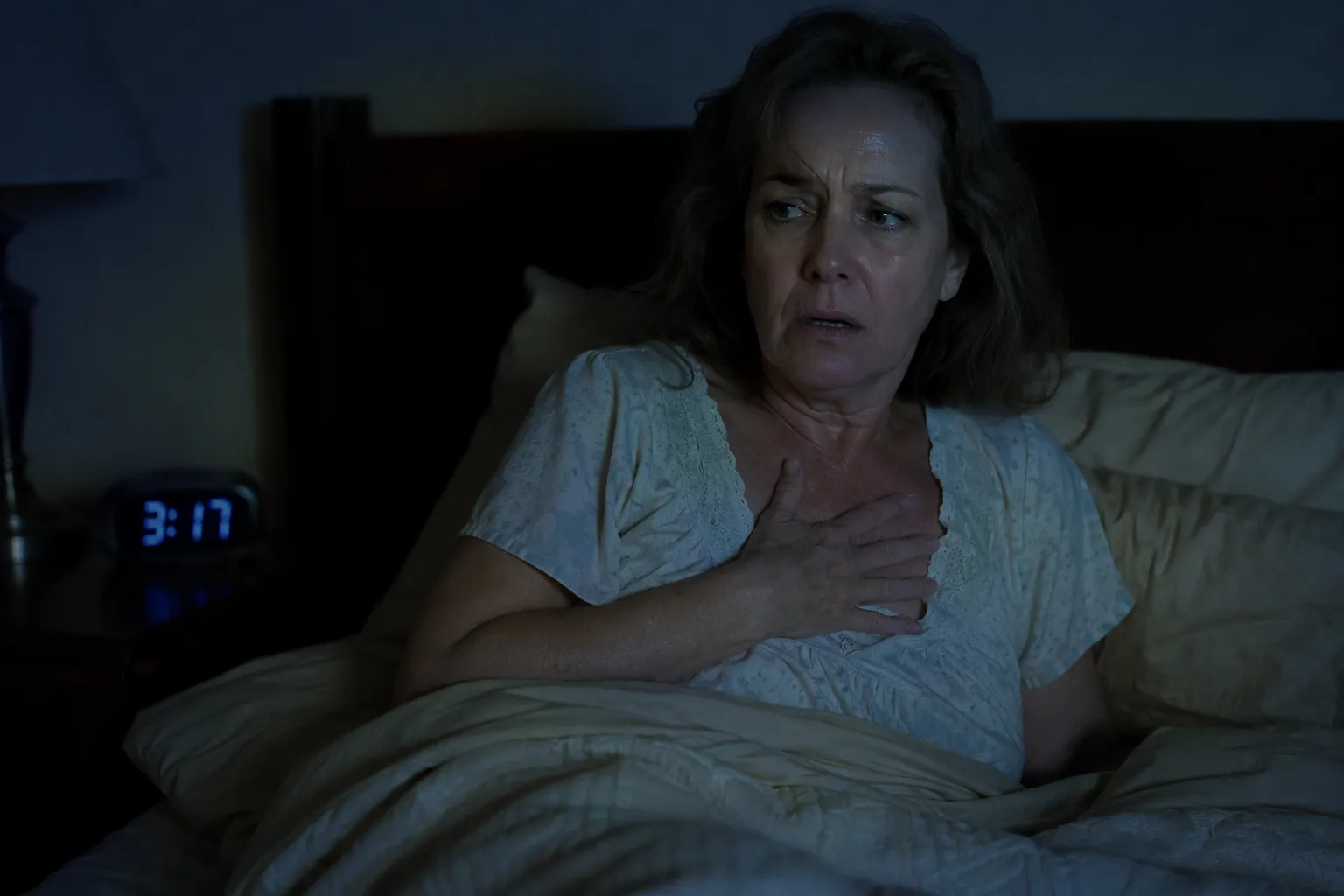
For many women in perimenopause, the answer is not neatly one thing. Panic attacks and sleep in perimenopause often meet at the intersection of three systems: shifting estrogen and progesterone, a stress-response system that is no longer keeping normal nighttime rhythm, and sleep-disordered breathing that can jolt the body awake with an adrenaline surge. If only the word “anxiety” is written in the chart, the loop can stay intact.
The pattern is common enough to deserve a serious explanation. Johns Hopkins Medicine notes that up to 55% of women report new or increased anxiety during perimenopause [1]. A more specific, older figure comes from a 2006 JAMA Internal Medicine study cited by Winona: about 9.8% of women experienced a panic attack during a 6-month window in the menopausal transition [2]. Sleep is already unstable in this period, with sleep disturbances affecting 40–60% of menopausal women [3].
That does not mean every 3 a.m. surge is hormonal. New chest pain, fainting, irregular heartbeat, severe shortness of breath, neurologic symptoms, or a sudden change in exercise tolerance belongs in medical evaluation, not self-reassurance. But when the same middle-of-the-night episode keeps repeating in the perimenopause years, the timing itself is a clue.
Why the body can feel ambushed at night
A daytime panic attack often has a story attached to it: a meeting, a conflict, a crowded room, a frightening thought. Nocturnal panic can feel more insulting because there may be no story at all. You were asleep. Then the alarm system went off.
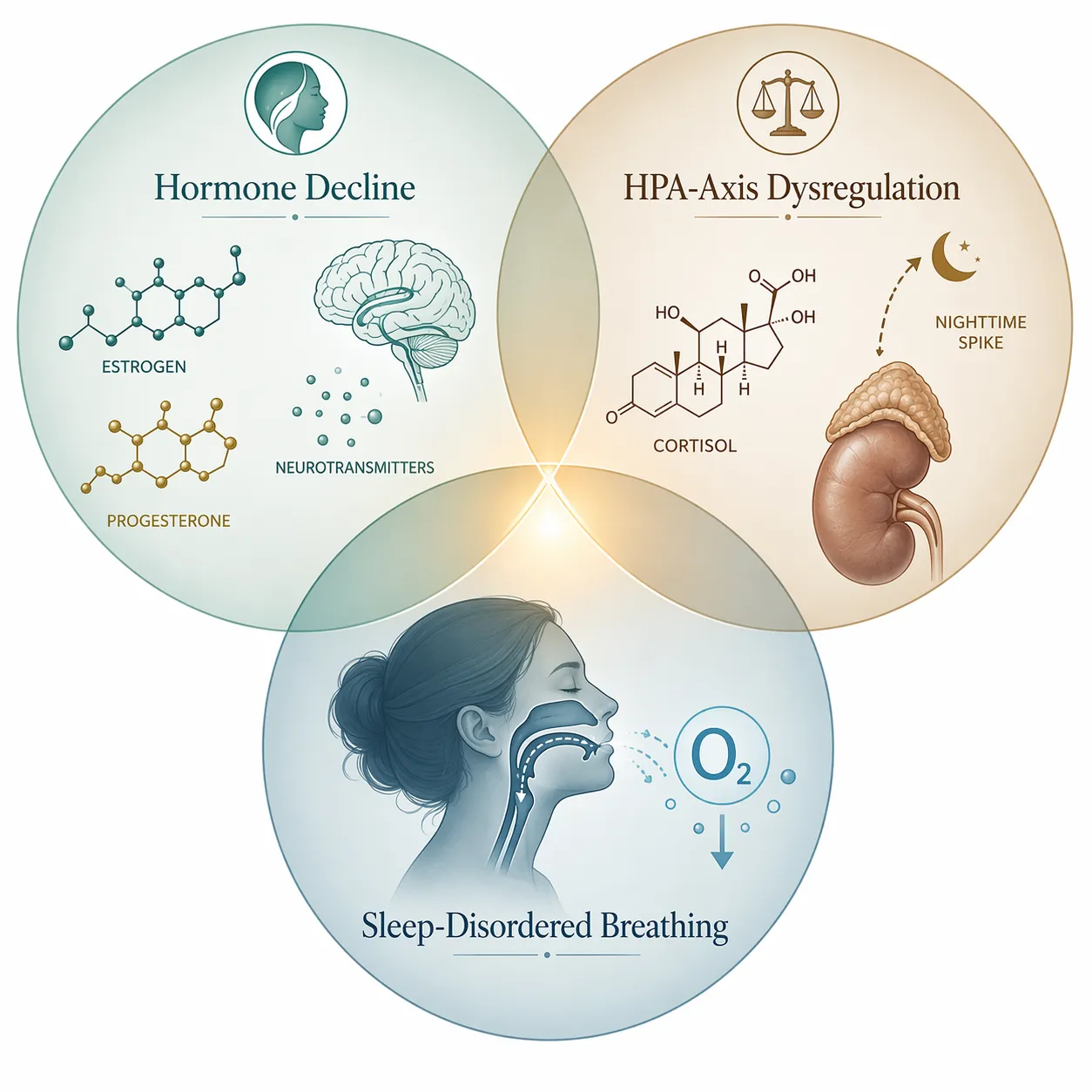
Perimenopause lowers the panic threshold partly because estrogen and progesterone are not just reproductive hormones. Estrogen is involved in serotonin signaling, and progesterone is metabolized into allopregnanolone, a neurosteroid that interacts with GABA-A receptors, one of the brain’s calming systems [4][5]. When levels fluctuate and decline, the same stimulus that once barely registered can feel like an emergency signal.
This is why some women describe themselves as suddenly less tolerant of caffeine, conflict, scary movies, noise, or bad news at bedtime. The stimulus did not become objectively more dangerous. The nervous system’s buffer changed. That lower threshold is also why a guide on why scary movies keep you up at night during perimenopause belongs in the same conversation as nighttime panic: the issue is not weakness, it is reactivity.
The second driver is the HPA axis, the body’s hypothalamic-pituitary-adrenal stress system. Cortisol is supposed to follow a daily rhythm, generally lower overnight and rising toward morning. In perimenopause, that rhythm can become less cooperative. The evidence supports a narrower but important conclusion: perimenopause-related stress-system dysregulation can contribute to nighttime cortisol activation, and chronic stress exposure predicted more wake-after-sleep-onset and higher insomnia likelihood in the SWAN sleep study as discussed by Baker and colleagues [3].
This helps explain why the episode lands in the 2–4 a.m. window for many women. The brain is moving through vulnerable sleep transitions; body temperature, cortisol rhythm, glucose regulation, and autonomic tone are all in motion. If the stress system fires at the wrong moment, the body can wake first and invent the fear second. The thought “something is wrong” may be a response to the surge, not its original cause.
Hot flashes complicate the picture because they can bring the same visible evidence: sudden onset, sweating, palpitations, nausea, and an abrupt awakening. In perimenopausal women, hot flashes were linked to about 27% of objective wake-after-sleep-onset, and 69% of nocturnal hot flash events coincided with an awakening [3]. In other words, it is not poor body awareness if you cannot tell at 3 a.m. whether the heat caused the panic or the panic caused the heat.
The most useful distinction is usually the emotional signature, though it is not a perfect diagnostic tool. A vasomotor symptom often centers on heat discomfort, flushing, and the need to uncover or cool down. A panic attack centers on dread, fear, doom, or a sense that something terrible is happening, even when heat and sweat are also present. Alloy, Bonafide, and the Psychopharmacology Institute all describe this overlap while cautioning that the two experiences can be difficult to separate in real time [6][7][8].
The breathing problem that can look like panic
Sleep-disordered breathing is the part too many women are not warned about. The stereotype is still a man snoring loudly, gasping, and falling asleep during the day. Women can have sleep apnea with a different presentation: insomnia, frequent awakenings, morning headaches, fatigue, anxiety symptoms, and episodes that feel like nocturnal panic.
The physiology is straightforward. If breathing is repeatedly restricted during sleep, oxygen and carbon dioxide signals can push the body into arousal. The brain wakes the body to reopen the airway. That arousal can arrive with a racing heart, adrenaline, sweating, and terror. From inside the episode, it may feel exactly like panic.
The menopausal transition matters here too. Wisconsin Sleep Cohort data found that postmenopausal women were 2.6 times more likely than premenopausal women to have an apnea-hypopnea index of at least 5, a threshold used to indicate sleep-disordered breathing [9]. The data comes from 2003 and 2017 analyses, so it should not be treated as the last word on current prevalence. It is still a strong signal that breathing deserves a seat at the table.
This is especially worth considering if the episodes come with snoring, witnessed pauses in breathing, waking with choking or gasping, dry mouth, morning headache, high blood pressure, reflux, restless sleep, or daytime fatigue despite enough hours in bed. A woman does not have to match the old apnea stereotype to merit screening. The atypical sleep apnea symptom checklist for women is a practical place to organize those clues before a clinician visit.
What actually breaks the loop
The useful question is not “Is this anxiety or hormones or sleep apnea?” It is “Which drivers are keeping this body on alert at night?” The answer determines the treatment sequence.
| Driver | What it can feel like at night | What to discuss or test |
|---|---|---|
| Hormone fluctuation and decline | Lower panic threshold, hot flashes, mood volatility, new sensitivity to stressors | Vasomotor symptom treatment, hormone therapy eligibility, mood treatment options |
| HPA-axis and insomnia feedback | Waking between 2–4 a.m., dread after repeated bad nights, fear of going to sleep | CBT-I, stress-system downregulation, treatment for chronic insomnia |
| Sleep-disordered breathing | Adrenaline jolts, gasping, racing heart, repeated awakenings, unrefreshing sleep | Sleep apnea screening or sleep study, especially with atypical symptoms |
Start with the insomnia-panic feedback loop
CBT-I deserves more attention than another list of bedtime tips because it targets the machinery that keeps nocturnal panic repeating: conditioned arousal, sleep effort, clock-watching, irregular sleep windows, and the dread that begins hours before bedtime. Once the bed becomes the place where the body expects alarm, reassurance alone rarely holds.
The evidence is unusually relevant. In the MsFLASH randomized clinical trial, telephone-delivered CBT-I improved insomnia symptoms in peri- and postmenopausal women with vasomotor symptoms, with benefits maintained at 6-month follow-up [10]. A separate JAMA trial found CBT-I superior to sleep medication alone over the long term in older adults with chronic insomnia [11]. These trials do not prove CBT-I cures nocturnal panic in perimenopause, but they do support it for the sleep instability that lets panic become habitual.
In practice, CBT-I is where many women should begin if the dominant problem is fear of the night itself: lying down already scanning the body, waking and checking the clock, extending time in bed to compensate, then sleeping more lightly because the brain has learned vigilance. The same logic is explained in more detail in Heat Dome Night Sweats? Why CBT-I Helps Perimenopause Sleep.
- Keep the clock out of view; time-stamping every episode can train the brain to expect another one.
- If you are awake and escalating, leave the bed briefly for a quiet, dim, non-rewarding reset rather than rehearsing panic in place.
- Do not expand the sleep window dramatically after a bad night; it can weaken the sleep drive that helps the next night consolidate.
- Track episodes by pattern, not obsession: time, heat, gasping, alcohol, late caffeine, stress load, cycle changes, and next-day fatigue.
For readers dealing with grief, caregiving strain, or cumulative stress, the 2–4 a.m. wake-up may also be the hour when the nervous system has the least margin. The sleep work is still practical, not moral. The goal is to stop teaching the brain that nighttime wakefulness requires emergency-level attention. Related strategies appear in Coping with Grief and Insomnia During Perimenopause and Perimenopause Thunderstorm Sleep Tips That Actually Help.
Screen for breathing-related surges before calling treatment failure
If an airway problem is waking the body, anxiety treatment may soften the fear without removing the trigger. That is why sleep apnea screening should not be saved for last, especially when the episodes include gasping, choking, snoring, morning headache, resistant hypertension, or unexplained daytime exhaustion.
A home sleep apnea test or lab sleep study is not a punishment for being anxious; it is a way to find out whether the body is being startled awake to breathe. If apnea is present, treating it can reduce the physiological arousals that keep being interpreted as panic. If it is not present, that result still narrows the field and keeps attention on hormones, insomnia, and mood.
Discuss hormone and mood treatment with the right level of certainty
Hormone therapy is worth discussing when nighttime panic travels with clear vasomotor symptoms, sleep disruption, cycle irregularity, and other perimenopausal changes. Oral micronized progesterone is especially interesting because progesterone’s allopregnanolone pathway has GABA-ergic calming effects, and progesterone treatment has been studied for sleep quality and vasomotor symptoms [4][5].
But the honest sentence matters: the evidence does not support a claim that hormone therapy has been proven in large randomized trials to treat nocturnal panic attacks specifically. The stronger evidence is adjacent: improvements in sleep quality, vasomotor symptoms, and mood-related outcomes, plus a plausible mechanism. That may still be clinically meaningful, but it is not the same as a direct cure claim.
SSRIs and related medications can also be useful, particularly when daytime anxiety, depression, frequent panic, or intrusive fear is part of the picture. There is an unresolved debate about whether hormone therapy should be considered earlier than SSRIs for some perimenopausal mood symptoms. The practical answer is individualized: risk profile, vasomotor symptoms, past mood history, clot and cancer risks, medication tolerance, and patient preference all matter.
Supplements deserve a much smaller role than they usually get online. Magnesium glycinate and L-theanine are often discussed for sleep and GABA support, and there is some supportive evidence in the broader sleep-and-calming category. But one of the cited consumer sources also sells L-theanine products, so supplement claims should be treated as lower-tier, conflict-aware possibilities rather than the backbone of care [4]. They should also be checked against kidney disease, blood pressure medication, sedatives, and other prescriptions.
A clinician visit is easier when the pattern is visible
Bring the pattern, not just the fear. A clinician can do more with “I wake between 2 and 4 a.m. three nights a week, drenched and tachycardic, sometimes gasping, worse after alcohol and before my period, with morning headaches twice a week” than with “I think I’m having panic attacks.” The first version keeps the body in the room.
- Ask whether the pattern warrants cardiac evaluation based on your symptoms and risk factors.
- Ask whether hot flashes, night sweats, and cycle changes make hormone treatment worth discussing.
- Ask whether your symptoms justify sleep apnea screening, even if you do not fit the loud-snoring stereotype.
- Ask for CBT-I or a qualified insomnia program if fear of sleep and repeated awakenings have become the main loop.
- Ask where SSRIs, SNRIs, or other mood treatments fit if anxiety is present during the day as well as at night.
The working frame is simple enough to remember at 3 a.m. and serious enough to take to an appointment: calm the insomnia loop, evaluate breathing-related adrenaline surges, and discuss hormone or mood treatment when the perimenopause pattern fits. That is not turning every nighttime symptom into a diagnosis. It is refusing to stop at “probably stress” when the body is giving timed, repeatable physiological clues.
References
- Perimenopause and Anxiety, Johns Hopkins Medicine.
- Menopause Panic Attacks, Winona.
- Sleep and Sleep Disorders in the Menopausal Transition, PMC, 2018.
- Perimenopause Anxiety at Night, Hone Health.
- Finding Relief: Understanding and Treating Panic Attacks During Perimenopause, Dr. Lassen.
- Is It a Panic Attack or a Vasomotor Symptom?, Alloy.
- Hot Flashes or Panic Attacks?, Bonafide.
- Perimenopausal Anxiety: Distinguishing Hot Flashes from Panic Attacks and the Role of Allopregnanolone, Psychopharmacology Institute.
- Wisconsin Sleep Cohort data on menopause and sleep-disordered breathing, as discussed in Sleep and Sleep Disorders in the Menopausal Transition, PMC, 2018.
- Telephone-Based Cognitive Behavioral Therapy for Insomnia in Perimenopausal and Postmenopausal Women With Vasomotor Symptoms, JAMA Internal Medicine, 2016.
- Cognitive Behavioral Therapy vs Zopiclone for Treatment of Chronic Primary Insomnia in Older Adults, JAMA, 2006.
Safety & eligibility read
Cross-check against other interventionsExplore the mechanism
Next step
Spot an error or have clinical feedback?
Because this article covers clinical, medication, or safety information, we use a moderated correction channel instead of open public comments. Let us know if something about “Why You Wake Up Panicking During Perimenopause” needs a closer look.
Send feedback on this article